
Circular Motion Sect 4 4 Uniform Circular Motion



- Slides: 13
Circular Motion – Sect. 4. 4: Uniform Circular Motion. Sect. 4. 5: Tangential & Radial Acceleration
Uniform Circular Motion • Motion of a mass in a circle at constant speed. • Constant speed v = |v| = constant The Magnitude (size) of the velocity vector v is constant. BUT the DIRECTION of v changes continually! r r v r
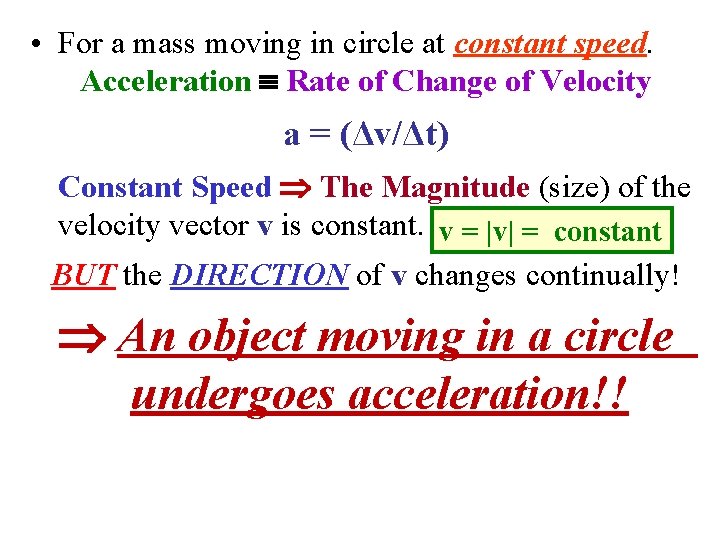
• For a mass moving in circle at constant speed. Acceleration Rate of Change of Velocity a = (Δv/Δt) Constant Speed The Magnitude (size) of the velocity vector v is constant. v = |v| = constant BUT the DIRECTION of v changes continually! An object moving in a circle undergoes acceleration!!
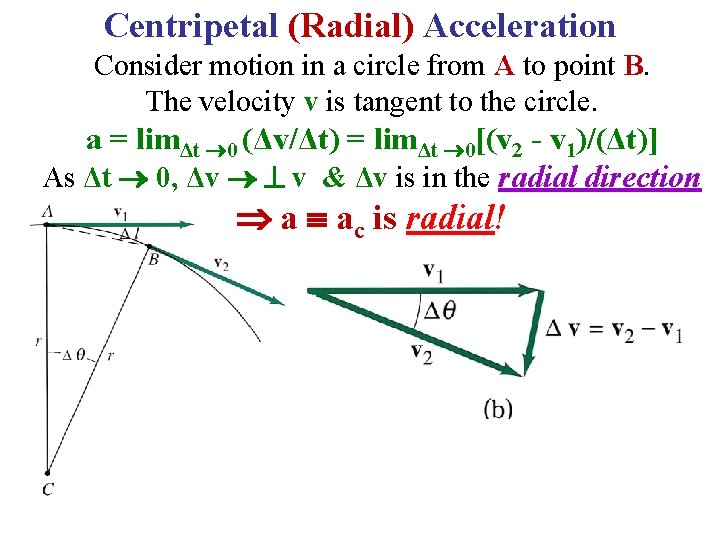
Centripetal (Radial) Acceleration Consider motion in a circle from A to point B. The velocity v is tangent to the circle. a = limΔt 0 (Δv/Δt) = limΔt 0[(v 2 - v 1)/(Δt)] As Δt 0, Δv v & Δv is in the radial direction a ac is radial!
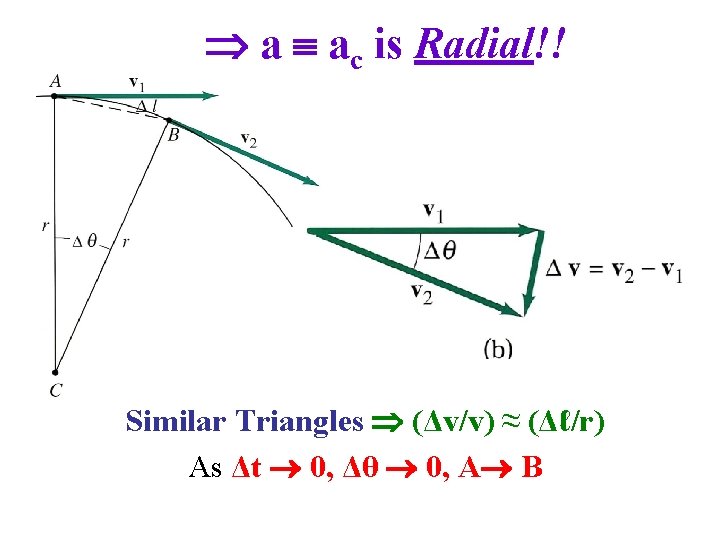
a ac is Radial!! Similar Triangles (Δv/v) ≈ (Δℓ/r) As Δt 0, Δθ 0, A B
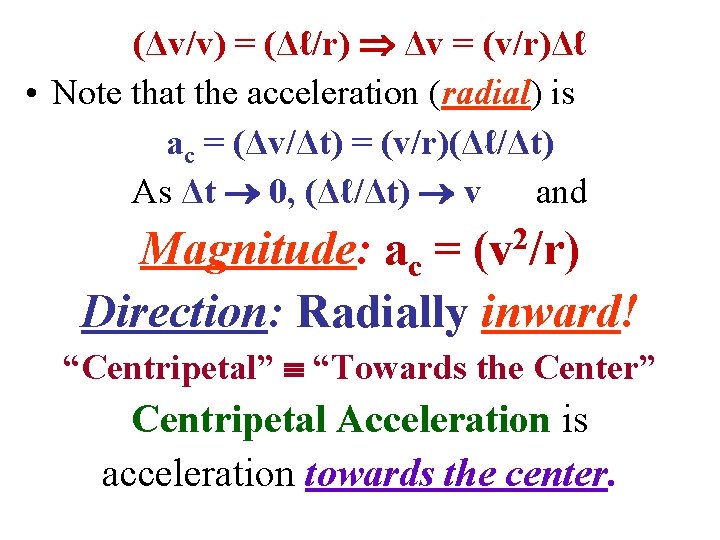
(Δv/v) = (Δℓ/r) Δv = (v/r)Δℓ • Note that the acceleration (radial) is ac = (Δv/Δt) = (v/r)(Δℓ/Δt) As Δt 0, (Δℓ/Δt) v and Magnitude: ac = (v 2/r) Direction: Radially inward! “Centripetal” “Towards the Center” Centripetal Acceleration is acceleration towards the center.
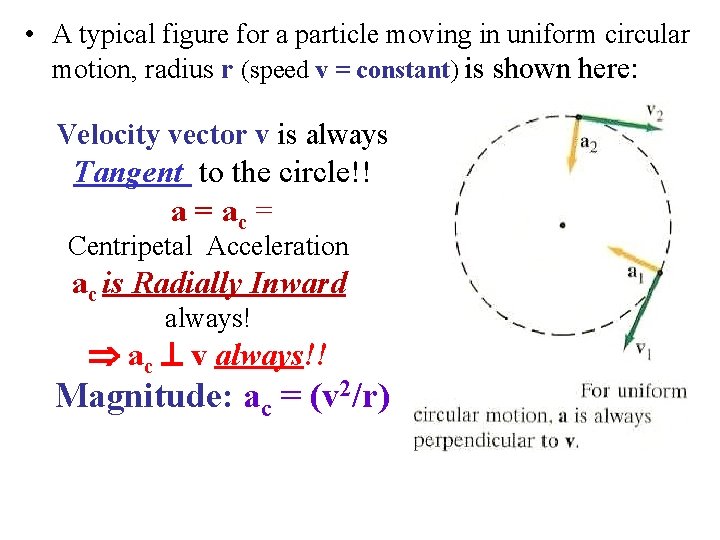
• A typical figure for a particle moving in uniform circular motion, radius r (speed v = constant) is shown here: Velocity vector v is always Tangent to the circle!! a = ac = Centripetal Acceleration ac is Radially Inward always! ac v always!! Magnitude: ac = (v 2/r)
Period & Frequency • Consider again a particle moving in uniform circular motion of radius r (speed v = constant) • Description in terms of period T & frequency f: • Period T The time for one revolution (time to go around once), usually in seconds. • Frequency f the number of revolutions per second. T = (1/f)
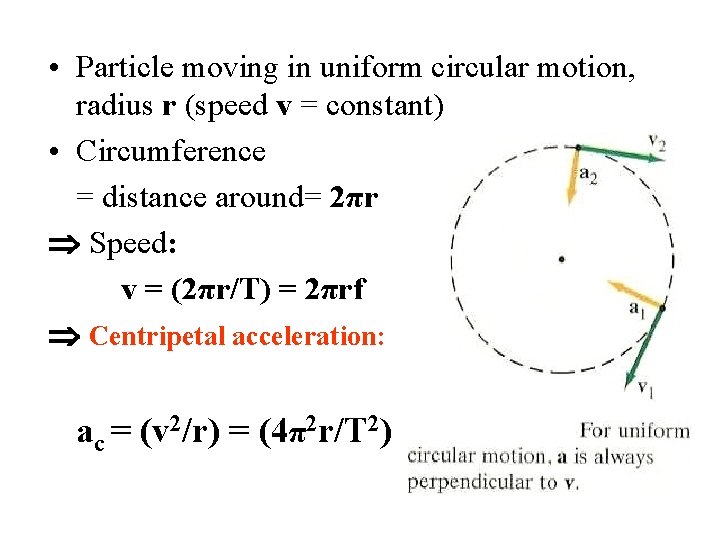
• Particle moving in uniform circular motion, radius r (speed v = constant) • Circumference = distance around= 2πr Speed: v = (2πr/T) = 2πrf Centripetal acceleration: ac = (v 2/r) = (4π2 r/T 2)
Example: Centripetal Acceleration of the Earth Problem 1: Calculate the centripetal acceleration of the Earth as it moves in its orbit around the Sun. NOTE: The radius of the Earth's orbit (from a table) is r ~ 1. 5 1011 m Problem 2: Calculate the centripetal acceleration due to the rotation of the Earth relative to the poles & compare with geo-stationary satellites. NOTE: From a table, the radius of the Earth is r ~ 6. 4 106 m & the height of geo-stationary satellites is ~ 3. 6 107 m
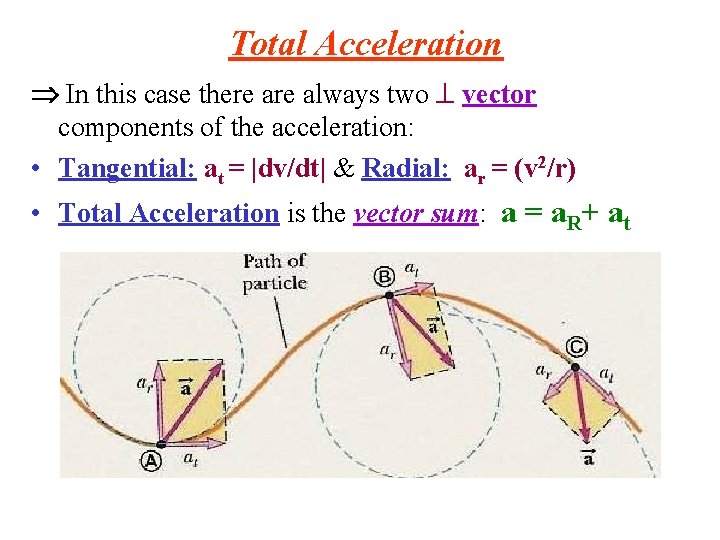
Tangential & Radial Acceleration • Consider an object moving in a curved path. If the speed |v| of object is changing, there is an acceleration in the direction of motion. ≡ Tangential Acceleration at ≡ |dv/dt| • But, there is also always a radial (or centripetal) acceleration perpendicular to the direction of motion. ≡ Radial (Centripetal) Acceleration ar = |ac| ≡ (v 2/r)
Total Acceleration In this case there always two vector components of the acceleration: • Tangential: at = |dv/dt| & Radial: ar = (v 2/r) • Total Acceleration is the vector sum: a = a. R+ at
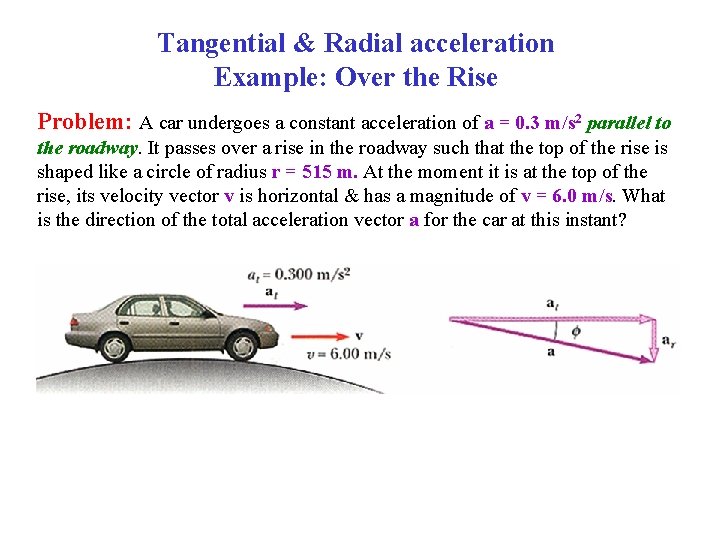
Tangential & Radial acceleration Example: Over the Rise Problem: A car undergoes a constant acceleration of a = 0. 3 m/s 2 parallel to the roadway. It passes over a rise in the roadway such that the top of the rise is shaped like a circle of radius r = 515 m. At the moment it is at the top of the rise, its velocity vector v is horizontal & has a magnitude of v = 6. 0 m/s. What is the direction of the total acceleration vector a for the car at this instant?