
Circular Motion Physics 1425 Lecture 18 Michael Fowler
- Slides: 31
Circular Motion Physics 1425 Lecture 18 Michael Fowler, UVa
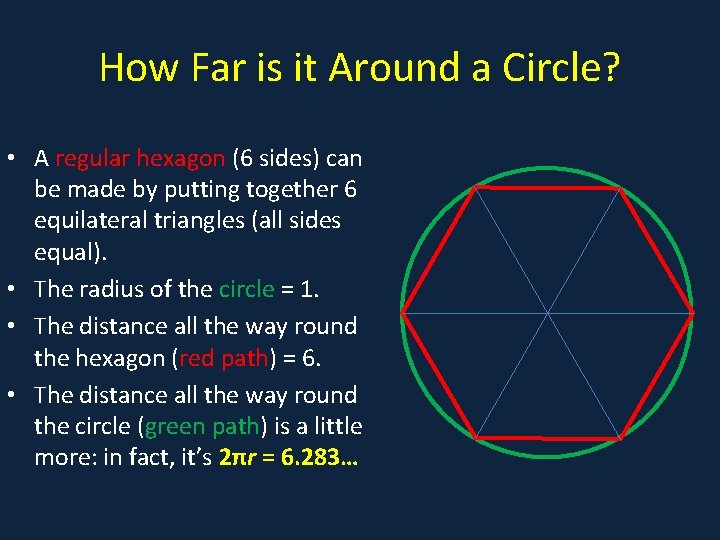
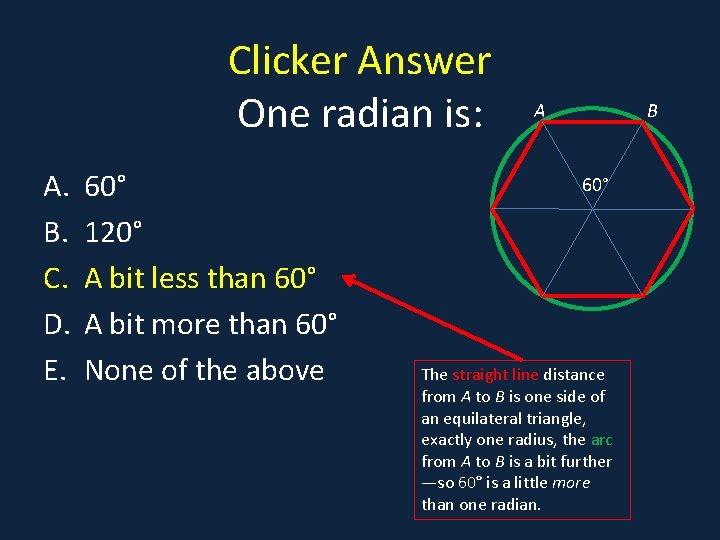
How Far is it Around a Circle? • A regular hexagon (6 sides) can • a be made by putting together 6 equilateral triangles (all sides equal). • The radius of the circle = 1. • The distance all the way round the hexagon (red path) = 6. • The distance all the way round the circle (green path) is a little more: in fact, it’s 2πr = 6. 283…
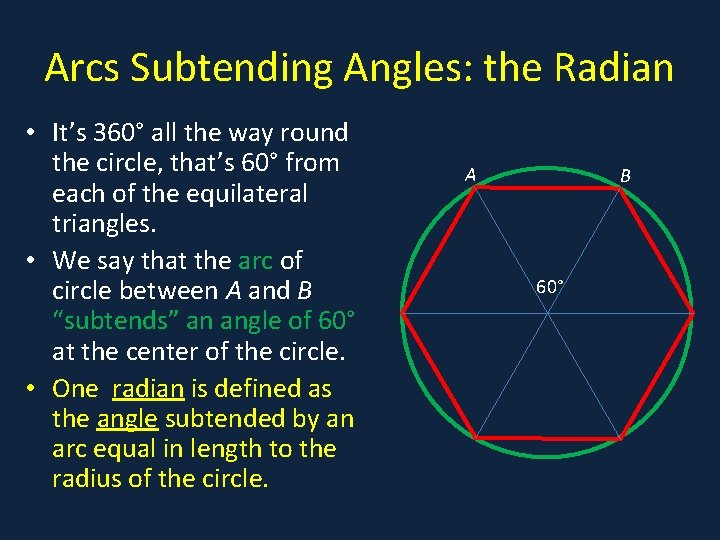
Arcs Subtending Angles: the Radian • It’s 360° all the way round • a the circle, that’s 60° from each of the equilateral triangles. • We say that the arc of circle between A and B “subtends” an angle of 60° at the center of the circle. • One radian is defined as the angle subtended by an arc equal in length to the radius of the circle. A B 60°
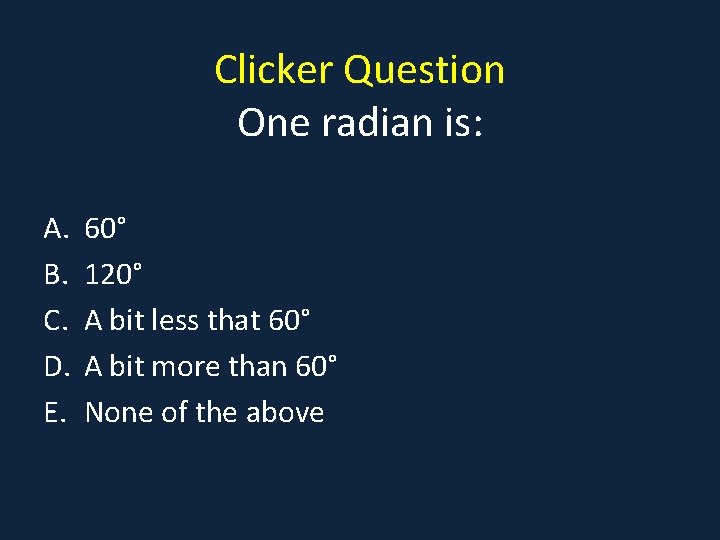
Clicker Question One radian is: A. B. C. D. E. 60° 120° A bit less that 60° A bit more than 60° None of the above
Clicker Answer One radian is: A. B. C. D. E. 60° 120° A bit less than 60° A bit more than 60° None of the above A B 60° The straight line distance from A to B is one side of an equilateral triangle, exactly one radius, the arc from A to B is a bit further —so 60° is a little more than one radian.
Full Circle • For a circular path of radius r, if you walk a distance r along the path, you have gone around an angle of one radian relative to the center. • If you walk all the way around the path, you have of course gone through 360°. • BUT you’ve walked a total distance 2πr, and therefore around an angle of 2π radians. • Conclusion: 360° = 2π radians
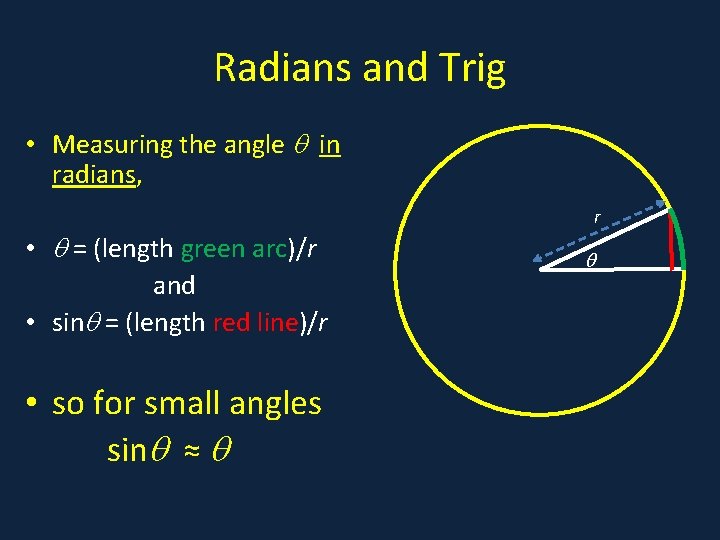
Radians and Trig • Measuring the angle in radians, • = (length green arc)/r and • sin = (length red line)/r • so for small angles sin ≈ • a r
Units for Angular Velocity • How fast is something rotating? • Car engine: units rpm, revs per minute, redlines around 6, 000 rpm or 100 revs/sec. • 1 Hertz, written 1 Hz, means one cycle/sec, used for electrical generators, circuits. (Often called the rotational frequency, and written f. ) • Second hand on watch turns at 1 rpm, or 6°/sec. • Earth goes round Sun at very close to 1°/day • (probably why the degree was the original measure of angle. )
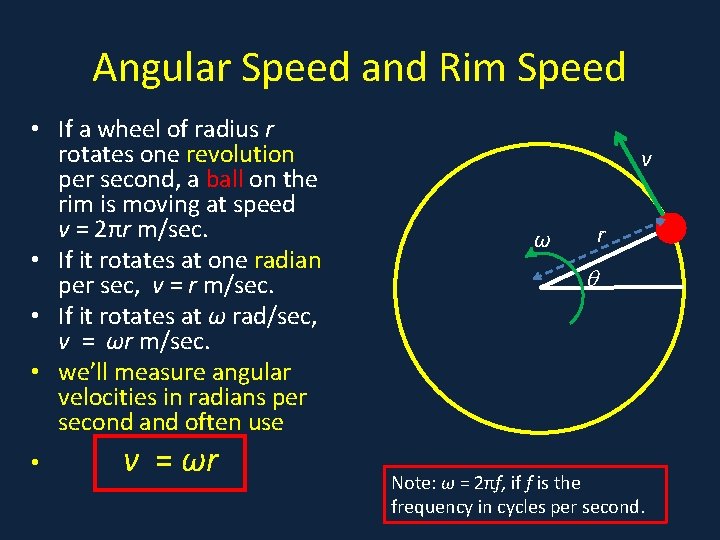
Angular Speed and Rim Speed • If a wheel of radius r rotates one revolution per second, a ball on the rim is moving at speed v = 2πr m/sec. • If it rotates at one radian per sec, v = r m/sec. • If it rotates at ω rad/sec, v = ωr m/sec. • we’ll measure angular velocities in radians per second and often use • v = ωr • a v ω r Note: ω = 2πf, if f is the frequency in cycles per second.
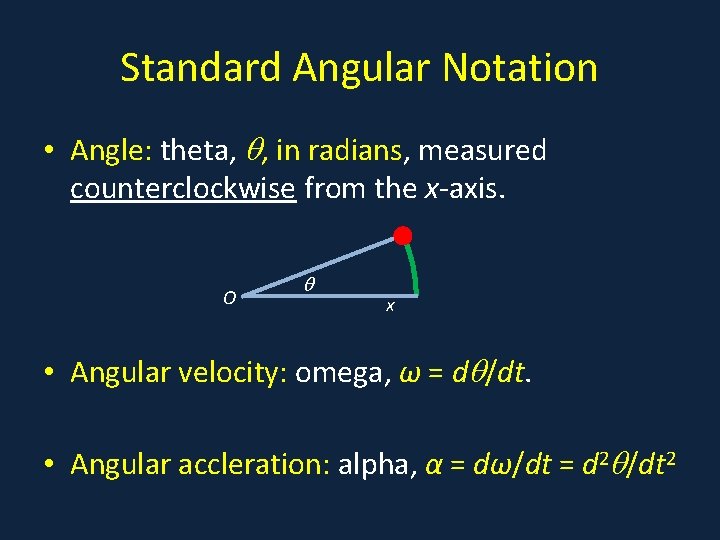
Standard Angular Notation • Angle: theta, , in radians, measured counterclockwise from the x-axis. O x • Angular velocity: omega, ω = d /dt. • Angular accleration: alpha, α = dω/dt = d 2 /dt 2
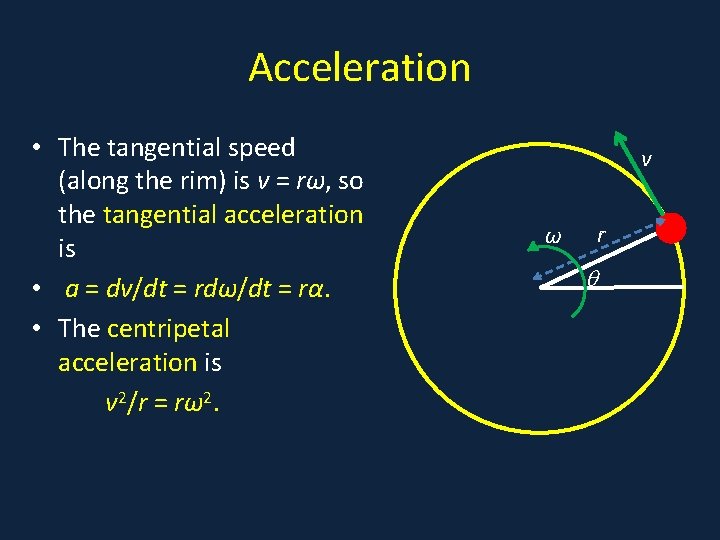
Acceleration • The tangential speed • A (along the rim) is v = rω, so the tangential acceleration is • a = dv/dt = rdω/dt = rα. • The centripetal acceleration is v 2/r = rω2. v ω r
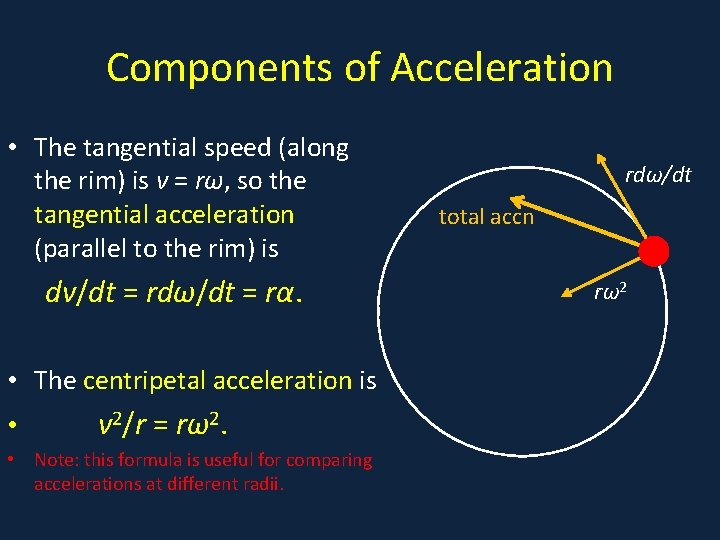
Components of Acceleration • The tangential speed (along • A the rim) is v = rω, so the tangential acceleration total accn (parallel to the rim) is dv/dt = rdω/dt = rα. • The centripetal acceleration is • v 2/r = rω2. • Note: this formula is useful for comparing accelerations at different radii. rdω/dt rω2
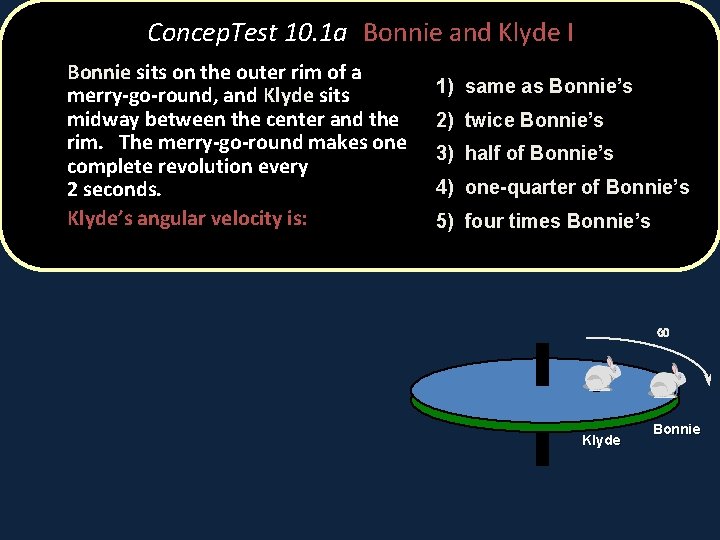
Concep. Test 10. 1 a Bonnie and Klyde I Bonnie sits on the outer rim of a merry-go-round, and Klyde sits midway between the center and the rim. The merry-go-round makes one complete revolution every 2 seconds. Klyde’s angular velocity is: 1) same as Bonnie’s 2) twice Bonnie’s 3) half of Bonnie’s 4) one-quarter of Bonnie’s 5) four times Bonnie’s w Klyde Bonnie
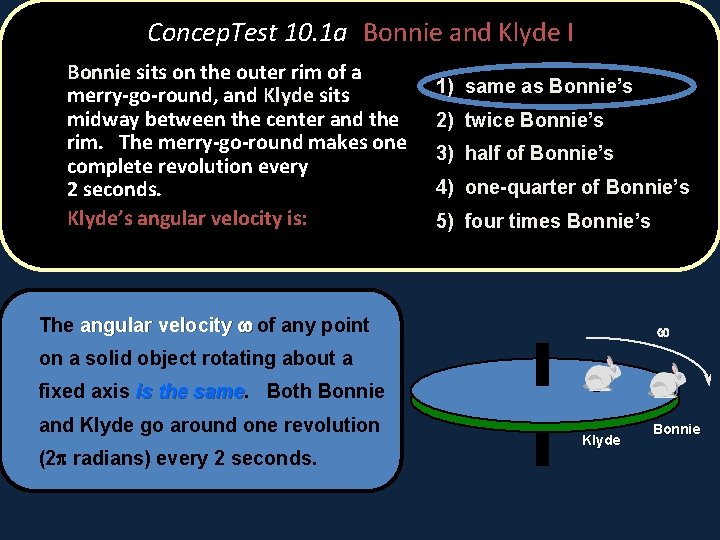
Concep. Test 10. 1 a Bonnie and Klyde I Bonnie sits on the outer rim of a merry-go-round, and Klyde sits midway between the center and the rim. The merry-go-round makes one complete revolution every 2 seconds. Klyde’s angular velocity is: 1) same as Bonnie’s 2) twice Bonnie’s 3) half of Bonnie’s 4) one-quarter of Bonnie’s 5) four times Bonnie’s The angular velocity w of any point w on a solid object rotating about a fixed axis is the same Both Bonnie and Klyde go around one revolution (2 p radians) every 2 seconds. Klyde Bonnie
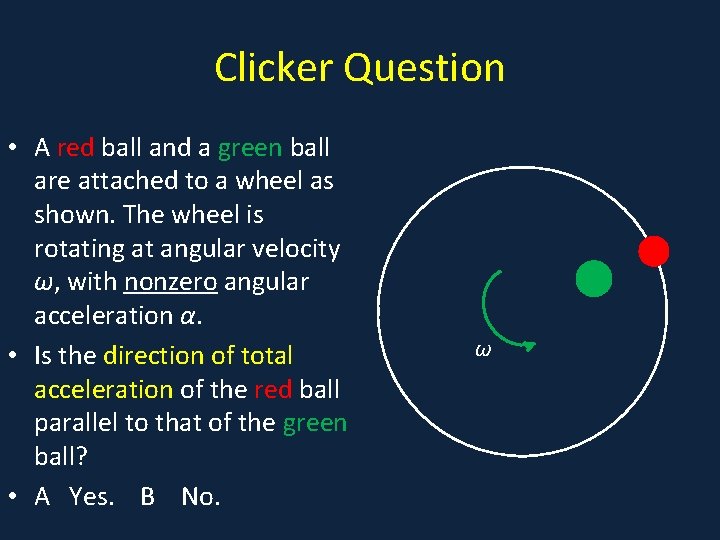
Clicker Question • A red ball and a green ball • A are attached to a wheel as shown. The wheel is rotating at angular velocity ω, with nonzero angular acceleration α. • Is the direction of total acceleration of the red ball parallel to that of the green ball? • A Yes. B No. ω
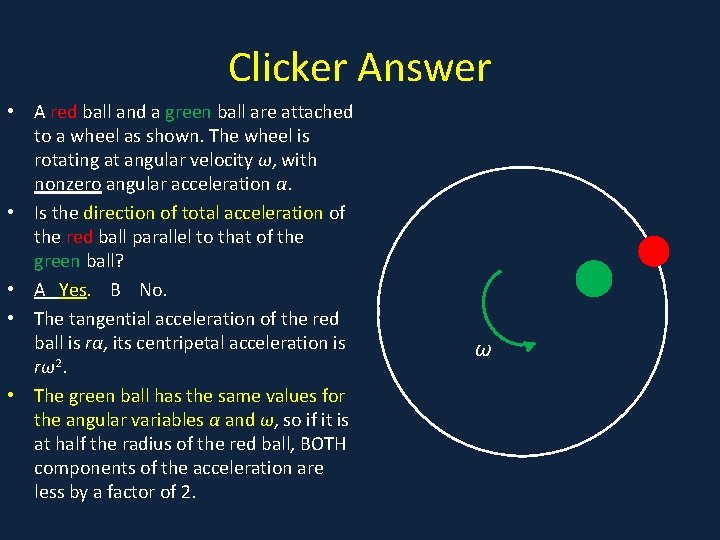
Clicker Answer • A red ball and a green ball are attached to a wheel as shown. The wheel is rotating at angular velocity ω, with nonzero angular acceleration α. • Is the direction of total acceleration of the red ball parallel to that of the green ball? • A Yes. B No. • The tangential acceleration of the red ball is rα, its centripetal acceleration is rω2. • The green ball has the same values for the angular variables α and ω, so if it is at half the radius of the red ball, BOTH components of the acceleration are less by a factor of 2. • A ω
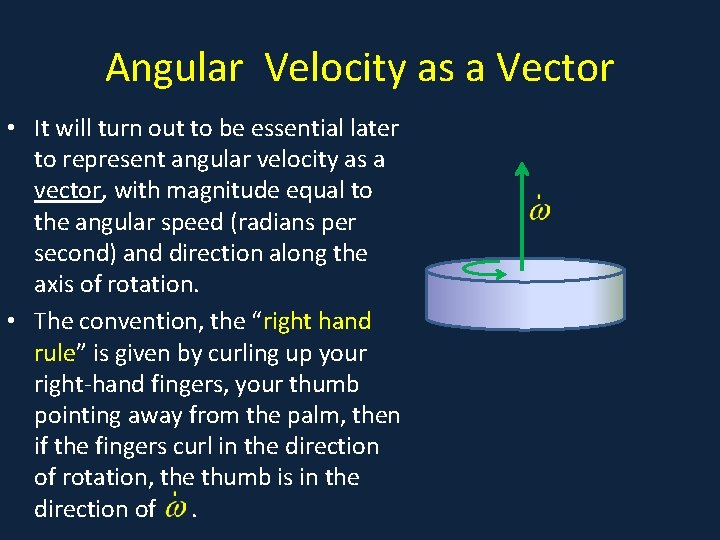
Angular Velocity as a Vector • It will turn out to be essential later • a to represent angular velocity as a vector, with magnitude equal to the angular speed (radians per second) and direction along the axis of rotation. • The convention, the “right hand rule” is given by curling up your right-hand fingers, your thumb pointing away from the palm, then if the fingers curl in the direction of rotation, the thumb is in the direction of.
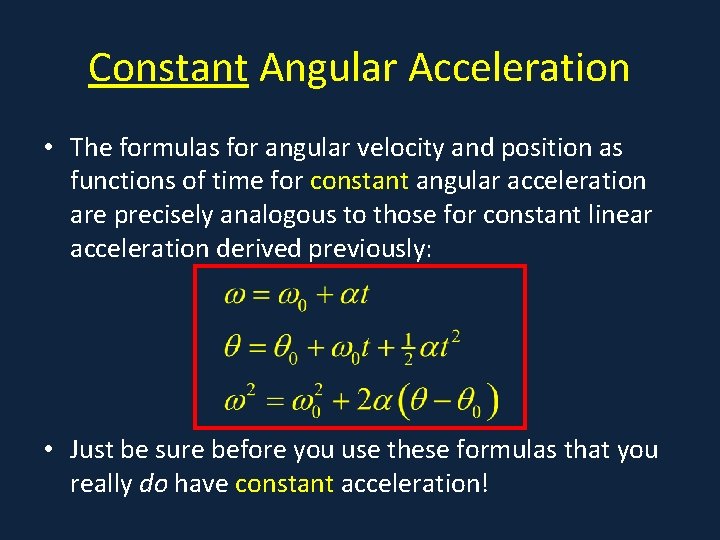
Constant Angular Acceleration • The formulas for angular velocity and position as functions of time for constant angular acceleration are precisely analogous to those for constant linear acceleration derived previously: • Just be sure before you use these formulas that you really do have constant acceleration!
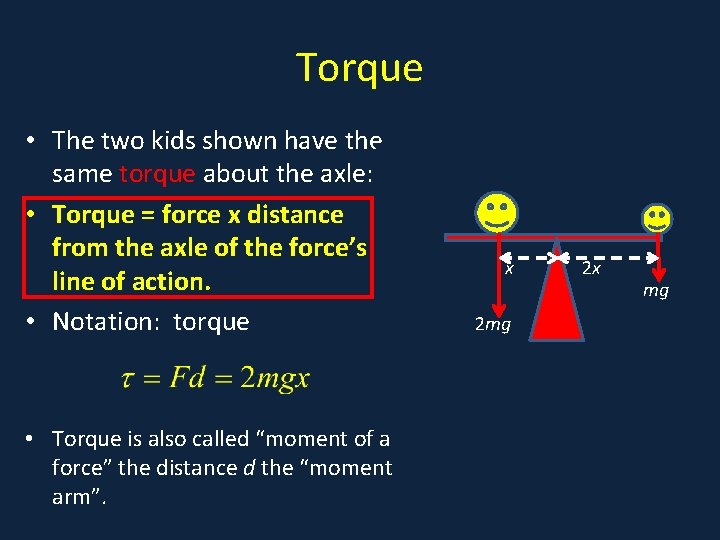
Torque • The two kids shown have the • Kids on seesaw same torque about the axle: • Torque = force x distance from the axle of the force’s x line of action. • Notation: torque 2 mg • Torque is also called “moment of a force” the distance d the “moment arm”. 2 x mg
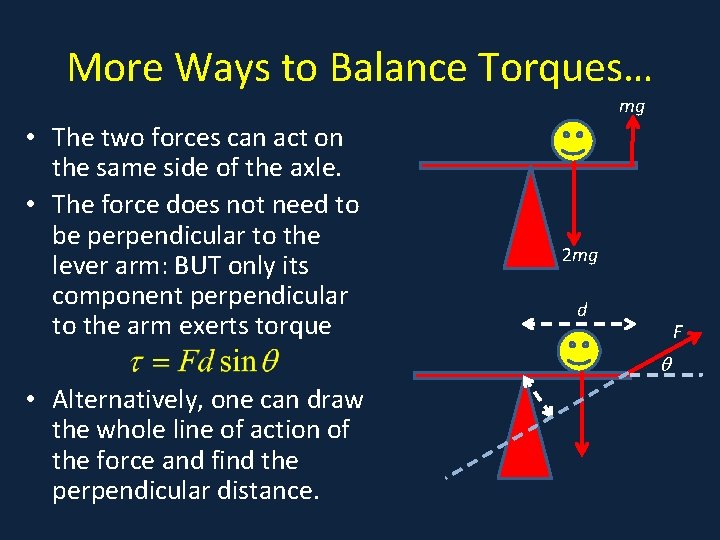
More Ways to Balance Torques… mg • The two forces can act on • Kids on seesaw the same side of the axle. • The force does not need to be perpendicular to the 2 mg lever arm: BUT only its component perpendicular d to the arm exerts torque F • Alternatively, one can draw the whole line of action of the force and find the perpendicular distance.
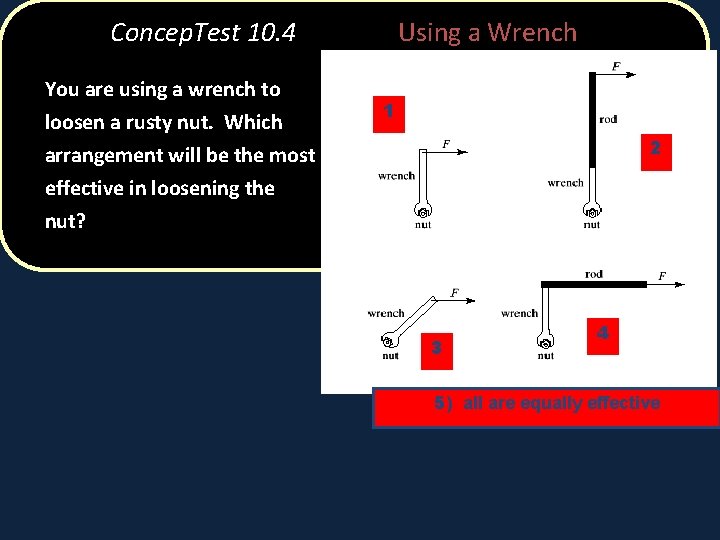
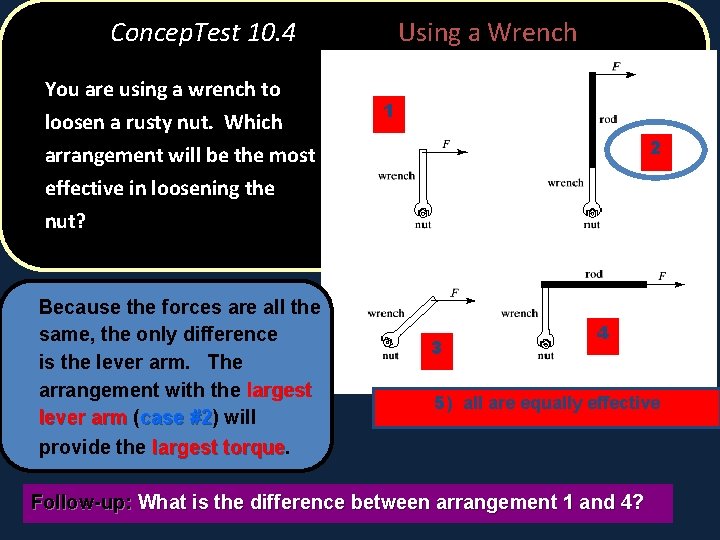
Concep. Test 10. 4 You are using a wrench to loosen a rusty nut. Which arrangement will be the most effective in loosening the Using a Wrench 1 2 nut? 3 4 5) all are equally effective
Concep. Test 10. 4 You are using a wrench to loosen a rusty nut. Which arrangement will be the most effective in loosening the Using a Wrench 1 2 nut? Because the forces are all the same, the only difference is the lever arm. The arrangement with the largest lever arm (case #2) #2 will provide the largest torque 3 4 5) all are equally effective Follow-up: What is the difference between arrangement 1 and 4?
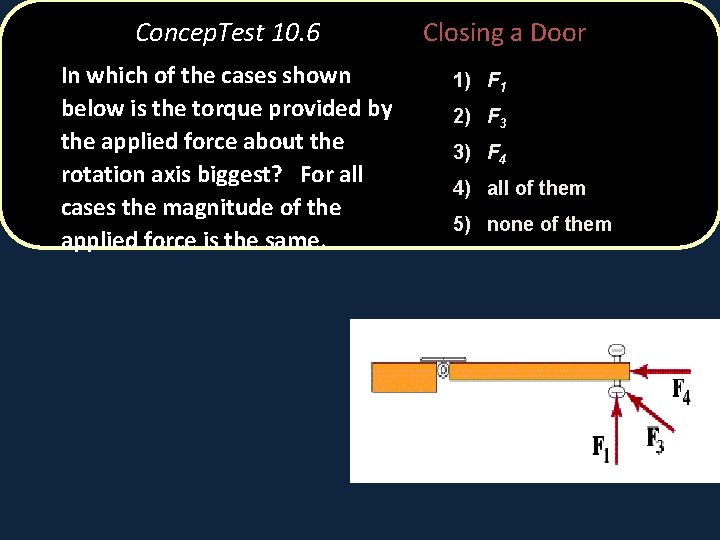
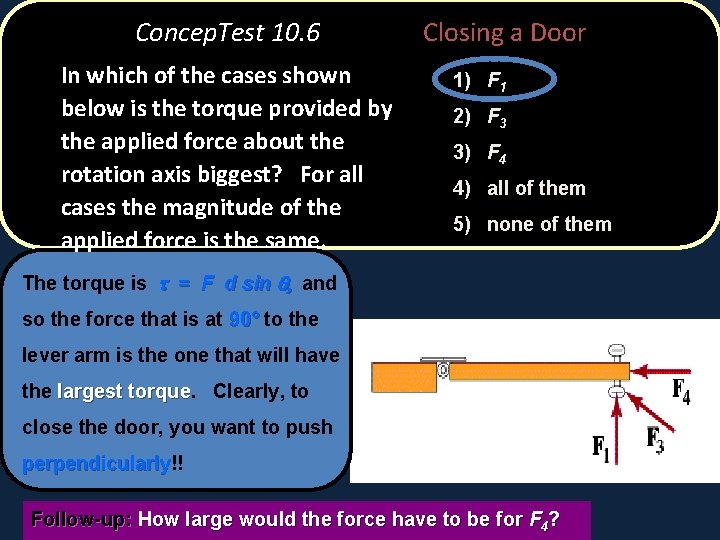
Concep. Test 10. 6 In which of the cases shown below is the torque provided by the applied force about the rotation axis biggest? For all cases the magnitude of the applied force is the same. Closing a Door 1) F 1 2) F 3 3) F 4 4) all of them 5) none of them
Concep. Test 10. 6 In which of the cases shown below is the torque provided by the applied force about the rotation axis biggest? For all cases the magnitude of the applied force is the same. Closing a Door 1) F 1 2) F 3 3) F 4 4) all of them 5) none of them The torque is t = F d sin q, and so the force that is at 90° to the lever arm is the one that will have the largest torque Clearly, to close the door, you want to push perpendicularly!! perpendicularly Follow-up: How large would the force have to be for F 4?
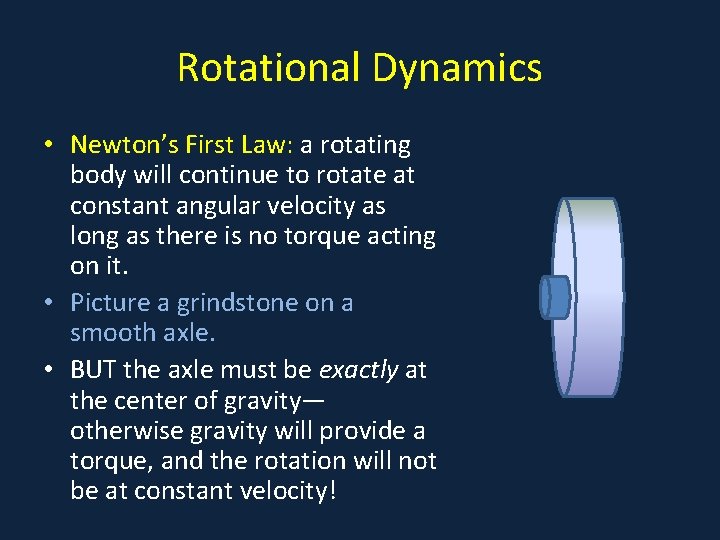
Rotational Dynamics • Newton’s First Law: a rotating body will continue to rotate at constant angular velocity as long as there is no torque acting on it. • Picture a grindstone on a smooth axle. • BUT the axle must be exactly at the center of gravity— otherwise gravity will provide a torque, and the rotation will not be at constant velocity! • A
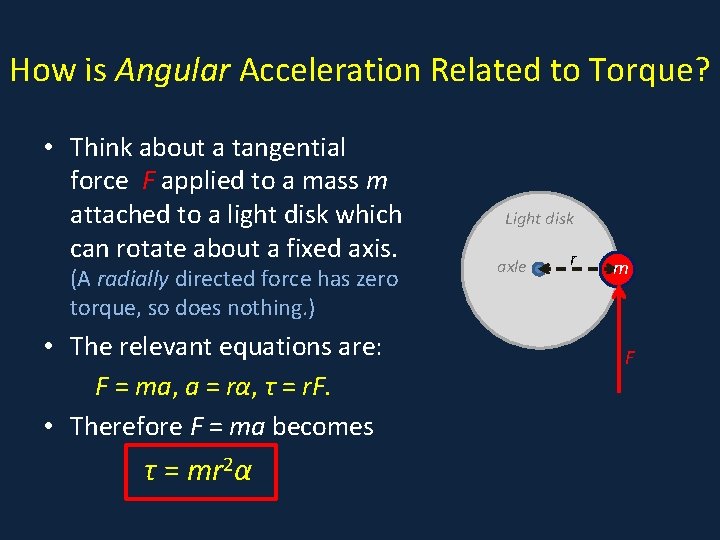
How is Angular Acceleration Related to Torque? • Vhas zero • Think about a tangential force F applied to a mass m attached to a light disk which Light disk can rotate about a fixed axis. r (A radially directed force has zero torque, so does nothing. ) • The relevant equations are: F = ma, a = rα, τ = r. F. • Therefore F = ma becomes τ = mr 2α axle m F
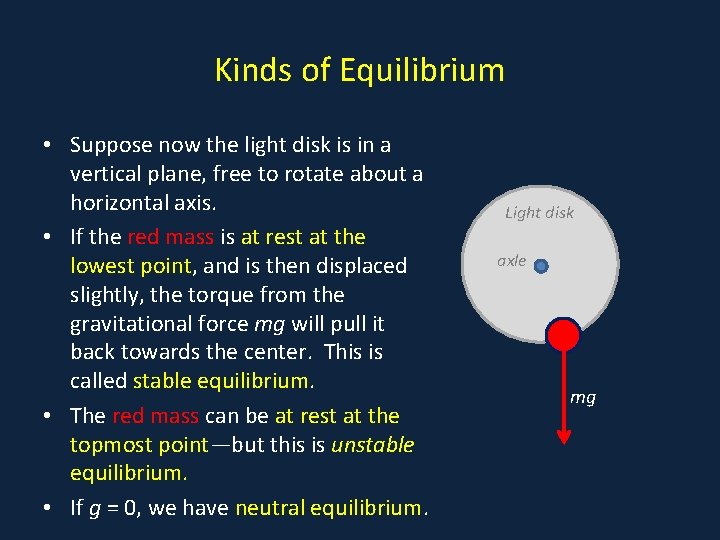
Kinds of Equilibrium • Suppose now the light disk is in a • Vhas zero vertical plane, free to rotate about a horizontal axis. Light disk • If the red mass is at rest at the axle lowest point, and is then displaced slightly, the torque from the gravitational force mg will pull it back towards the center. This is called stable equilibrium. mg • The red mass can be at rest at the topmost point—but this is unstable equilibrium. • If g = 0, we have neutral equilibrium.
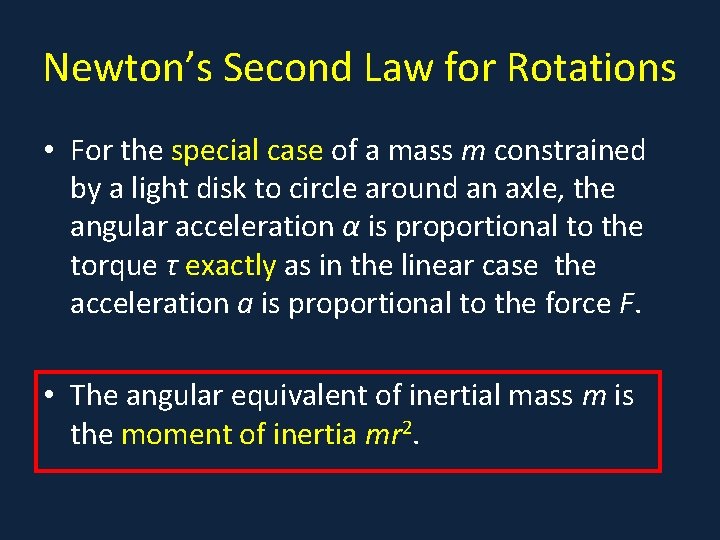
Newton’s Second Law for Rotations • For the special case of a mass m constrained by a light disk to circle around an axle, the angular acceleration α is proportional to the torque τ exactly as in the linear case the acceleration a is proportional to the force F. • The angular equivalent of inertial mass m is the moment of inertia mr 2.
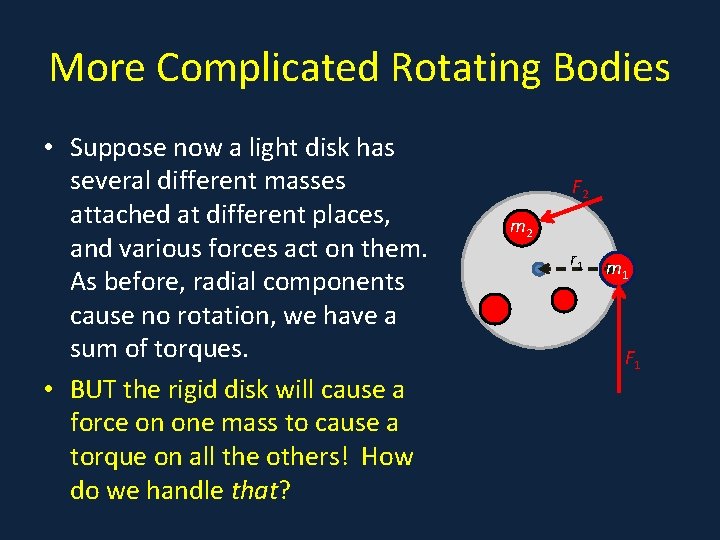
More Complicated Rotating Bodies • Suppose now a light disk has • A several different masses attached at different places, and various forces act on them. As before, radial components cause no rotation, we have a sum of torques. • BUT the rigid disk will cause a force on one mass to cause a torque on all the others! How do we handle that? F 2 m 2 r 1 m 1 F 1
Newton’s Third Law for a Rigid Rotating Body • If a rigid body is made up of many masses mi connected by rigid rods, the force exerted along the rod of mi on mj is equal in magnitude and opposite in direction to that of mj on mi, therefore the internal torques come in equal and opposite pairs, and therefore cannot contribute to the angular acceleration. • It follows that the angular acceleration is generated by the sum of the external torques.
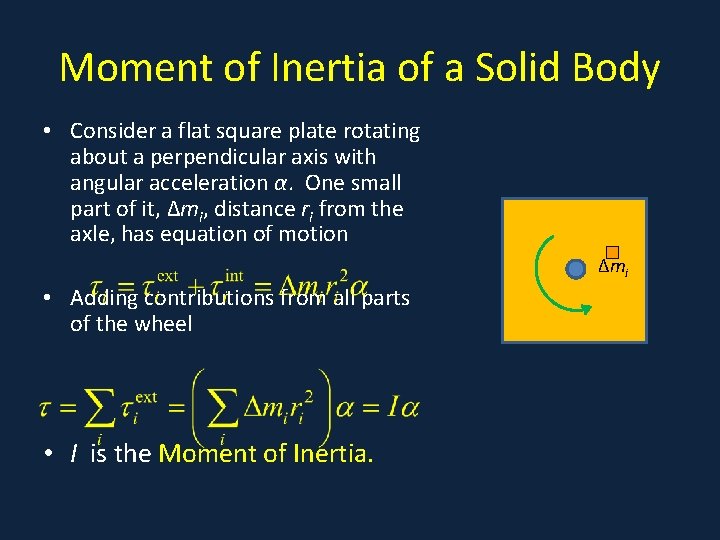
Moment of Inertia of a Solid Body • Consider a flat square plate rotating about a perpendicular axis with angular acceleration α. One small part of it, Δmi, distance ri from the axle, has equation of motion • Z Δmi • Adding contributions from all parts of the wheel • I is the Moment of Inertia.