
Circular Motion and Gravity axis line about which
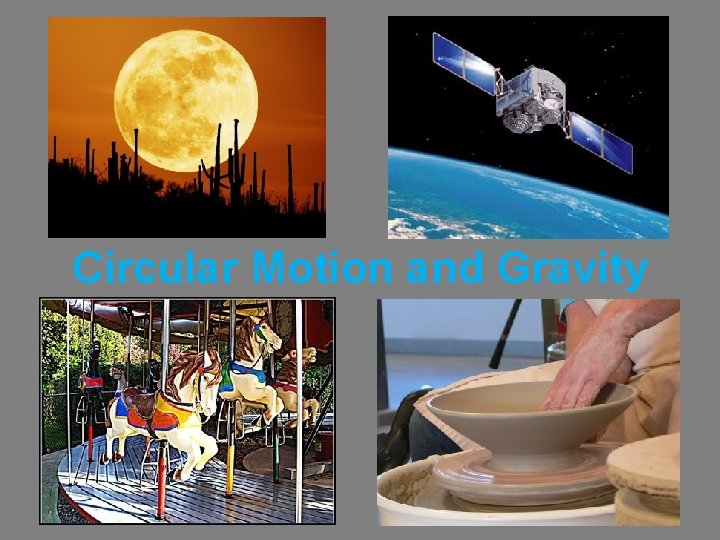
Circular Motion and Gravity

axis: line about which circular motion occurs rotation: axis is within object; “spinning” revolution: axis is outside object Earth rotates on its axis (this causes day and night) and revolves around the Sun (this, coupled with the tilt of Earth’s axis, causes the seasons)
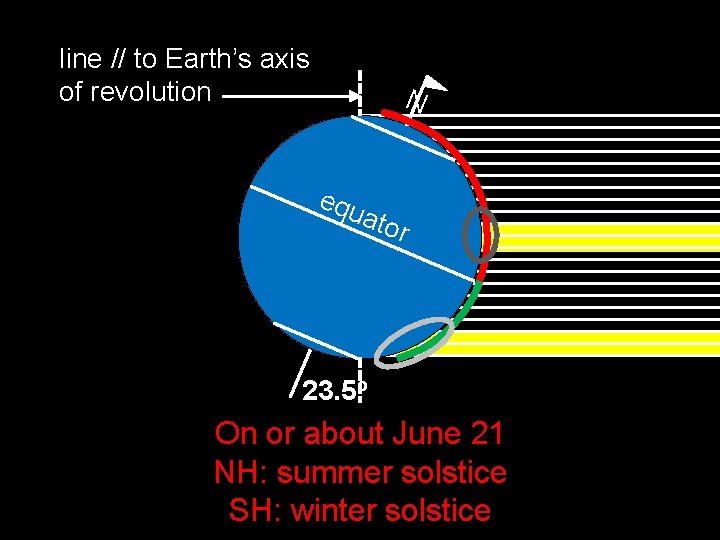
line // to Earth’s axis of revolution N equ ato r 23. 5 o On or about June 21 NH: summer solstice SH: winter solstice
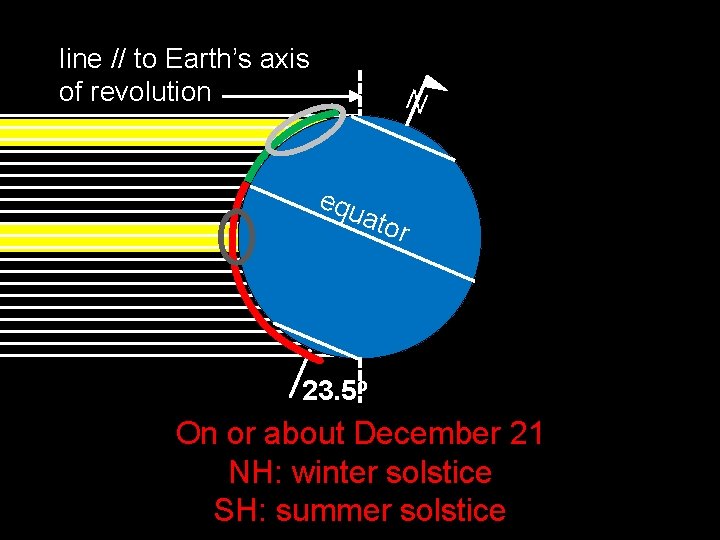
line // to Earth’s axis of revolution N equ ato r 23. 5 o On or about December 21 NH: winter solstice SH: summer solstice
line // to Earth’s axis of revolution N equ ato r 23. 5 o On or about March 21 NH: vernal equinox SH: autumnal equinox
FINAL THOUGHTS: Rotation, Revolution, and the Seasons 1. An axis of rotation is an imaginary line about which circular motion occurs. 2. If the axis of rotation is within the object under consideration, the object is rotating. If the axis of rotation is outside the object, the object is revolving. 3. Day and night are due to Earth’s rotation. The seasons are caused by Earth’s revolution around the Sun, in conjunction with the non-perpendicular tilt of Earth’s axis relative to the plane of Earth’s revolution.
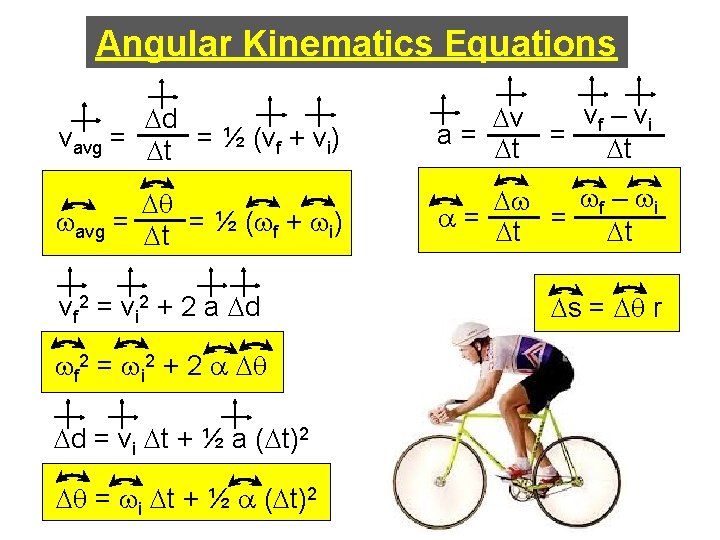
Angular Kinematics Equations Dd vavg = Dt = ½ (vf + vi) vf – vi Dv = a= Dt Dt Dq wavg = Dt = ½ (wf + wi) wf – wi Dw = a= Dt Dt vf 2 = vi 2 + 2 a Dd wf 2 = wi 2 + 2 a Dq Dd = vi Dt + ½ a (Dt)2 Dq = wi Dt + ½ a (Dt)2 Ds = Dq r
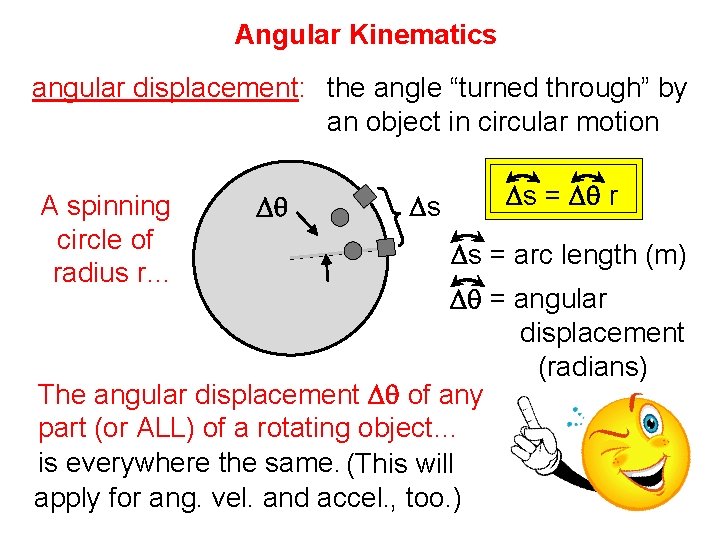
Angular Kinematics angular displacement: the angle “turned through” by an object in circular motion A spinning circle of radius r… Dq Ds Ds = Dq r Ds = arc length (m) Dq = angular displacement (radians) The angular displacement Dq of any part (or ALL) of a rotating object… is everywhere the same. (This will apply for ang. vel. and accel. , too. )
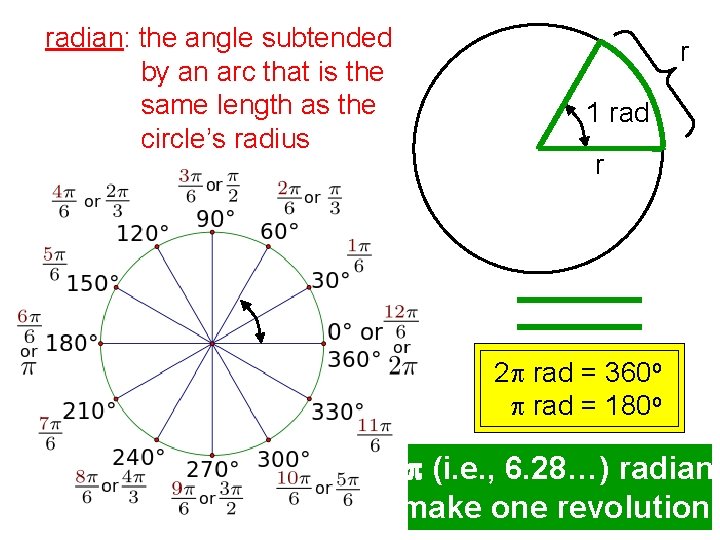
radian: the angle subtended by an arc that is the same length as the circle’s radius r 1 rad r 2 p rad = 360 o p rad = 180 o 2 p (i. e. , 6. 28…) radians make one revolution.
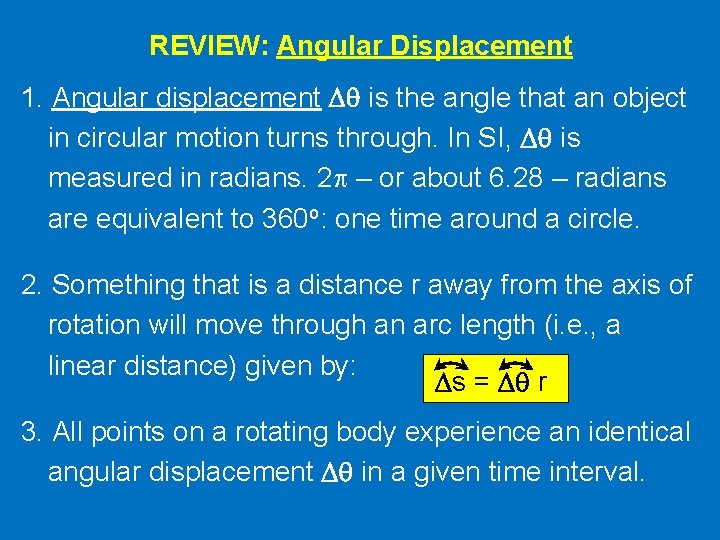
REVIEW: Angular Displacement 1. Angular displacement Dq is the angle that an object in circular motion turns through. In SI, Dq is measured in radians. 2 p – or about 6. 28 – radians are equivalent to 360 o: one time around a circle. 2. Something that is a distance r away from the axis of rotation will move through an arc length (i. e. , a linear distance) given by: Ds = Dq r 3. All points on a rotating body experience an identical angular displacement Dq in a given time interval.
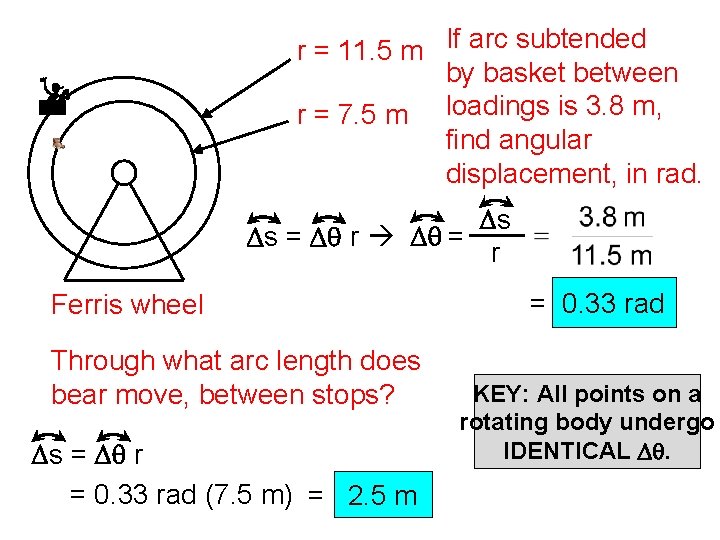
r = 11. 5 m If arc subtended by basket between r = 7. 5 m loadings is 3. 8 m, find angular displacement, in rad. Ds Ds = Dq r Dq = r Ferris wheel Through what arc length does bear move, between stops? Ds = Dq r = 0. 33 rad (7. 5 m) = 2. 5 m = 0. 33 rad KEY: All points on a rotating body undergo IDENTICAL Dq.
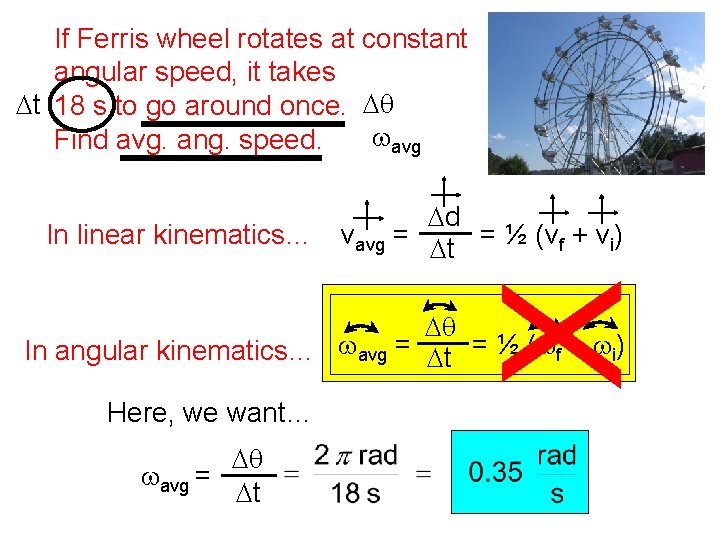
If Ferris wheel rotates at constant angular speed, it takes Dt 18 s to go around once. Dq wavg Find avg. ang. speed. X In linear kinematics… Dd vavg = Dt = ½ (vf + vi) Dq In angular kinematics… wavg = Dt = ½ (wf + wi) Here, we want… Dq wavg = Dt
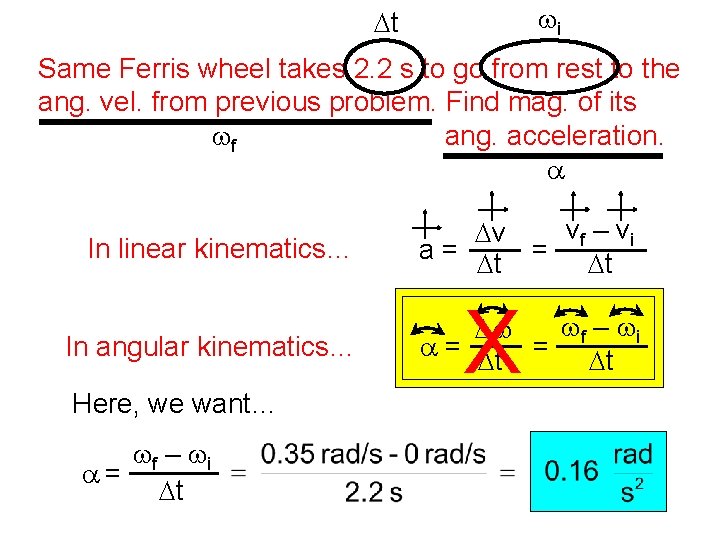
wi Dt Same Ferris wheel takes 2. 2 s to go from rest to the ang. vel. from previous problem. Find mag. of its ang. acceleration. wf a In linear kinematics… vf – vi Dv = a= Dt Dt In angular kinematics… wf – wi Dw = a= Dt Dt Here, we want… wf – wi a= Dt X
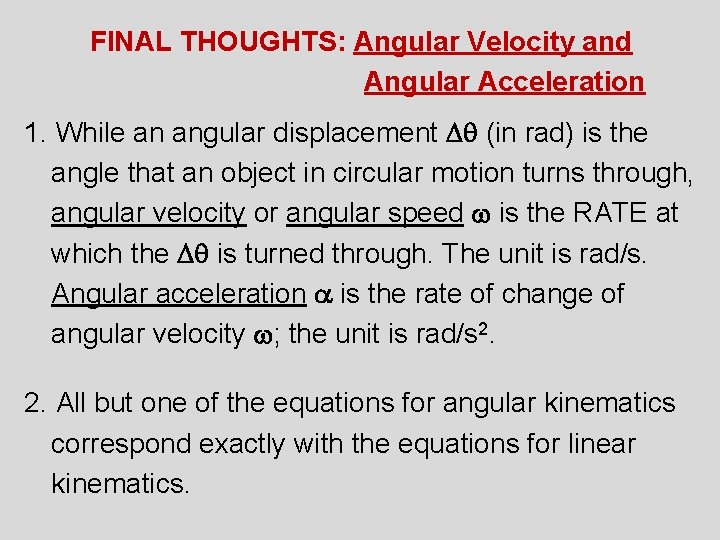
FINAL THOUGHTS: Angular Velocity and Angular Acceleration 1. While an angular displacement Dq (in rad) is the angle that an object in circular motion turns through, angular velocity or angular speed w is the RATE at which the Dq is turned through. The unit is rad/s. Angular acceleration a is the rate of change of angular velocity w; the unit is rad/s 2. 2. All but one of the equations for angular kinematics correspond exactly with the equations for linear kinematics.
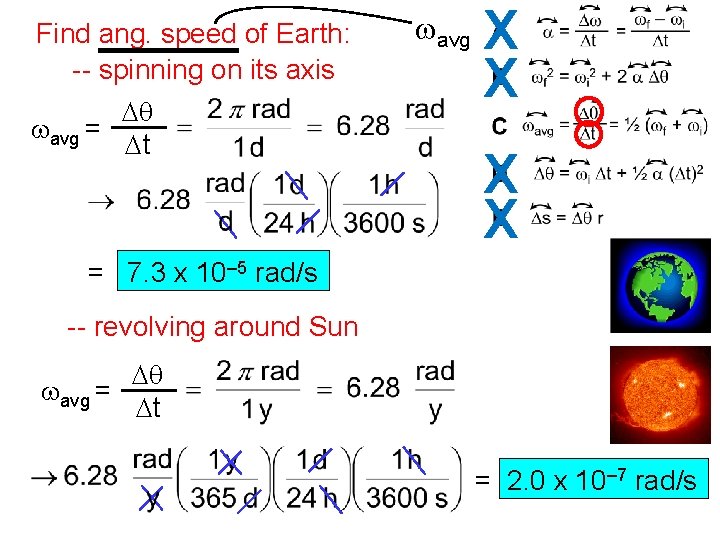
Find ang. speed of Earth: -- spinning on its axis Dq wavg = Dt wavg X X = 7. 3 x 10– 5 rad/s -- revolving around Sun Dq wavg = Dt = 2. 0 x 10– 7 rad/s
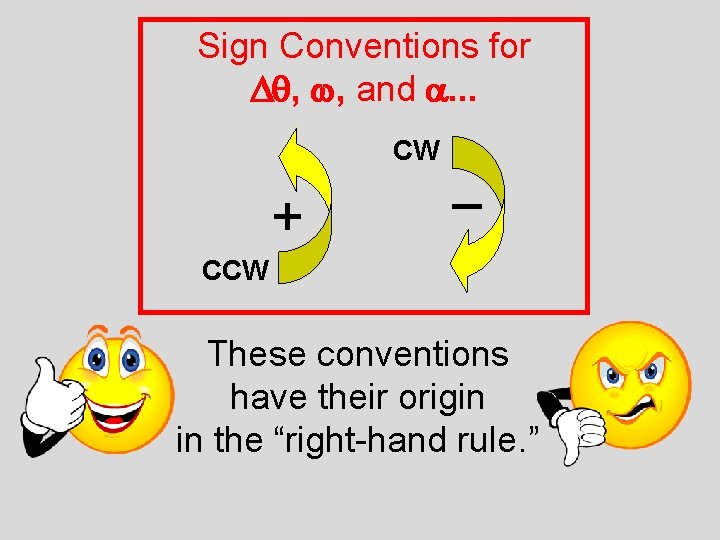
Sign Conventions for Dq, w, and a. . . CW + – CCW These conventions have their origin in the “right-hand rule. ”
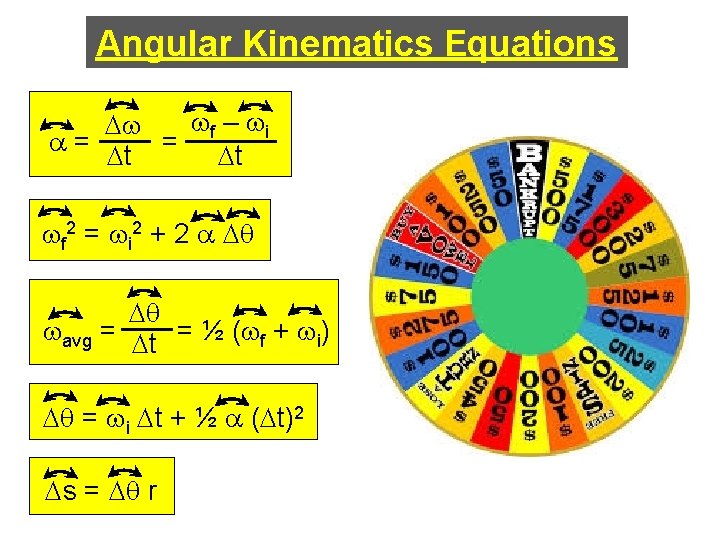
Angular Kinematics Equations wf – wi Dw = a= Dt Dt wf 2 = wi 2 + 2 a Dq Dq wavg = Dt = ½ (wf + wi) Dq = wi Dt + ½ a (Dt)2 Ds = Dq r
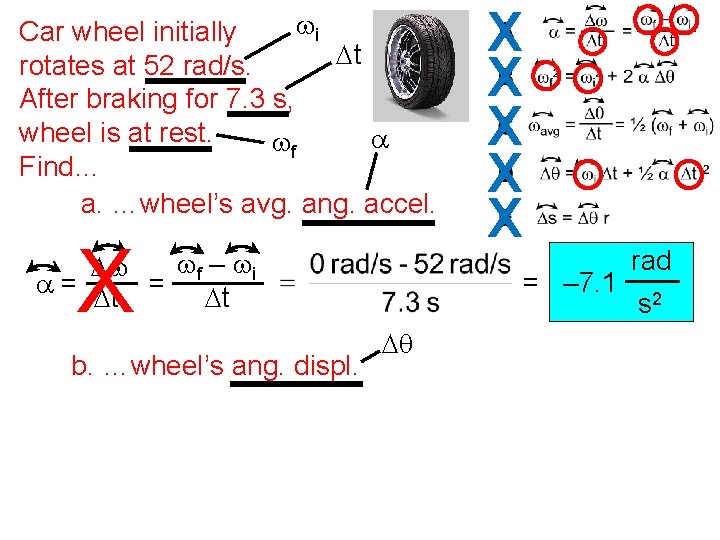
wi Car wheel initially Dt rotates at 52 rad/s. After braking for 7. 3 s, wheel is at rest. a wf Find… a. …wheel’s avg. ang. accel. X wf – wi Dw = a= Dt Dt b. …wheel’s ang. displ. X X X = – 7. 1 Dq rad s 2
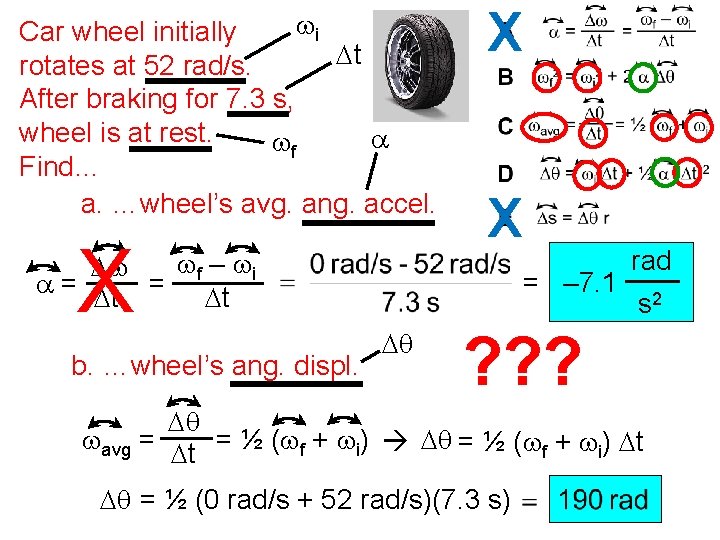
wi Car wheel initially Dt rotates at 52 rad/s. After braking for 7. 3 s, wheel is at rest. a wf Find… a. …wheel’s avg. ang. accel. X wf – wi Dw = a= Dt Dt b. …wheel’s ang. displ. X X = – 7. 1 Dq rad s 2 ? ? ? Dq wavg = Dt = ½ (wf + wi) Dq = ½ (wf + wi) Dt Dq = ½ (0 rad/s + 52 rad/s)(7. 3 s)
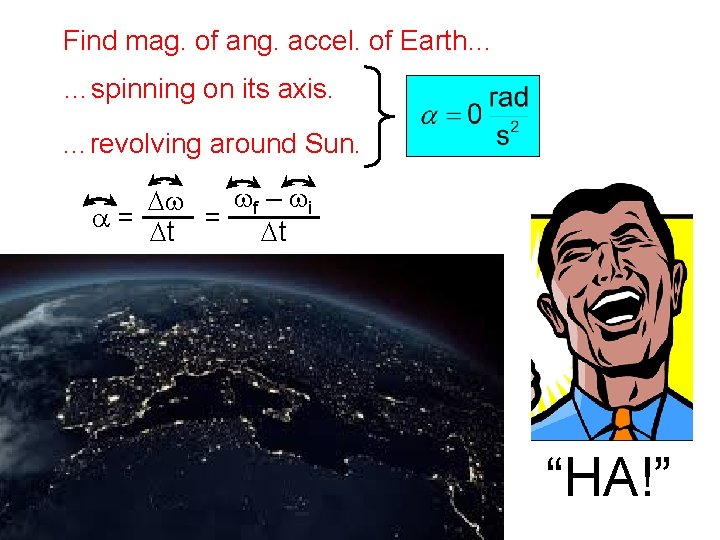
Find mag. of ang. accel. of Earth… …spinning on its axis. …revolving around Sun. wf – wi Dw = a= Dt Dt “HA!”
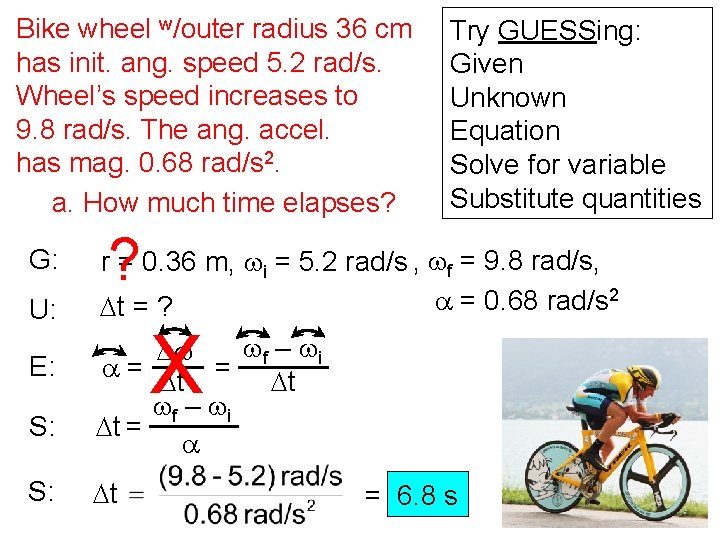
Bike wheel w/outer radius 36 cm has init. ang. speed 5. 2 rad/s. Wheel’s speed increases to 9. 8 rad/s. The ang. accel. has mag. 0. 68 rad/s 2. a. How much time elapses? G: U: E: S: S: Try GUESSing: Given Unknown Equation Solve for variable Substitute quantities ? r = 0. 36 m, wi = 5. 2 rad/s , wf = 9. 8 rad/s, 2 a = 0. 68 rad/s Dt = ? X wf – wi Dw = a= Dt Dt wf – wi Dt = a Dt = 6. 8 s
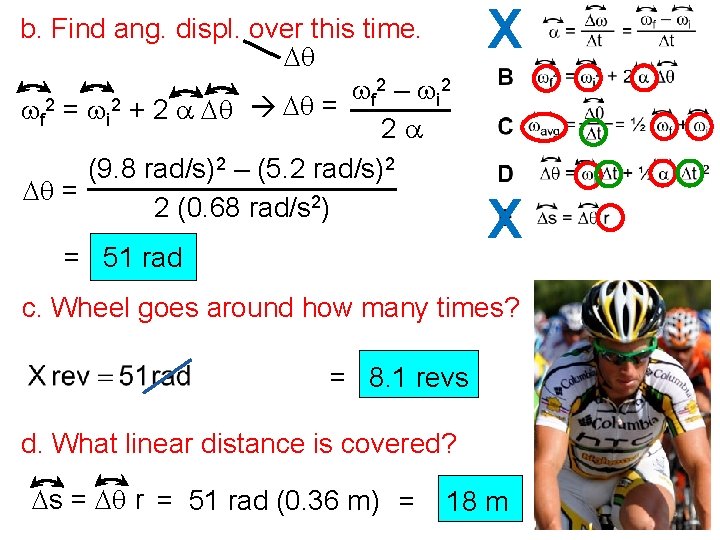
b. Find ang. displ. over this time. Dq 2 – w 2 w i wf 2 = wi 2 + 2 a Dq = f 2 a (9. 8 rad/s)2 – (5. 2 rad/s)2 Dq = 2 (0. 68 rad/s 2) = 51 rad X X c. Wheel goes around how many times? = 8. 1 revs d. What linear distance is covered? Ds = Dq r = 51 rad (0. 36 m) = 18 m
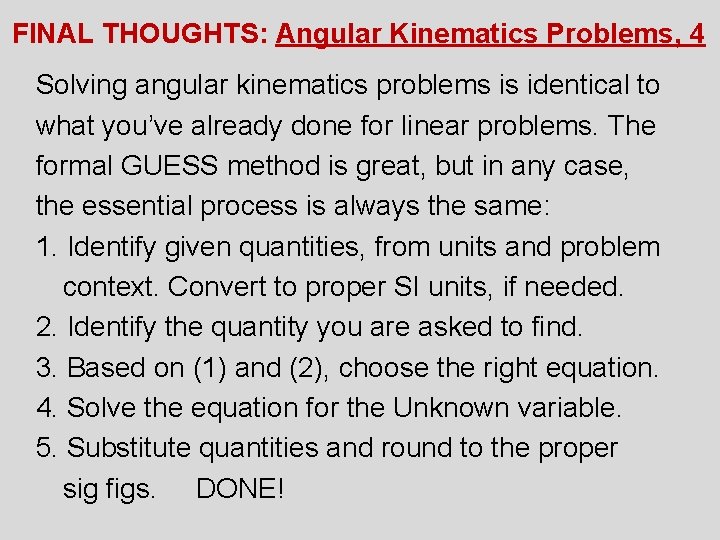
FINAL THOUGHTS: Angular Kinematics Problems, 4 Solving angular kinematics problems is identical to what you’ve already done for linear problems. The formal GUESS method is great, but in any case, the essential process is always the same: 1. Identify given quantities, from units and problem context. Convert to proper SI units, if needed. 2. Identify the quantity you are asked to find. 3. Based on (1) and (2), choose the right equation. 4. Solve the equation for the Unknown variable. 5. Substitute quantities and round to the proper sig figs. DONE!
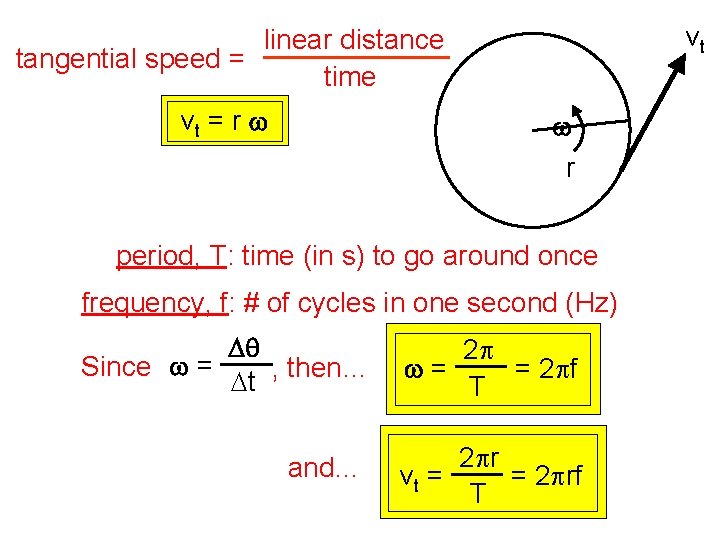
vt linear distance tangential speed = time vt = r w w r period, T: time (in s) to go around once frequency, f: # of cycles in one second (Hz) Dq Since w = , then… Dt 2 p w= = 2 pf T and… 2 pr vt = = 2 prf T
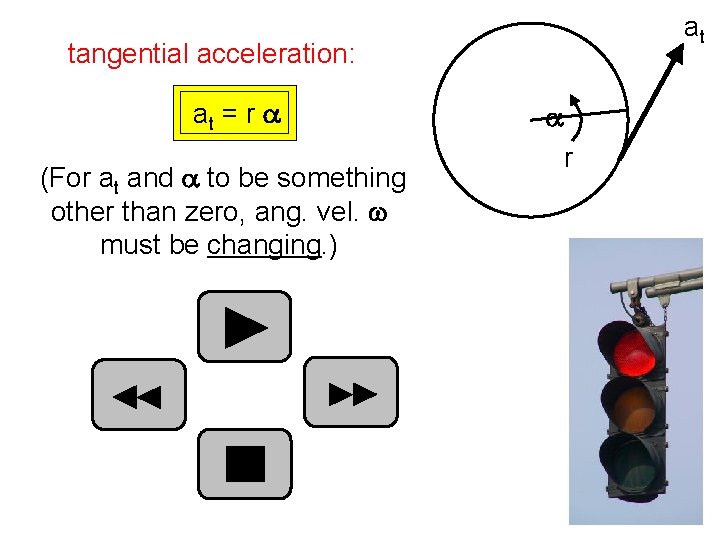
at tangential acceleration: at = r a (For at and a to be something other than zero, ang. vel. w must be changing. ) a r
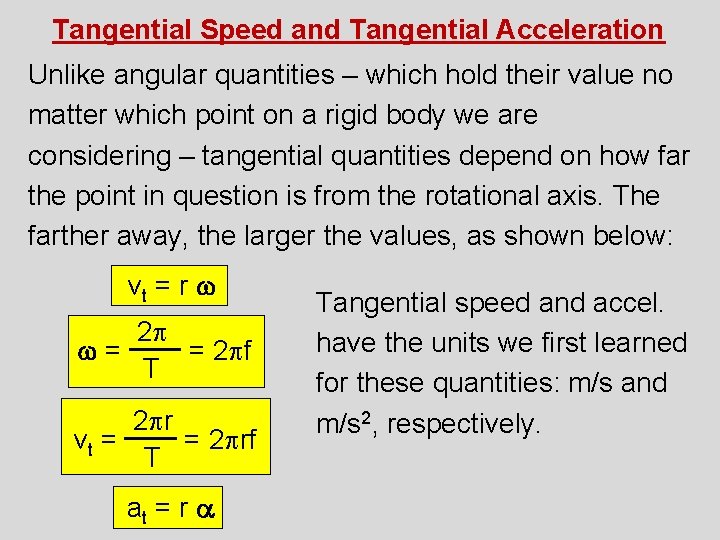
Tangential Speed and Tangential Acceleration Unlike angular quantities – which hold their value no matter which point on a rigid body we are considering – tangential quantities depend on how far the point in question is from the rotational axis. The farther away, the larger the values, as shown below: vt = r w 2 p w= = 2 pf T 2 pr vt = = 2 prf T at = r a Tangential speed and accel. have the units we first learned for these quantities: m/s and m/s 2, respectively.
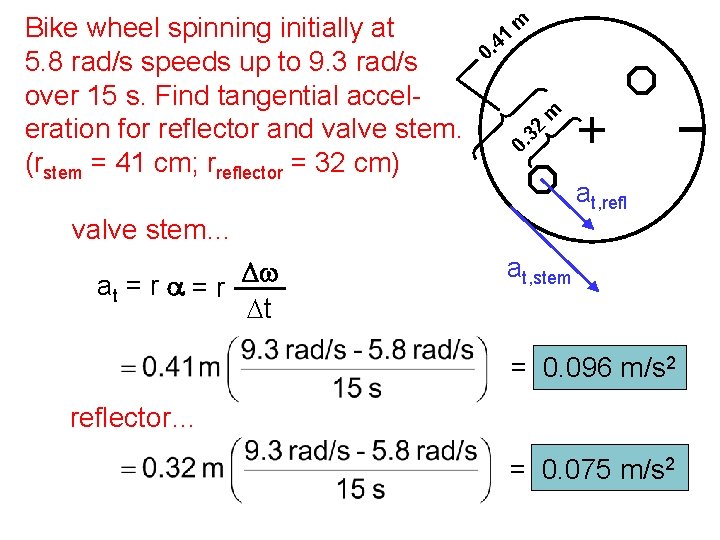
41 m 32 m 0. Bike wheel spinning initially at 5. 8 rad/s speeds up to 9. 3 rad/s over 15 s. Find tangential acceleration for reflector and valve stem. (rstem = 41 cm; rreflector = 32 cm) at, refl valve stem… Dw at = r a = r Dt at, stem = 0. 096 m/s 2 reflector… = 0. 075 m/s 2
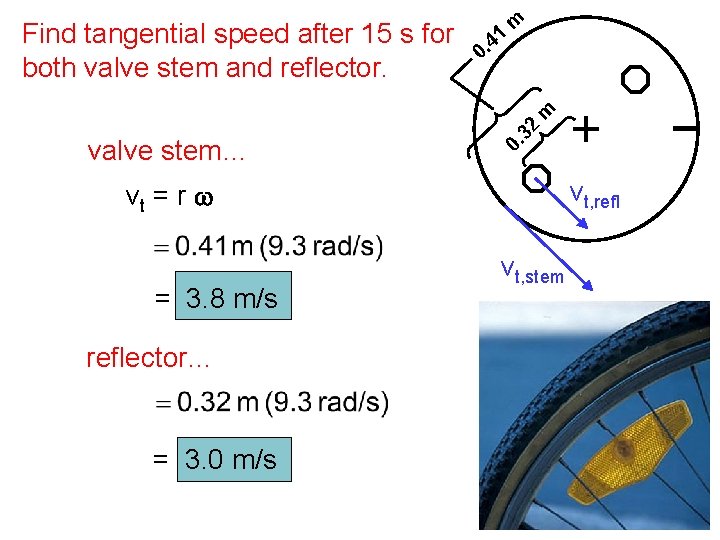
41 m 0. valve stem… 32 m Find tangential speed after 15 s for both valve stem and reflector. vt, refl vt = r w = 3. 8 m/s reflector… = 3. 0 m/s vt, stem
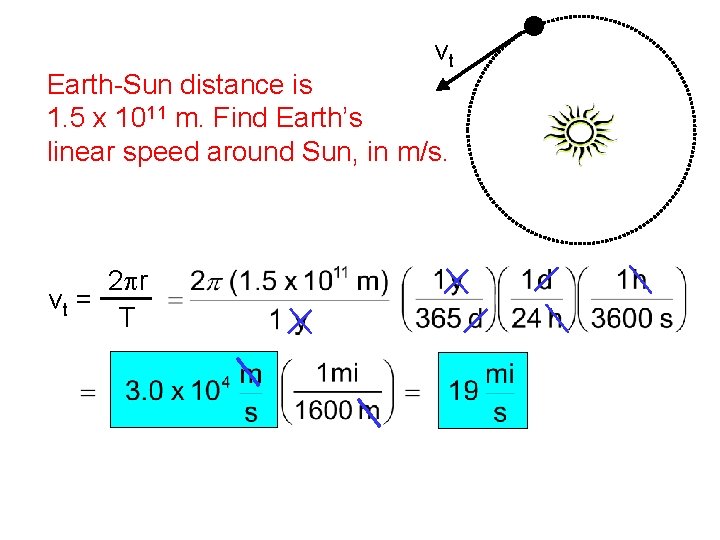
vt Earth-Sun distance is 1. 5 x 10¹¹ m. Find Earth’s linear speed around Sun, in m/s. 2 pr vt = T
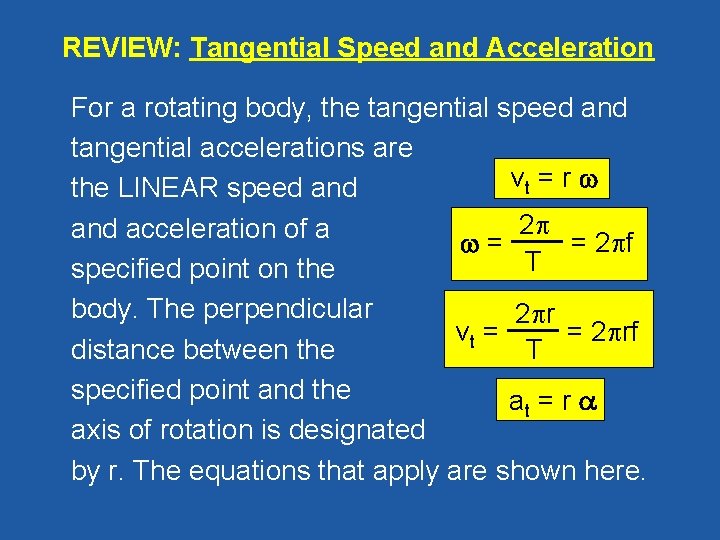
REVIEW: Tangential Speed and Acceleration For a rotating body, the tangential speed and tangential accelerations are vt = r w the LINEAR speed and 2 p and acceleration of a w= = 2 pf T specified point on the body. The perpendicular 2 pr vt = = 2 prf distance between the T specified point and the at = r a axis of rotation is designated by r. The equations that apply are shown here.
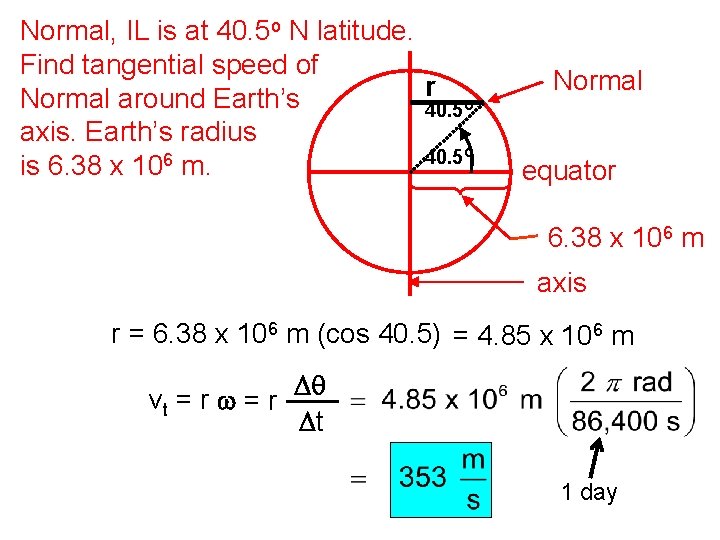
Normal, IL is at 40. 5 o N latitude. Find tangential speed of r o Normal around Earth’s 40. 5 axis. Earth’s radius 40. 5 o 6 is 6. 38 x 10 m. Normal equator 6. 38 x 106 m axis r = 6. 38 x 106 m (cos 40. 5) = 4. 85 x 106 m Dq vt = r w = r Dt 1 day
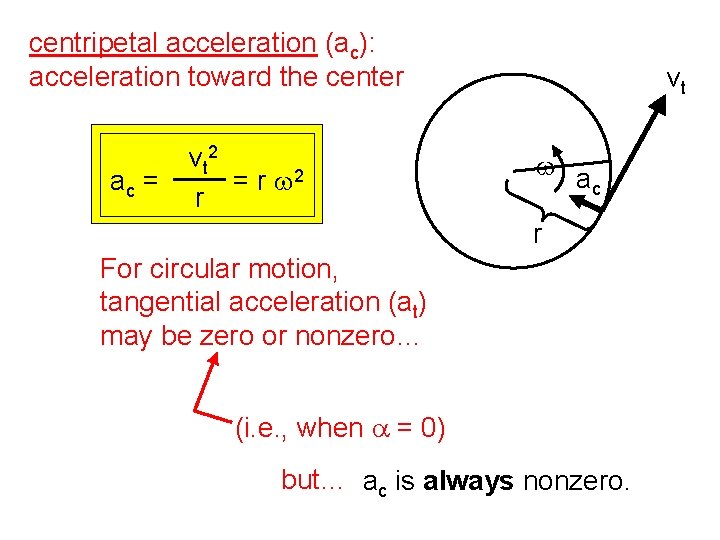
centripetal acceleration (ac): acceleration toward the center ac = vt 2 = r w 2 r vt w a c r For circular motion, tangential acceleration (at) may be zero or nonzero… (i. e. , when a = 0) but… ac is always nonzero.
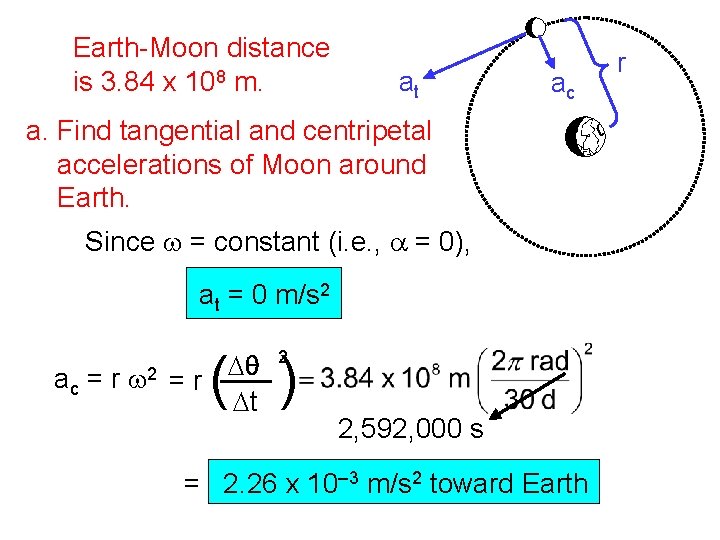
Earth-Moon distance is 3. 84 x 108 m. at ac a. Find tangential and centripetal accelerations of Moon around Earth. Since w = constant (i. e. , a = 0), at = 0 m/s 2 ( ) Dq 2 ac = r w = r Dt 2 2, 592, 000 s = 2. 26 x 10– 3 m/s 2 toward Earth r
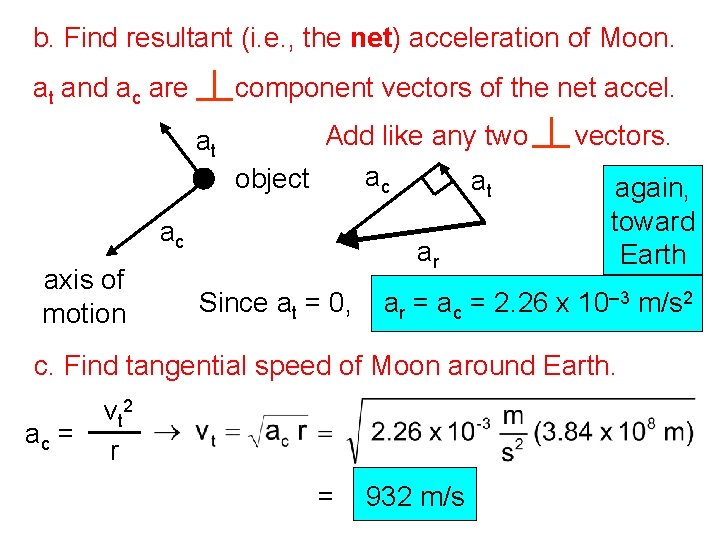
b. Find resultant (i. e. , the net) acceleration of Moon. at and ac are component vectors of the net accel. at Add like any two ac object at ac axis of motion ar Since at = 0, vectors. again, toward Earth ar = ac = 2. 26 x 10– 3 m/s 2 c. Find tangential speed of Moon around Earth. ac = vt 2 r = 932 m/s
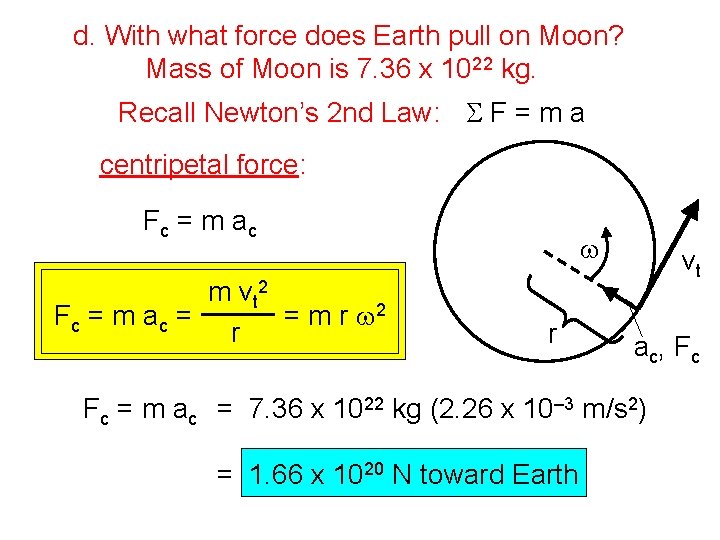
d. With what force does Earth pull on Moon? Mass of Moon is 7. 36 x 1022 kg. Recall Newton’s 2 nd Law: S F = m a centripetal force: Fc = m a c m v t 2 Fc = m a c = = m r w 2 r w r vt ac, Fc Fc = m ac = 7. 36 x 1022 kg (2. 26 x 10– 3 m/s 2) = 1. 66 x 1020 N toward Earth
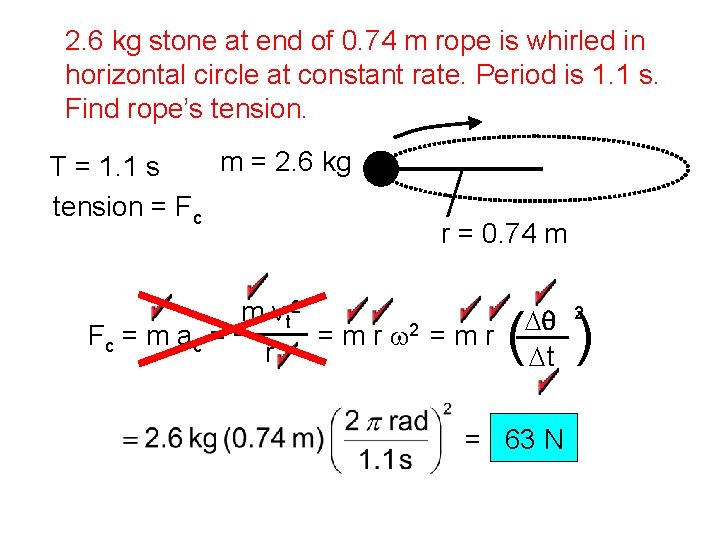
2. 6 kg stone at end of 0. 74 m rope is whirled in horizontal circle at constant rate. Period is 1. 1 s. Find rope’s tension. m = 2. 6 kg T = 1. 1 s tension = Fc r = 0. 74 m m v t 2 Fc = m a c = = m r w 2 = m r r ( ) Dq Dt = 63 N 2
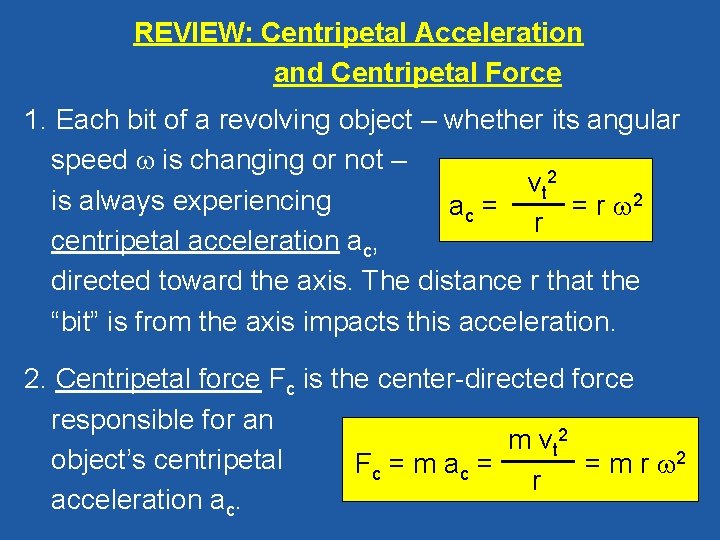
REVIEW: Centripetal Acceleration and Centripetal Force 1. Each bit of a revolving object – whether its angular speed w is changing or not – vt 2 is always experiencing ac = = r w 2 r centripetal acceleration ac, directed toward the axis. The distance r that the “bit” is from the axis impacts this acceleration. 2. Centripetal force Fc is the center-directed force responsible for an m v t 2 object’s centripetal Fc = m a c = = m r w 2 r acceleration ac.
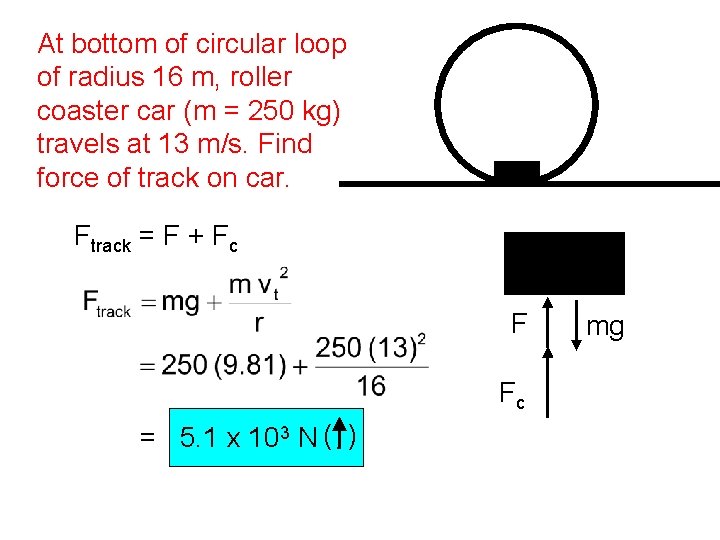
At bottom of circular loop of radius 16 m, roller coaster car (m = 250 kg) travels at 13 m/s. Find force of track on car. Ftrack = F + Fc F Fc = 5. 1 x 10³ N ( ) mg
FINAL THOUGHTS: Centripetal Force Centripetal forces come in many shapes and sizes: the tension in a rope or string, the pull of gravity on a celestial object, the force of a curved track on a bobsled, the pull of an atom’s nucleus on the orbiting electrons, friction between the road and the wheels of of a turning vehicle, and many more. Basically, any time something is traveling in a circle (or just simply curving), there is a centripetal force at work causing a centripetal acceleration.
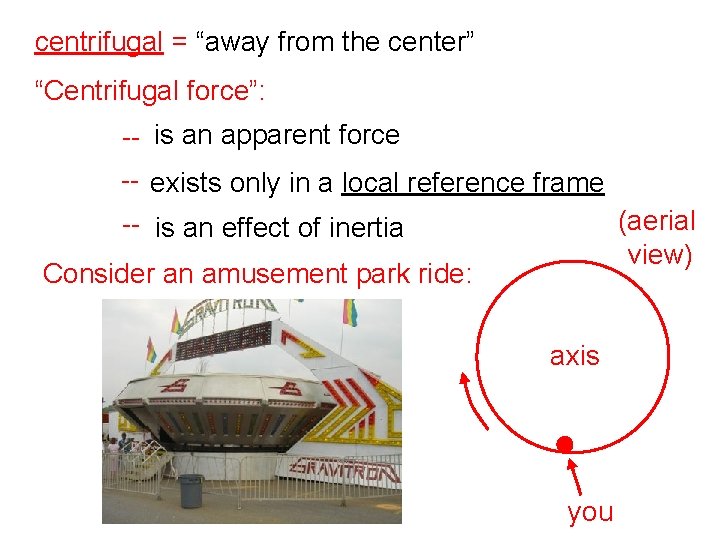
centrifugal = “away from the center” “Centrifugal force”: -- is an apparent force -- exists only in a local reference frame (aerial -- is an effect of inertia view) Consider an amusement park ride: axis you
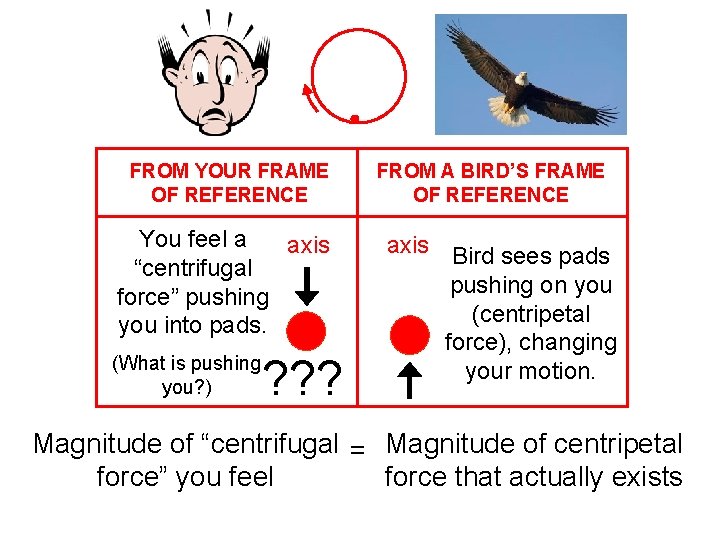
FROM YOUR FRAME OF REFERENCE You feel a axis “centrifugal force” pushing you into pads. (What is pushing you? ) ? ? ? FROM A BIRD’S FRAME OF REFERENCE axis Bird sees pads pushing on you (centripetal force), changing your motion. Magnitude of “centrifugal = Magnitude of centripetal force that actually exists force” you feel
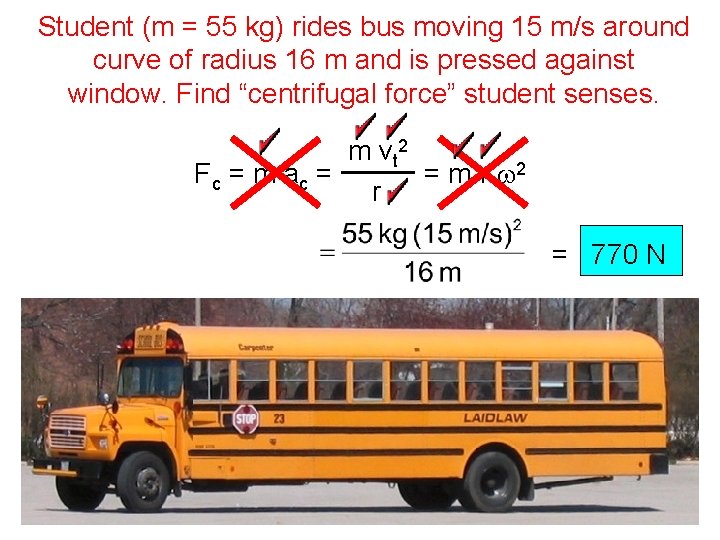
Student (m = 55 kg) rides bus moving 15 m/s around curve of radius 16 m and is pressed against window. Find “centrifugal force” student senses. m v t 2 Fc = m a c = = m r w 2 r = 770 N

C E N T R I F U G A L F O R C E ?
FINAL THOUGHTS: “Centrifugal Force” “Centrifugal force” is a force one perceives due to some kind of circular motion. It involves an object’s inertia (i. e. , its tendency to maintain a constant state of motion) and the circular motion of either the object itself or the surroundings. When examined from a more global reference frame, “centrifugal force” can be shown to be either the very real centripetal force that keeps an observer in a circular path, or the ABSENCE of such a force while the surroundings rotate away from the observer.
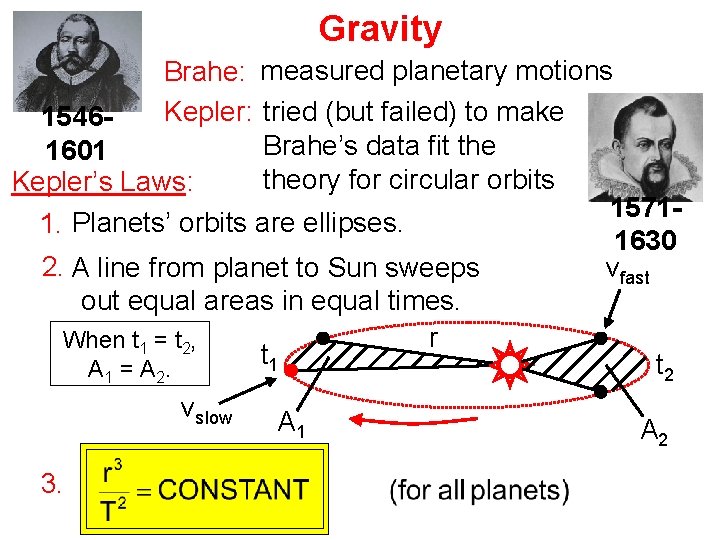
Gravity Brahe: measured planetary motions Kepler: tried (but failed) to make 1546 Brahe’s data fit the 1601 theory for circular orbits Kepler’s Laws: 1571 Planets’ orbits are ellipses. 1. 1630 2. A line from planet to Sun sweeps vfast out equal areas in equal times. r When t 1 = t 2, t 1 t 2 A 1 = A 2. vslow 3. A 1 A 2
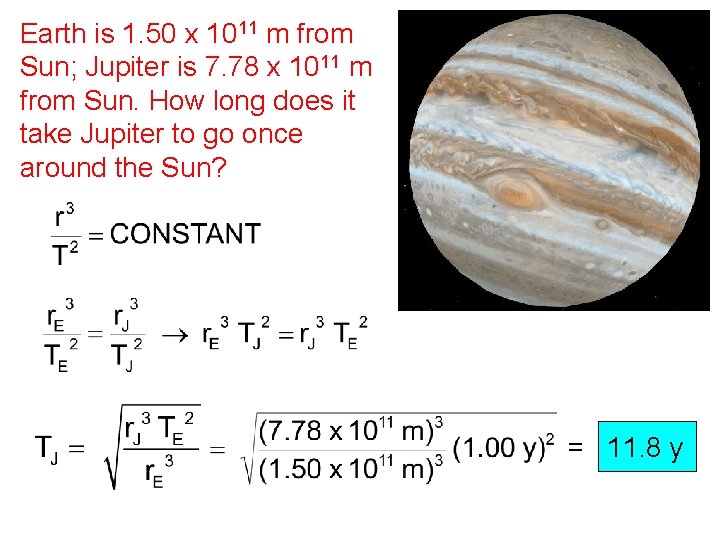
Earth is 1. 50 x 1011 m from Sun; Jupiter is 7. 78 x 1011 m from Sun. How long does it take Jupiter to go once around the Sun? = 11. 8 y
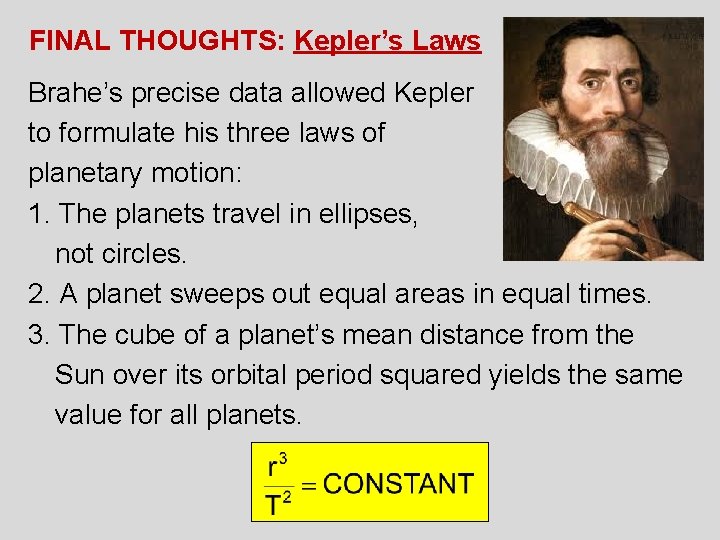
FINAL THOUGHTS: Kepler’s Laws Brahe’s precise data allowed Kepler to formulate his three laws of planetary motion: 1. The planets travel in ellipses, not circles. 2. A planet sweeps out equal areas in equal times. 3. The cube of a planet’s mean distance from the Sun over its orbital period squared yields the same value for all planets.
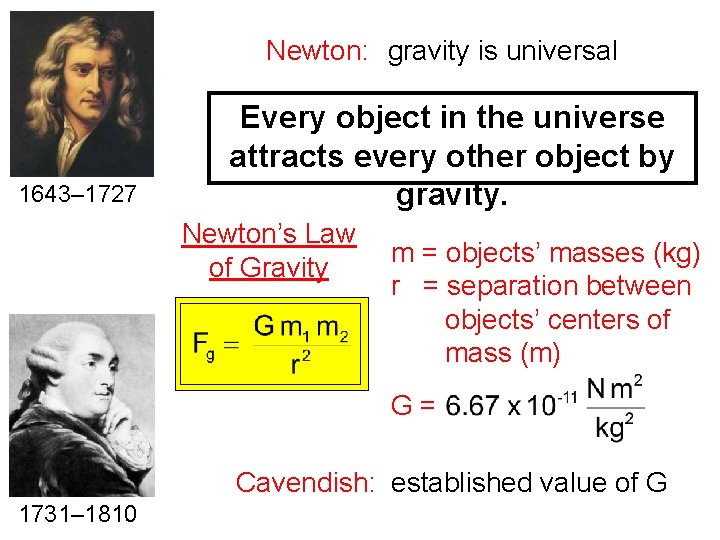
Newton: gravity is universal 1643– 1727 Every object in the universe attracts every other object by gravity. Newton’s Law of Gravity m = objects’ masses (kg) r = separation between objects’ centers of mass (m) G= Cavendish: established value of G 1731– 1810
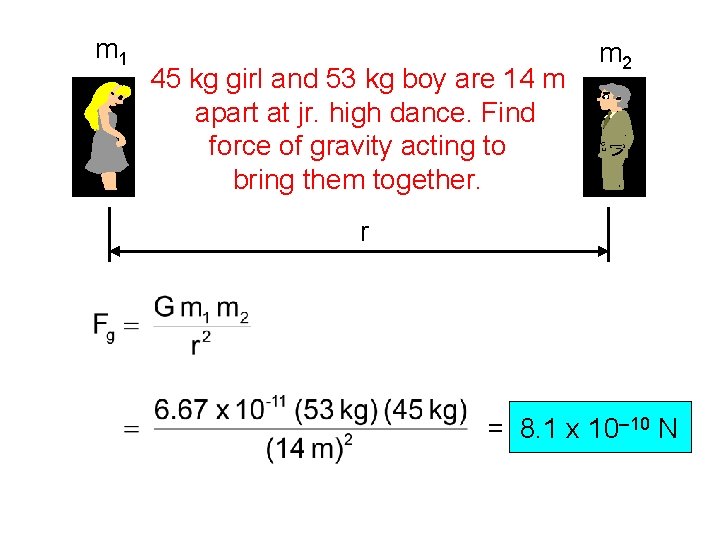
m 1 45 kg girl and 53 kg boy are 14 m apart at jr. high dance. Find force of gravity acting to bring them together. m 2 r = 8. 1 x 10– 10 N
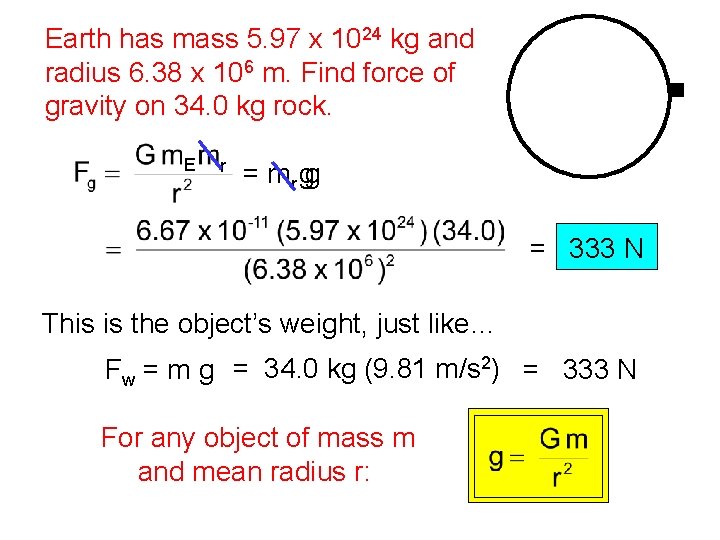
Earth has mass 5. 97 x 1024 kg and radius 6. 38 x 106 m. Find force of gravity on 34. 0 kg rock. E r = mr gg = 333 N This is the object’s weight, just like… Fw = m g = 34. 0 kg (9. 81 m/s 2) = 333 N For any object of mass m and mean radius r:
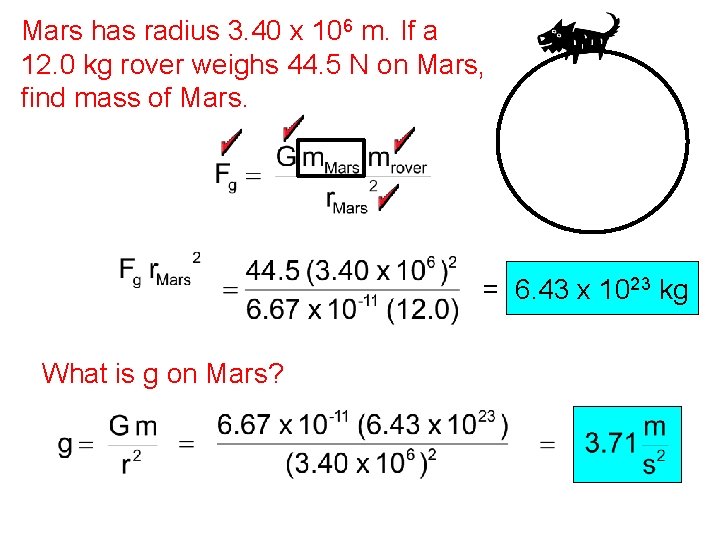
Mars has radius 3. 40 x 106 m. If a 12. 0 kg rover weighs 44. 5 N on Mars, find mass of Mars. = 6. 43 x 1023 kg What is g on Mars?
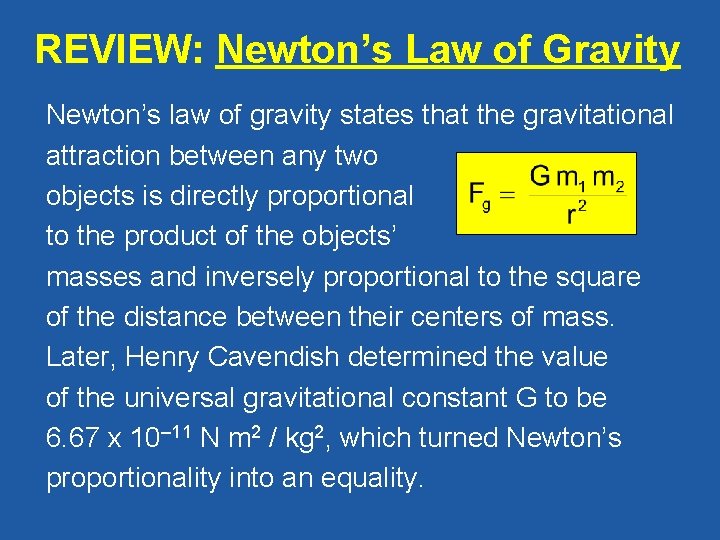
REVIEW: Newton’s Law of Gravity Newton’s law of gravity states that the gravitational attraction between any two objects is directly proportional to the product of the objects’ masses and inversely proportional to the square of the distance between their centers of mass. Later, Henry Cavendish determined the value of the universal gravitational constant G to be 6. 67 x 10– 11 N m 2 / kg 2, which turned Newton’s proportionality into an equality.
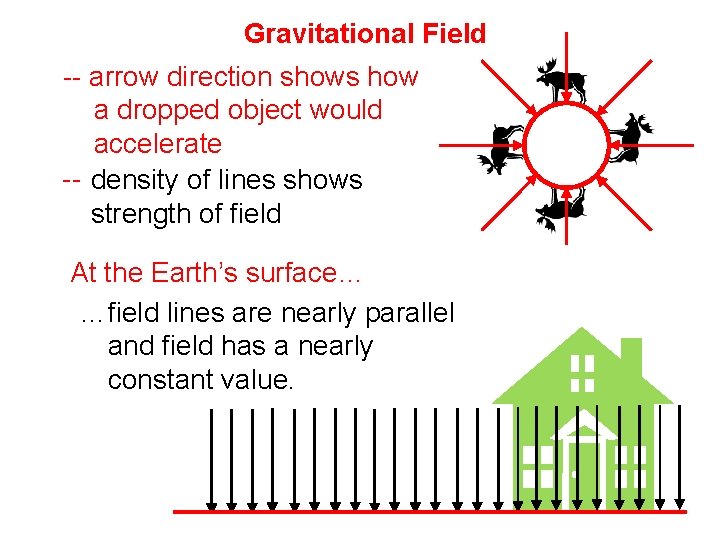
Gravitational Field -- arrow direction shows how a dropped object would accelerate -- density of lines shows strength of field At the Earth’s surface… …field lines are nearly parallel and field has a nearly constant value.
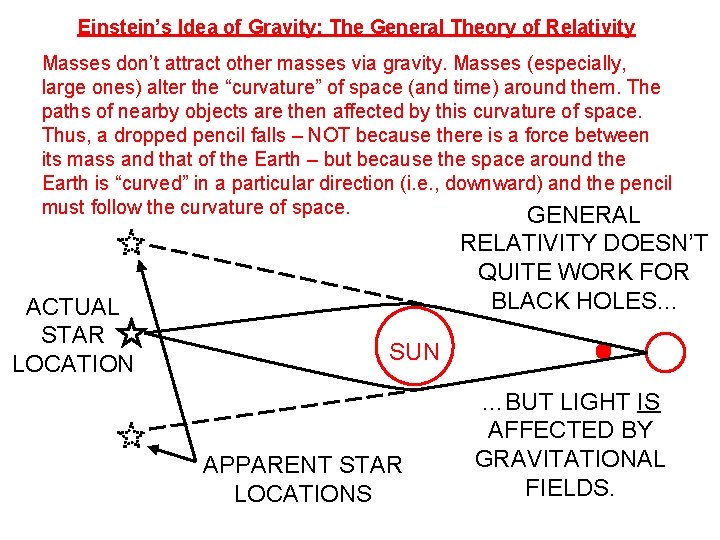
Einstein’s Idea of Gravity: The General Theory of Relativity Masses don’t attract other masses via gravity. Masses (especially, large ones) alter the “curvature” of space (and time) around them. The paths of nearby objects are then affected by this curvature of space. Thus, a dropped pencil falls – NOT because there is a force between its mass and that of the Earth – but because the space around the Earth is “curved” in a particular direction (i. e. , downward) and the pencil must follow the curvature of space. GENERAL ACTUAL STAR LOCATION RELATIVITY DOESN’T QUITE WORK FOR BLACK HOLES. . . SUN APPARENT STAR LOCATIONS …BUT LIGHT IS AFFECTED BY GRAVITATIONAL FIELDS.
MMARY: Gravitational Fields and General Relativ Gravity is such a part of our everyday experience that we often don’t bother to think about it very much. But when we do – and we have someone explain a few things – an awareness of gravity and other ideas in science makes us realize that this is a pretty amazing universe we live in. How lucky we are to be here, and how lucky we are to be able to make sense of a good deal of the natural world around us. That fact is so remarkable that, along with Vizzini, we say: “Inconceivable!”
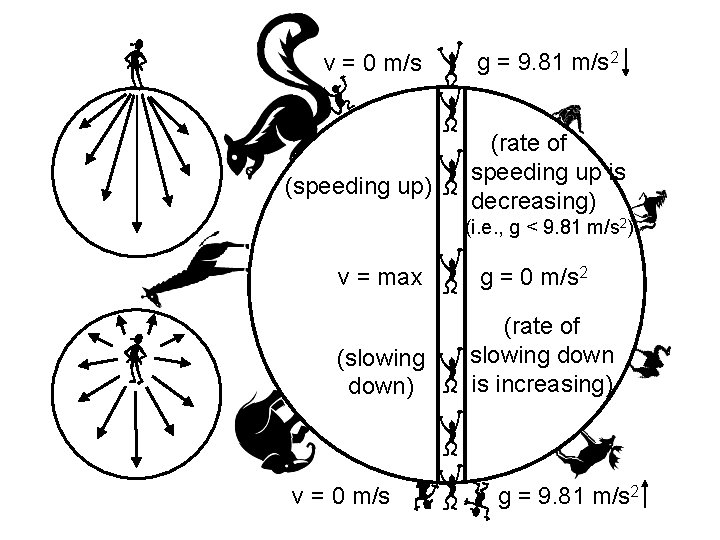
v = 0 m/s (speeding up) g = 9. 81 m/s 2 (rate of speeding up is decreasing) (i. e. , g < 9. 81 m/s 2) v = max (slowing down) v = 0 m/s g = 0 m/s 2 (rate of slowing down is increasing) g = 9. 81 m/s 2
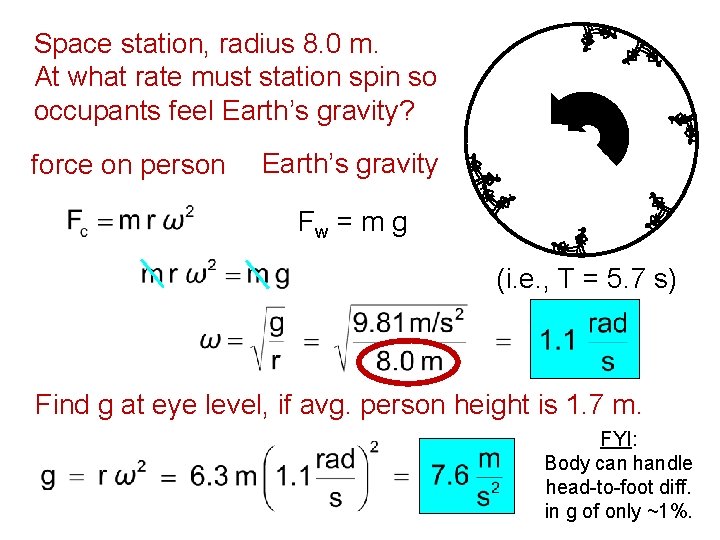
Space station, radius 8. 0 m. At what rate must station spin so occupants feel Earth’s gravity? force on person Earth’s gravity Fw = m g (i. e. , T = 5. 7 s) Find g at eye level, if avg. person height is 1. 7 m. FYI: Body can handle head-to-foot diff. in g of only ~1%.
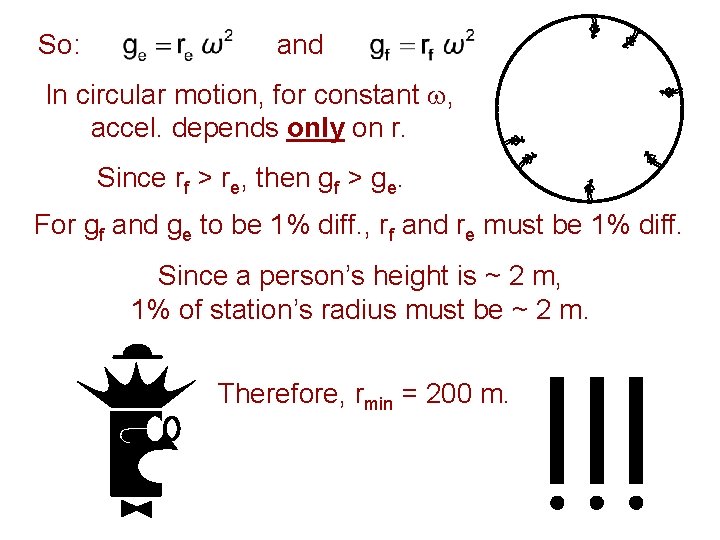
So: and In circular motion, for constant w, accel. depends only on r. Since rf > re, then gf > ge. For gf and ge to be 1% diff. , rf and re must be 1% diff. Since a person’s height is ~ 2 m, 1% of station’s radius must be ~ 2 m. Therefore, rmin = 200 m.
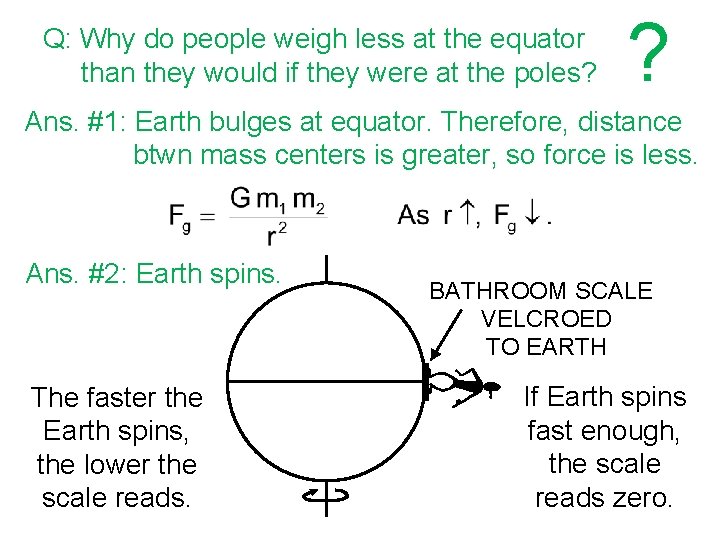
Q: Why do people weigh less at the equator than they would if they were at the poles? ? Ans. #1: Earth bulges at equator. Therefore, distance btwn mass centers is greater, so force is less. Ans. #2: Earth spins. The faster the Earth spins, the lower the scale reads. BATHROOM SCALE VELCROED TO EARTH If Earth spins fast enough, the scale reads zero.
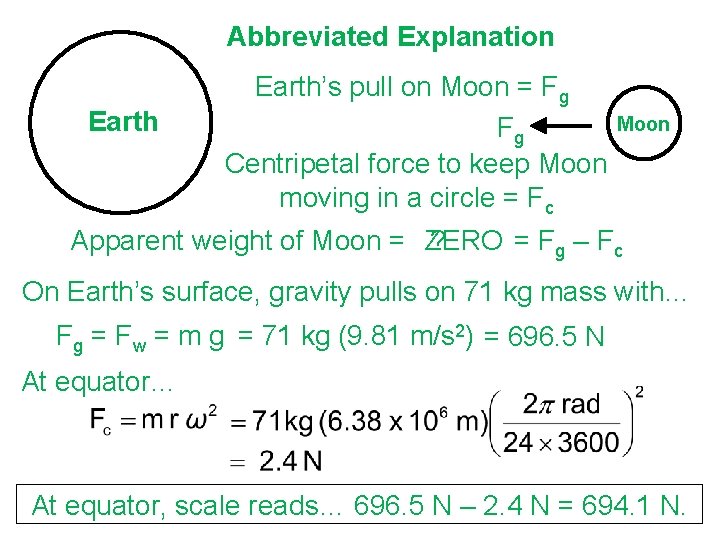
Abbreviated Explanation Earth’s pull on Moon = Fg Fg Centripetal force to keep Moon moving in a circle = Fc Moon = Fg – Fc ? Apparent weight of Moon = ZERO On Earth’s surface, gravity pulls on 71 kg mass with… Fg = Fw = m g = 71 kg (9. 81 m/s 2) = 696. 5 N At equator… At equator, scale reads… 696. 5 N – 2. 4 N = 694. 1 N.
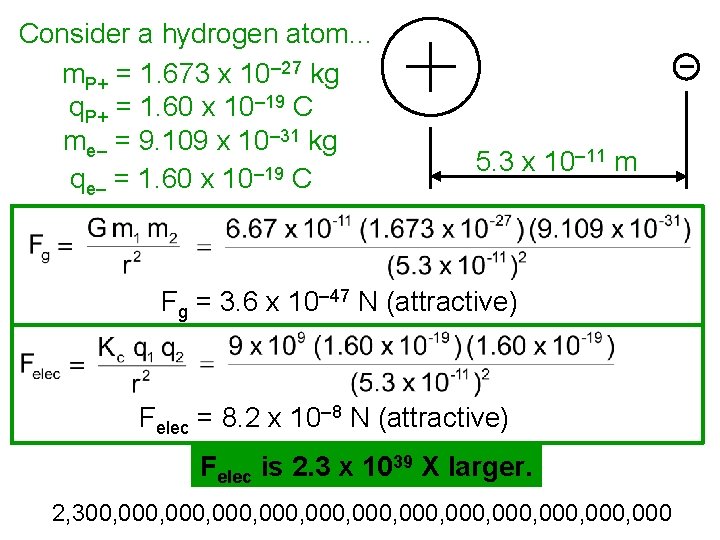
Consider a hydrogen atom… m. P+ = 1. 673 x 10– 27 kg q. P+ = 1. 60 x 10– 19 C me– = 9. 109 x 10– 31 kg qe– = 1. 60 x 10– 19 C 5. 3 x 10– 11 m Fg = 3. 6 x 10– 47 N (attractive) Felec = 8. 2 x 10– 8 N (attractive) Felec is 2. 3 x 1039 X larger. 2, 300, 000, 000, 000, 000
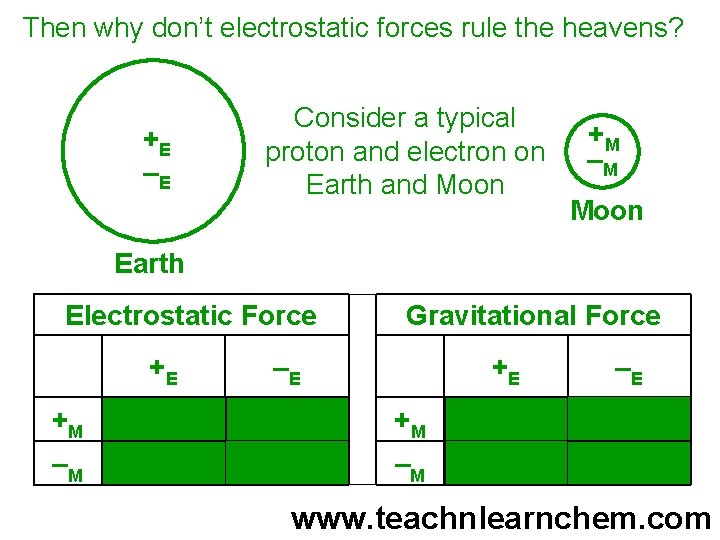
Then why don’t electrostatic forces rule the heavens? +E –E Consider a typical proton and electron on Earth and Moon +M –M Moon Earth Electrostatic Force +E –E +M repel attract –M attract repel Gravitational Force +E –E +M attract –M attract www. teachnlearnchem. com
- Slides: 62