
Circular Economy beyond the EU Dr Hugo Maria
Circular Economy beyond the EU Dr. Hugo Maria Schally European Commission DG Environment
Policy Framework 7 th Environment Action Programme (20142020) • The transformation into an inclusive green economy requires the integration of environment issues into other policies, such as … trade …, so as to create a coherent, joined-up approach. • In parallel, the Union should pursue and further intensify climate change partnerships with strategic partners and take further action to mainstream environmental and climaterelated considerations in its trade and development policies, bearing in mind mutual commitments and benefits. 2
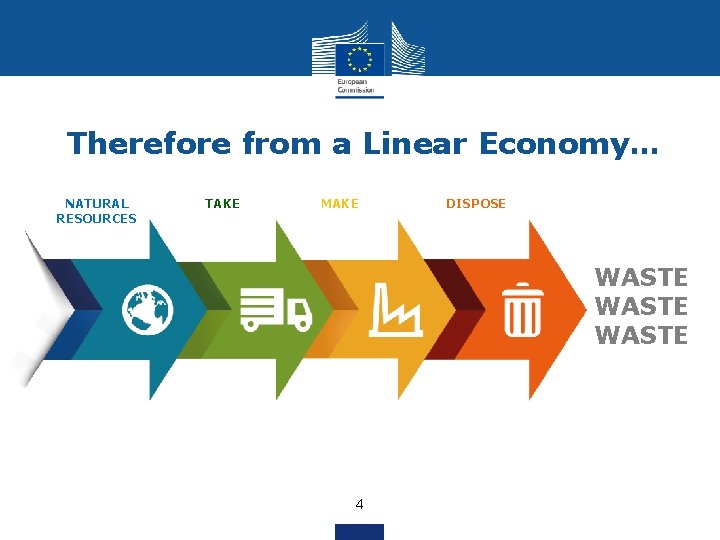
Therefore from a Linear Economy… NATURAL RESOURCES TAKE MAKE DISPOSE WASTE 4
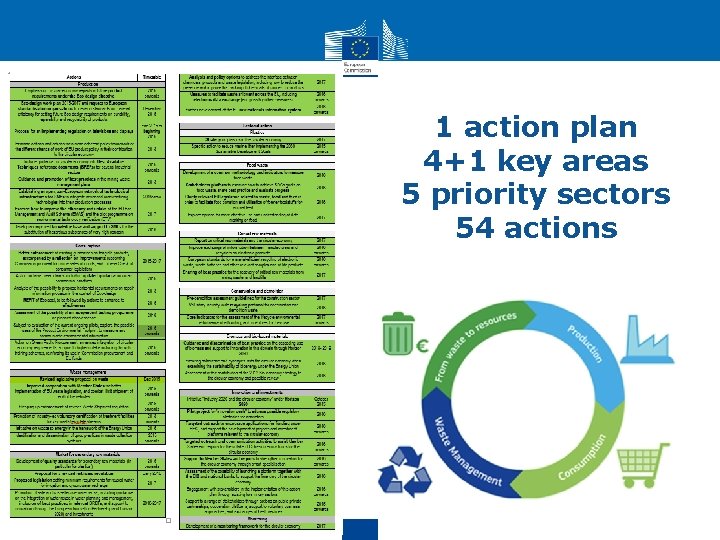
1 action plan 4+1 key areas 5 priority sectors 54 actions
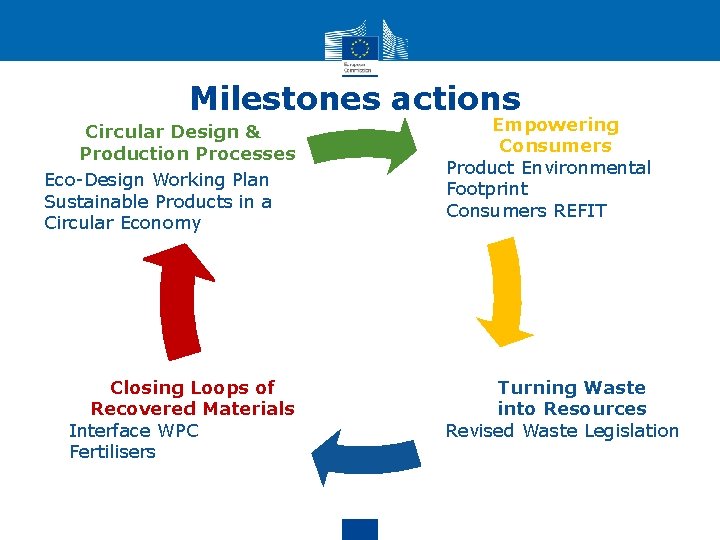
Milestones actions Circular Design & Production Processes Eco-Design Working Plan Sustainable Products in a Circular Economy Closing Loops of Recovered Materials Interface WPC Fertilisers Empowering Consumers Product Environmental Footprint Consumers REFIT Turning Waste into Resources Revised Waste Legislation
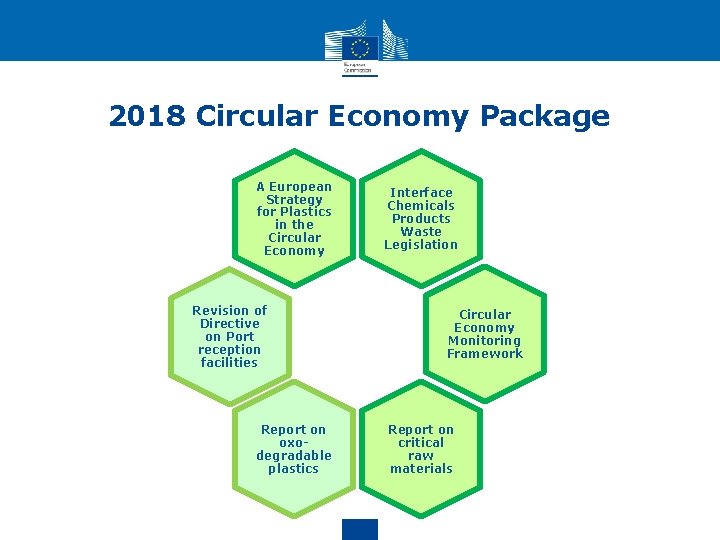
2018 Circular Economy Package A European Strategy for Plastics in the Circular Economy Revision of Directive on Port reception facilities Report on oxodegradable plastics Interface Chemicals Products Waste Legislation Circular Economy Monitoring Framework Report on critical raw materials
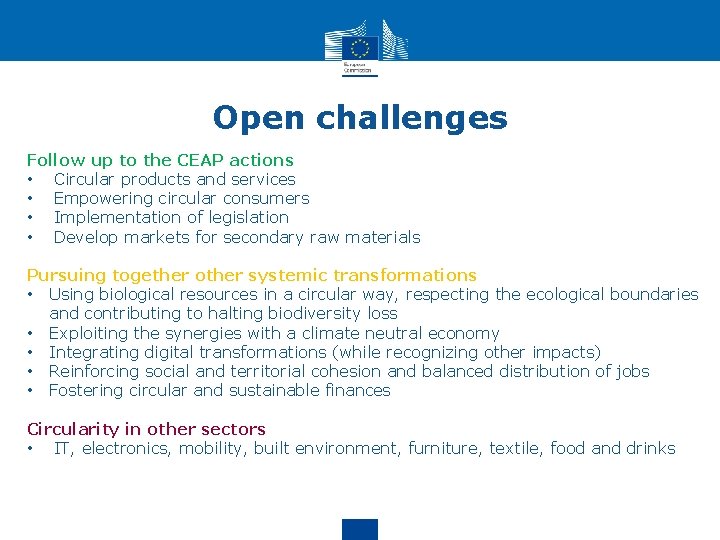
Open challenges Follow up to the CEAP actions • Circular products and services • Empowering circular consumers • Implementation of legislation • Develop markets for secondary raw materials Pursuing together other systemic transformations • Using biological resources in a circular way, respecting the ecological boundaries and contributing to halting biodiversity loss • Exploiting the synergies with a climate neutral economy • Integrating digital transformations (while recognizing other impacts) • Reinforcing social and territorial cohesion and balanced distribution of jobs • Fostering circular and sustainable finances Circularity in other sectors • IT, electronics, mobility, built environment, furniture, textile, food and drinks
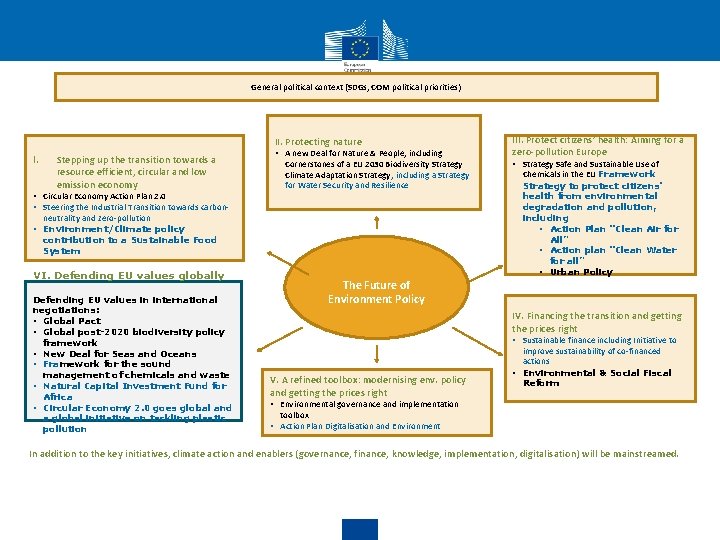
General political context (SDGs, COM political priorities) II. Protecting nature I. Stepping up the transition towards a resource efficient, circular and low emission economy • Circular Economy Action Plan 2. 0 • Steering the Industrial Transition towards carbon- • A new Deal for Nature & People, including Cornerstones of a EU 2030 Biodiversity Strategy Climate Adaptation Strategy, including a Strategy for Water Security and Resilience neutrality and zero-pollution • Environment/Climate policy contribution to a Sustainable Food System VI. Defending EU values globally Defending EU values in international negotiations: • Global Pact • Global post-2020 biodiversity policy framework • New Deal for Seas and Oceans • Framework for the sound management of chemicals and waste • Natural Capital Investment Fund for Africa • Circular Economy 2. 0 goes global and a global initiative on tackling plastic pollution III. Protect citizens’ health: Aiming for a zero-pollution Europe • Strategy Safe and Sustainable Use of Chemicals in the EU Framework Strategy to protect citizens' health from environmental degradation and pollution, including • Action Plan “Clean Air for All” • Action plan “Clean Water for all” • Urban Policy The Future of Environment Policy IV. Financing the transition and getting the prices right • Sustainable finance including Initiative to V. A refined toolbox: modernising env. policy and getting the prices right improve sustainability of co-financed actions • Environmental & Social Fiscal Reform • Environmental governance and implementation toolbox • Action Plan Digitalisation and Environment In addition to the key initiatives, climate action and enablers (governance, finance, knowledge, implementation, digitalisation) will be mainstreamed.
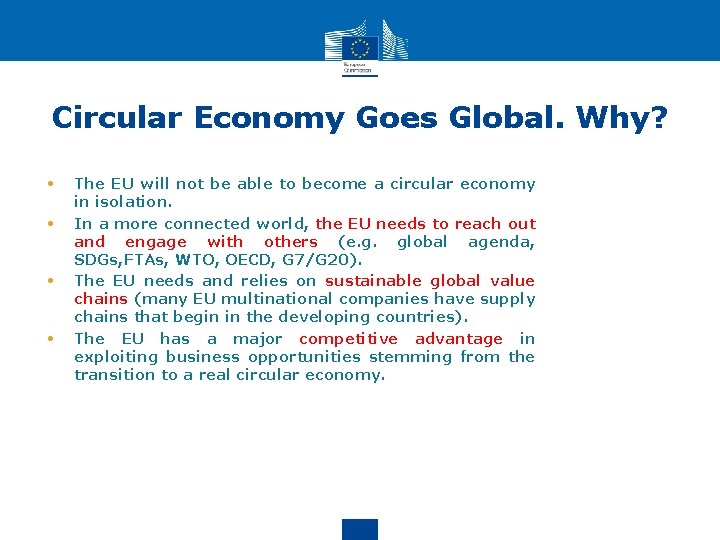
Circular Economy Goes Global. Why? • • The EU will not be able to become a circular economy in isolation. In a more connected world, the EU needs to reach out and engage with others (e. g. global agenda, SDGs, FTAs, WTO, OECD, G 7/G 20). The EU needs and relies on sustainable global value chains (many EU multinational companies have supply chains that begin in the developing countries). The EU has a major competitive advantage in exploiting business opportunities stemming from the transition to a real circular economy.
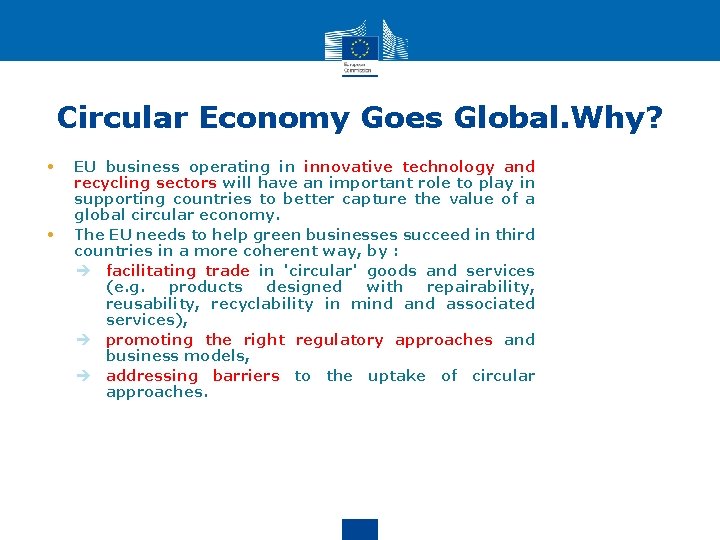
Circular Economy Goes Global. Why? • • EU business operating in innovative technology and recycling sectors will have an important role to play in supporting countries to better capture the value of a global circular economy. The EU needs to help green businesses succeed in third countries in a more coherent way, by : facilitating trade in 'circular' goods and services (e. g. products designed with repairability, reusability, recyclability in mind associated services), promoting the right regulatory approaches and business models, addressing barriers to the uptake of circular approaches.
Plurilateral - G 7/G 20 • Since 2015 – Circular Economy in G 7 • How to get CE on the agenda • Link to specific initiatives such Resource efficiency Marine Litter Plastics +
Multilateral - United Nations Environment Assembly : 2019 – Ministerial Declaration Resolution on “ Innovative Pathways towards Sustainable Consumption and Production “ +
Multilateral • Multilateral Environmental Agreements (MEAs): à Basel, Rotterdam, Stockholm, CITES, CBD and Nagoya Protocol…. (over 200 MEAs). à ENV Global Public Goods and Challenges Programme (GPGC) subdelegation to support global env governance (Cooperation Agreement with UNEP). • Working with the IOs (e. g. UNEP, UNSD, OECD): à Grant to OECD for the work of the Joint Working Party on Trade and Environment (JWPTE). à UNEP project on Trade in Env Sound Technologies. à UNSD project on life-cycle approaches in international supply chains. • Working with the CSOs under LIFE programme: à 2019 Call for Proposal has specific ref to trade policy and FTAs. 14
Bilateral: FTAs-TSD Chapter • Focus on dialogue and cooperation. Article on MEAs à Effective implementation and cooperation. à Mutual supportiveness between trade and environmental policies.
Bilateral: FTAs-TSD Chapter • Focus on dialogue and cooperation. Article on Areas of Cooperation à Cooperation in the relevant international for a (OECD, WTO, UNEP, MEAs). à Impact of FTA on env and that of env standards on trade. à Trade and investment in env goods and services. à Cooperation/exchange of info in specific
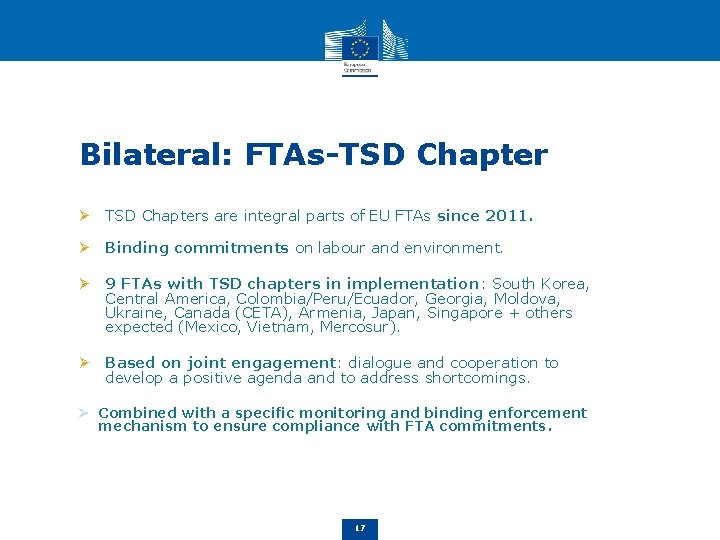
Bilateral: FTAs-TSD Chapter Ø TSD Chapters are integral parts of EU FTAs since 2011. Ø Binding commitments on labour and environment. Ø 9 FTAs with TSD chapters in implementation: South Korea, Central America, Colombia/Peru/Ecuador, Georgia, Moldova, Ukraine, Canada (CETA), Armenia, Japan, Singapore + others expected (Mexico, Vietnam, Mercosur). Ø Based on joint engagement: dialogue and cooperation to develop a positive agenda and to address shortcomings. Ø Combined with a specific monitoring and binding enforcement mechanism to ensure compliance with FTA commitments. 17
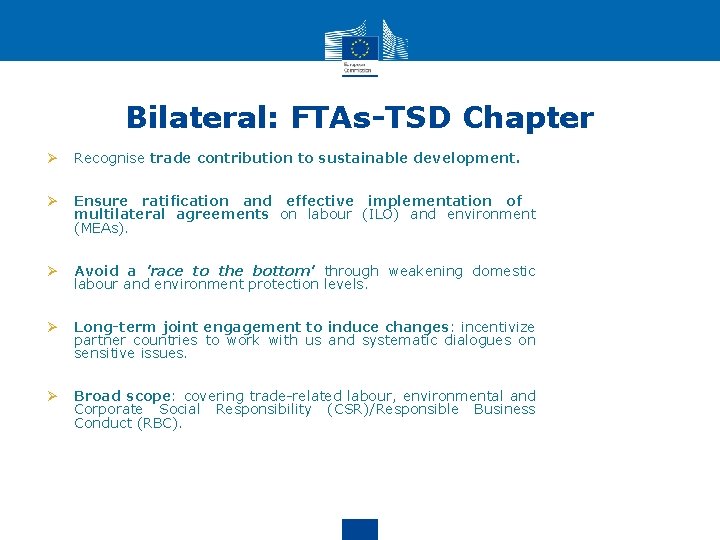
Bilateral: FTAs-TSD Chapter Ø Recognise trade contribution to sustainable development. Ø Ensure ratification and effective implementation of multilateral agreements on labour (ILO) and environment (MEAs). Ø Avoid a 'race to the bottom' through weakening domestic labour and environment protection levels. Ø Long-term joint engagement to induce changes: incentivize partner countries to work with us and systematic dialogues on sensitive issues. Ø Broad scope: covering trade-related labour, environmental and Corporate Social Responsibility (CSR)/Responsible Business Conduct (RBC).
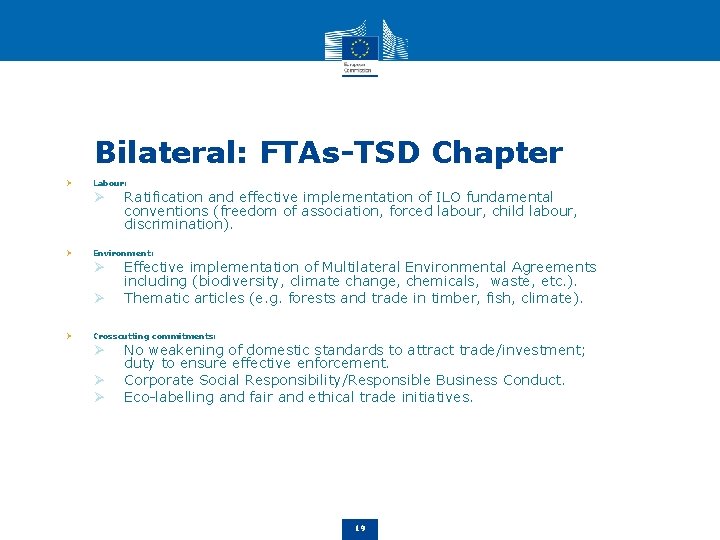
Bilateral: FTAs-TSD Chapter Ø Labour: Ø Ø Environment: Ø Ø Ø Ratification and effective implementation of ILO fundamental conventions (freedom of association, forced labour, child labour, discrimination). Effective implementation of Multilateral Environmental Agreements including (biodiversity, climate change, chemicals, waste, etc. ). Thematic articles (e. g. forests and trade in timber, fish, climate). Crosscutting commitments: Ø Ø Ø No weakening of domestic standards to attract trade/investment; duty to ensure effective enforcement. Corporate Social Responsibility/Responsible Business Conduct. Eco-labelling and fair and ethical trade initiatives. 19
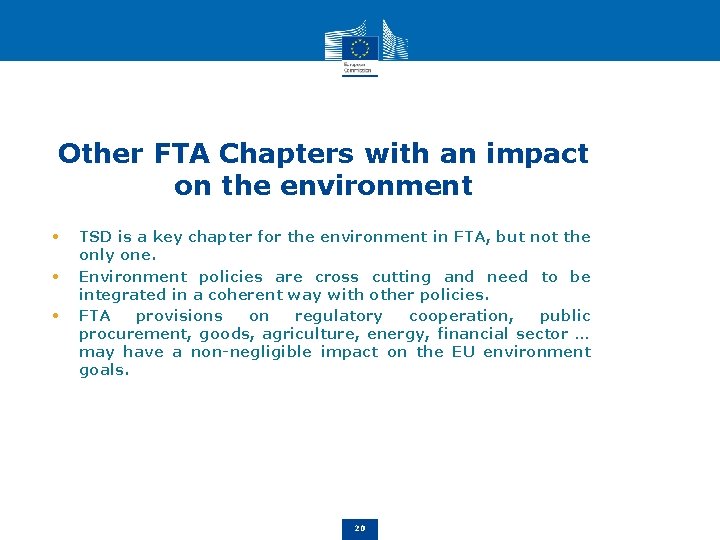
Other FTA Chapters with an impact on the environment • • • TSD is a key chapter for the environment in FTA, but not the only one. Environment policies are cross cutting and need to be integrated in a coherent way with other policies. FTA provisions on regulatory cooperation, public procurement, goods, agriculture, energy, financial sector … may have a non-negligible impact on the EU environment goals. 20
Bilateral – Political Dialogue à High-level dialogues: JPN, CAN, BRA, MEX, IDN, Ro. K, AUS, ASEAN, etc. à Environment Sub-Committees with Associated Countries. à Cooperation priorities/activities informed TSD country à CE/green among EU Economic Diplomacy (EED): MEX, CAN, COL, Ro. K, MY, VT, NZ, JPN. à FPI, Dialogue Facilities and DEVCO/NEAR funding available to support concrete cooperation activities, which are relevant in the TSD context. 21
Bilateral – Circular Economy Missions • Circular Economy Missions (CEMs) and other outreach activities to third countries: Two key objectives: 1) Promote CE approaches in the visited third country (policy focus: circular economy, resource efficiency and sustainable use of natural resources). 2) Facilitate green business partnerships between EU and local businesses. CEMs so far: • China, Chile (2016) • Iran, Colombia, South Africa (2017) • India, Japan Indonesia (2018) • Mexico, Singapore, Malaysia (2019) 22
Bilateral – Circular Economy Missions Workshops so far: • • Southern Neighbourhood (Casablanca - 2017) Saudi Arabia (Riyadh - 2018) Egypt (Sharm El Sheikh - 2018) Eastern Neighbourhood (Kiev - 2018) Western Balkans (Tirana - 2018) Andean Countries (Lima - 2018) Western Africa (Dakar - 2019) Forthcoming Workshop: • EU-African Business November 2019 Summit, 23 Marrakech, 28 -29
Supporting evidence à ENV study on the “Development of a methodology to assess the impact of trade liberalisation on biodiversity”. à Report on Plastics Waste Trade and Environment (EEA in the lead). à Consumer and consumption footprints in the EU (JRC in the lead). à Palm oil and deforestation studies. 24
Learn more about the circular economy http: //ec. europa. eu/environment/circular-economy/index_en. htm
- Slides: 25