
Circular Economy and impact on SME businesses how
Circular Economy and impact on SME businesses: how the European Commission encourages sustainability Peter Czaga, DG Environment, European Commission
Questions to be answered: 1) What is the Circular Economy? 2) Why is it relevant also for small companies? 3) What practical tools the European Commission offers to small companies to become more circular and sustainable?
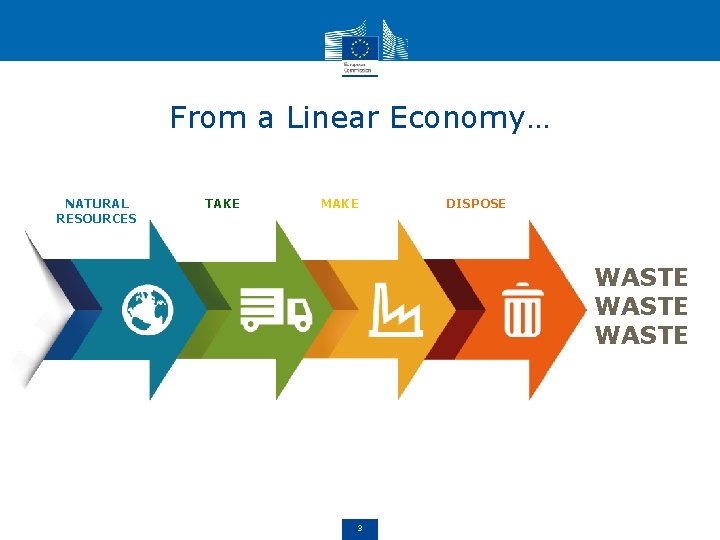
From a Linear Economy… NATURAL RESOURCES TAKE MAKE DISPOSE WASTE 3
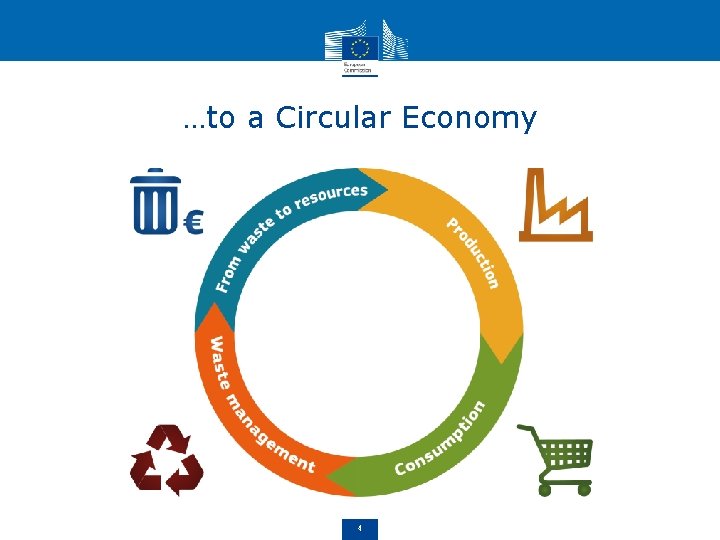
…to a Circular Economy 4
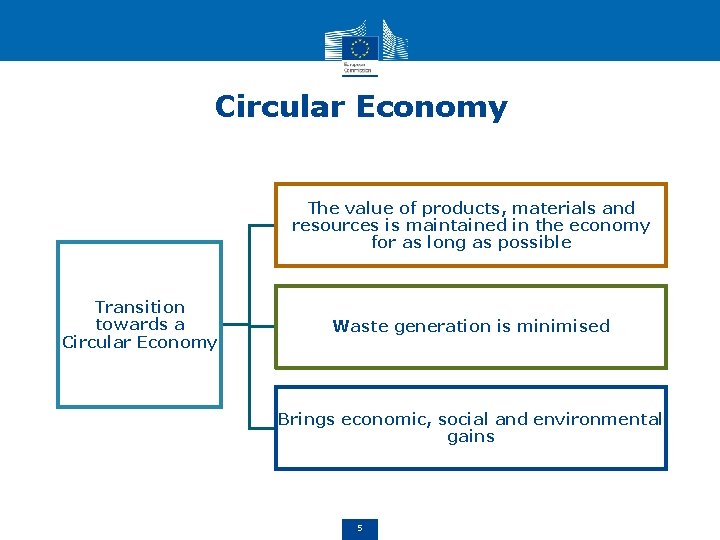
Circular Economy The value of products, materials and resources is maintained in the economy for as long as possible Transition towards a Circular Economy Waste generation is minimised Brings economic, social and environmental gains 5
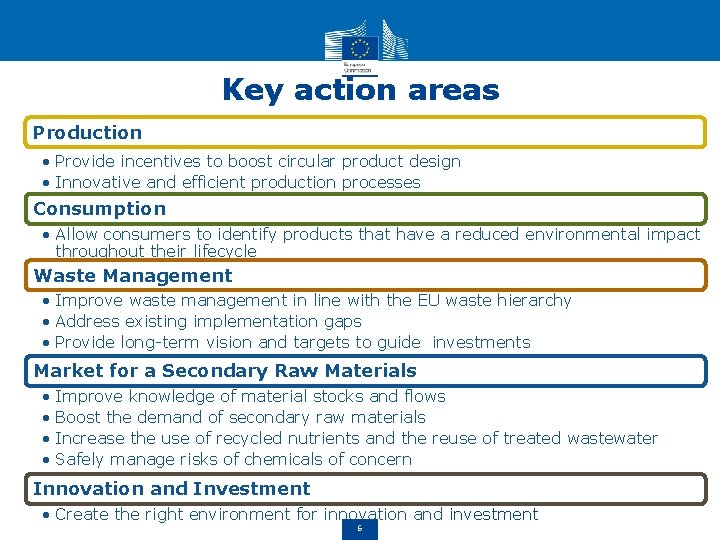
Key action areas Production • Provide incentives to boost circular product design • Innovative and efficient production processes Consumption • Allow consumers to identify products that have a reduced environmental impact throughout their lifecycle Waste Management • Improve waste management in line with the EU waste hierarchy • Address existing implementation gaps • Provide long-term vision and targets to guide investments Market for a Secondary Raw Materials • Improve knowledge of material stocks and flows • Boost the demand of secondary raw materials • Increase the use of recycled nutrients and the reuse of treated wastewater • Safely manage risks of chemicals of concern Innovation and Investment • Create the right environment for innovation and investment 6
Why is the circular economy relevant also for small companies? 1) REDUCING RESOURCE USE / RE-USING WASTE / CUTTING COSTS / IMPROVING COMPETITVENESS • Raw materials + energy and water = 50% of total manufacturing costs of companies vs. 20% for labour costs. • 60% of total waste is not recycled, composted or reused. • 44% of large companies in the EU sell their scrap material to another company vs. 24% of SMEs.
Why is the circular economy relevant also for small companies? 2) PARTICIPATION IN GREEN MARKETS / NEW BUSINESS OPPORTUNITIES • EU market for environmental industries is growing by 5% a year • Market potential is high: 80% of EU consumers buy green products at least sometimes – 26% buy them regularly • Only half of EU citizens trust producers' claims about the environmental performance of their products or services
The EU Ecolabel ü Voluntary scheme aiming at promoting the products with a lower environmental impact ü Criteria are mainly based on Life Cycle Assessment studies ü Multi-criteria based on pass/fail ü Third party verified ü Criteria established for 30 Product Groups, incl paints and varnishes. Awarded to more than 37000 Products
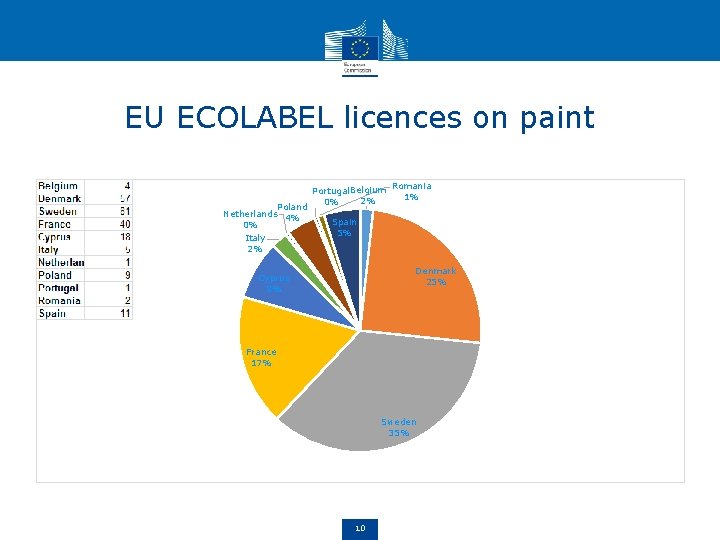
EU ECOLABEL licences on paint Poland Netherlands 4% 0% Italy 2% Romania Portugal. Belgium 1% 2% 0% Spain 5% Denmark 25% Cyprus 8% France 17% Sweden 35% 10
Why apply for EU Ecolabel? GUARANTEES a high level of transparency, reliability and scientific credibility. CERTIFIES that your product is among the most environmentally-friendly in its class. INCREASES the visibility of your product on the market among competitors. REPRESENTS a growing international market with a logo recognised throughout Europe by millions of consumers. 11
Green Public Procurement ". . . a process whereby public authorities seek to procure goods, services and works with a reduced environmental impact throughout their life cycle when compared to goods, services and works with the same primary function that would otherwise be procured. " • EU GPP criteria: • • • Criteria sets developed for 19 priority product groups since 2008 9 currently under revision/development Two levels of ambition: "core" and "comprehensive" = light/dark green Criteria developed in broad stakeholder process by JRC/IPTS Criteria under development: paints and varnishes 12

EU Eco-Management and Audit Scheme (EMAS) Voluntary environmental management instrument designed by the European Union = a tool to tackle resource use and other environmental impacts • Aim: Continuous improvement of environmental performance • Means: Measure, evaluate, report and improve environmental issues (with help of a management system) • • Outcomes: Performance and efficiency improvements, credible ‘externally’ (third party) verified environmental information
EU Product Environmental Footprint ( PEF / OEF ) • Development of a harmonised methodology for the calculation of the environmental footprint of products and organisations • Open the door to competition based on environmental performance with a common, reliable tool for measuring performance • One pilot on decorative paints (2014 – end 2016) • SME tool for the simplifed use of the methods 14
European Resource Efficiency Excellence Centre A virtual Centre that will provide information and support to European SMEs, business intermediaries, resource efficiency practitioners, regional authorities. Operational from January 2017 • Operate the European Resource Efficiency Self-Assessment Tool for SMEs • Enhance the support and advice that SMEs receive to improve their resource efficiency • Maintain the interactive collaborative website • Promote resource efficiency support measures for SMEs across the European Union 15
Funding opportunities for green SMEs • Horizon 2020 funds eco-innovative SMEs to develop, grow and internationalise including through collaborative R&D actions. • The LIFE programme will promote the uptake of the circular business models and resource efficiency practices in SMEs. • The financial instruments under COSME support SMEs to eco-innovate, introduce energy and resource efficiency actions and internationalise. • Private Finance for Energy Efficiency instruments (PF 4 EE) can support SMEs undertaking small energy efficiency investments. • European Regional Development Fund (ERDF) includes possibilities for investments in competitiveness, energy efficiency and renewable energy use in SMEs. 16
Links • • • Economia Circolare: http: //ec. europa. eu/environment/circular-economy/index_en. htm Horizon 2020: https: //ec. europa. eu/programmes/horizon 2020 Participant Portal: http: //ec. europa. eu/research/participants/portal/desktop/en/opportunities/h 2020 • • • LIFE: http: //ec. europa. eu/environment/life COSME: http: //ec. europa. eu/growth/smes/cosme European Structural and Investments Funds: http: //ec. europa. eu/regional_policy/en/funding • Guide to Research and Innovation Strategies for Smart Specialisations (RIS 3) http: //ec. europa. eu/regional_policy/sources/docgener/presenta/smart_specialisation/smart_ris 3_2 012. pdf • Connecting Smart and Sustainable Growth through Smart Specialisation: http: //ec. europa. eu/regional_policy/sources/docgener/presenta/green_growth/greengrowth. pdf • • • EIB: http: //www. eib. org/products/blending/innovfin EIF: http: //www. eif. org Investment Plan: http: //ec. europa. eu/priorities/jobs-growth-investment/plan
THANK YOU! PETER. CZAGA@EC. EUROPA. EU 18
- Slides: 18