
Circuits with Resistor Combinations 2 6 7 7
Circuits with Resistor Combinations (2. 6, 7. 7) Prof. Phillips Jan 31, 2003 ECE 201 Lect-8 1

Solving Circuits with Series and Parallel Combinations • The combination of series and parallel impedances can be used to find voltages and currents in circuits. • This process can often yield the fastest solutions to networks. • This process may not apply to complicated networks. ECE 201 Lect-8 2
Series and Parallel Impedances • Impedances are combined to create a simple circuit (usually one source and one impedance), from which a voltage or current can be found • Once the voltage or current is found, KCL and KVL are used to work back through the network to find voltages and currents. ECE 201 Lect-8 3

Example: Resistor Ladder 1 k. W 10 V + – 1 k. W + V 1 1 k. W + 2 k. W V 2 – + 2 k. W – V 3 1 k. W – Find V 1, V 2, and V 3 ECE 201 Lect-8 4
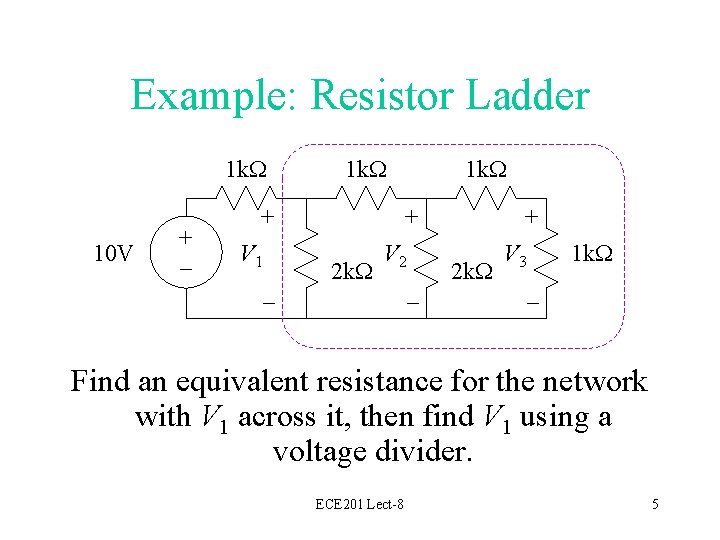
Example: Resistor Ladder 1 k. W 10 V + – 1 k. W + V 1 1 k. W + 2 k. W V 2 – – + 2 k. W V 3 1 k. W – Find an equivalent resistance for the network with V 1 across it, then find V 1 using a voltage divider. ECE 201 Lect-8 5
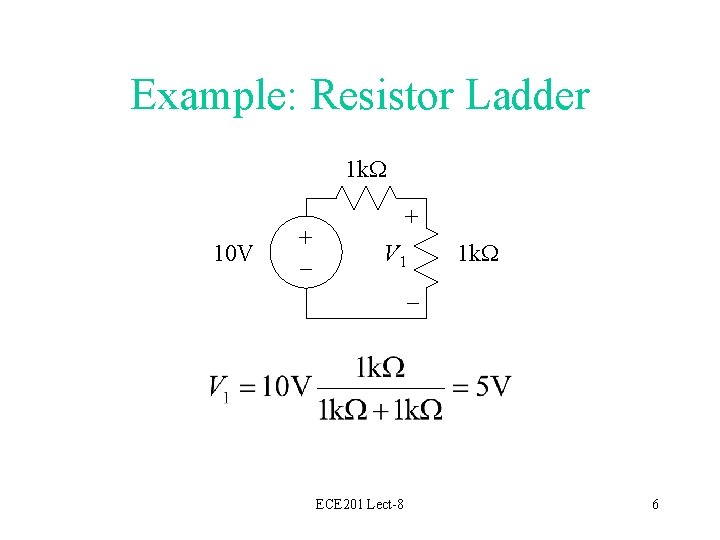
Example: Resistor Ladder 1 k. W 10 V + – + V 1 1 k. W – ECE 201 Lect-8 6
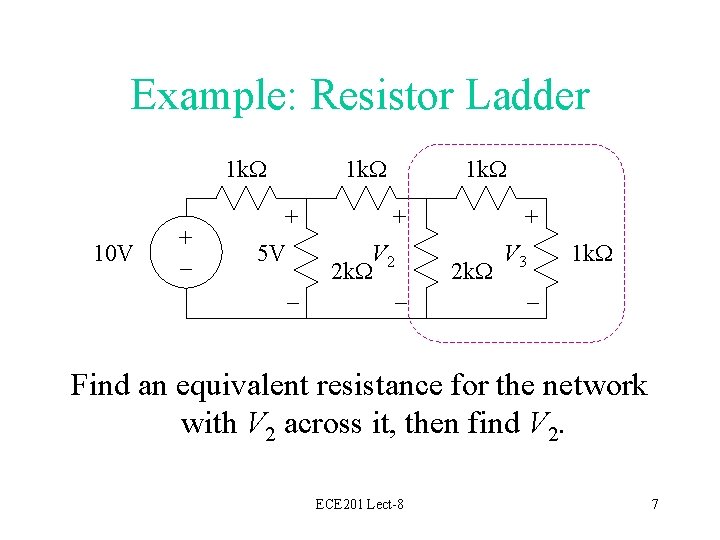
Example: Resistor Ladder 1 k. W 10 V + – 1 k. W + 5 V – 1 k. W + V 2 2 k. W – + 2 k. W V 3 1 k. W – Find an equivalent resistance for the network with V 2 across it, then find V 2. ECE 201 Lect-8 7
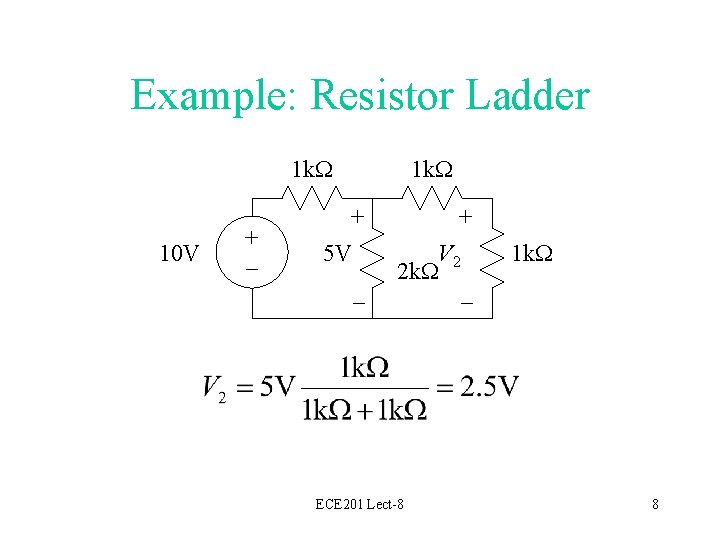
Example: Resistor Ladder 1 k. W 10 V + – 1 k. W + 5 V – + V 2 2 k. W – ECE 201 Lect-8 1 k. W 8
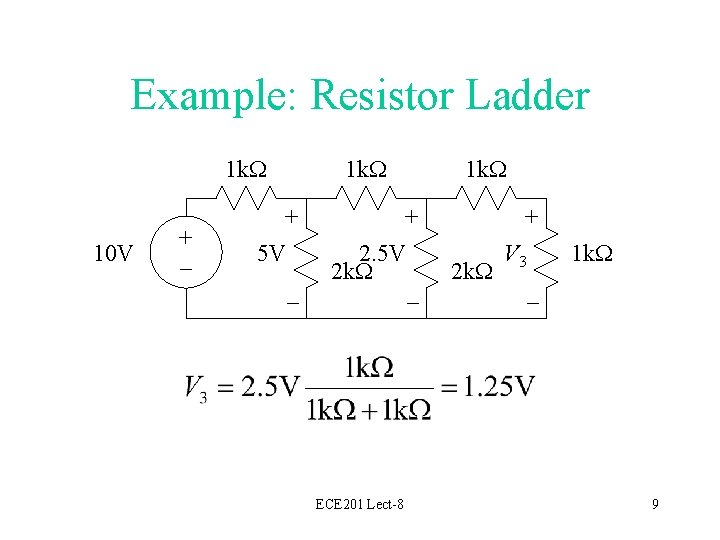
Example: Resistor Ladder 1 k. W 10 V + – 1 k. W + 5 V – + 2. 5 V 2 k. W – ECE 201 Lect-8 1 k. W + 2 k. W V 3 1 k. W – 9
Class Examples ECE 201 Lect-8 10
- Slides: 10