
Circuits and Interconnects In Aggressively Scaled CMOS Mark
- Slides: 10
Circuits and Interconnects In Aggressively Scaled CMOS Mark Horowitz Computer Systems Laboratory Stanford University horowitz@stanford. edu MAH VLSI Scaling 1
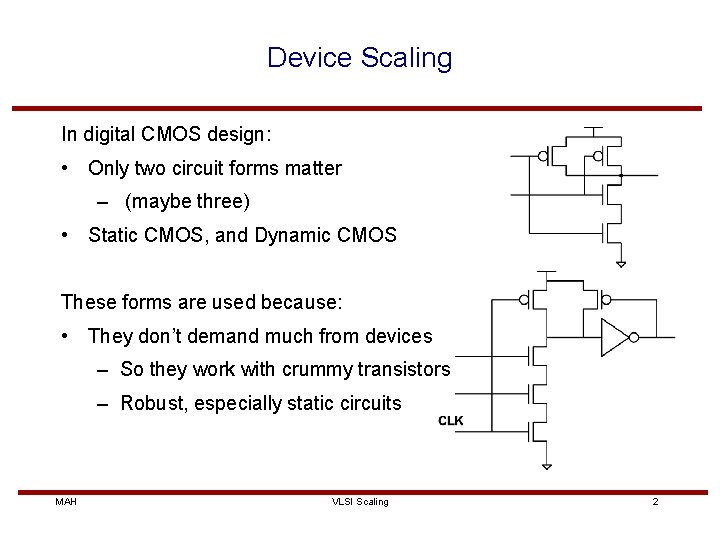
Device Scaling In digital CMOS design: • Only two circuit forms matter – (maybe three) • Static CMOS, and Dynamic CMOS These forms are used because: • They don’t demand much from devices – So they work with crummy transistors – Robust, especially static circuits MAH VLSI Scaling 2
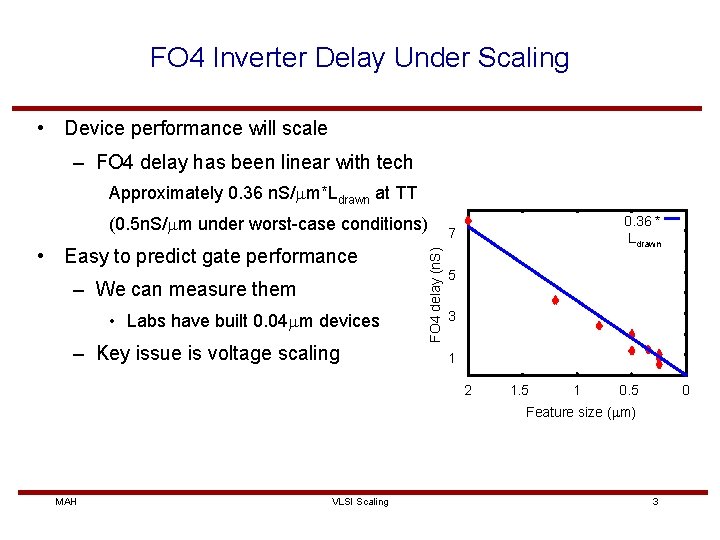
FO 4 Inverter Delay Under Scaling • Device performance will scale – FO 4 delay has been linear with tech Approximately 0. 36 n. S/mm*Ldrawn at TT • Easy to predict gate performance – We can measure them • Labs have built 0. 04 mm devices – Key issue is voltage scaling FO 4 delay (n. S) (0. 5 n. S/mm under worst-case conditions) 0. 36 * Ldrawn 7 5 3 1 2 1. 5 1 0. 5 0 Feature size (mm) MAH VLSI Scaling 3
Circuit Power • Is very much tied to voltage scaling • If the power supply scales with technology For a fixed complexity circuit – Power scales down as a^3 if you run as same frequency – Power scales down as a^2 if you run it 1/ a times faster • Power scaling is a problem because – Freq has been scaling at faster than 1/ a – Complexity of machine has been growing • This will continue to be an issue in future chips • Remember scaling the technology makes a chip lower power! MAH VLSI Scaling 4
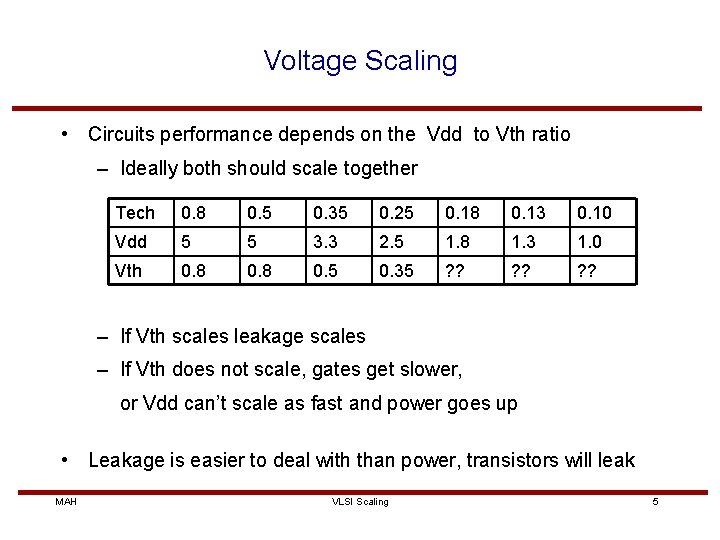
Voltage Scaling • Circuits performance depends on the Vdd to Vth ratio – Ideally both should scale together Tech 0. 8 0. 5 0. 35 0. 25 0. 18 0. 13 0. 10 Vdd 5 5 3. 3 2. 5 1. 8 1. 3 1. 0 Vth 0. 8 0. 5 0. 35 ? ? – If Vth scales leakage scales – If Vth does not scale, gates get slower, or Vdd can’t scale as fast and power goes up • Leakage is easier to deal with than power, transistors will leak MAH VLSI Scaling 5
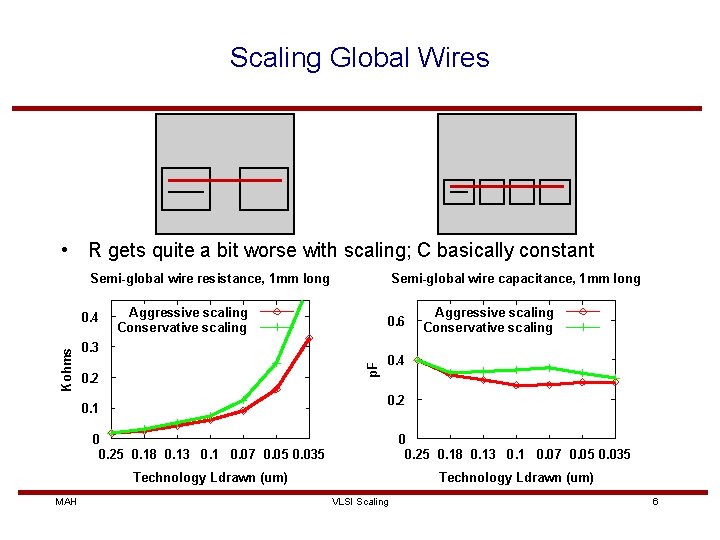
Scaling Global Wires • R gets quite a bit worse with scaling; C basically constant Semi-global wire resistance, 1 mm long Aggressive scaling Conservative scaling 0. 3 0. 2 Aggressive scaling Conservative scaling 0. 4 0. 2 0. 1 MAH 0. 6 p. F Kohms 0. 4 Semi-global wire capacitance, 1 mm long 0 0. 25 0. 18 0. 13 0. 1 0. 07 0. 05 0. 035 Technology Ldrawn (um) VLSI Scaling 6
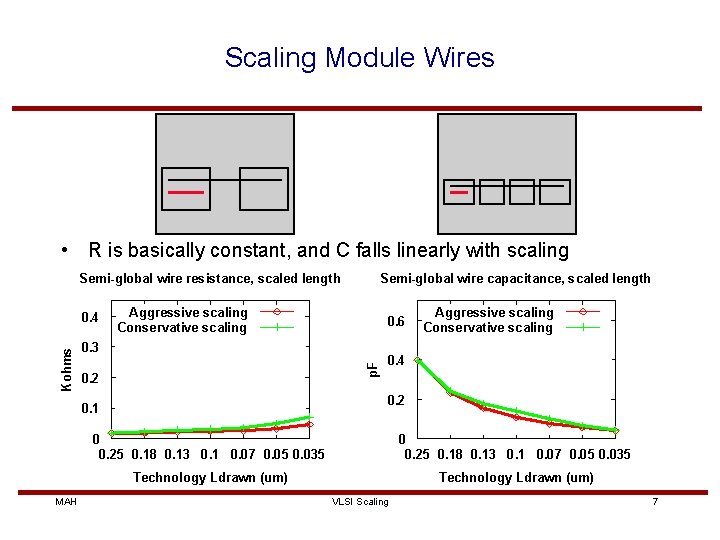
Scaling Module Wires • R is basically constant, and C falls linearly with scaling Semi-global wire resistance, scaled length Aggressive scaling Conservative scaling 0. 3 0. 2 Aggressive scaling Conservative scaling 0. 4 0. 2 0. 1 MAH 0. 6 p. F Kohms 0. 4 Semi-global wire capacitance, scaled length 0 0. 25 0. 18 0. 13 0. 1 0. 07 0. 05 0. 035 Technology Ldrawn (um) VLSI Scaling 7
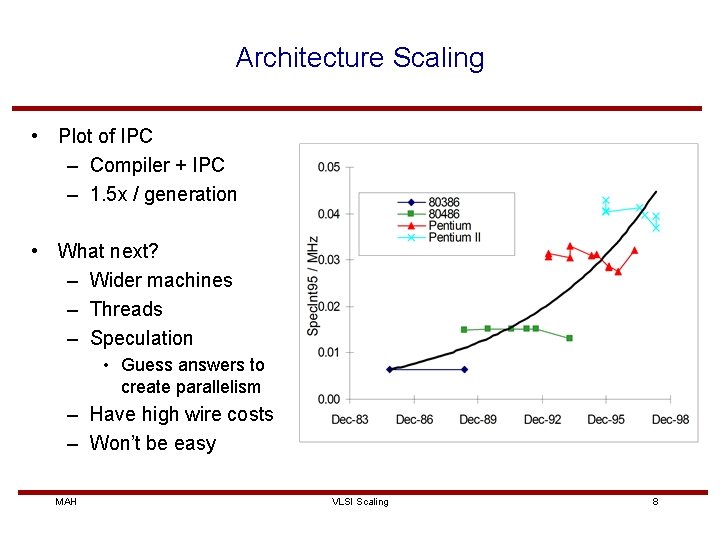
Architecture Scaling • Plot of IPC – Compiler + IPC – 1. 5 x / generation • What next? – Wider machines – Threads – Speculation • Guess answers to create parallelism – Have high wire costs – Won’t be easy MAH VLSI Scaling 8
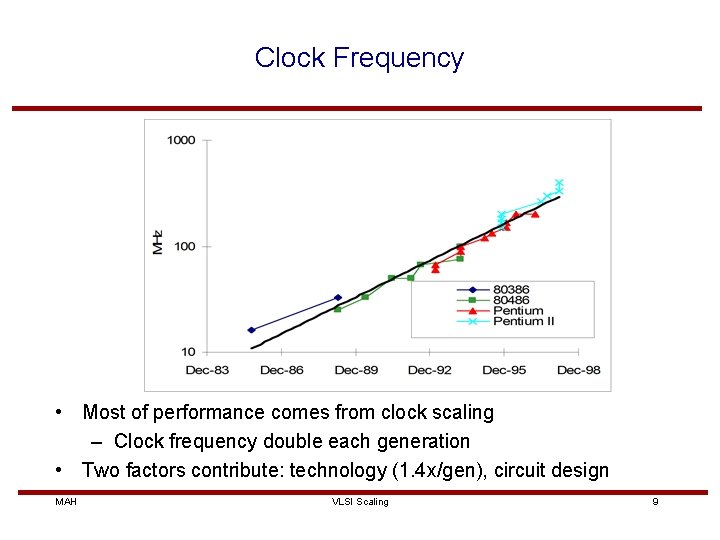
Clock Frequency • Most of performance comes from clock scaling – Clock frequency double each generation • Two factors contribute: technology (1. 4 x/gen), circuit design MAH VLSI Scaling 9
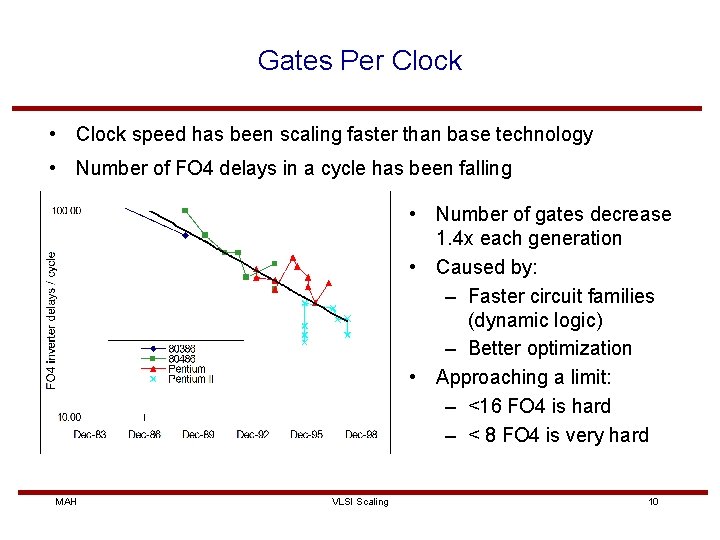
Gates Per Clock • Clock speed has been scaling faster than base technology • Number of FO 4 delays in a cycle has been falling • Number of gates decrease 1. 4 x each generation • Caused by: – Faster circuit families (dynamic logic) – Better optimization • Approaching a limit: – <16 FO 4 is hard – < 8 FO 4 is very hard MAH VLSI Scaling 10