
Circuits and Circuit Elements Preview Section 1 Schematic
- Slides: 32
Circuits and Circuit Elements Preview Section 1 Schematic Diagrams and Circuits Section 2 Resistors in Series or in Parallel Section 3 Complex Resistor Combination © Houghton Mifflin Harcourt Publishing Company Section 1
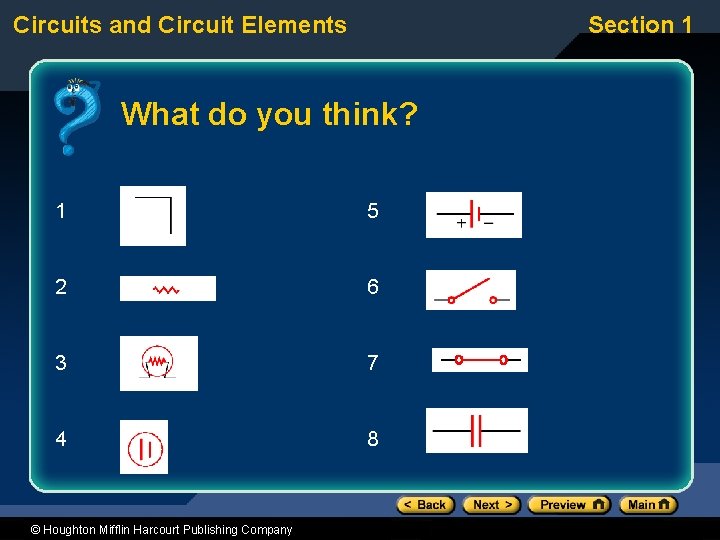
Circuits and Circuit Elements Section 1 What do you think? • Scientists often use symbols to represent electrical components, such as batteries, bulbs, and wires. On the next slide, you will see the symbols for eight common electrical components that you have seen and discussed previously. • Predict the component shown by looking at each symbol. • Briefly explain why you think each symbol represents that particular electrical component. © Houghton Mifflin Harcourt Publishing Company
Circuits and Circuit Elements Section 1 What do you think? 1 5 2 6 3 7 4 8 © Houghton Mifflin Harcourt Publishing Company
Circuits and Circuit Elements Section 1 Schematic Diagram and Common Symbols Click below to watch the Visual Concept © Houghton Mifflin Harcourt Publishing Company
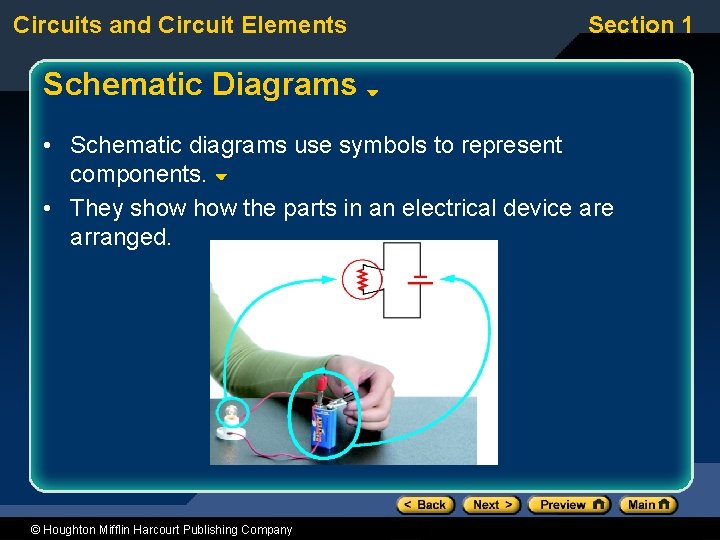
Circuits and Circuit Elements Section 1 Schematic Diagrams • Schematic diagrams use symbols to represent components. • They show the parts in an electrical device arranged. © Houghton Mifflin Harcourt Publishing Company
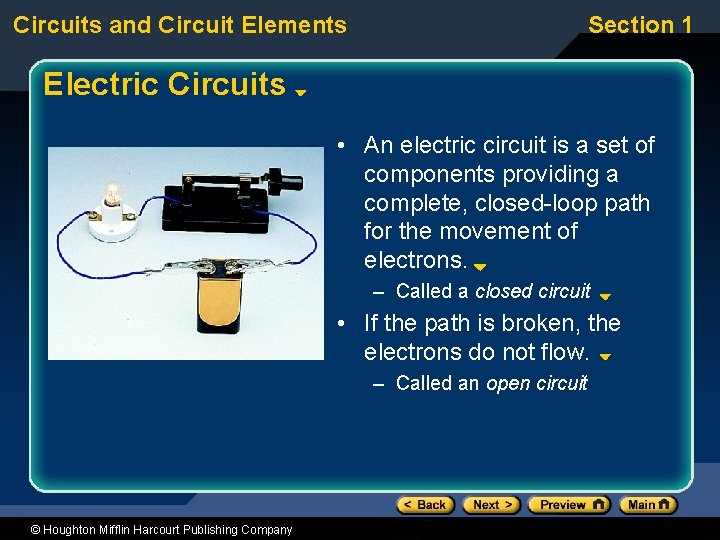
Circuits and Circuit Elements Section 1 Electric Circuits • An electric circuit is a set of components providing a complete, closed-loop path for the movement of electrons. – Called a closed circuit • If the path is broken, the electrons do not flow. – Called an open circuit © Houghton Mifflin Harcourt Publishing Company
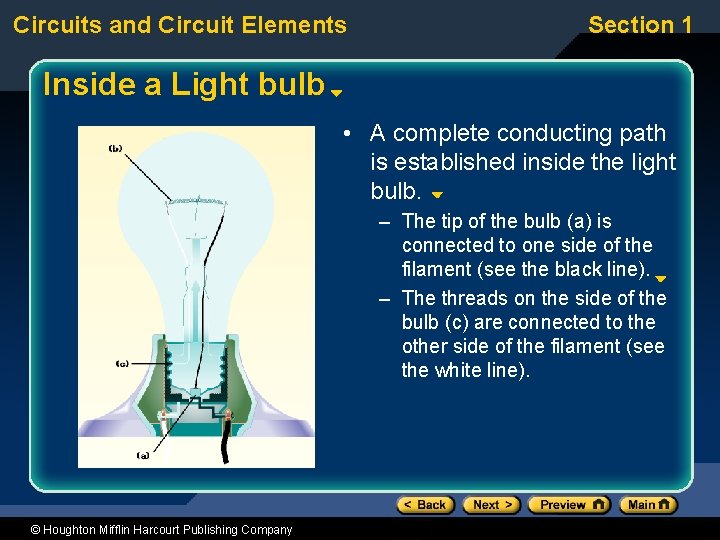
Circuits and Circuit Elements Section 1 Inside a Light bulb • A complete conducting path is established inside the light bulb. – The tip of the bulb (a) is connected to one side of the filament (see the black line). – The threads on the side of the bulb (c) are connected to the other side of the filament (see the white line). © Houghton Mifflin Harcourt Publishing Company
Circuits and Circuit Elements Section 1 Short Circuits • A short circuit bypasses the light bulb or other load. – It is a closed circuit. – Electrons flow directly from - to + without passing through the bulb. – The current is large and the wire becomes hot. • Short circuits in homes can cause fires. – Fuses or circuit breakers are designed to turn off the electron flow if short circuits occur. © Houghton Mifflin Harcourt Publishing Company
Circuits and Circuit Elements Section 1 Potential Difference in Circuits • A device that increases the PE of the electrons, such as a battery, is a source of emf (electromotive force). – Not really a force, but a PE difference • Energy is conserved in electric circuits. – The potential difference ( V) for the battery equals the energy converted into heat as the electrons move through the bulb. • Electrons gain energy (battery) and lose energy (bulb) as they make a complete trip. © Houghton Mifflin Harcourt Publishing Company
Circuits and Circuit Elements Section 1 Internal Resistance, EMF, and Terminal Voltage Click below to watch the Visual Concept © Houghton Mifflin Harcourt Publishing Company
Circuits and Circuit Elements Section 1 Now what do you think? • Draw schematic diagrams showing each of the following circuits: • An open circuit including a battery, open switch, and bulb • A closed circuit including a battery, closed switch, and resistor • A short circuit including a battery, bulb, and closed switch © Houghton Mifflin Harcourt Publishing Company
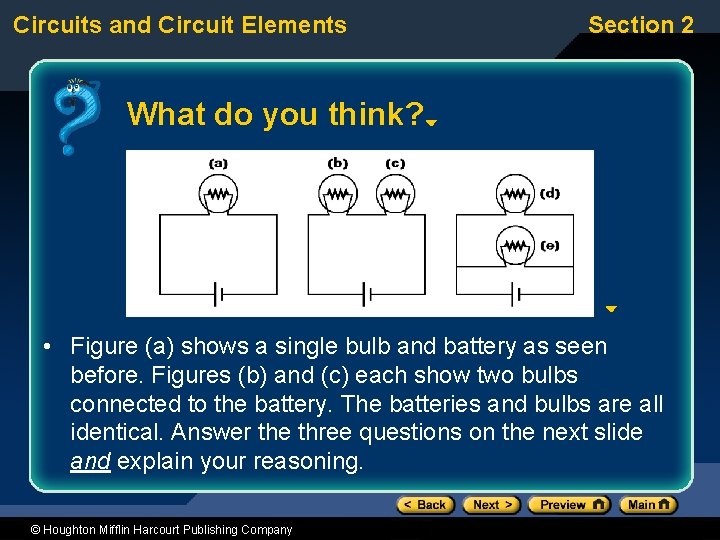
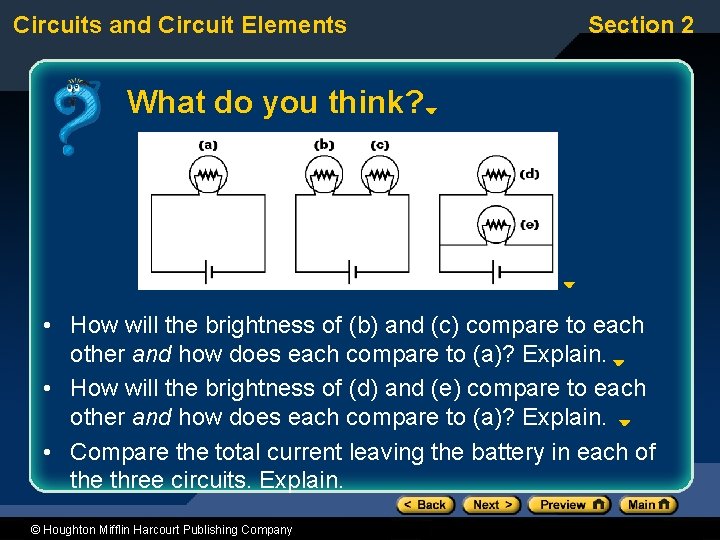
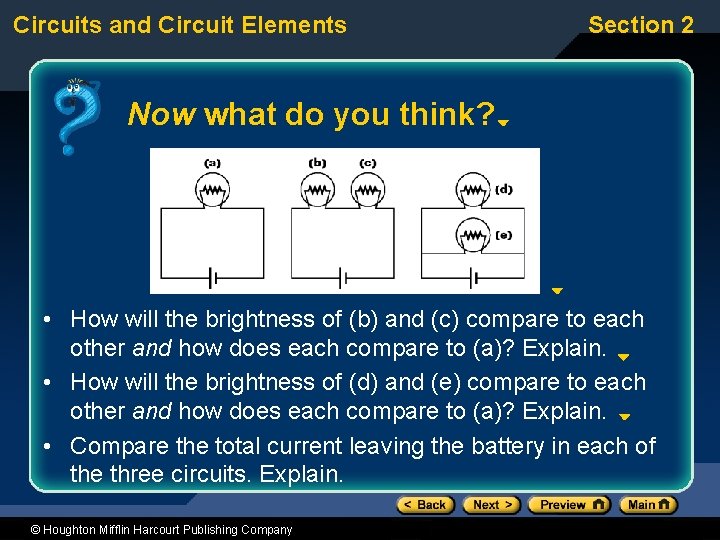
Circuits and Circuit Elements Section 2 What do you think? • Figure (a) shows a single bulb and battery as seen before. Figures (b) and (c) each show two bulbs connected to the battery. The batteries and bulbs are all identical. Answer the three questions on the next slide and explain your reasoning. © Houghton Mifflin Harcourt Publishing Company
Circuits and Circuit Elements Section 2 What do you think? • How will the brightness of (b) and (c) compare to each other and how does each compare to (a)? Explain. • How will the brightness of (d) and (e) compare to each other and how does each compare to (a)? Explain. • Compare the total current leaving the battery in each of the three circuits. Explain. © Houghton Mifflin Harcourt Publishing Company
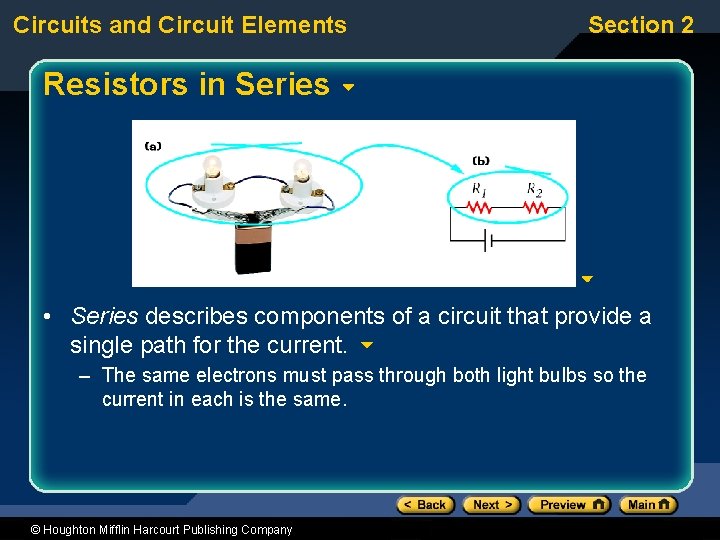
Circuits and Circuit Elements Section 2 Resistors in Series • Series describes components of a circuit that provide a single path for the current. – The same electrons must pass through both light bulbs so the current in each is the same. © Houghton Mifflin Harcourt Publishing Company
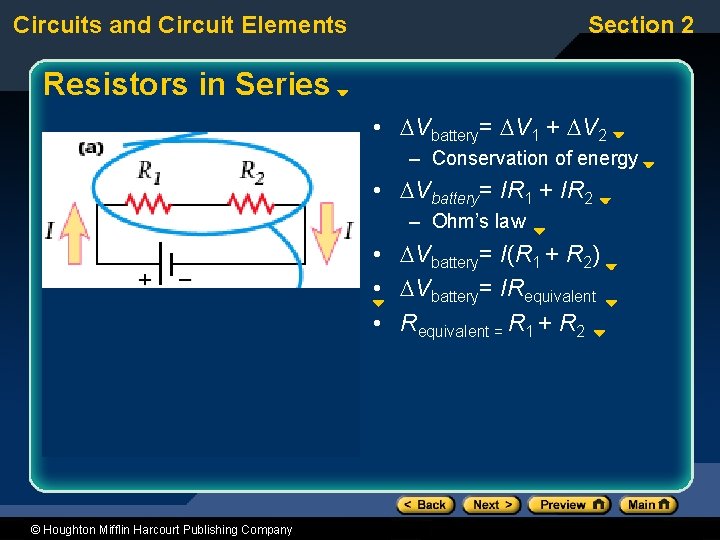
Circuits and Circuit Elements Section 2 Resistors in Series • Vbattery= V 1 + V 2 – Conservation of energy • Vbattery= IR 1 + IR 2 – Ohm’s law • Vbattery= I(R 1 + R 2) • Vbattery= IRequivalent • Requivalent = R 1 + R 2 © Houghton Mifflin Harcourt Publishing Company
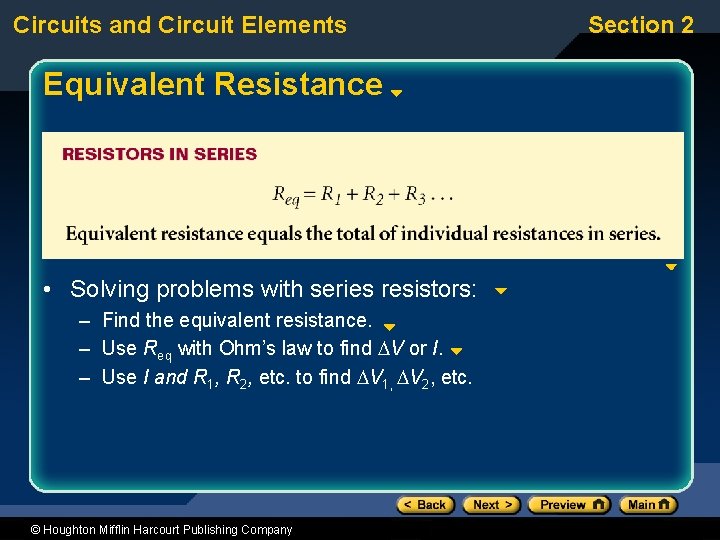
Circuits and Circuit Elements Equivalent Resistance • Solving problems with series resistors: – Find the equivalent resistance. – Use Req with Ohm’s law to find V or I. – Use I and R 1, R 2, etc. to find V 1, V 2, etc. © Houghton Mifflin Harcourt Publishing Company Section 2
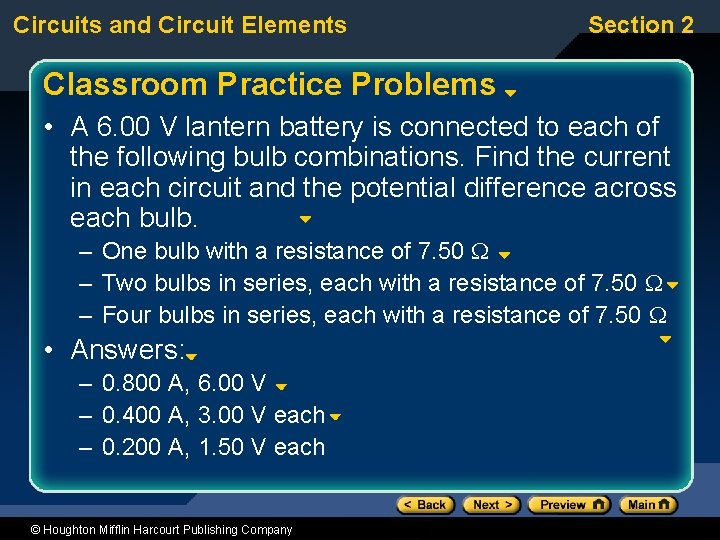
Circuits and Circuit Elements Section 2 Classroom Practice Problems • A 6. 00 V lantern battery is connected to each of the following bulb combinations. Find the current in each circuit and the potential difference across each bulb. – One bulb with a resistance of 7. 50 – Two bulbs in series, each with a resistance of 7. 50 – Four bulbs in series, each with a resistance of 7. 50 • Answers: – 0. 800 A, 6. 00 V – 0. 400 A, 3. 00 V each – 0. 200 A, 1. 50 V each © Houghton Mifflin Harcourt Publishing Company
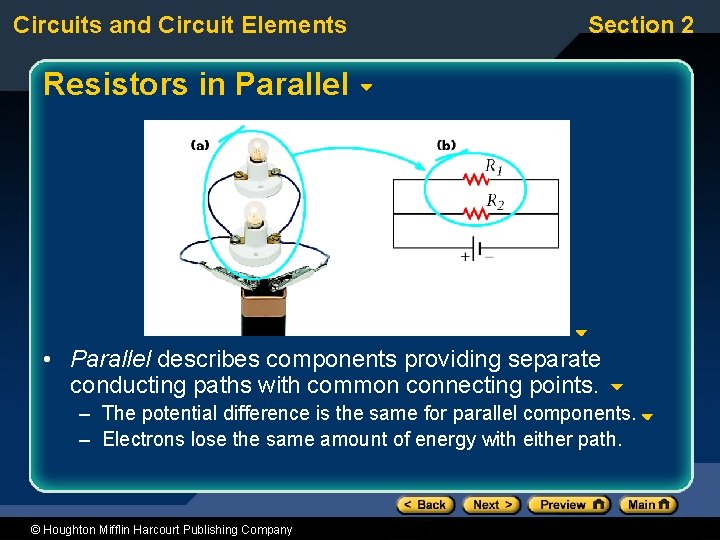
Circuits and Circuit Elements Section 2 Resistors in Parallel • Parallel describes components providing separate conducting paths with common connecting points. – The potential difference is the same for parallel components. – Electrons lose the same amount of energy with either path. © Houghton Mifflin Harcourt Publishing Company
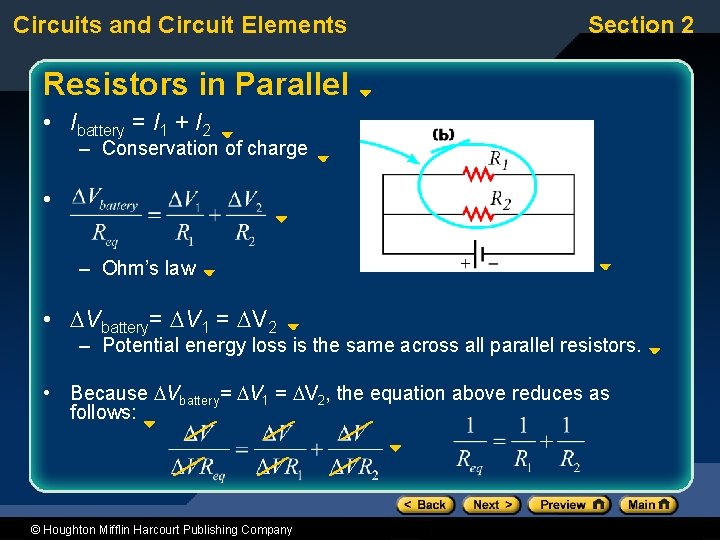
Circuits and Circuit Elements Section 2 Resistors in Parallel • Ibattery = I 1 + I 2 – Conservation of charge • – Ohm’s law • Vbattery= V 1 = V 2 – Potential energy loss is the same across all parallel resistors. • Because Vbattery= V 1 = V 2, the equation above reduces as follows: © Houghton Mifflin Harcourt Publishing Company
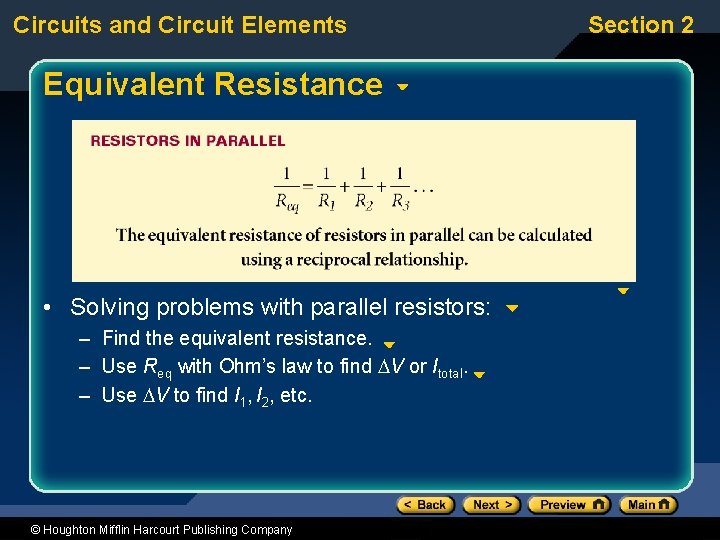
Circuits and Circuit Elements Equivalent Resistance • Solving problems with parallel resistors: – Find the equivalent resistance. – Use Req with Ohm’s law to find V or Itotal. – Use V to find I 1, I 2, etc. © Houghton Mifflin Harcourt Publishing Company Section 2
Circuits and Circuit Elements Section 2 Classroom Practice Problems • Find the equivalent resistance, the total current drawn by the circuit, and the current in each resistor for a 9. 00 V battery connected to: – One 30. 0 resistor – Three 30. 0 resistors connected in parallel • Answers: – 30. 0 , 0. 300 A – 10. 0 , 0. 900 A, 0. 300 A © Houghton Mifflin Harcourt Publishing Company
Circuits and Circuit Elements Section 2 Comparing Resistors in Series and in Parallel Click below to watch the Visual Concept © Houghton Mifflin Harcourt Publishing Company
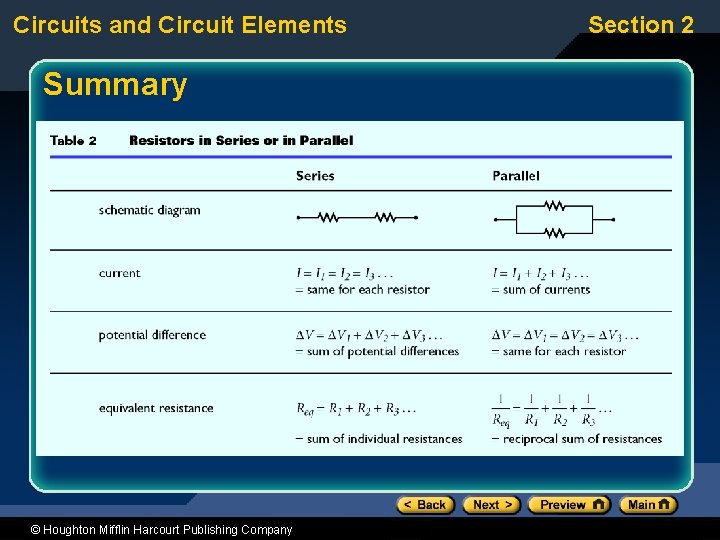
Circuits and Circuit Elements Summary © Houghton Mifflin Harcourt Publishing Company Section 2
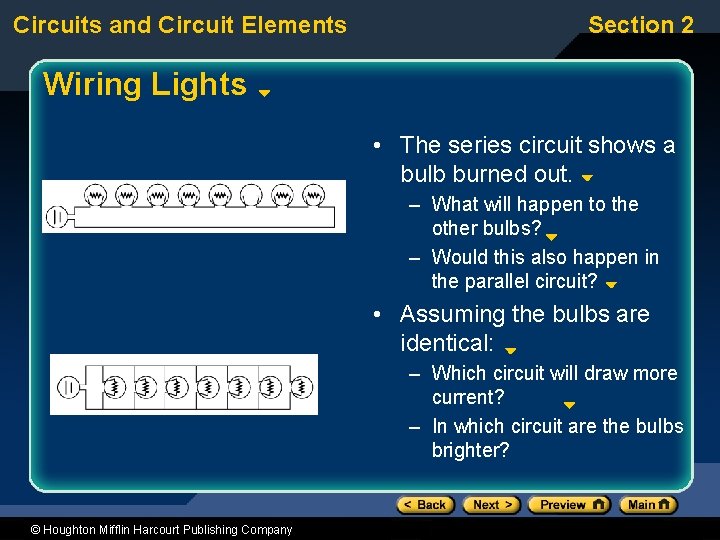
Circuits and Circuit Elements Section 2 Wiring Lights • The series circuit shows a bulb burned out. – What will happen to the other bulbs? – Would this also happen in the parallel circuit? • Assuming the bulbs are identical: – Which circuit will draw more current? – In which circuit are the bulbs brighter? © Houghton Mifflin Harcourt Publishing Company
Circuits and Circuit Elements Section 2 Now what do you think? • How will the brightness of (b) and (c) compare to each other and how does each compare to (a)? Explain. • How will the brightness of (d) and (e) compare to each other and how does each compare to (a)? Explain. • Compare the total current leaving the battery in each of the three circuits. Explain. © Houghton Mifflin Harcourt Publishing Company
Circuits and Circuit Elements Section 3 What do you think? • Household circuits typically have many outlets and permanent fixtures such as hanging light fixtures on each circuit. • Are these wired in series or in parallel? • Why do you believe one of these methods has an advantage over the other method? • What disadvantages would the other method of wiring have for household circuits? © Houghton Mifflin Harcourt Publishing Company
Circuits and Circuit Elements Analysis of Complex Circuits Click below to watch the Visual Concept © Houghton Mifflin Harcourt Publishing Company Section 3
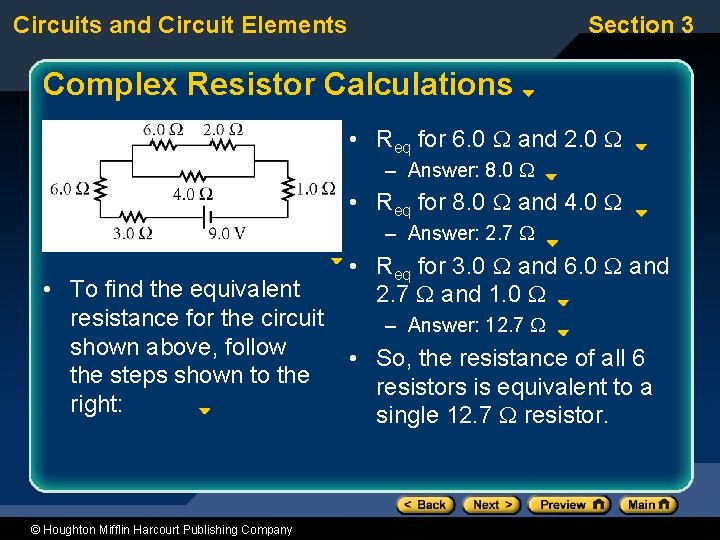
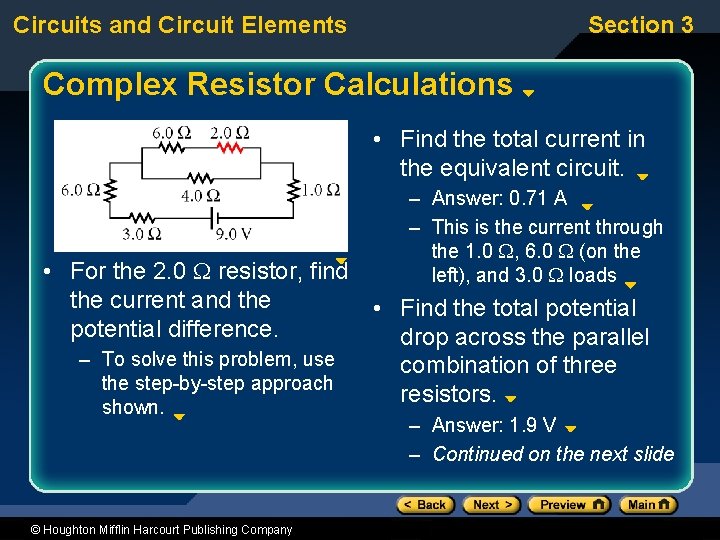
Circuits and Circuit Elements Section 3 Complex Resistor Calculations • Req for 6. 0 and 2. 0 – Answer: 8. 0 • Req for 8. 0 and 4. 0 – Answer: 2. 7 • To find the equivalent resistance for the circuit shown above, follow the steps shown to the right: © Houghton Mifflin Harcourt Publishing Company • Req for 3. 0 and 6. 0 and 2. 7 and 1. 0 – Answer: 12. 7 • So, the resistance of all 6 resistors is equivalent to a single 12. 7 resistor.
Circuits and Circuit Elements Section 3 Complex Resistor Calculations • Find the total current in the equivalent circuit. • For the 2. 0 resistor, find the current and the potential difference. – To solve this problem, use the step-by-step approach shown. © Houghton Mifflin Harcourt Publishing Company – Answer: 0. 71 A – This is the current through the 1. 0 , 6. 0 (on the left), and 3. 0 loads • Find the total potential drop across the parallel combination of three resistors. – Answer: 1. 9 V – Continued on the next slide
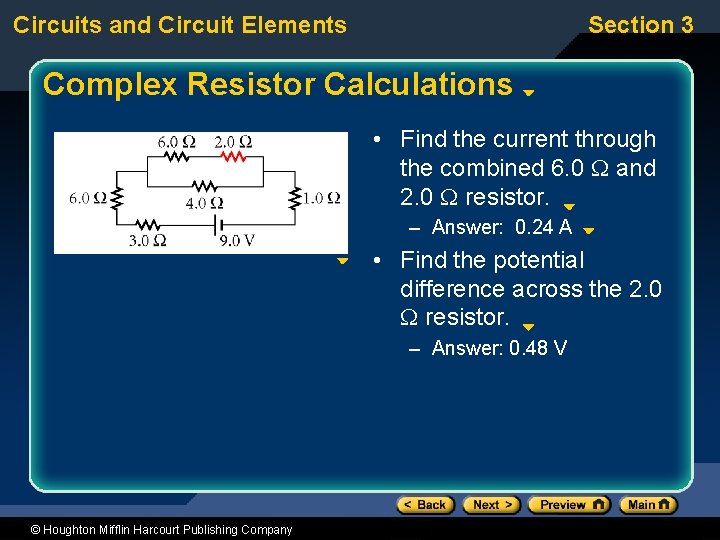
Circuits and Circuit Elements Section 3 Complex Resistor Calculations • Find the current through the combined 6. 0 and 2. 0 resistor. – Answer: 0. 24 A • Find the potential difference across the 2. 0 resistor. – Answer: 0. 48 V © Houghton Mifflin Harcourt Publishing Company
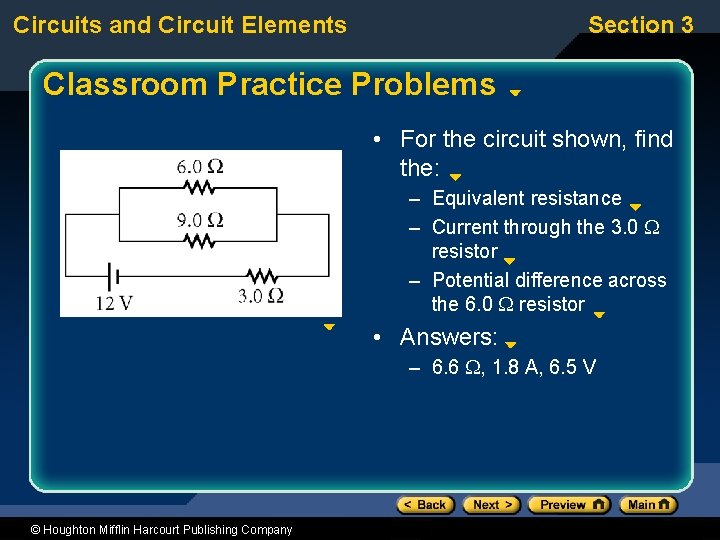
Circuits and Circuit Elements Section 3 Classroom Practice Problems • For the circuit shown, find the: – Equivalent resistance – Current through the 3. 0 resistor – Potential difference across the 6. 0 resistor • Answers: – 6. 6 , 1. 8 A, 6. 5 V © Houghton Mifflin Harcourt Publishing Company
Circuits and Circuit Elements Section 3 Now what do you think? • Household circuits typically have many outlets and permanent fixtures such as hanging light fixtures on each circuit. • Are these wired in series or in parallel? • Why do you believe one of these methods has an advantage over the other method? • What disadvantages would the other method of wiring have for household circuits? © Houghton Mifflin Harcourt Publishing Company