
Circuit Theory Chapter 6 Capacitors and Inductors Copyright
- Slides: 21
Circuit Theory Chapter 6 Capacitors and Inductors Copyright © The Mc. Graw-Hill Companies, Inc. Permission required for reproduction or display. 1
Capacitors and Inductors Chapter 6 6. 1 6. 2 6. 3 6. 4 Capacitors Series and Parallel Capacitors Inductors Series and Parallel Inductors 2
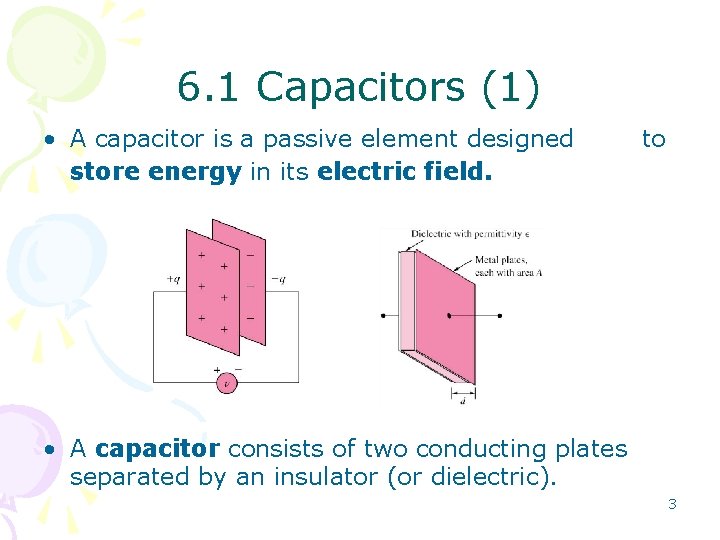
6. 1 Capacitors (1) • A capacitor is a passive element designed store energy in its electric field. to • A capacitor consists of two conducting plates separated by an insulator (or dielectric). 3
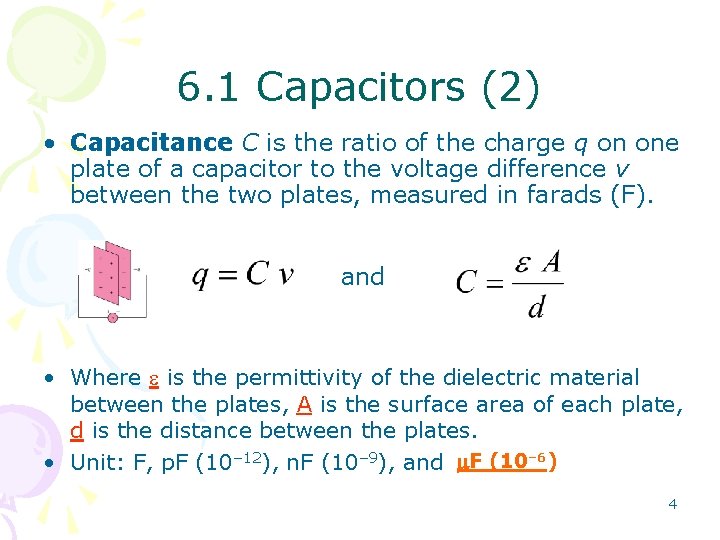
6. 1 Capacitors (2) • Capacitance C is the ratio of the charge q on one plate of a capacitor to the voltage difference v between the two plates, measured in farads (F). and • Where is the permittivity of the dielectric material between the plates, A is the surface area of each plate, d is the distance between the plates. • Unit: F, p. F (10– 12), n. F (10– 9), and F (10– 6) 4
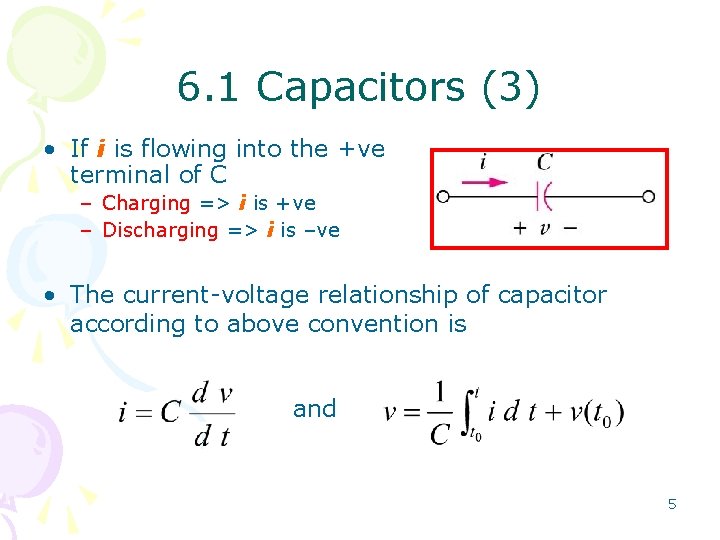
6. 1 Capacitors (3) • If i is flowing into the +ve terminal of C – Charging => i is +ve – Discharging => i is –ve • The current-voltage relationship of capacitor according to above convention is and 5
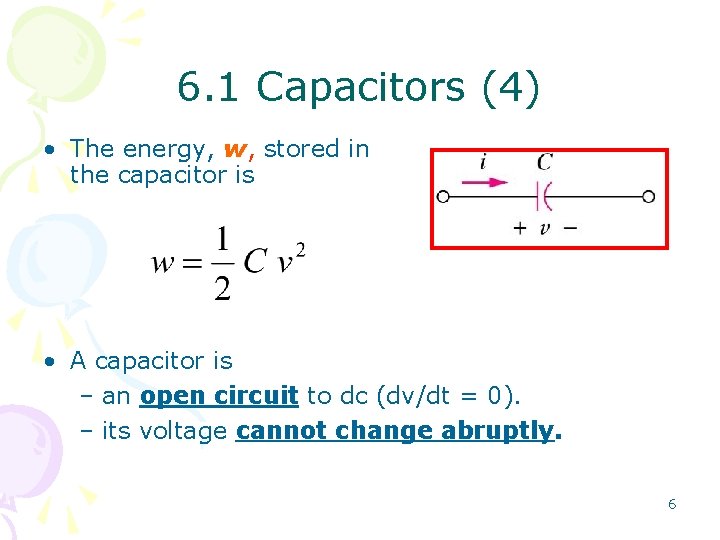
6. 1 Capacitors (4) • The energy, w, stored in the capacitor is • A capacitor is – an open circuit to dc (dv/dt = 0). – its voltage cannot change abruptly. 6
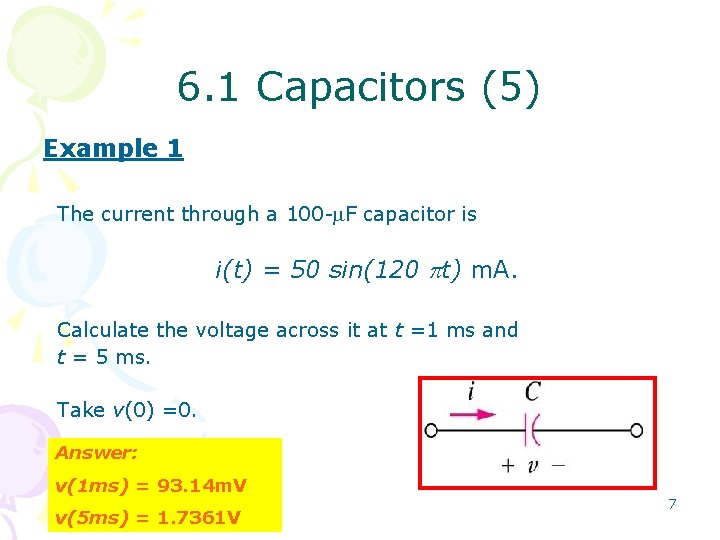
6. 1 Capacitors (5) Example 1 The current through a 100 - F capacitor is i(t) = 50 sin(120 t) m. A. Calculate the voltage across it at t =1 ms and t = 5 ms. Take v(0) =0. Answer: v(1 ms) = 93. 14 m. V v(5 ms) = 1. 7361 V 7
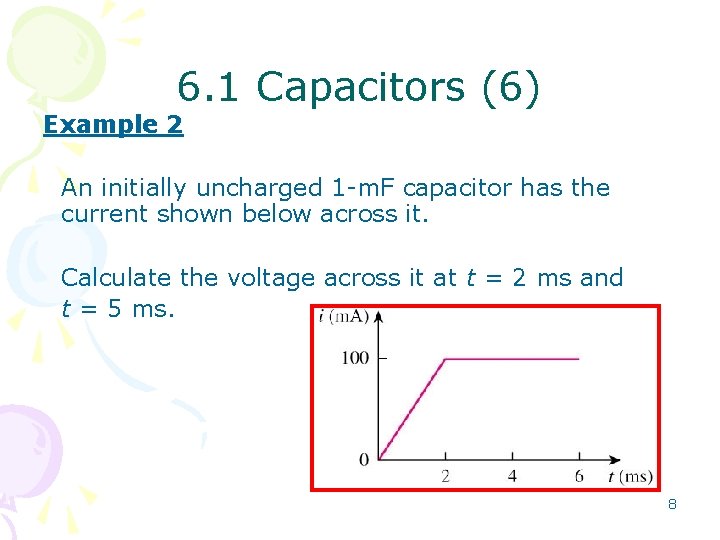
6. 1 Capacitors (6) Example 2 An initially uncharged 1 -m. F capacitor has the current shown below across it. Calculate the voltage across it at t = 2 ms and t = 5 ms. Answer: v(2 ms) = 100 m. V v(5 ms) = 500 m. V 8
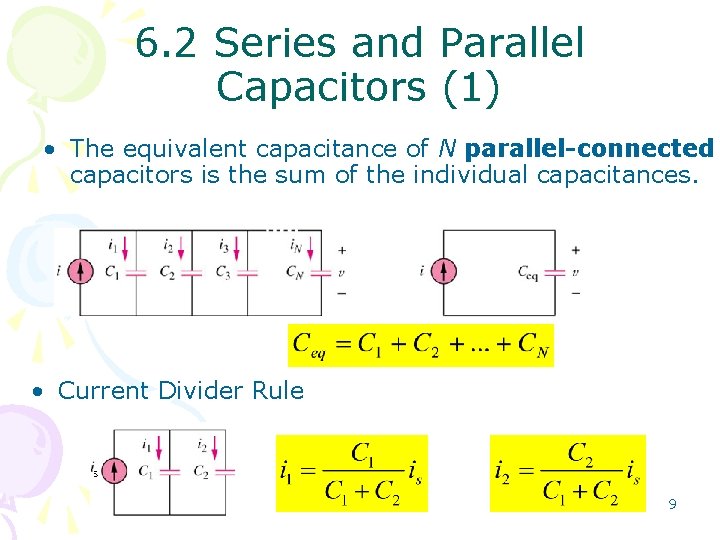
6. 2 Series and Parallel Capacitors (1) • The equivalent capacitance of N parallel-connected capacitors is the sum of the individual capacitances. • Current Divider Rule 9
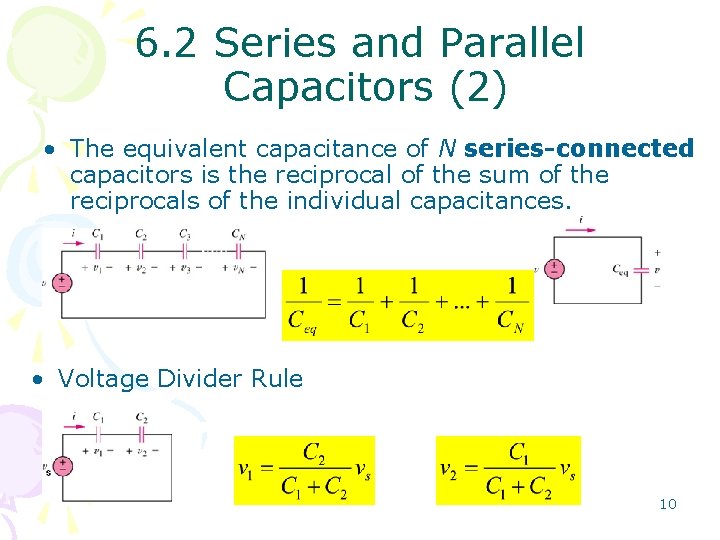
6. 2 Series and Parallel Capacitors (2) • The equivalent capacitance of N series-connected capacitors is the reciprocal of the sum of the reciprocals of the individual capacitances. • Voltage Divider Rule 10
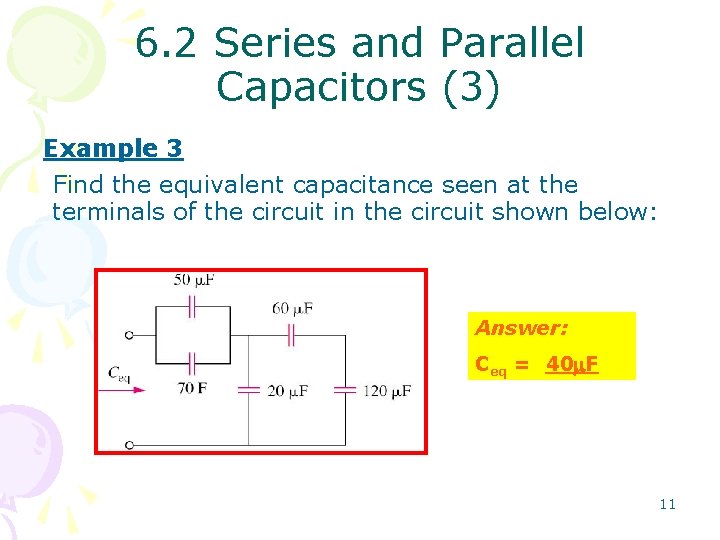
6. 2 Series and Parallel Capacitors (3) Example 3 Find the equivalent capacitance seen at the terminals of the circuit in the circuit shown below: Answer: Ceq = 40 F 11
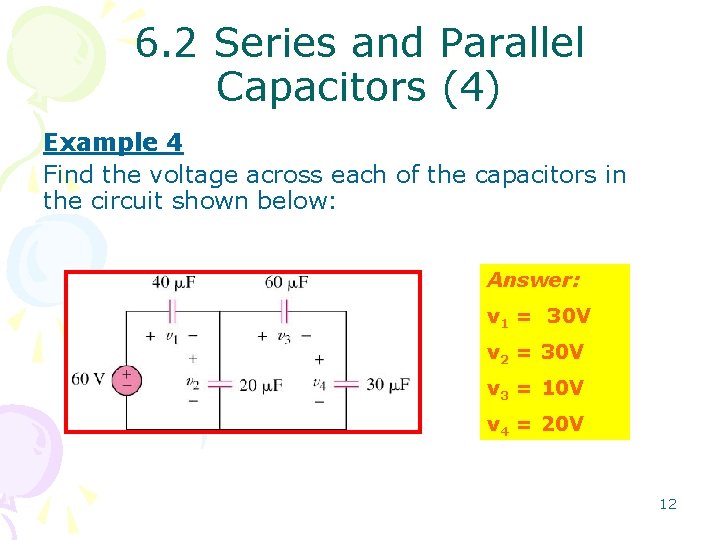
6. 2 Series and Parallel Capacitors (4) Example 4 Find the voltage across each of the capacitors in the circuit shown below: Answer: v 1 = 30 V v 2 = 30 V v 3 = 10 V v 4 = 20 V 12
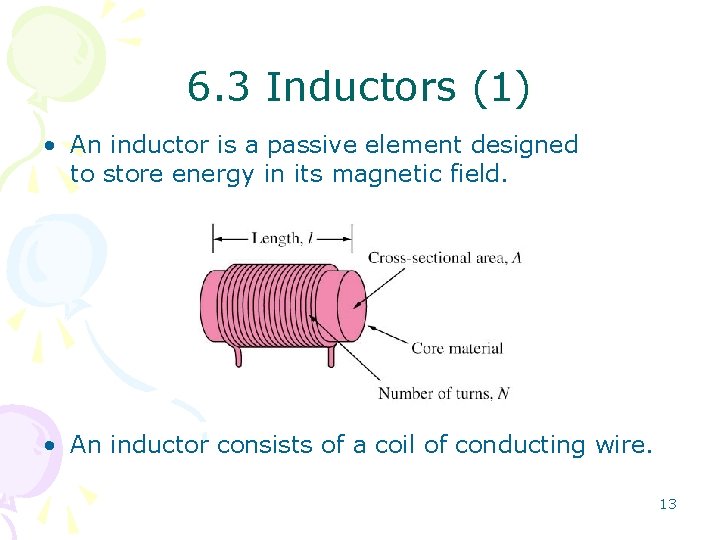
6. 3 Inductors (1) • An inductor is a passive element designed to store energy in its magnetic field. • An inductor consists of a coil of conducting wire. 13
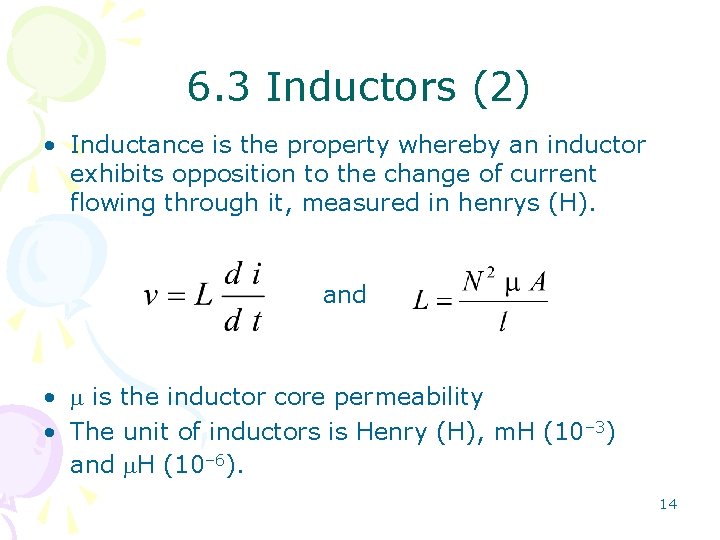
6. 3 Inductors (2) • Inductance is the property whereby an inductor exhibits opposition to the change of current flowing through it, measured in henrys (H). and • is the inductor core permeability • The unit of inductors is Henry (H), m. H (10– 3) and H (10– 6). 14
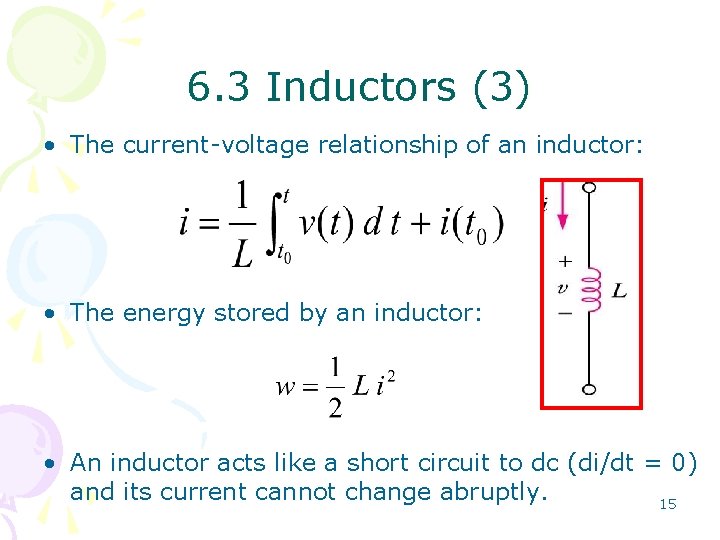
6. 3 Inductors (3) • The current-voltage relationship of an inductor: • The energy stored by an inductor: • An inductor acts like a short circuit to dc (di/dt = 0) and its current cannot change abruptly. 15
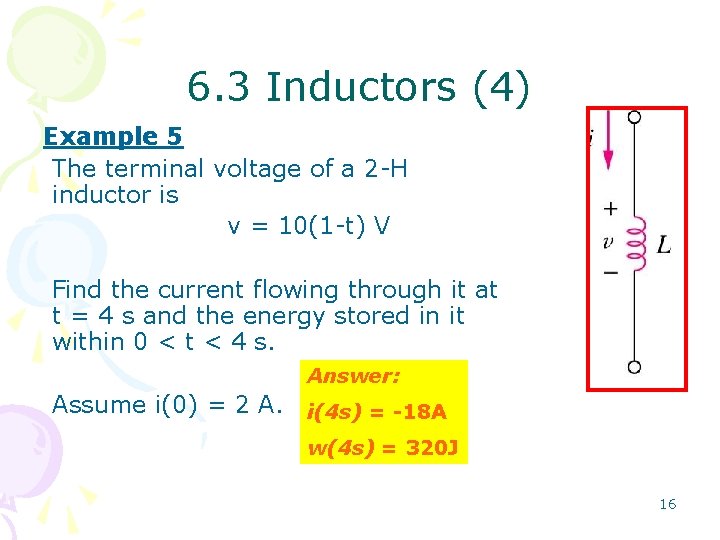
6. 3 Inductors (4) Example 5 The terminal voltage of a 2 -H inductor is v = 10(1 -t) V Find the current flowing through it at t = 4 s and the energy stored in it within 0 < t < 4 s. Answer: Assume i(0) = 2 A. i(4 s) = -18 A w(4 s) = 320 J 16
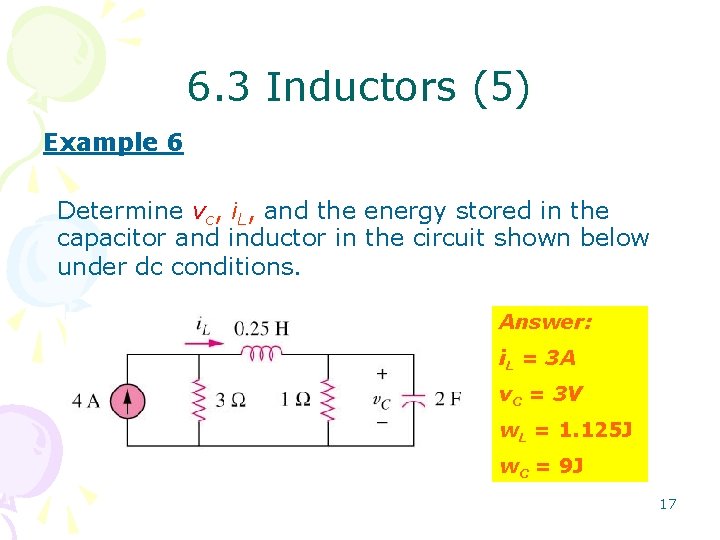
6. 3 Inductors (5) Example 6 Determine vc, i. L, and the energy stored in the capacitor and inductor in the circuit shown below under dc conditions. Answer: i. L = 3 A v. C = 3 V w. L = 1. 125 J w. C = 9 J 17
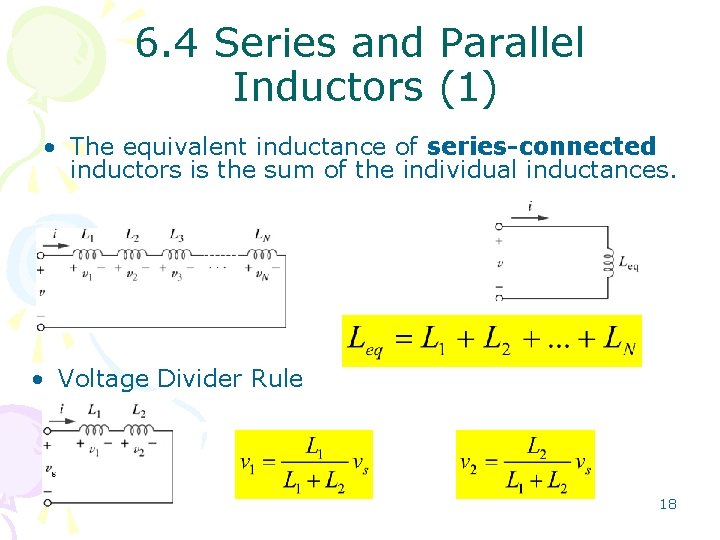
6. 4 Series and Parallel Inductors (1) • The equivalent inductance of series-connected inductors is the sum of the individual inductances. • Voltage Divider Rule 18
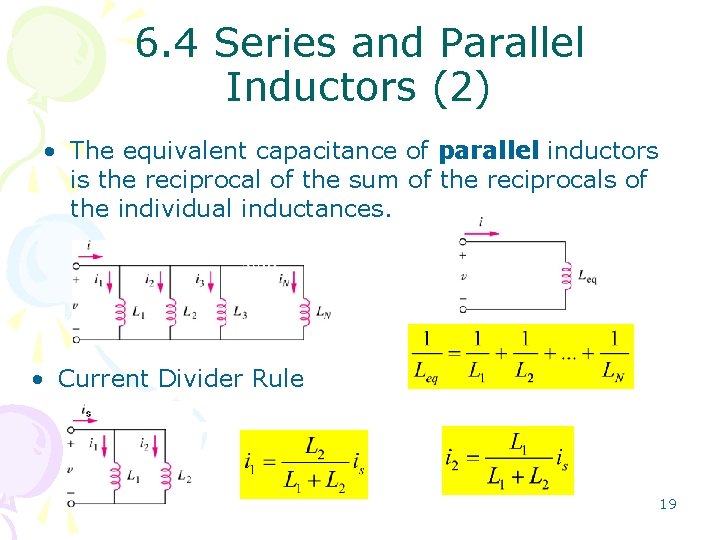
6. 4 Series and Parallel Inductors (2) • The equivalent capacitance of parallel inductors is the reciprocal of the sum of the reciprocals of the individual inductances. • Current Divider Rule 19
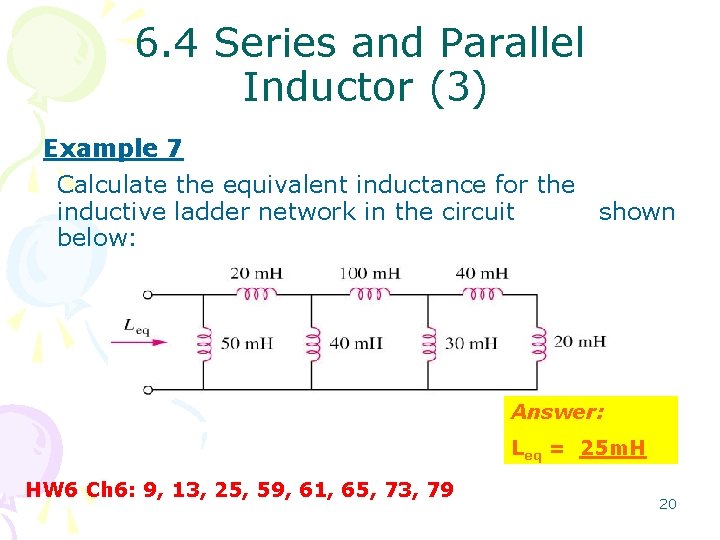
6. 4 Series and Parallel Inductor (3) Example 7 Calculate the equivalent inductance for the inductive ladder network in the circuit shown below: Answer: Leq = 25 m. H HW 6 Ch 6: 9, 13, 25, 59, 61, 65, 73, 79 20
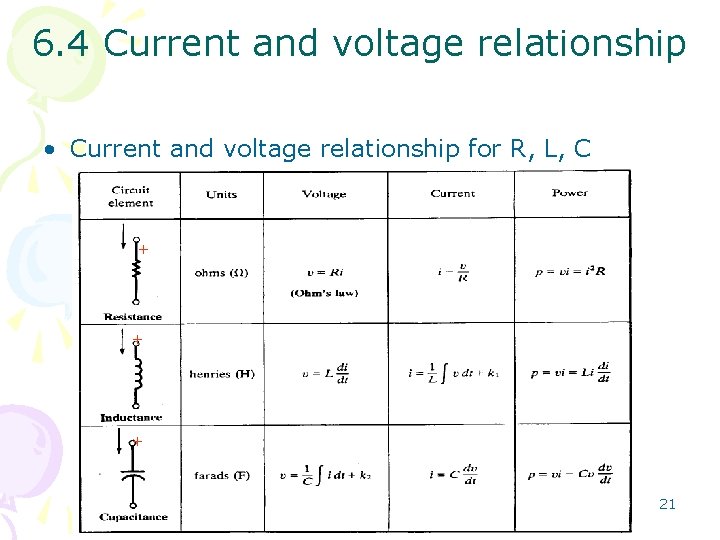
6. 4 Current and voltage relationship • Current and voltage relationship for R, L, C + + + 21