
Circuit Switching and Telephone Network Kyung Hee University
- Slides: 27
Circuit Switching and Telephone Network Kyung Hee University 1
8장 Circuit Switching and Telephone Network 8. 1 회선교환(Circuit Switching) 8. 2 전화망 (Telephone Network) Kyung Hee University 2
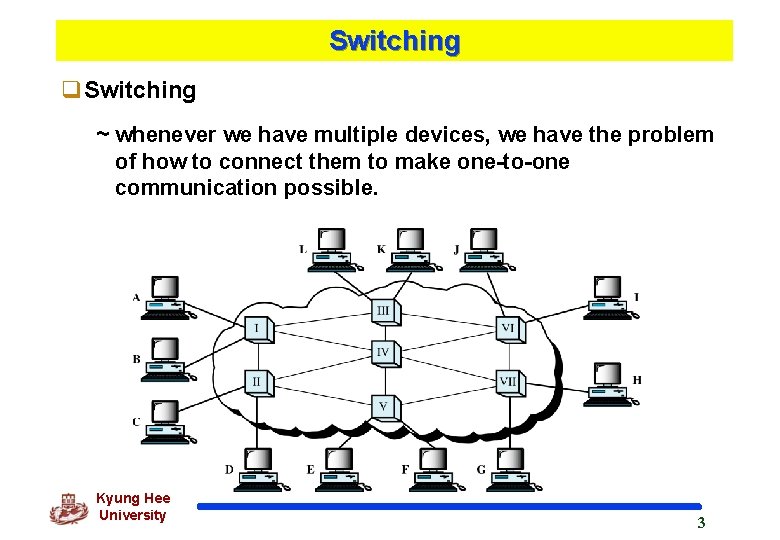
Switching q. Switching ~ whenever we have multiple devices, we have the problem of how to connect them to make one-to-one communication possible. Kyung Hee University 3
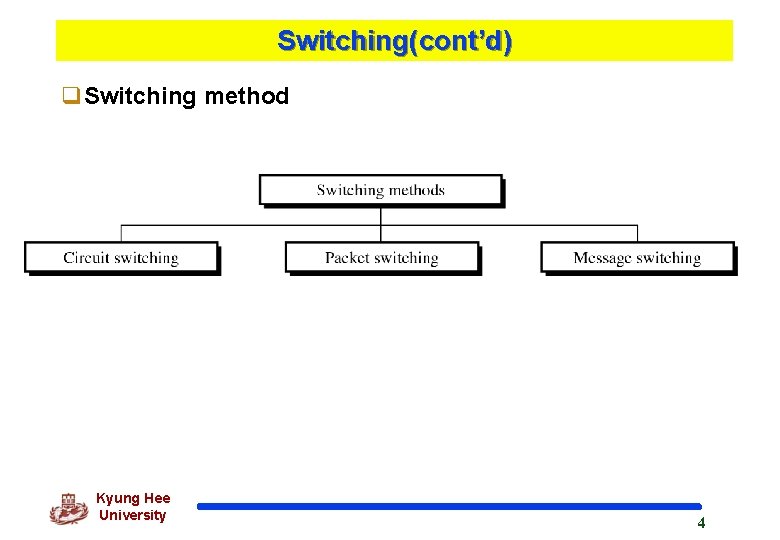
Switching(cont’d) q. Switching method Kyung Hee University 4
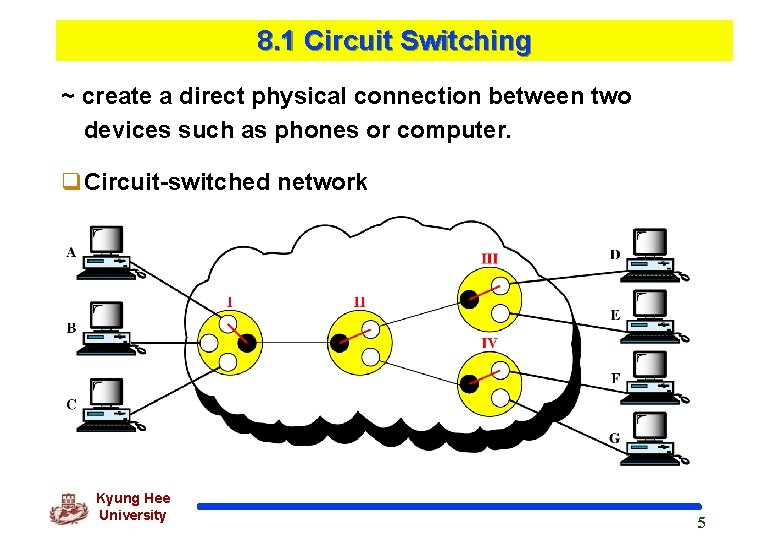
8. 1 Circuit Switching ~ create a direct physical connection between two devices such as phones or computer. q. Circuit-switched network Kyung Hee University 5
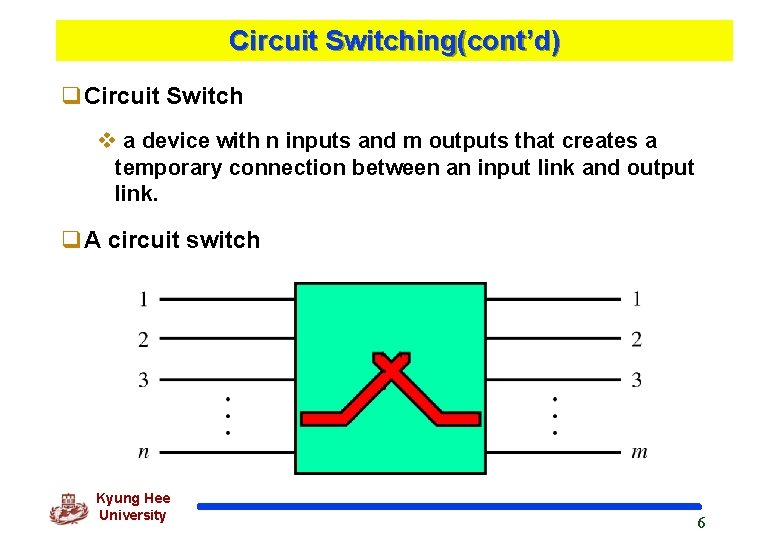
Circuit Switching(cont’d) q. Circuit Switch v a device with n inputs and m outputs that creates a temporary connection between an input link and output link. q. A circuit switch Kyung Hee University 6
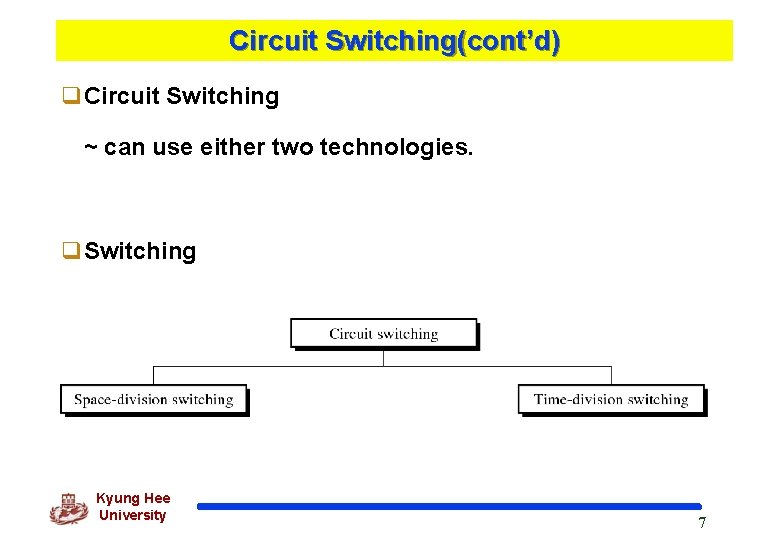
Circuit Switching(cont’d) q. Circuit Switching ~ can use either two technologies. q. Switching Kyung Hee University 7
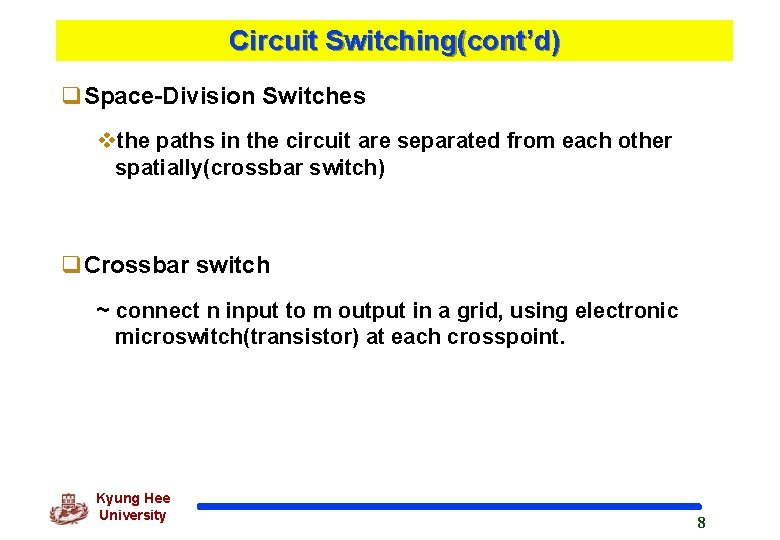
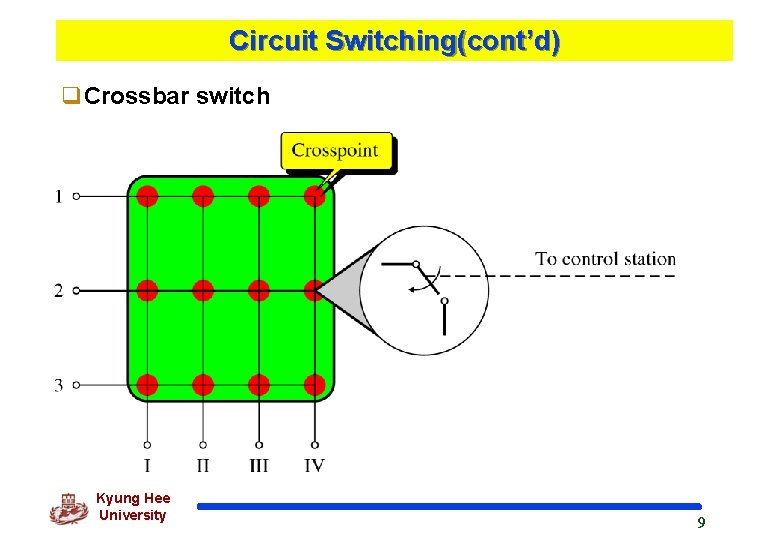
Circuit Switching(cont’d) q. Space-Division Switches vthe paths in the circuit are separated from each other spatially(crossbar switch) q. Crossbar switch ~ connect n input to m output in a grid, using electronic microswitch(transistor) at each crosspoint. Kyung Hee University 8
Circuit Switching(cont’d) q. Crossbar switch Kyung Hee University 9
Circuit Switching(cont’d) q. Limitation of crossbar switch v. The number of switch (huge size) : connect n inputs by m output l require n * m crosspoint. (ex : 1000 input, 1000 output → 1, 000 crosspoint) vinefficient l fewer than 25% of the crosspoints are in use at a given time. l the rest are idle Kyung Hee University 10
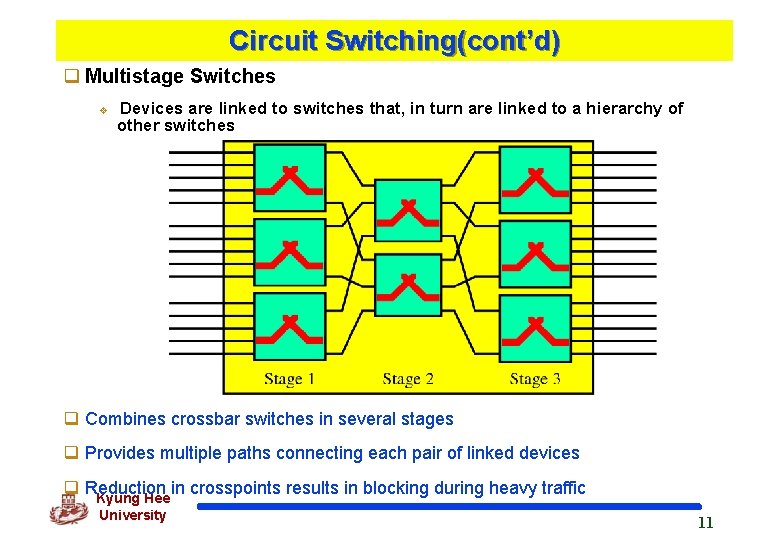
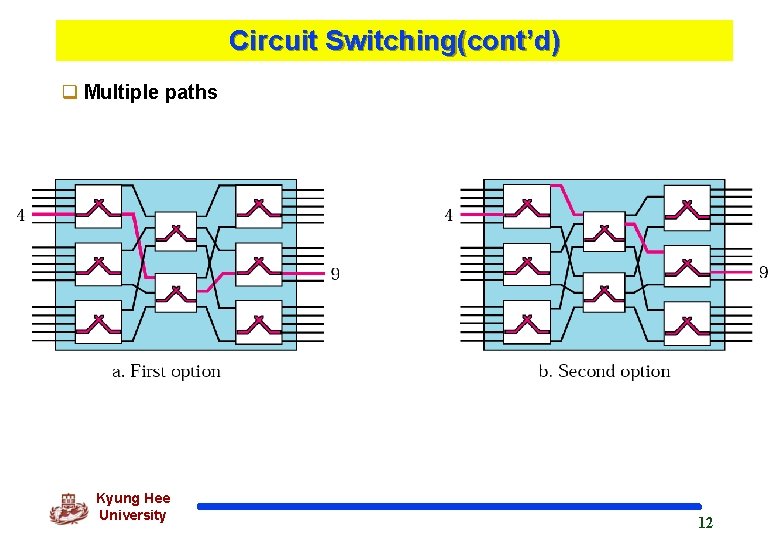
Circuit Switching(cont’d) q Multistage Switches v Devices are linked to switches that, in turn are linked to a hierarchy of other switches q Combines crossbar switches in several stages q Provides multiple paths connecting each pair of linked devices q Reduction in crosspoints results in blocking during heavy traffic Kyung Hee University 11
Circuit Switching(cont’d) q Multiple paths Kyung Hee University 12
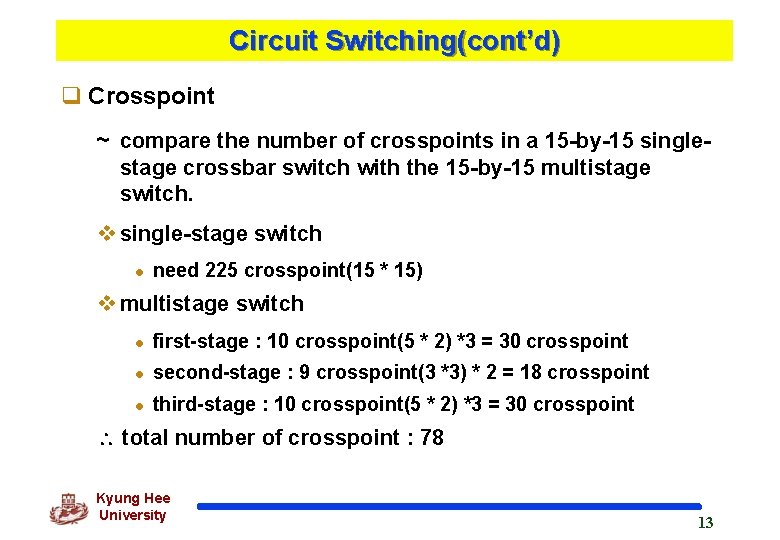
Circuit Switching(cont’d) q Crosspoint ~ compare the number of crosspoints in a 15 -by-15 singlestage crossbar switch with the 15 -by-15 multistage switch. v single-stage switch l need 225 crosspoint(15 * 15) v multistage switch l first-stage : 10 crosspoint(5 * 2) *3 = 30 crosspoint l second-stage : 9 crosspoint(3 *3) * 2 = 18 crosspoint l third-stage : 10 crosspoint(5 * 2) *3 = 30 crosspoint total number of crosspoint : 78 Kyung Hee University 13
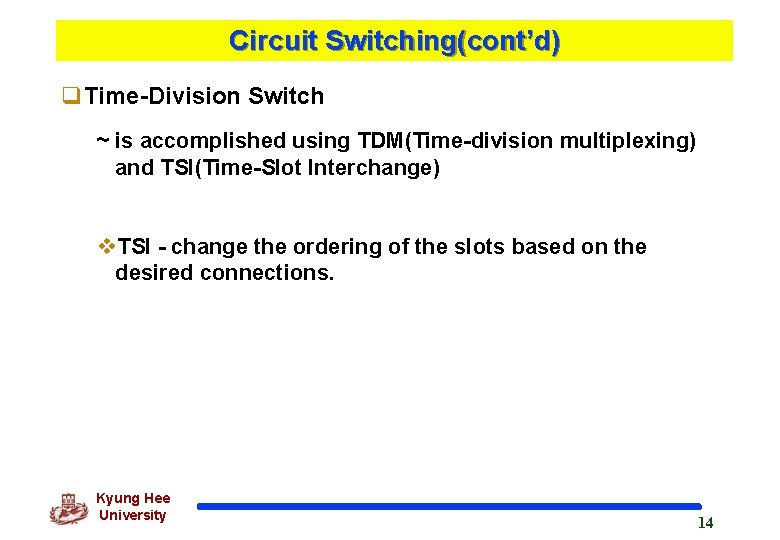
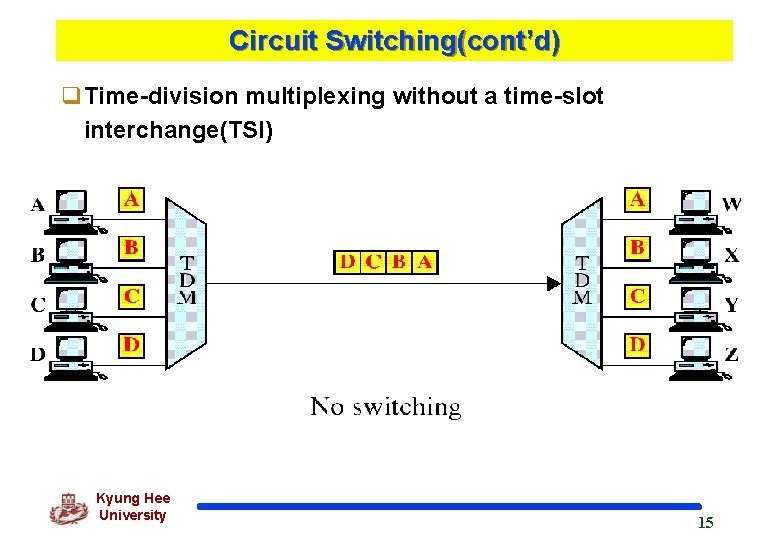
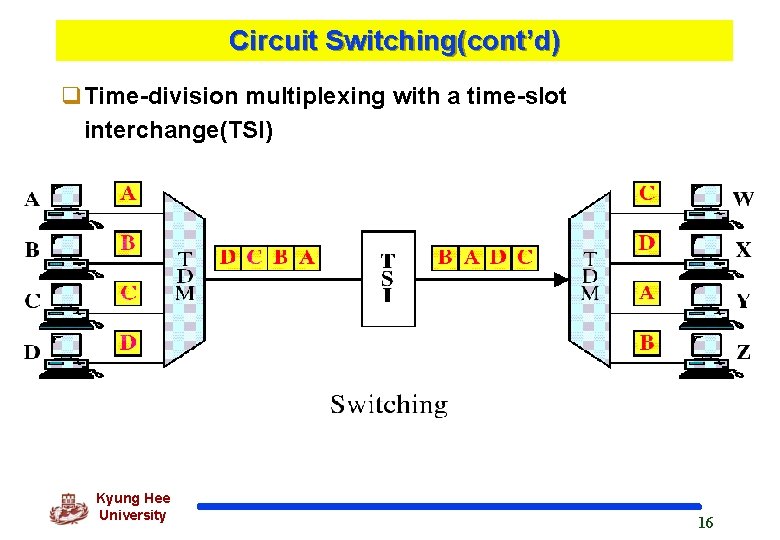
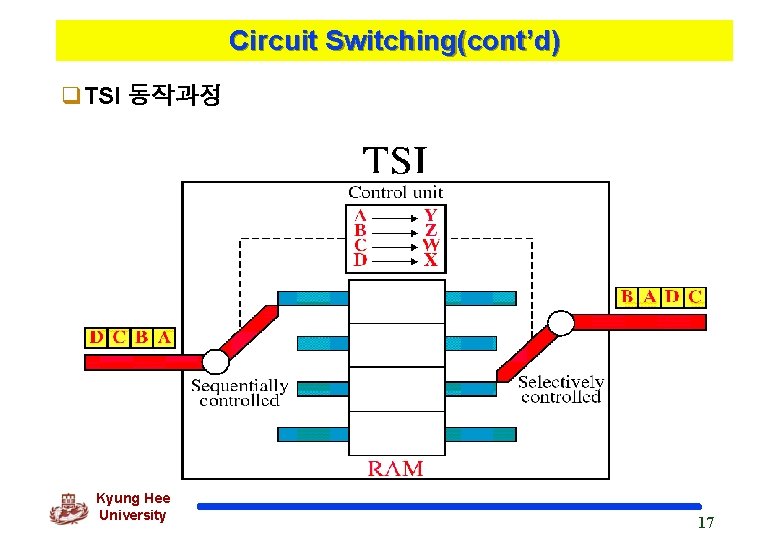
Circuit Switching(cont’d) q. Time-Division Switch ~ is accomplished using TDM(Time-division multiplexing) and TSI(Time-Slot Interchange) v. TSI - change the ordering of the slots based on the desired connections. Kyung Hee University 14
Circuit Switching(cont’d) q. Time-division multiplexing without a time-slot interchange(TSI) Kyung Hee University 15
Circuit Switching(cont’d) q. Time-division multiplexing with a time-slot interchange(TSI) Kyung Hee University 16
Circuit Switching(cont’d) q. TSI 동작과정 Kyung Hee University 17
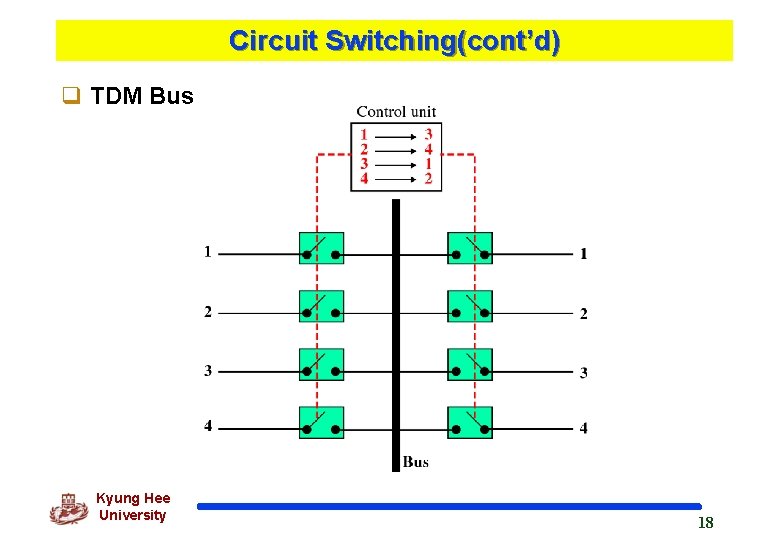
Circuit Switching(cont’d) q TDM Bus Kyung Hee University 18
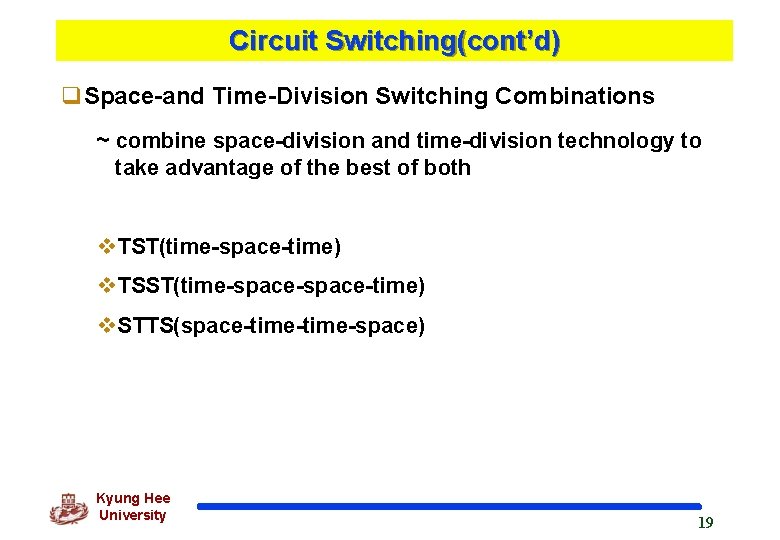
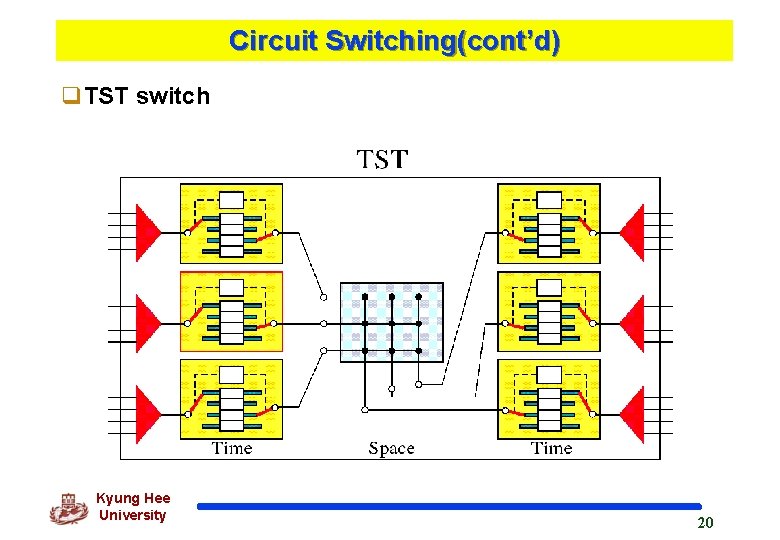
Circuit Switching(cont’d) q. Space-and Time-Division Switching Combinations ~ combine space-division and time-division technology to take advantage of the best of both v. TST(time-space-time) v. TSST(time-space-time) v. STTS(space-time-space) Kyung Hee University 19
Circuit Switching(cont’d) q. TST switch Kyung Hee University 20
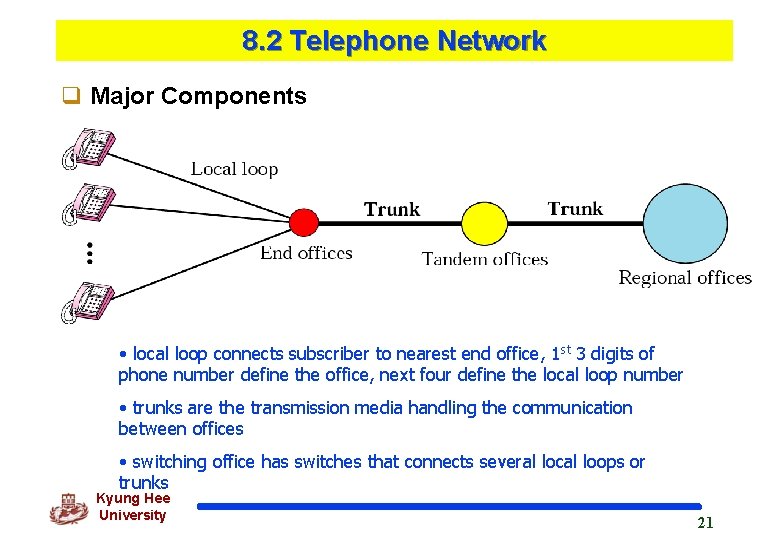
8. 2 Telephone Network q Major Components • local loop connects subscriber to nearest end office, 1 st 3 digits of phone number define the office, next four define the local loop number • trunks are the transmission media handling the communication between offices • switching office has switches that connects several local loops or trunks Kyung Hee University 21
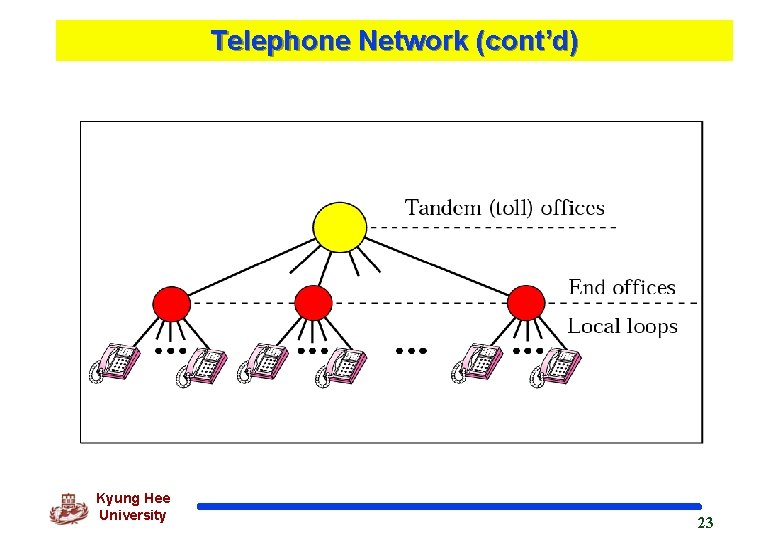
Telephone Network (cont’d) q Intra-LATA (local access transport area) services are provided by local exchange carriers. Since 1996, there are two types of LECs (local exchange carriers): incumbent local exchange carriers and competitive local exchange carriers. Kyung Hee University 22
Telephone Network (cont’d) Kyung Hee University 23
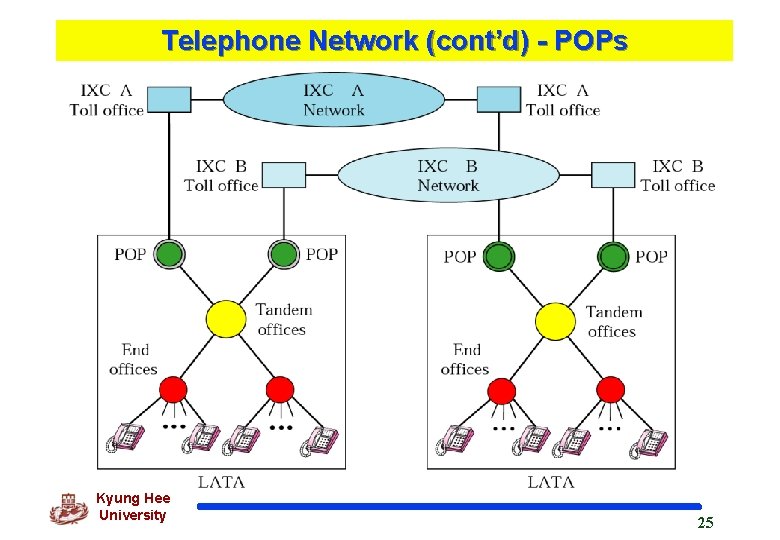
Telephone Network (cont’d) q IXCs are interexchange carriers (long-distance companies) q POPs are points of presence – a switching office in a LATA that allows an IXC to provide inter-LATA services Kyung Hee University 24
Telephone Network (cont’d) - POPs Kyung Hee University 25
Telephone Network (cont’d) q Voice communication used analog signals in the past, but is now moving to digital signals. On the other hand, dialing started with digital signals (rotary) and is now moving to analog signals (touch-tone). Kyung Hee University 26
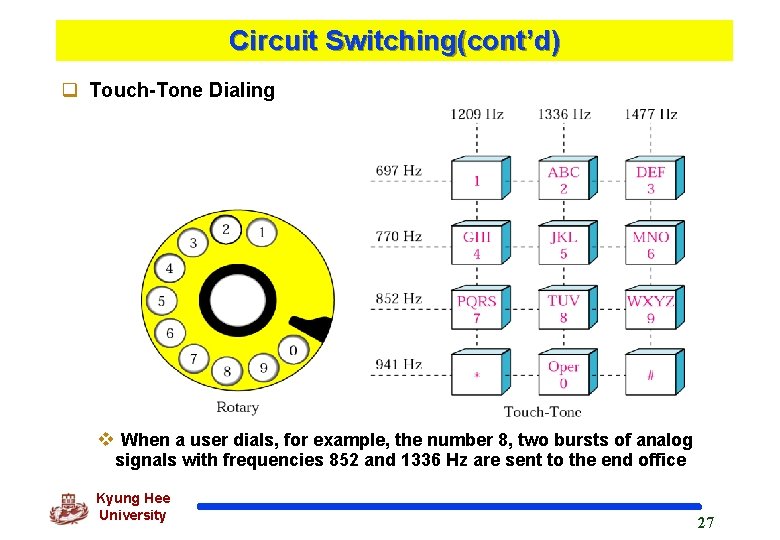
Circuit Switching(cont’d) q Touch-Tone Dialing v When a user dials, for example, the number 8, two bursts of analog signals with frequencies 852 and 1336 Hz are sent to the end office Kyung Hee University 27