
Circle Detection by Arcsupport Line Segments Changsheng Lu
Circle Detection by Arc-support Line Segments Changsheng Lu 1, Siyu Xia 1, Wangming Huang 2, Ming Shao 3, Yun Fu 4 Southeast University, Nanjing 210096, China 2 Joint Stars Technology CO. , LTD, Nanjing 211100, China 3 University of Massachusetts, Dartmouth, MA 02747, USA 4 Northeastern University, Boston, MA 02115, USA 1 Sep. 18 th, 2017 ICIP 2017
Contents Ø Background introduction Ø Arc-support line segment extraction Ø Paired line segments analysis Ø Circle candidate generation and validation Ø Experimental results Ø Summary ICIP 2017
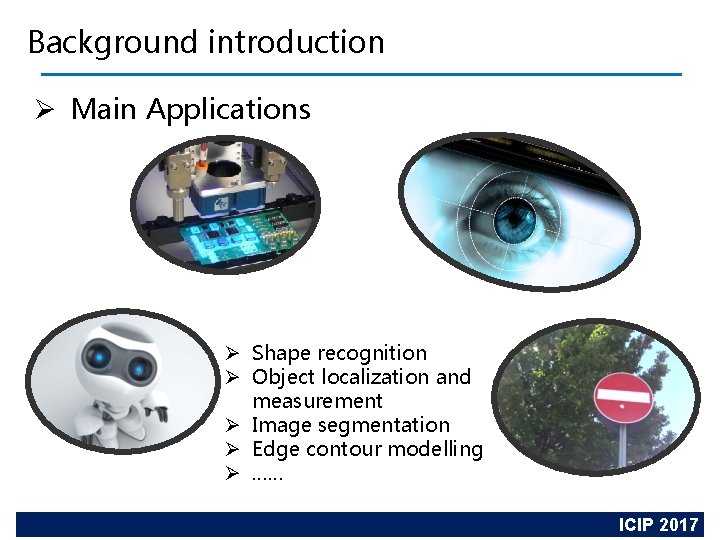
Background introduction Ø Main Applications Ø Shape recognition Ø Object localization and measurement Ø Image segmentation Ø Edge contour modelling Ø …… SEU Academic Report ICIP 2017
Background introduction Ø Current methods 1) Hough Transform (HT) based methods Ø Circle Hough Transform (CHT) Ø Randomized Hough Transform (RHT) 2) Random Sample Consensus (RANSAC) based methods Ø Random Circle Detection (RCD) 3) Line Segments Approximating based methods Ø Truc Le el. al [1] method [1] Truc Le and Ye Duan, Circle detection on images by line segment and circle completeness, IEEE ICIP, 2016, pp. 3648– 3652. SEU Academic Report ICIP 2017
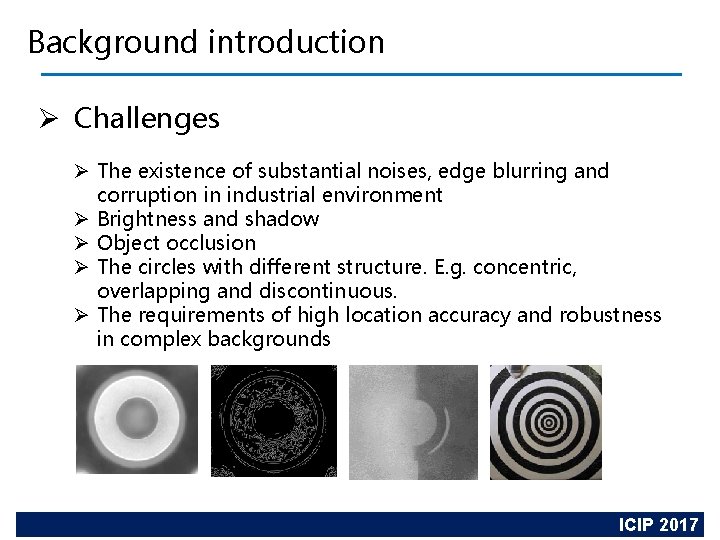
Background introduction Ø Challenges Ø The existence of substantial noises, edge blurring and corruption in industrial environment Ø Brightness and shadow Ø Object occlusion Ø The circles with different structure. E. g. concentric, overlapping and discontinuous. Ø The requirements of high location accuracy and robustness in complex backgrounds SEU Academic Report ICIP 2017
Background introduction Ø Goal Ø Propose an effective, high-accuracy and robust circle detector Ø Achieve very low error recognition rate which guarantees the detection system’ s stability and security. Ø Be capable to deal with the disturbances of complex environment SEU Academic Report ICIP 2017
Contents Ø Background introduction of circle detection Ø Arc-support line segment extraction Ø Paired line segments analysis Ø Circle candidate generation and validation Ø Experimental results Ø Summary ICIP 2017
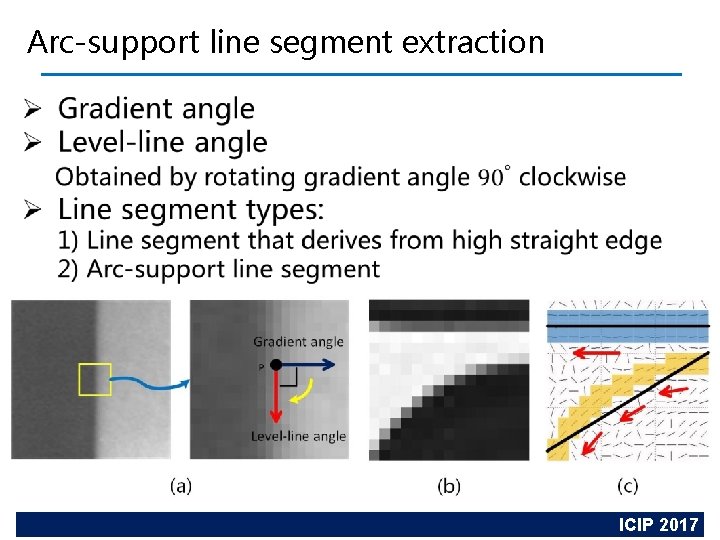
Arc-support line segment extraction SEU Academic Report ICIP 2017
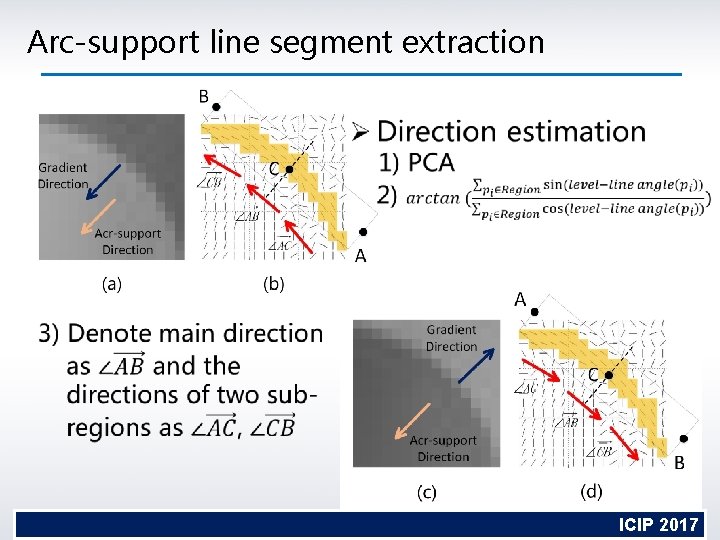
Arc-support line segment extraction SEU Academic Report ICIP 2017
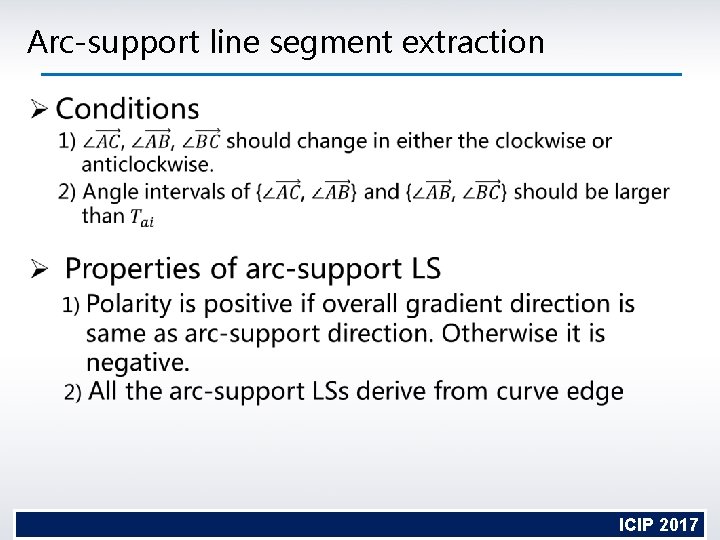
Arc-support line segment extraction SEU Academic Report ICIP 2017
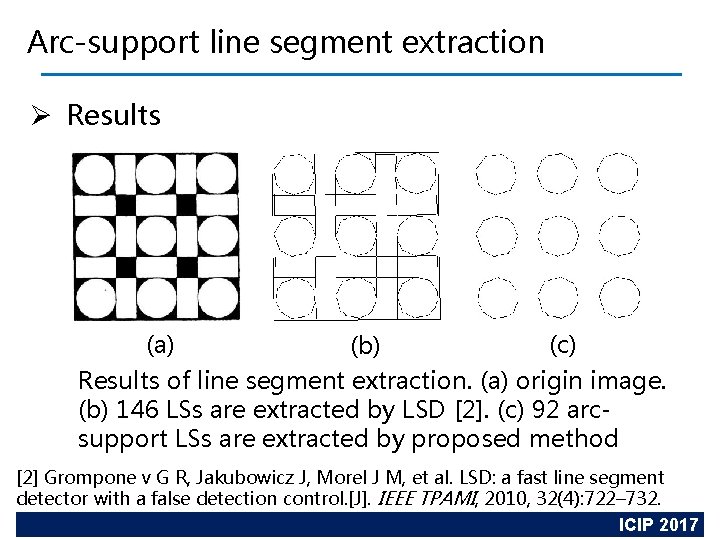
Arc-support line segment extraction Ø Results (a) (c) (b) Results of line segment extraction. (a) origin image. (b) 146 LSs are extracted by LSD [2]. (c) 92 arcsupport LSs are extracted by proposed method [2] Grompone v G R, Jakubowicz J, Morel J M, et al. LSD: a fast line segment detector with a false detection control. [J]. IEEE TPAMI, 2010, 32(4): 722– 732. SEU Academic Report ICIP 2017
Contents Ø Background introduction of circle detection Ø Arc-support line segment extraction Ø Paired line segments analysis Ø Circle candidates generation and validation Ø Experimental results Ø Summary ICIP 2017
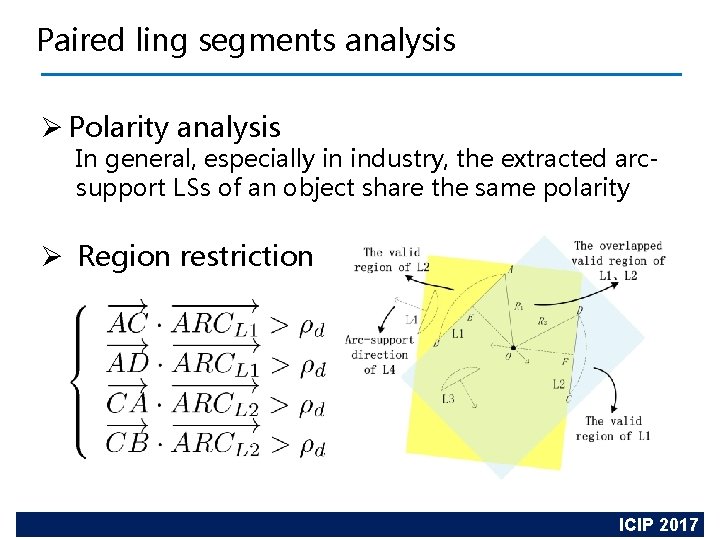
Paired ling segments analysis Ø Polarity analysis In general, especially in industry, the extracted arcsupport LSs of an object share the same polarity Ø Region restriction SEU Academic Report ICIP 2017
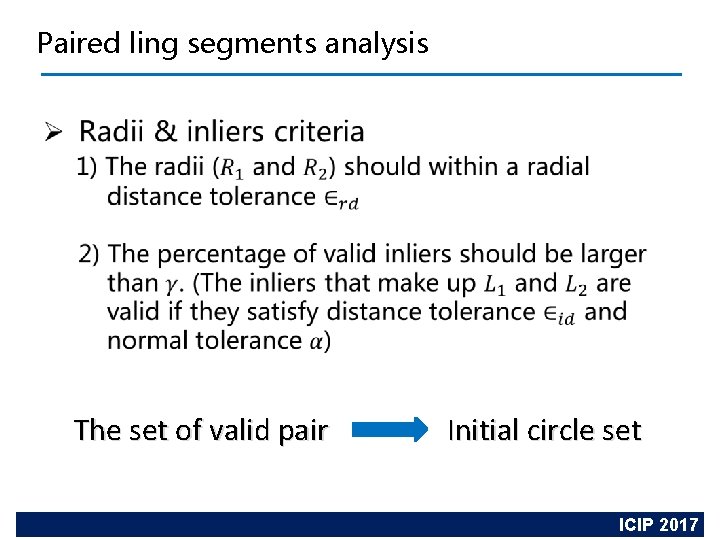
Paired ling segments analysis The set of valid pair Initial circle set SEU Academic Report ICIP 2017
Contents Ø Background introduction of circle detection Ø Arc-support line segment extraction Ø Paired line segments analysis Ø Circle candidate generation and validation Ø Experimental results Ø Summary ICIP 2017
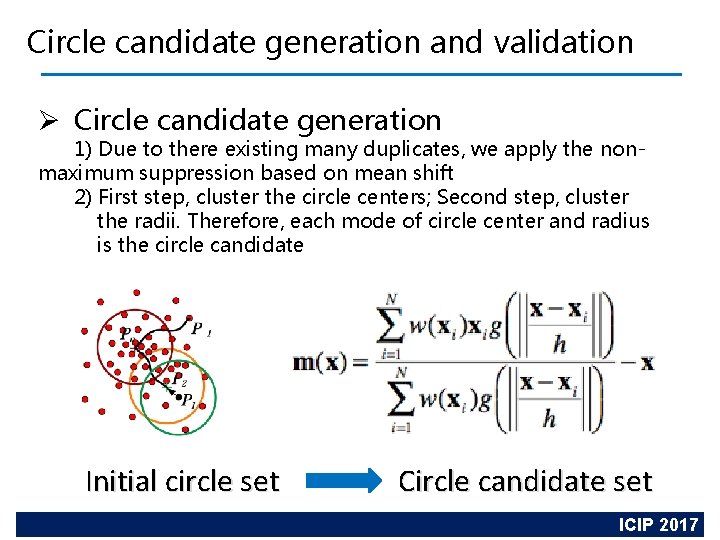
Circle candidate generation and validation Ø Circle candidate generation 1) Due to there existing many duplicates, we apply the nonmaximum suppression based on mean shift 2) First step, cluster the circle centers; Second step, cluster the radii. Therefore, each mode of circle center and radius is the circle candidate Initial circle set Circle candidate set SEU Academic Report ICIP 2017
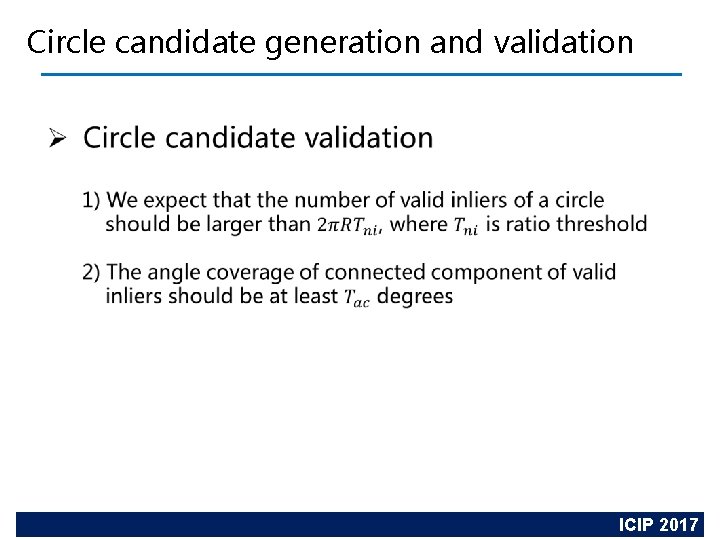
Circle candidate generation and validation SEU Academic Report ICIP 2017
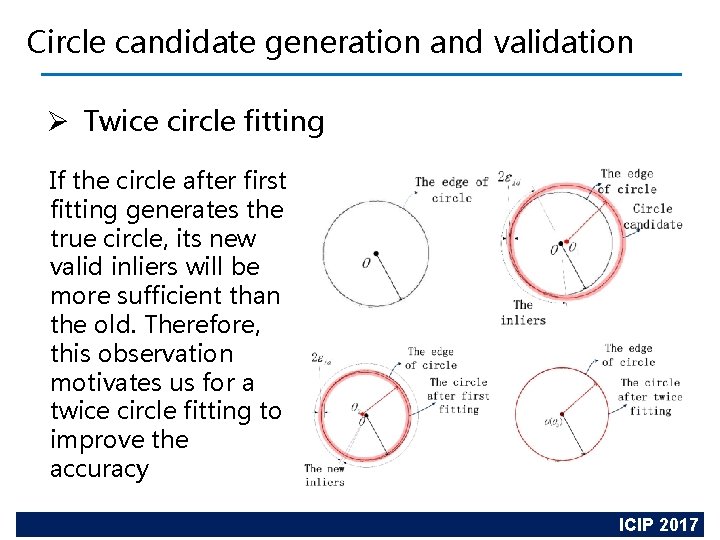
Circle candidate generation and validation Ø Twice circle fitting If the circle after first fitting generates the true circle, its new valid inliers will be more sufficient than the old. Therefore, this observation motivates us for a twice circle fitting to improve the accuracy SEU Academic Report ICIP 2017
Contents Ø Background introduction of circle detection Ø Arc-support line segment extraction Ø Paired line segments analysis Ø Circle candidate generation and validation Ø Experimental results Ø Summary ICIP 2017
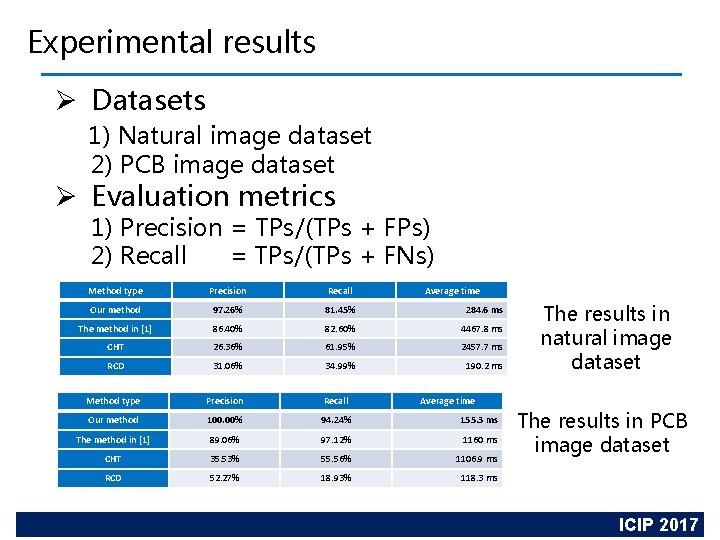
Experimental results Ø Datasets 1) Natural image dataset 2) PCB image dataset Ø Evaluation metrics 1) Precision = TPs/(TPs + FPs) 2) Recall = TPs/(TPs + FNs) Method type Precision Recall Average time Our method 97. 26% 81. 45% 284. 6 ms The method in [1] 86. 40% 82. 60% 4467. 8 ms CHT 26. 36% 61. 95% 2457. 7 ms RCD 31. 06% 34. 99% 190. 2 ms Method type Precision Recall Our method 100. 00% 94. 24% 155. 3 ms The method in [1] 89. 06% 97. 12% 1160 ms CHT 35. 53% 55. 56% 1106. 9 ms RCD 52. 27% 18. 93% 118. 3 ms The results in natural image dataset Average time The results in PCB image dataset SEU Academic Report ICIP 2017
![Experimental results Origin image Our method The method in [1] CHT RCD SEU Academic](http://slidetodoc.com/presentation_image_h2/470a708bb03830d6b9774efa6cf2eafb/image-21.jpg "Experimental results Origin image Our method The method in [1] CHT RCD SEU Academic")
Experimental results Origin image Our method The method in [1] CHT RCD SEU Academic Report ICIP 2017
![Experimental results Origin image Our method The method in [1] CHT RCD SEU Academic](http://slidetodoc.com/presentation_image_h2/470a708bb03830d6b9774efa6cf2eafb/image-22.jpg "Experimental results Origin image Our method The method in [1] CHT RCD SEU Academic")
Experimental results Origin image Our method The method in [1] CHT RCD SEU Academic Report ICIP 2017
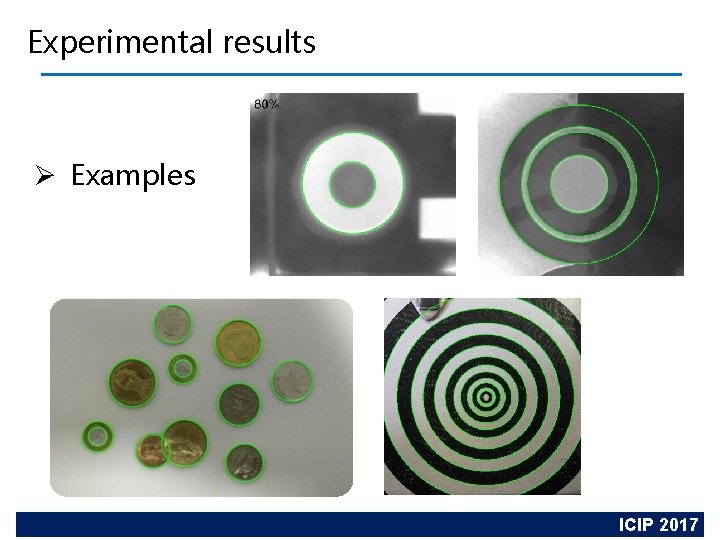
Experimental results Ø Examples SEU Academic Report ICIP 2017
Contents Ø Background introduction of circle detection Ø Arc-support line segment extraction Ø Paired line segments analysis Ø Circle candidate generation and validation Ø Experimental results Ø Summary ICIP 2017
Summary Ø We propose the concept of arc-support line segment, and point out corresponding property of polarity Ø We use the polarity analysis, region restriction and effective criteria to reduce the arc-support line segments pairing time, which improves the circle detection efficiency. Ø Validate the circle candidates from the number of inliers and the circle completeness, which increases the algorithm’ s robustness Ø Improve the circle location accuracy by twice circle fitting SEU Academic Report ICIP 2017
Thanks for listening SEU Academic Report ICIP 2017
- Slides: 26