
CIRAMICS Factors that Determine Crystal Structure 1 Relative
- Slides: 13
CIRAMICS
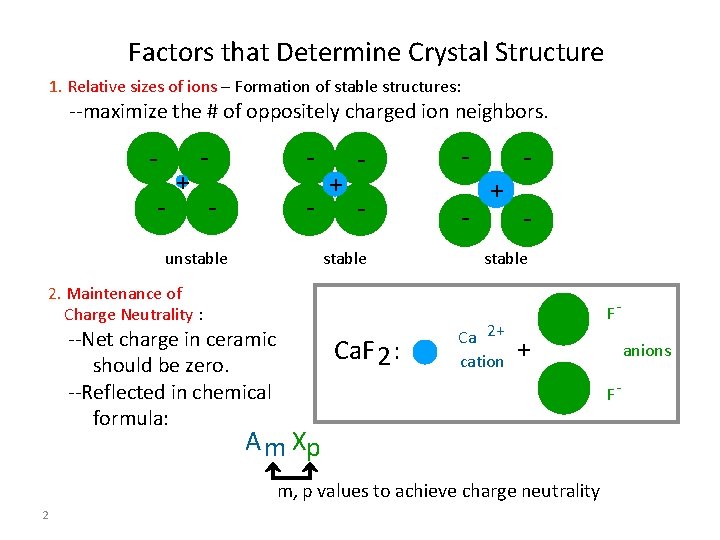
Factors that Determine Crystal Structure 1. Relative sizes of ions – Formation of stable structures: --maximize the # of oppositely charged ion neighbors. - + - - unstable + - - stable 2. Maintenance of Charge Neutrality : --Net charge in ceramic should be zero. --Reflected in chemical formula: Ca. F 2 : + - stable Ca 2+ cation F- + F- A m Xp m, p values to achieve charge neutrality 2 anions
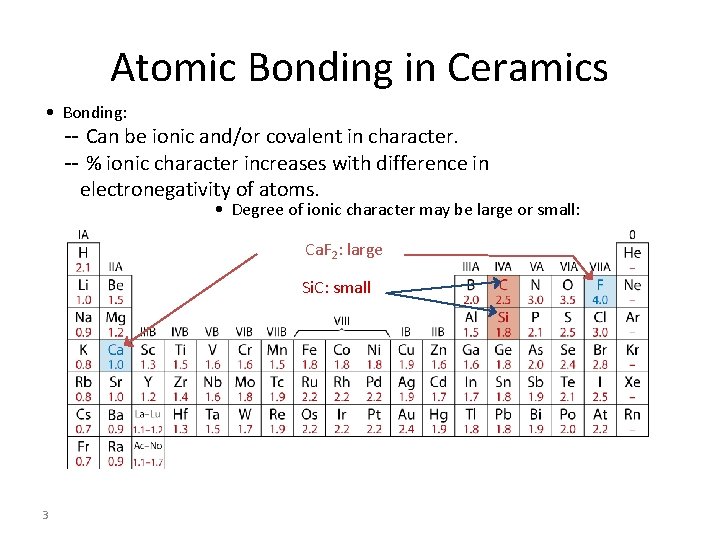
Atomic Bonding in Ceramics • Bonding: -- Can be ionic and/or covalent in character. -- % ionic character increases with difference in electronegativity of atoms. • Degree of ionic character may be large or small: Ca. F 2: large Si. C: small 3
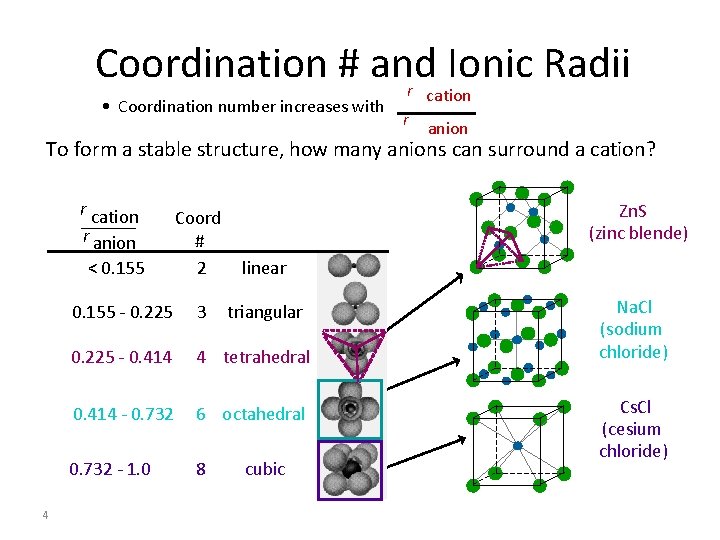
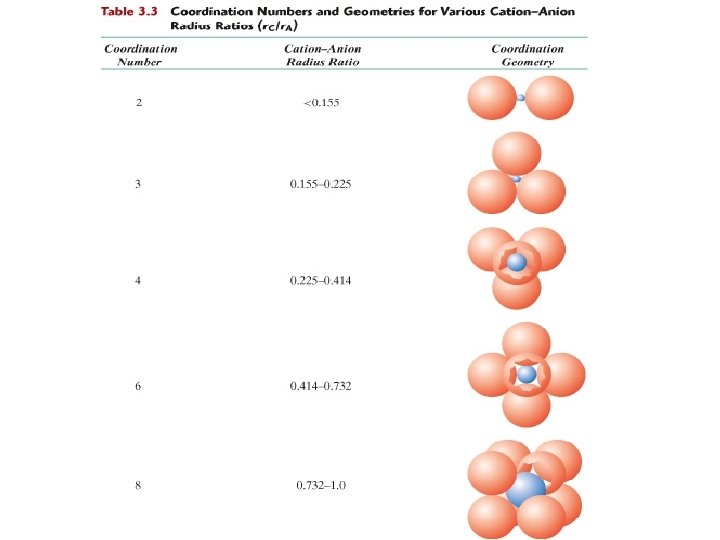
Coordination # and Ionic Radii r • Coordination number increases with cation r anion To form a stable structure, how many anions can surround a cation? r cation r anion linear 0. 155 - 0. 225 3 triangular 0. 225 - 0. 414 4 tetrahedral 0. 414 - 0. 732 6 octahedral 0. 732 - 1. 0 8 < 0. 155 4 Zn. S (zinc blende) Coord # 2 cubic Na. Cl (sodium chloride) Cs. Cl (cesium chloride)
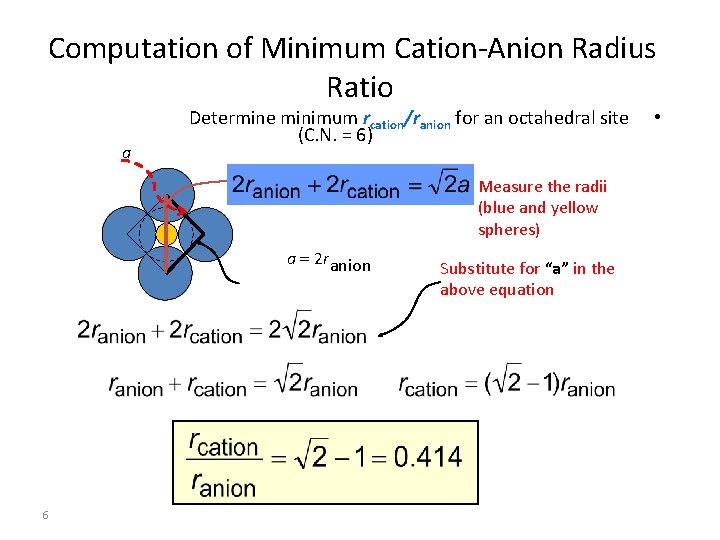
Computation of Minimum Cation-Anion Radius Ratio a Determine minimum rcation/ranion for an octahedral site (C. N. = 6) Measure the radii (blue and yellow spheres) a = 2 ranion 6 Substitute for “a” in the above equation •
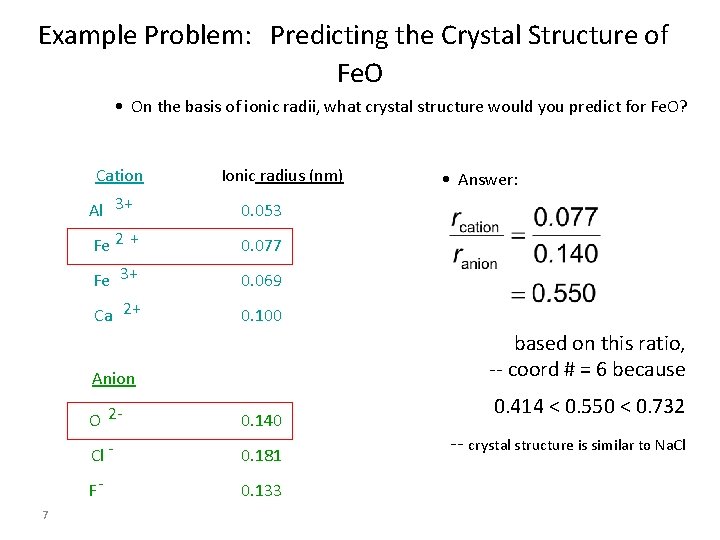
Example Problem: Predicting the Crystal Structure of Fe. O • On the basis of ionic radii, what crystal structure would you predict for Fe. O? Cation Ionic radius (nm) Al 3+ 0. 053 Fe 2 + 0. 077 Fe 3+ 0. 069 Ca 2+ 0. 100 based on this ratio, -- coord # = 6 because Anion 7 • Answer: O 2 - 0. 140 Cl - 0. 181 F- 0. 133 0. 414 < 0. 550 < 0. 732 -- crystal structure is similar to Na. Cl
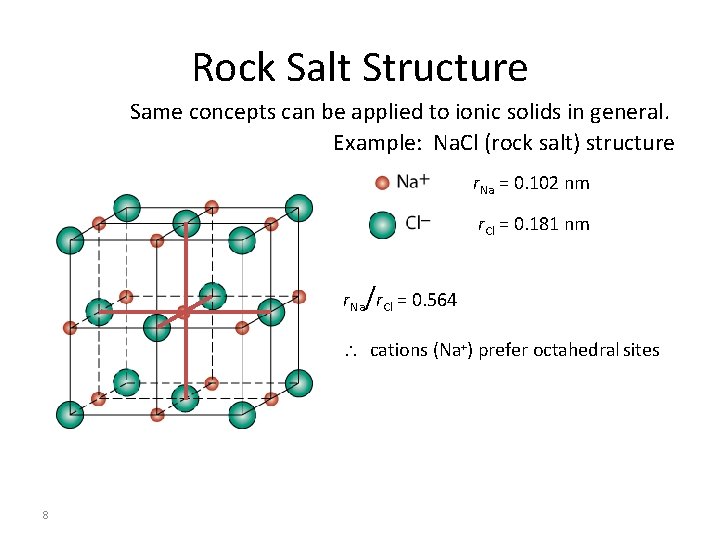
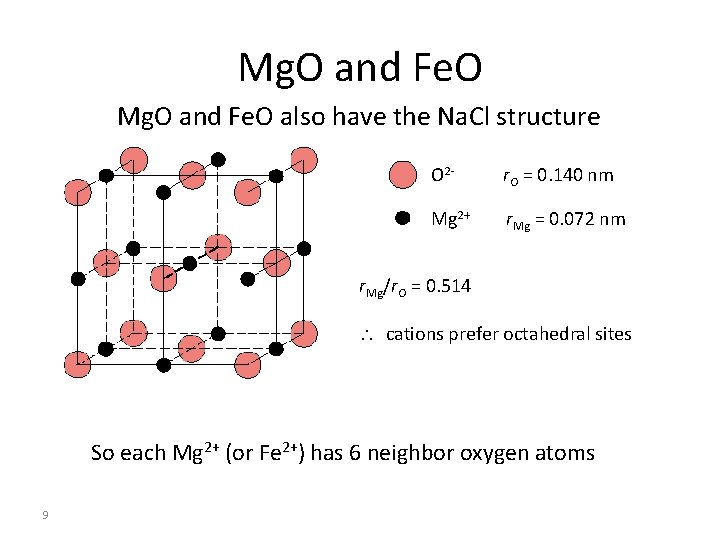
Rock Salt Structure Same concepts can be applied to ionic solids in general. Example: Na. Cl (rock salt) structure r. Na = 0. 102 nm r. Cl = 0. 181 nm r. Na/r. Cl = 0. 564 cations (Na+) prefer octahedral sites 8
Mg. O and Fe. O also have the Na. Cl structure O 2 - r. O = 0. 140 nm Mg 2+ r. Mg = 0. 072 nm r. Mg/r. O = 0. 514 cations prefer octahedral sites So each Mg 2+ (or Fe 2+) has 6 neighbor oxygen atoms 9
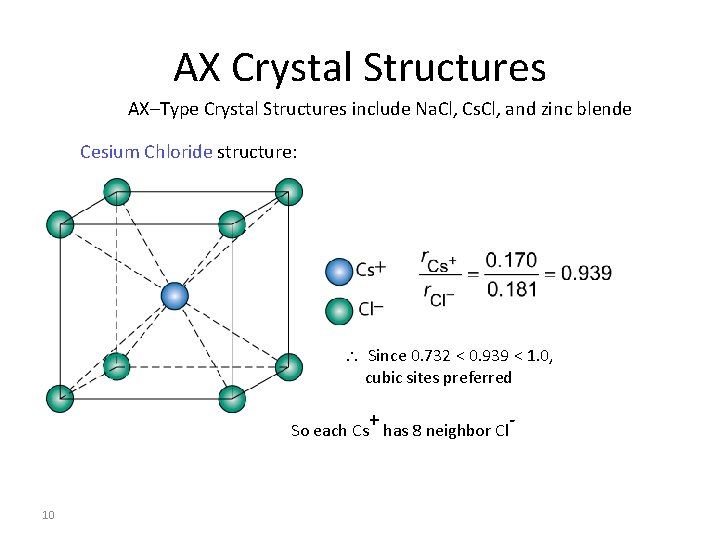
AX Crystal Structures AX–Type Crystal Structures include Na. Cl, Cs. Cl, and zinc blende Cesium Chloride structure: Since 0. 732 < 0. 939 < 1. 0, cubic sites preferred + So each Cs has 8 neighbor Cl 10 -
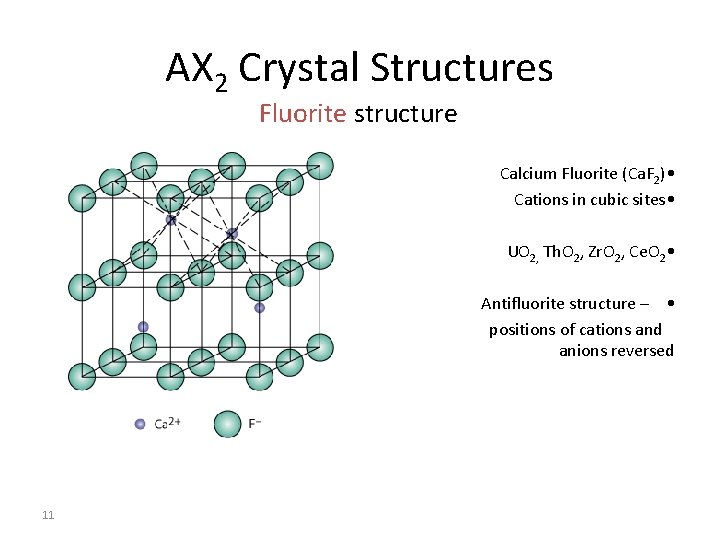
AX 2 Crystal Structures Fluorite structure Calcium Fluorite (Ca. F 2) • Cations in cubic sites • UO 2, Th. O 2, Zr. O 2, Ce. O 2 • Antifluorite structure – • positions of cations and anions reversed 11
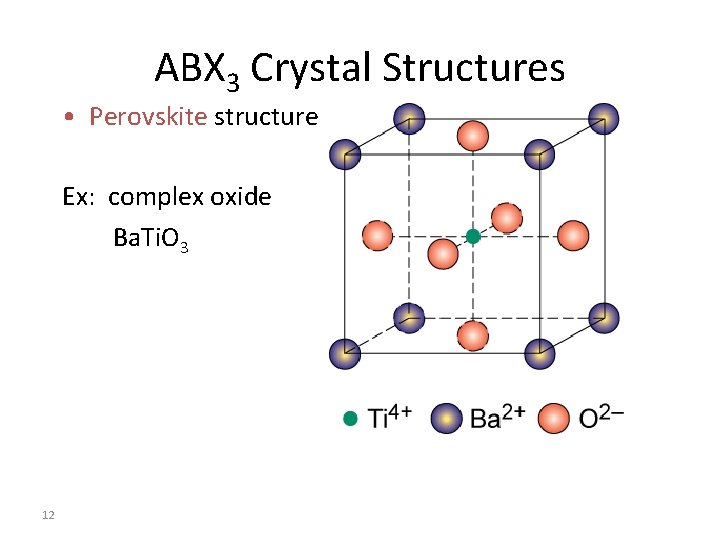
ABX 3 Crystal Structures • Perovskite structure Ex: complex oxide Ba. Ti. O 3 12
SUMMARY • Atoms may assemble into crystalline or amorphous structures. • Common metallic crystal structures are FCC, BCC and HCP. Coordination number and atomic packing factor are the same for both FCC and HCP crystal structures. • We can predict the density of a material, provided we know the atomic weight, atomic radius, and crystal geometry (e. g. , FCC, BCC, HCP). • Interatomic bonding in ceramics is ionic and/or covalent. • Ceramic crystal structures are based on: -- maintaining charge neutrality -- cation-anion radii ratios. 13