
CIO Build a Personal Development Plan to Become
CIO: Build a Personal Development Plan to Become Chief Enterprise Integration Officer Your role is at a crossroads. Reinvent yourself now or risk becoming head of technology support. Info-Tech Research Group, Inc. Is a global leader in providing IT research and advice. Info-Tech’s products and services combine actionable insight and relevant advice with Info-Tech's products and services combine actionable insight advice ready-to-use tools and templates that cover theand fullrelevant spectrum of IT with concerns. and templates that cover the full spectrum©of 1997 -2013 IT concerns. © 1997 -Research 2013 Info-Tech Group Research Inc. Info-Tech Research Group 1
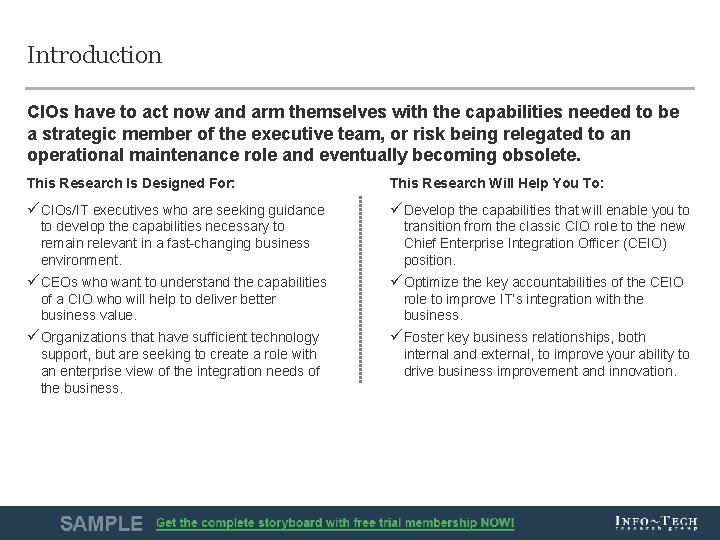
Introduction CIOs have to act now and arm themselves with the capabilities needed to be a strategic member of the executive team, or risk being relegated to an operational maintenance role and eventually becoming obsolete. This Research Is Designed For: This Research Will Help You To: üCIOs/IT executives who are seeking guidance üDevelop the capabilities that will enable you to to develop the capabilities necessary to remain relevant in a fast-changing business environment. üCEOs who want to understand the capabilities of a CIO who will help to deliver better business value. üOrganizations that have sufficient technology support, but are seeking to create a role with an enterprise view of the integration needs of the business. transition from the classic CIO role to the new Chief Enterprise Integration Officer (CEIO) position. üOptimize the key accountabilities of the CEIO role to improve IT’s integration with the business. üFoster key business relationships, both internal and external, to improve your ability to drive business improvement and innovation. Info-Tech Research Group 2

Solution Set Overview • This solution set is designed to help the IT executive set a course to becoming the Chief Enterprise Integration Officer (CEIO). • It includes several tools to assist in that journey: ◦ ◦ ◦ CEIO Capabilities Scorecard Template CEIO Stakeholder Power Map Template CEIO Stakeholder Management Strategy Template Personal Development Plan Chief Enterprise Integration Officer (CEIO) Capabilities Mapping Tool • Completion of these tools will take time – recognize that you are responsible for your next career move, and make the necessary commitment to positioning yourself for success. Become the Chief Enterprise Integration Officer Appreciate the key drivers for the CEIO role Understand how the CIO role has evolved Identify the five drivers demanding change The CIO will be the nucleus of any company, working closely with business executives and finance; strategizing about future technology directions; leading a staff of highly skilled professionals and leaders; championing streamlined technical operations. - Louis Lantin, Director, Enterprise Collaboration Group, Amtrak Assess your CEIO capabilities and stakeholder relationships Determine your high priority capability gaps Identify the most important stakeholders Build your transformation action plan Design your CEIO Personal Development Plan Develop a scorecard to track your progress Info-Tech Research Group 3
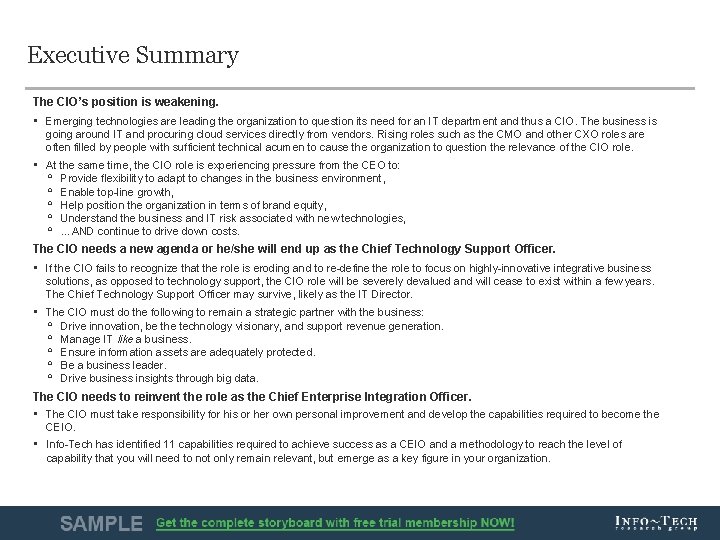
Executive Summary The CIO’s position is weakening. • Emerging technologies are leading the organization to question its need for an IT department and thus a CIO. The business is going around IT and procuring cloud services directly from vendors. Rising roles such as the CMO and other CXO roles are often filled by people with sufficient technical acumen to cause the organization to question the relevance of the CIO role. • At the same time, the CIO role is experiencing pressure from the CEO to: ◦ ◦ ◦ Provide flexibility to adapt to changes in the business environment, Enable top-line growth, Help position the organization in terms of brand equity, Understand the business and IT risk associated with new technologies, …AND continue to drive down costs. The CIO needs a new agenda or he/she will end up as the Chief Technology Support Officer. • If the CIO fails to recognize that the role is eroding and to re-define the role to focus on highly-innovative integrative business solutions, as opposed to technology support, the CIO role will be severely devalued and will cease to exist within a few years. The Chief Technology Support Officer may survive, likely as the IT Director. • The CIO must do the following to remain a strategic partner with the business: ◦ ◦ ◦ Drive innovation, be the technology visionary, and support revenue generation. Manage IT like a business. Ensure information assets are adequately protected. Be a business leader. Drive business insights through big data. The CIO needs to reinvent the role as the Chief Enterprise Integration Officer. • The CIO must take responsibility for his or her own personal improvement and develop the capabilities required to become the CEIO. • Info-Tech has identified 11 capabilities required to achieve success as a CEIO and a methodology to reach the level of capability that you will need to not only remain relevant, but emerge as a key figure in your organization. Info-Tech Research Group 4
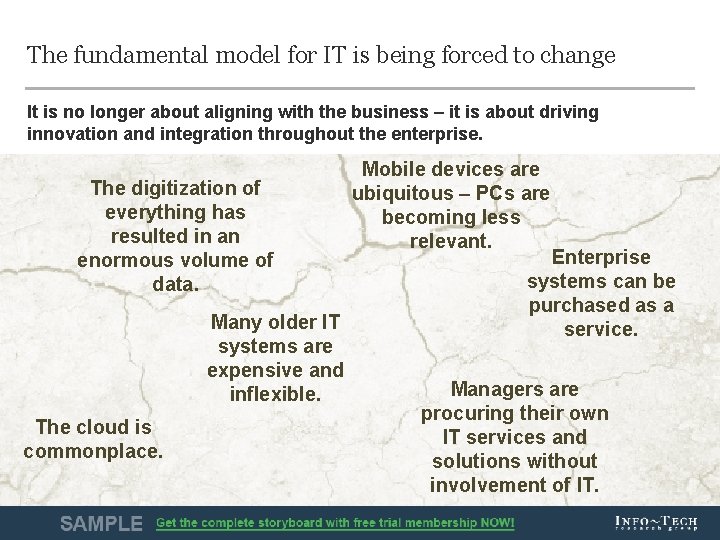
The fundamental model for IT is being forced to change It is no longer about aligning with the business – it is about driving innovation and integration throughout the enterprise. The digitization of everything has resulted in an enormous volume of data. Many older IT systems are expensive and inflexible. The cloud is commonplace. Mobile devices are ubiquitous – PCs are becoming less relevant. Enterprise systems can be purchased as a service. Managers are procuring their own IT services and solutions without involvement of IT. Info-Tech Research Group 5
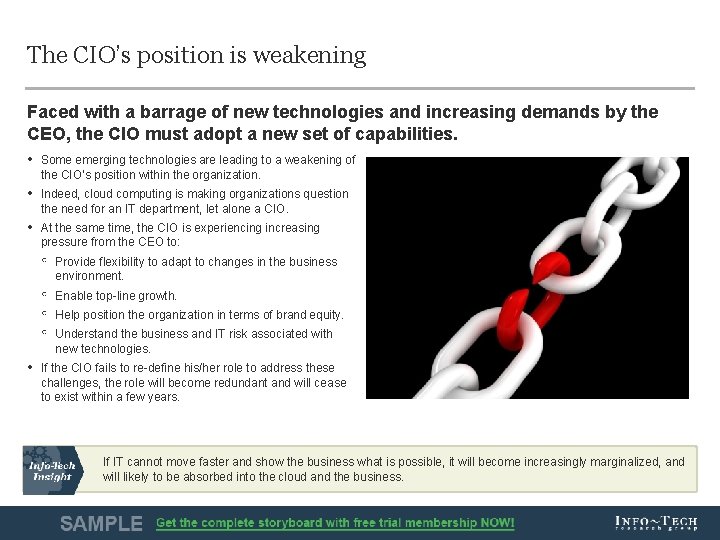
The CIO’s position is weakening Faced with a barrage of new technologies and increasing demands by the CEO, the CIO must adopt a new set of capabilities. • Some emerging technologies are leading to a weakening of the CIO’s position within the organization. • Indeed, cloud computing is making organizations question the need for an IT department, let alone a CIO. • At the same time, the CIO is experiencing increasing pressure from the CEO to: ◦ Provide flexibility to adapt to changes in the business environment. ◦ ◦ ◦ Enable top-line growth. Help position the organization in terms of brand equity. Understand the business and IT risk associated with new technologies. • If the CIO fails to re-define his/her role to address these challenges, the role will become redundant and will cease to exist within a few years. If IT cannot move faster and show the business what is possible, it will become increasingly marginalized, and will likely to be absorbed into the cloud and the business. Info-Tech Research Group 6
The VP of electricity did not disappear because electricity disappeared The pessimists believe that the CIO role will become redundant and may cease to exist – at least in its current form and shape. • It has been said that, at the turn of the 20 th century, electricity was so scarce that there was a very senior role in the organization to generate, secure, and manage it. • As the infrastructure for electricity generation developed, and electricity became a commodity, this position disappeared. • There are those who believe that IT faces a similar future. • The most extreme view contends that in-house IT will become a shadow of its former self, looking after old legacy applications that no one else wants to touch. • Under this scenario, funding for IT services will flow from the business through business IT groups that will devise processes out of cloud services. • Another scenario envisions the merger of the CIO and CFO. • And still another – recognizing that marketing is now the central engine of growth for many companies – proposes the creation of a Chief Marketing Technologist to replace the CIO. I think the role of the IT leader will change in many ways. It’s hard to say where the IT group will be. The role will definitely be more about advisory around emerging technologies and assisting with mergers and acquisitions. - Harald Ujc, Director of IT, George Weston Limited Info-Tech Research Group 7
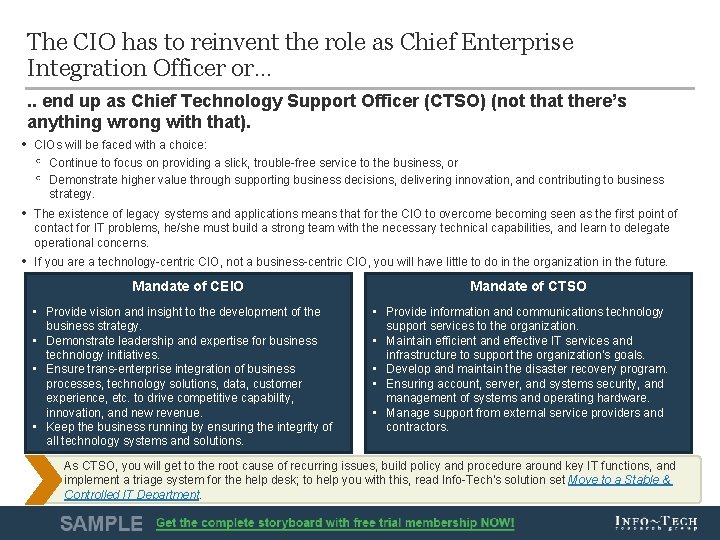
The CIO has to reinvent the role as Chief Enterprise Integration Officer or…. . end up as Chief Technology Support Officer (CTSO) (not that there’s anything wrong with that). • CIOs will be faced with a choice: ◦ ◦ Continue to focus on providing a slick, trouble-free service to the business, or Demonstrate higher value through supporting business decisions, delivering innovation, and contributing to business strategy. • The existence of legacy systems and applications means that for the CIO to overcome becoming seen as the first point of contact for IT problems, he/she must build a strong team with the necessary technical capabilities, and learn to delegate operational concerns. • If you are a technology-centric CIO, not a business-centric CIO, you will have little to do in the organization in the future. Mandate of CEIO • Provide vision and insight to the development of the business strategy. • Demonstrate leadership and expertise for business technology initiatives. • Ensure trans-enterprise integration of business processes, technology solutions, data, customer experience, etc. to drive competitive capability, innovation, and new revenue. • Keep the business running by ensuring the integrity of all technology systems and solutions. Mandate of CTSO • Provide information and communications technology support services to the organization. • Maintain efficient and effective IT services and infrastructure to support the organization’s goals. • Develop and maintain the disaster recovery program. • Ensuring account, server, and systems security, and management of systems and operating hardware. • Manage support from external service providers and contractors. As CTSO, you will get to the root cause of recurring issues, build policy and procedure around key IT functions, and implement a triage system for the help desk; to help you with this, read Info-Tech’s solution set Move to a Stable & Controlled IT Department. Info-Tech Research Group 8
Firms will always need a chief integrator The CEIO will be the common thread that weaves the various fabrics of data, business processes, and technology together across the enterprise. • It is risky for firms to think they can handle IT without an IT leader in place. • Though everyone uses technology, not everyone can: ◦ ◦ Map out its strategic deployment, or Understand the business and IT risks associated with it. • While business and functional units might choose the products to use and the strategies to adopt, the CEIO will be the common thread across the enterprise – ensuring that the decisions being made by the business units facilitate a seamless flow of information across the enterprise. • Firms need someone at a suitably strategic position in the organization to: ◦ ◦ Guide business prioritization and technology decisions. ◦ Oversee the value the company creates from its investments. Articulate the value of complex technology-based initiatives. • Ditch the CIO role – reinvent it as the Chief Enterprise Integration Officer. The new CIO is as pervasive a role as the CFO. There is no part of the business that technology doesn't touch. Like the CFO, the CIO should have a seat at the most senior level of the company. - Irving Wladawsky-Berger, Strategic Advisor, Wall Street Journal Contributor Info-Tech Research Group 9
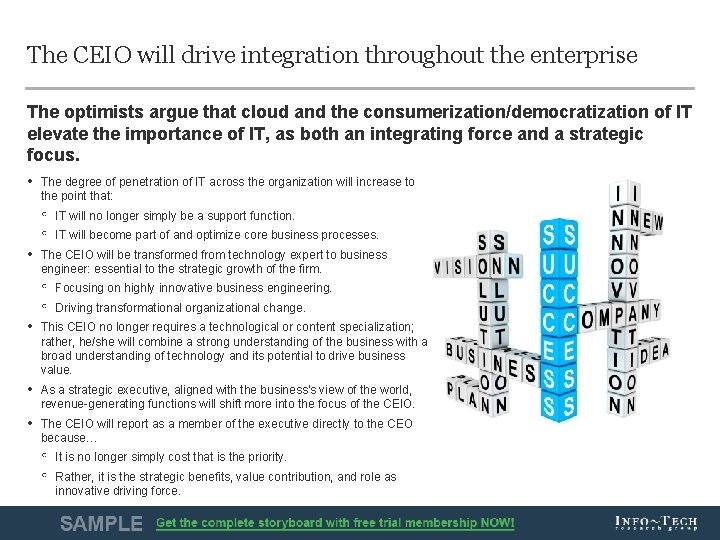
The CEIO will drive integration throughout the enterprise The optimists argue that cloud and the consumerization/democratization of IT elevate the importance of IT, as both an integrating force and a strategic focus. • The degree of penetration of IT across the organization will increase to the point that: ◦ ◦ IT will no longer simply be a support function. IT will become part of and optimize core business processes. • The CEIO will be transformed from technology expert to business engineer: essential to the strategic growth of the firm. ◦ ◦ Focusing on highly innovative business engineering. Driving transformational organizational change. • This CEIO no longer requires a technological or content specialization; rather, he/she will combine a strong understanding of the business with a broad understanding of technology and its potential to drive business value. • As a strategic executive, aligned with the business's view of the world, revenue-generating functions will shift more into the focus of the CEIO. • The CEIO will report as a member of the executive directly to the CEO because… ◦ ◦ It is no longer simply cost that is the priority. Rather, it is the strategic benefits, value contribution, and role as innovative driving force. Info-Tech Research Group 10
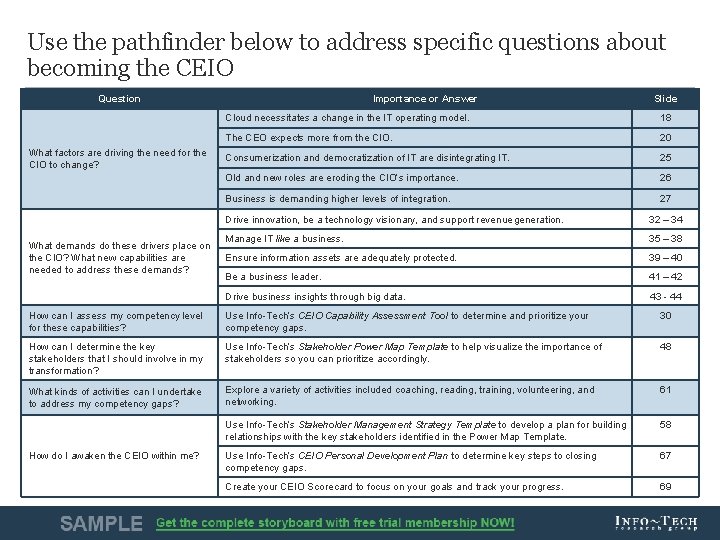
Use the pathfinder below to address specific questions about becoming the CEIO Question What factors are driving the need for the CIO to change? What demands do these drivers place on the CIO? What new capabilities are needed to address these demands? Importance or Answer Slide Cloud necessitates a change in the IT operating model. 18 The CEO expects more from the CIO. 20 Consumerization and democratization of IT are disintegrating IT. 25 Old and new roles are eroding the CIO’s importance. 26 Business is demanding higher levels of integration. 27 Drive innovation, be a technology visionary, and support revenue generation. 32 – 34 Manage IT like a business. 35 – 38 Ensure information assets are adequately protected. 39 – 40 Be a business leader. 41 – 42 Drive business insights through big data. 43 - 44 How can I assess my competency level for these capabilities? Use Info-Tech’s CEIO Capability Assessment Tool to determine and prioritize your competency gaps. 30 How can I determine the key stakeholders that I should involve in my transformation? Use Info-Tech’s Stakeholder Power Map Template to help visualize the importance of stakeholders so you can prioritize accordingly. 48 What kinds of activities can I undertake to address my competency gaps? Explore a variety of activities included coaching, reading, training, volunteering, and networking. 61 Use Info-Tech’s Stakeholder Management Strategy Template to develop a plan for building relationships with the key stakeholders identified in the Power Map Template. 58 Use Info-Tech’s CEIO Personal Development Plan to determine key steps to closing competency gaps. 67 Create your CEIO Scorecard to focus on your goals and track your progress. 69 How do I awaken the CEIO within me? Info-Tech Research Group 11
Info-Tech Research Group Helps IT Professionals To: ü ü ü Quickly get up to speed with new technologies ü Manage business expectations ü Justify IT spending and prove the value of IT ü Train IT staff and effectively manage an IT department Make the right technology purchasing decisions – fast Deliver critical IT projects, on time and within budget Sign up for free trial membership to get practical solutions for your IT challenges • “Info-Tech helps me to be proactive instead of reactive – a cardinal rule in a stable and leading edge IT environment. - ARCS Commercial Mortgage Co. , LP Toll Free: 1 -888 -670 -8889 www. infotech. com Info-Tech Research Group 12
- Slides: 12