
Cinnteacht Comhaont Mitrs Stacey Agreement and Certainty Matrix
- Slides: 17
Cinnteacht & Comhaontú Máitrís Stacey Agreement and Certainty Matrix conlan. sean@gmail. com
Basic Concept • Stacey Agreement & Certainty Matrix* • Select appropriate management actions based on the degree of Certainty & Level of Agreement *Stacey, Ralph. Strategic Management and Organizational Dynamics. London: Pitman Publishing, 1996 See also Zimmerman, Brenda et al. Insights from complexity science for health care leaders Edgeware, VHA inc. Irving, Texas 1998 conlan. sean@gmail. com
Possible Context for use – Choose between management & leadership approaches – Making sense of array of decisions or an agenda for a group – Communicate why a particular approach is appropriate – Deliberately increase uncertainty/disagreement needed to push the system towards chaos in order to create alternatives or stimulate innovation conlan. sean@gmail. com
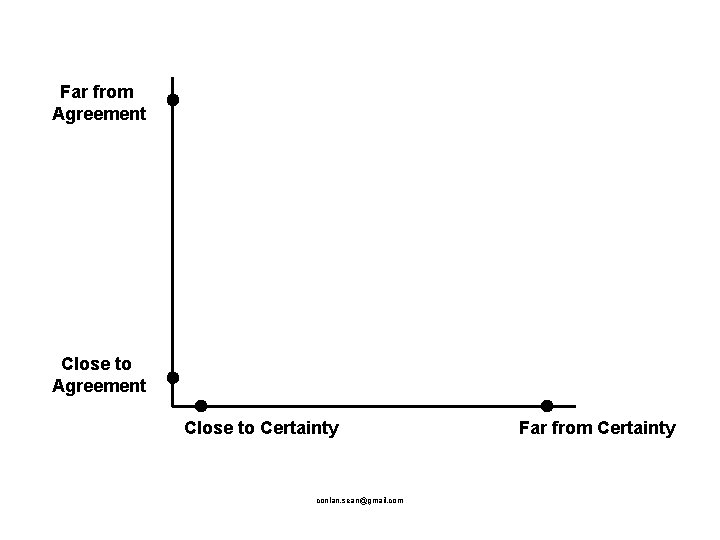
Description Management & leadership has an array of approaches – the art is to know when to use which one Decisions are identified on two dimensions Degree of Certainty & Level of Agreement conlan. sean@gmail. com
Far from Agreement Close to Certainty conlan. sean@gmail. com Far from Certainty
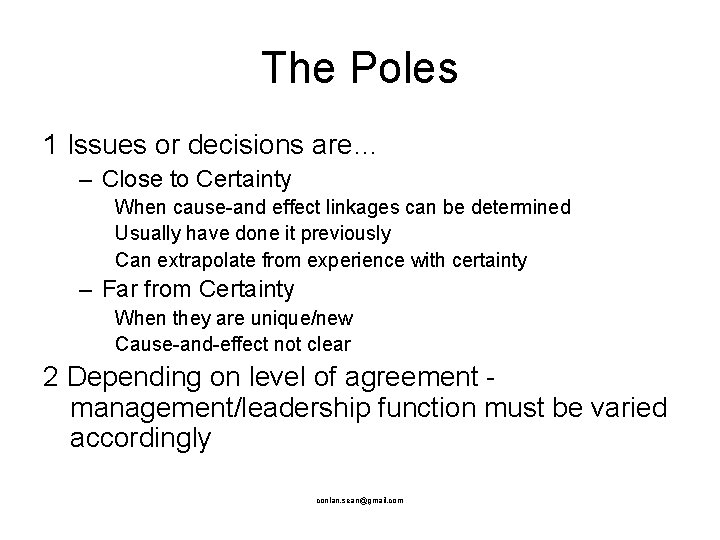
The Poles 1 Issues or decisions are… – Close to Certainty When cause-and effect linkages can be determined Usually have done it previously Can extrapolate from experience with certainty – Far from Certainty When they are unique/new Cause-and-effect not clear 2 Depending on level of agreement management/leadership function must be varied accordingly conlan. sean@gmail. com
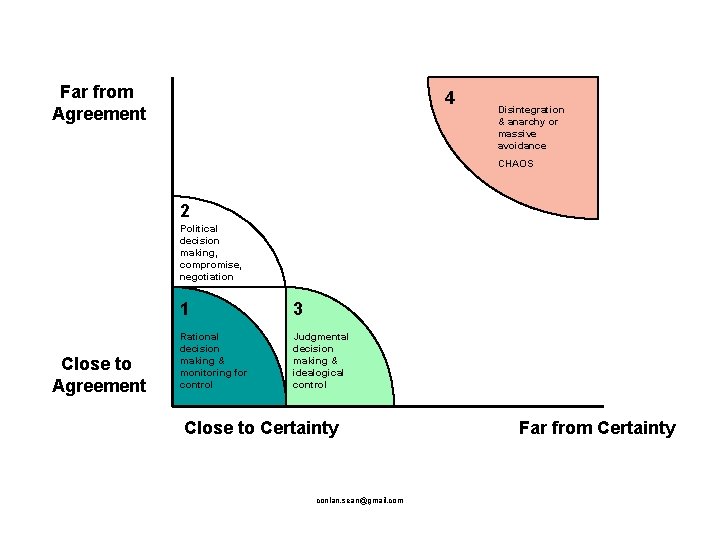
Far from Agreement 4 Disintegration & anarchy or massive avoidance CHAOS 2 Political decision making, compromise, negotiation Close to Agreement 1 3 Rational decision making & monitoring for control Judgmental decision making & idealogical control Close to Certainty conlan. sean@gmail. com Far from Certainty
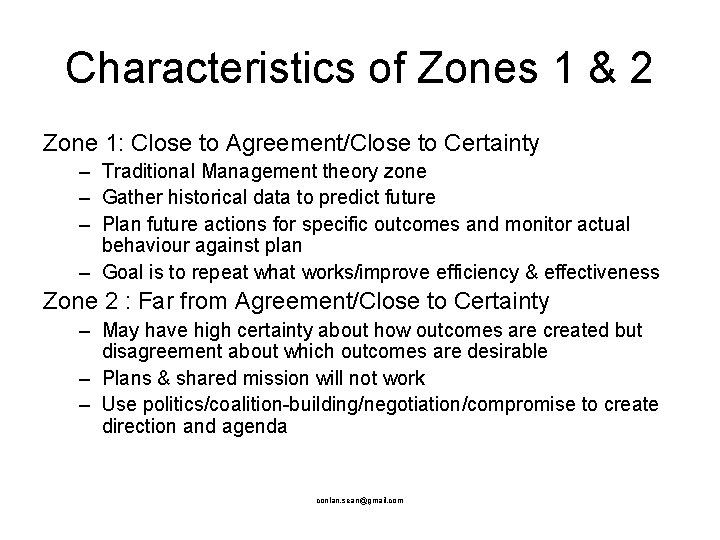
Characteristics of Zones 1 & 2 Zone 1: Close to Agreement/Close to Certainty – Traditional Management theory zone – Gather historical data to predict future – Plan future actions for specific outcomes and monitor actual behaviour against plan – Goal is to repeat what works/improve efficiency & effectiveness Zone 2 : Far from Agreement/Close to Certainty – May have high certainty about how outcomes are created but disagreement about which outcomes are desirable – Plans & shared mission will not work – Use politics/coalition-building/negotiation/compromise to create direction and agenda conlan. sean@gmail. com
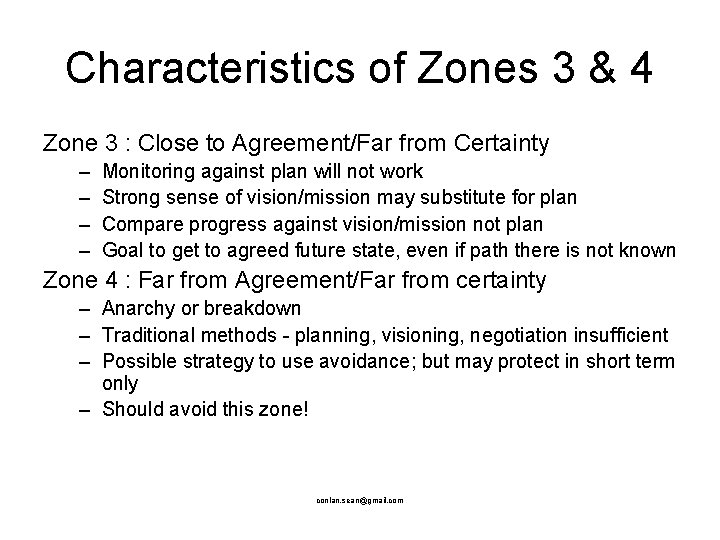
Characteristics of Zones 3 & 4 Zone 3 : Close to Agreement/Far from Certainty – – Monitoring against plan will not work Strong sense of vision/mission may substitute for plan Compare progress against vision/mission not plan Goal to get to agreed future state, even if path there is not known Zone 4 : Far from Agreement/Far from certainty – Anarchy or breakdown – Traditional methods - planning, visioning, negotiation insufficient – Possible strategy to use avoidance; but may protect in short term only – Should avoid this zone! conlan. sean@gmail. com
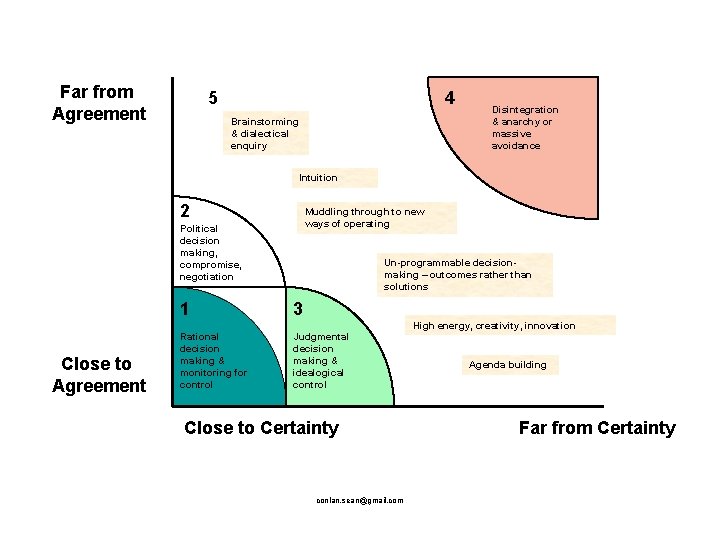
Far from Agreement 5 4 Brainstorming & dialectical enquiry Disintegration & anarchy or massive avoidance Intuition 2 Muddling through to new ways of operating Political decision making, compromise, negotiation Un-programmable decisionmaking – outcomes rather than solutions 1 3 Rational decision making & monitoring for control Judgmental decision making & idealogical control High energy, creativity, innovation Close to Agreement Close to Certainty conlan. sean@gmail. com Agenda building Far from Certainty
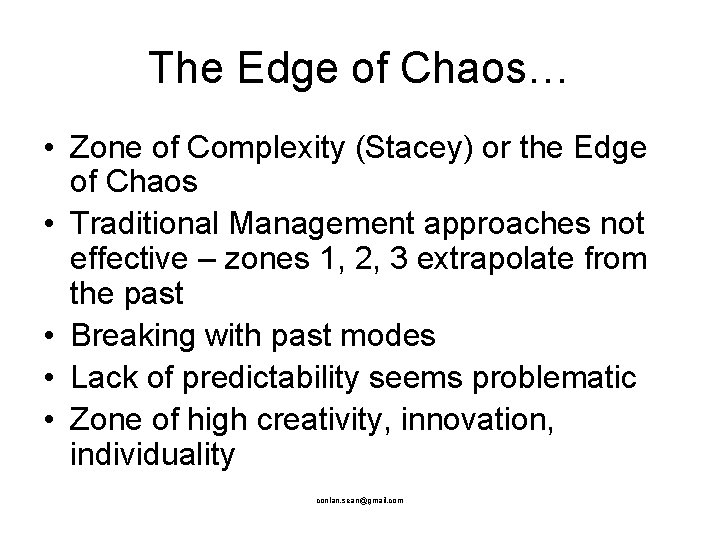
The Edge of Chaos… • Zone of Complexity (Stacey) or the Edge of Chaos • Traditional Management approaches not effective – zones 1, 2, 3 extrapolate from the past • Breaking with past modes • Lack of predictability seems problematic • Zone of high creativity, innovation, individuality conlan. sean@gmail. com
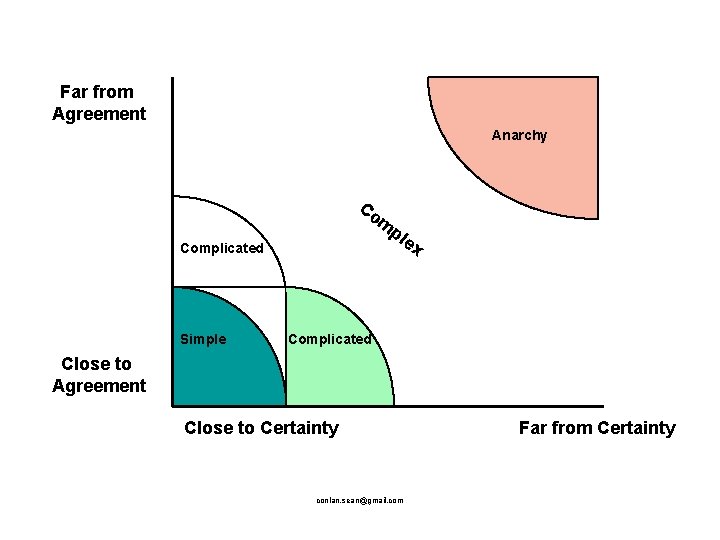
Far from Agreement Anarchy Co m Complicated Simple pl ex Complicated Close to Agreement Close to Certainty conlan. sean@gmail. com Far from Certainty
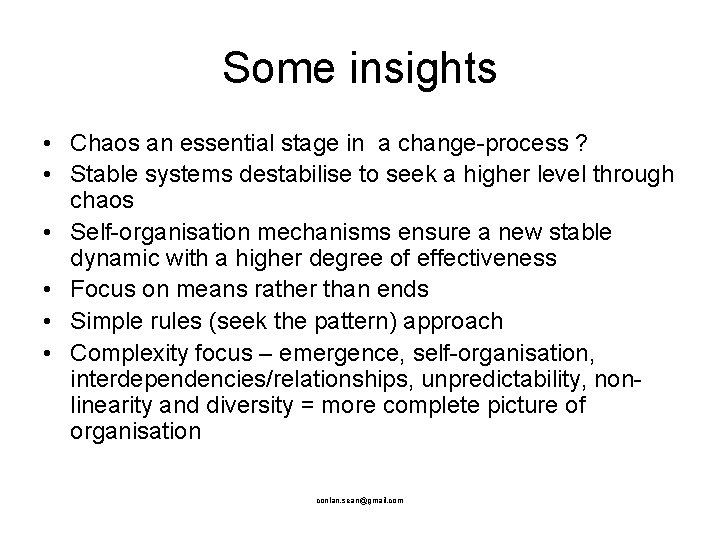
Some insights • Chaos an essential stage in a change-process ? • Stable systems destabilise to seek a higher level through chaos • Self-organisation mechanisms ensure a new stable dynamic with a higher degree of effectiveness • Focus on means rather than ends • Simple rules (seek the pattern) approach • Complexity focus – emergence, self-organisation, interdependencies/relationships, unpredictability, nonlinearity and diversity = more complete picture of organisation conlan. sean@gmail. com
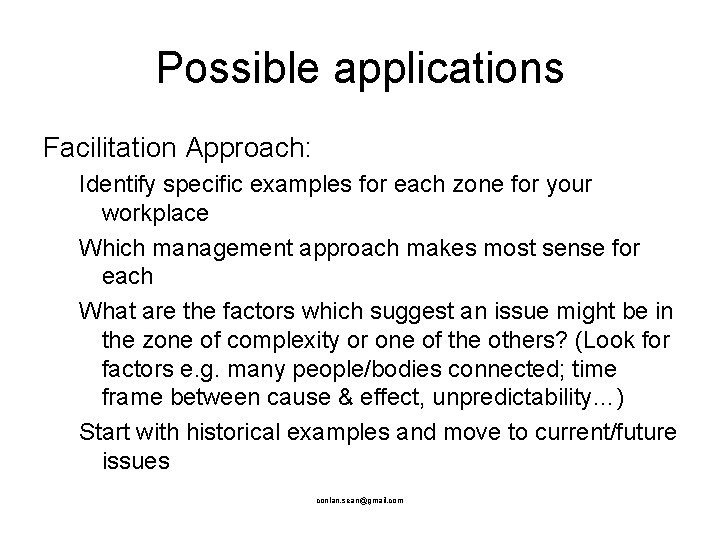
Possible applications Facilitation Approach: Identify specific examples for each zone for your workplace Which management approach makes most sense for each What are the factors which suggest an issue might be in the zone of complexity or one of the others? (Look for factors e. g. many people/bodies connected; time frame between cause & effect, unpredictability…) Start with historical examples and move to current/future issues conlan. sean@gmail. com
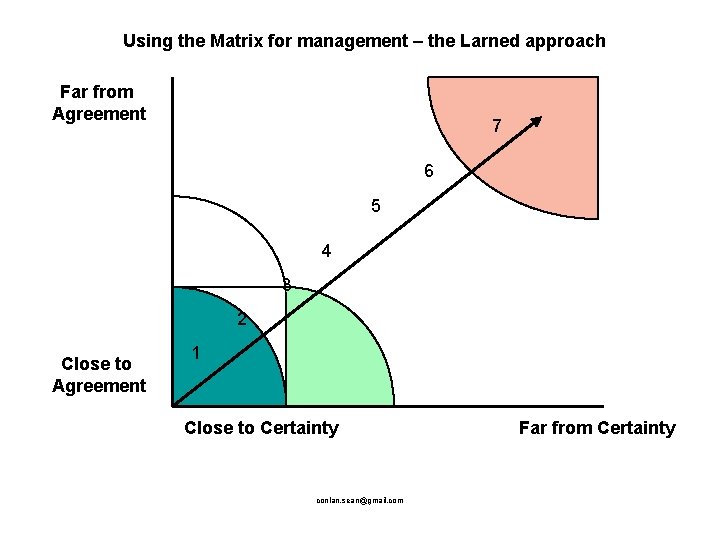
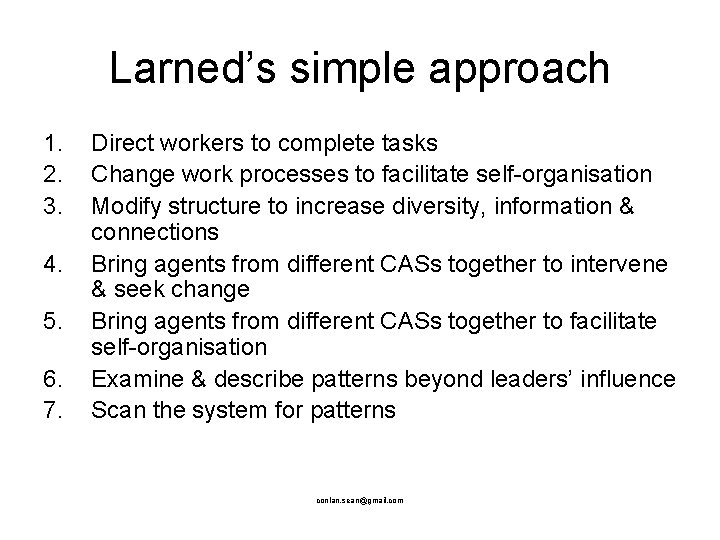
Using the Matrix for management – the Larned approach Far from Agreement 7 6 5 4 3 2 Close to Agreement 1 Close to Certainty conlan. sean@gmail. com Far from Certainty
Larned’s simple approach 1. 2. 3. 4. 5. 6. 7. Direct workers to complete tasks Change work processes to facilitate self-organisation Modify structure to increase diversity, information & connections Bring agents from different CASs together to intervene & seek change Bring agents from different CASs together to facilitate self-organisation Examine & describe patterns beyond leaders’ influence Scan the system for patterns conlan. sean@gmail. com
In Summary • • Stacey offers insights not normally exposed in ‘traditional’ management Insights enable mapping of ‘where the organisation is at’ Possible roadmap for innovation For more on it try: 1. http: //www. plexusinstitute. org/edgeware/archive/thin k/main_aides 3. html 2. http: //www. change-managementtoolbook. com/tools/cert_matrix. html conlan. sean@gmail. com