
CINEMAcraft Virtual Minecraft Presence Using OPERAcraft Ico Bukvic
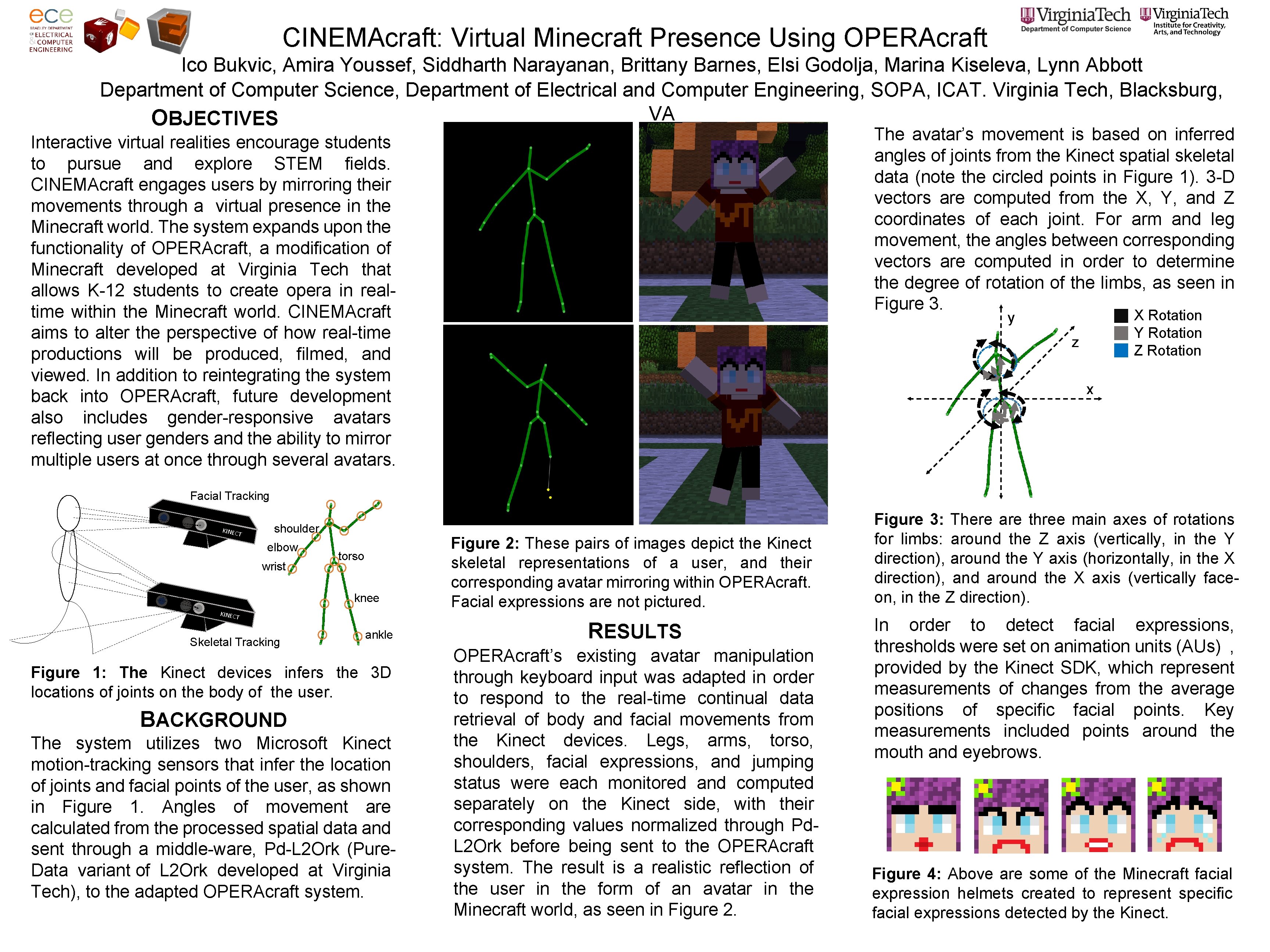
CINEMAcraft: Virtual Minecraft Presence Using OPERAcraft Ico Bukvic, Amira Youssef, Siddharth Narayanan, Brittany Barnes, Elsi Godolja, Marina Kiseleva, Lynn Abbott Department of Computer Science, Department of Electrical and Computer Engineering, SOPA, ICAT. Virginia Tech, Blacksburg, VA OBJECTIVES The avatar’s movement is based on inferred angles of joints from the Kinect spatial skeletal data (note the circled points in Figure 1). 3 -D vectors are computed from the X, Y, and Z coordinates of each joint. For arm and leg movement, the angles between corresponding vectors are computed in order to determine the degree of rotation of the limbs, as seen in Figure 3. Interactive virtual realities encourage students to pursue and explore STEM fields. CINEMAcraft engages users by mirroring their movements through a virtual presence in the Minecraft world. The system expands upon the functionality of OPERAcraft, a modification of Minecraft developed at Virginia Tech that allows K-12 students to create opera in realtime within the Minecraft world. CINEMAcraft aims to alter the perspective of how real-time productions will be produced, filmed, and viewed. In addition to reintegrating the system back into OPERAcraft, future development also includes gender-responsive avatars reflecting user genders and the ability to mirror multiple users at once through several avatars. X Rotation Y Rotation Z Rotation y z x Facial Tracking KINEC T shoulder elbow wrist torso knee KINEC T Skeletal Tracking ankle Figure 1: The Kinect devices infers the 3 D locations of joints on the body of the user. BACKGROUND The system utilizes two Microsoft Kinect motion-tracking sensors that infer the location of joints and facial points of the user, as shown in Figure 1. Angles of movement are calculated from the processed spatial data and sent through a middle-ware, Pd-L 2 Ork (Pure. Data variant of L 2 Ork developed at Virginia Tech), to the adapted OPERAcraft system. Figure 2: These pairs of images depict the Kinect skeletal representations of a user, and their corresponding avatar mirroring within OPERAcraft. Facial expressions are not pictured. RESULTS OPERAcraft’s existing avatar manipulation through keyboard input was adapted in order to respond to the real-time continual data retrieval of body and facial movements from the Kinect devices. Legs, arms, torso, shoulders, facial expressions, and jumping status were each monitored and computed separately on the Kinect side, with their corresponding values normalized through Pd. L 2 Ork before being sent to the OPERAcraft system. The result is a realistic reflection of the user in the form of an avatar in the Minecraft world, as seen in Figure 2. Figure 3: There are three main axes of rotations for limbs: around the Z axis (vertically, in the Y direction), around the Y axis (horizontally, in the X direction), and around the X axis (vertically faceon, in the Z direction). In order to detect facial expressions, thresholds were set on animation units (AUs) , provided by the Kinect SDK, which represent measurements of changes from the average positions of specific facial points. Key measurements included points around the mouth and eyebrows. Figure 4: Above are some of the Minecraft facial expression helmets created to represent specific facial expressions detected by the Kinect.
- Slides: 1