
Cincinnati Homelessness Study The Family Point of View
- Slides: 1
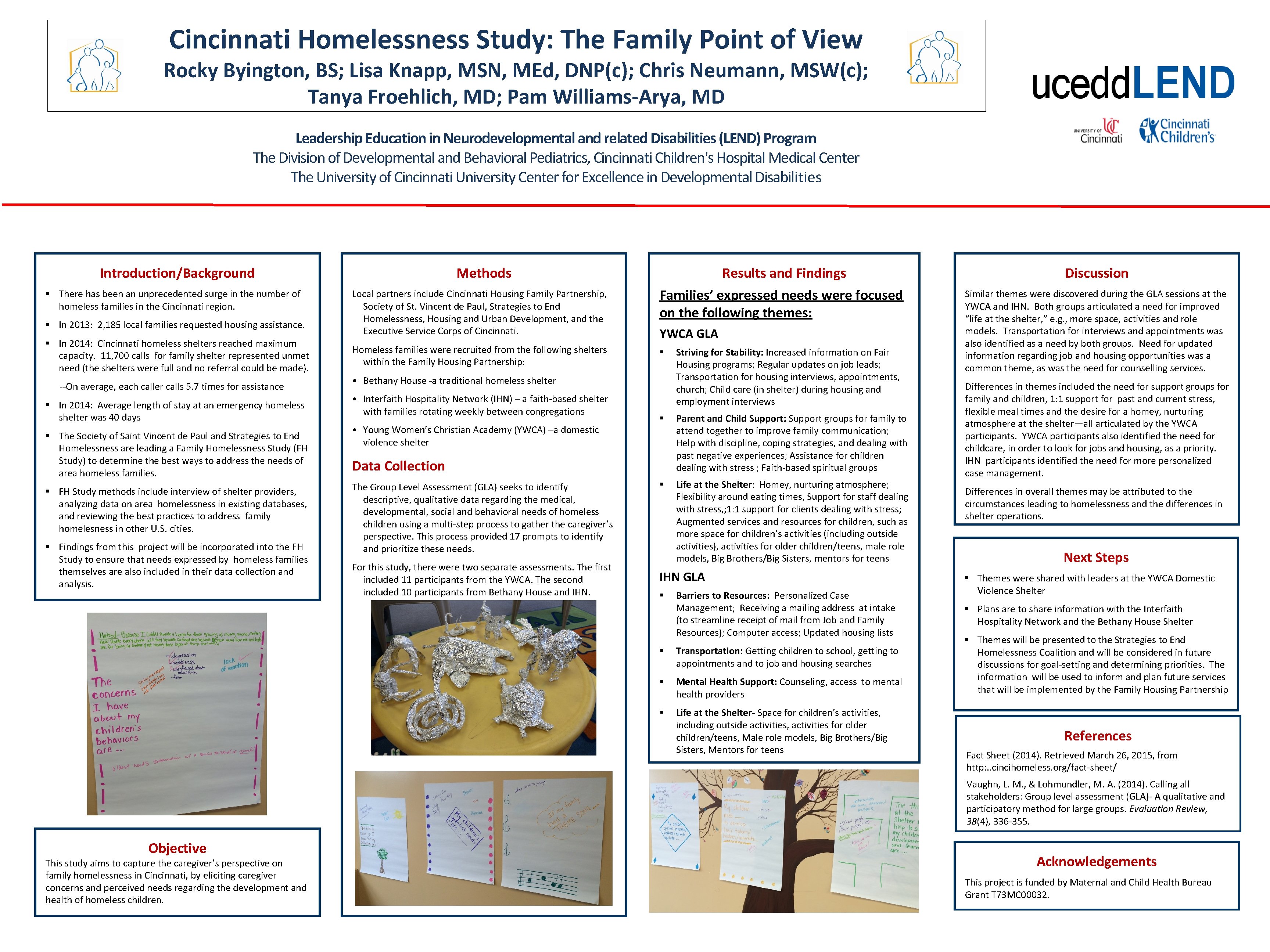
Cincinnati Homelessness Study: The Family Point of View Rocky Byington, BS; Lisa Knapp, MSN, MEd, DNP(c); Chris Neumann, MSW(c); Tanya Froehlich, MD; Pam Williams-Arya, MD Leadership Education in Neurodevelopmental and related Disabilities (LEND) Program The Division of Developmental and Behavioral Pediatrics, Cincinnati Children's Hospital Medical Center The University of Cincinnati University Center for Excellence in Developmental Disabilities Methods Results and Findings Discussion Local partners include Cincinnati Housing Family Partnership, Society of St. Vincent de Paul, Strategies to End Homelessness, Housing and Urban Development, and the Executive Service Corps of Cincinnati. Families’ expressed needs were focused on the following themes: Homeless families were recruited from the following shelters within the Family Housing Partnership: § Similar themes were discovered during the GLA sessions at the YWCA and IHN. Both groups articulated a need for improved “life at the shelter, ” e. g. , more space, activities and role models. Transportation for interviews and appointments was also identified as a need by both groups. Need for updated information regarding job and housing opportunities was a common theme, as was the need for counselling services. Introduction/Background § There has been an unprecedented surge in the number of homeless families in the Cincinnati region. § In 2013: 2, 185 local families requested housing assistance. § In 2014: Cincinnati homeless shelters reached maximum capacity. 11, 700 calls for family shelter represented unmet need (the shelters were full and no referral could be made). --On average, each caller calls 5. 7 times for assistance § In 2014: Average length of stay at an emergency homeless shelter was 40 days § The Society of Saint Vincent de Paul and Strategies to End Homelessness are leading a Family Homelessness Study (FH Study) to determine the best ways to address the needs of area homeless families. § FH Study methods include interview of shelter providers, analyzing data on area homelessness in existing databases, and reviewing the best practices to address family homelesness in other U. S. cities. § Findings from this project will be incorporated into the FH Study to ensure that needs expressed by homeless families themselves are also included in their data collection and analysis. YWCA GLA • Bethany House -a traditional homeless shelter • Interfaith Hospitality Network (IHN) – a faith-based shelter with families rotating weekly between congregations • Young Women’s Christian Academy (YWCA) –a domestic violence shelter § Parent and Child Support: Support groups for family to attend together to improve family communication; Help with discipline, coping strategies, and dealing with past negative experiences; Assistance for children dealing with stress ; Faith-based spiritual groups § Life at the Shelter: Homey, nurturing atmosphere; Flexibility around eating times, Support for staff dealing with stress, ; 1: 1 support for clients dealing with stress; Augmented services and resources for children, such as more space for children’s activities (including outside activities), activities for older children/teens, male role models, Big Brothers/Big Sisters, mentors for teens Data Collection The Group Level Assessment (GLA) seeks to identify descriptive, qualitative data regarding the medical, developmental, social and behavioral needs of homeless children using a multi-step process to gather the caregiver’s perspective. This process provided 17 prompts to identify and prioritize these needs. For this study, there were two separate assessments. The first included 11 participants from the YWCA. The second included 10 participants from Bethany House and IHN. Striving for Stability: Increased information on Fair Housing programs; Regular updates on job leads; Transportation for housing interviews, appointments, church; Child care (in shelter) during housing and employment interviews IHN GLA § Barriers to Resources: Personalized Case Management; Receiving a mailing address at intake (to streamline receipt of mail from Job and Family Resources); Computer access; Updated housing lists § Transportation: Getting children to school, getting to appointments and to job and housing searches § Mental Health Support: Counseling, access to mental health providers § Life at the Shelter- Space for children’s activities, including outside activities, activities for older children/teens, Male role models, Big Brothers/Big Sisters, Mentors for teens Differences in themes included the need for support groups for family and children, 1: 1 support for past and current stress, flexible meal times and the desire for a homey, nurturing atmosphere at the shelter—all articulated by the YWCA participants also identified the need for childcare, in order to look for jobs and housing, as a priority. IHN participants identified the need for more personalized case management. Differences in overall themes may be attributed to the circumstances leading to homelessness and the differences in shelter operations. Next Steps § Themes were shared with leaders at the YWCA Domestic Violence Shelter § Plans are to share information with the Interfaith Hospitality Network and the Bethany House Shelter § Themes will be presented to the Strategies to End Homelessness Coalition and will be considered in future discussions for goal-setting and determining priorities. The information will be used to inform and plan future services that will be implemented by the Family Housing Partnership References Fact Sheet (2014). Retrieved March 26, 2015, from http: . . cincihomeless. org/fact-sheet/ Vaughn, L. M. , & Lohmundler, M. A. (2014). Calling all stakeholders: Group level assessment (GLA)- A qualitative and participatory method for large groups. Evaluation Review, 38(4), 336 -355. Objective This study aims to capture the caregiver’s perspective on family homelessness in Cincinnati, by eliciting caregiver concerns and perceived needs regarding the development and health of homeless children. Acknowledgements This project is funded by Maternal and Child Health Bureau Grant T 73 MC 00032.