
Church Fathers Apostolic Fathers Who were they Successors
- Slides: 54
Church Fathers Apostolic Fathers
Who were they? • Successors of the apostles. • Responsible for spreading the Gospel. • Interpreting Christ’s message. • Some of them (Clement of Rome and Polycarp of Smyrna) might have known some of the apostles personally. • These are also referred to as “apostolic fathers”. • Some of them are universally recognized, e. g. , Augustine, Athanasius, and Ambrose. • Others are not quite recognized universally.
Characteristics 1. Orthodoxy • Orthodoxy means right teaching as opposed to false teaching. • Teachings in line with what Christ taught. • Some of them were not orthodox all the time. • But they stayed within the accepted boundaries of doctrine. • Some helped set the boundaries. • Some were found to be in error later, e. g. , Origen and Tertullian (not saints). • Those who erred were not completely rejected. • Most of their teachings were not discarded.
2. Holiness of Life • Wide area of interpretation. • Cyril of Alexandria perhaps committed murder. • Most fathers were holy. • Holiness may not mean geniality or affability. • Saints may not always be easy to live with. • E. g. , Jerome was known for his sharp tongue, which he often directed at Saint Augustine.
3. Approval by the Church • For most of them, the church’s approval was unequivocal. • Origen and Tertullian were found wanting. • However, their writings were carefully preserved.
4. Antiquity • They come from the period, not later than AD 750. • John Damascene (AD 750) is generally regarded as the last of the fathers.
1. Origen (184 AD - 253 AD) • Origen of Alexandria, also known as Origen Adamantius. • Was an early Christian scholar, ascetic, and theologian. • Was born and spent the first half of his career in Alexandria. • Was educated at the Catechetical School of Alexandria • Parents: Leonides of Alexandria • Was influenced by Plato, Clement of Alexandria, Ammonius Saccas.
• Was born during Septimius’ persecution. • His father was martyred when Origen was 17. • Was a gifted and eminent teacher and scholar. • Was named head teacher of the Alexandria catechetical school. • Travelled to Rome, Athens, Arabia on Church business. • Travelled to Caesarea, Palestine. • He was ordained in Palestine.
• His bishop, Demetrius exiled him to Palestine. • Worked in Palestine as a priest. • During Decius’ persecution, Origen was severely tortured. • He died a few years later. • Had a significant influence on monasticism. • He was condemned at the 2 nd Council of Constantinople (553). • Also condemned in subsequent councils. Major charges against him: 1. He believed in universal salvation. 2. He also believed in the pre-existence of souls.
Universal Salvation (Apokatastasis ) • Every created thing would eventually return to him. • Every soul is ultimately saved. • Purification of sinners would be severe. • God wants everyone to be saved. • God wants everyone to come to knowledge. • Sin cannot thwart God’s providence. • The worst sinners would be saved too.
Preexistence of Souls • Souls existed with God before the creation of this world. • Persons attained bodies after the fall. • He believed in the resurrection of the body. • To him the resurrected body would be spiritual. • Origen was condemned after 300 years in the grave. • His teachings influenced theology and spirituality.
Origen’s Mystical Path • Original creation was spiritual. • Spiritual beings were created equal. • They were created after the image of God, the Logos. • Each intellect had a spiritual body. • They contemplated God. • This was kind of preexistent church. • It was under the preexistent Christ. • Preexistent beings had freedom. • The freedom allowed for the possibility of fall.
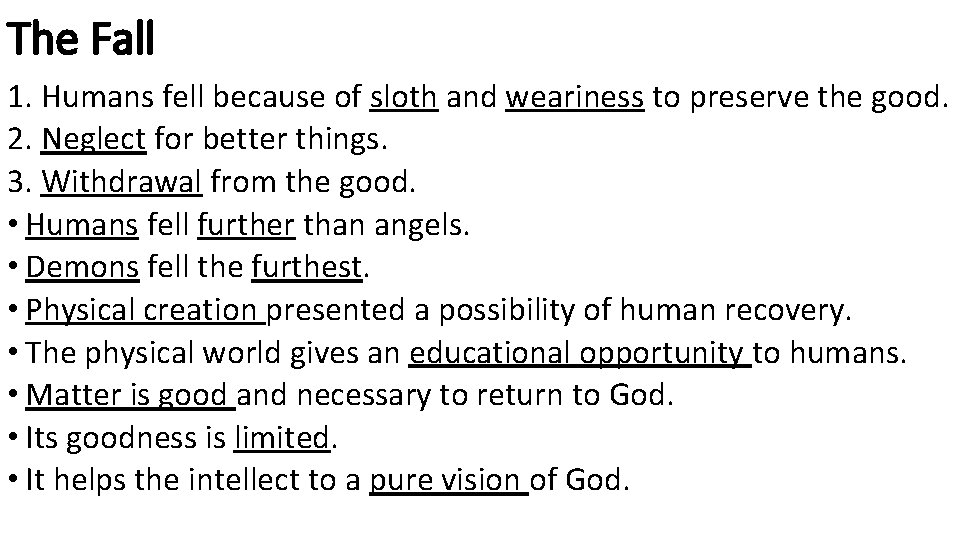
The Fall 1. Humans fell because of sloth and weariness to preserve the good. 2. Neglect for better things. 3. Withdrawal from the good. • Humans fell further than angels. • Demons fell the furthest. • Physical creation presented a possibility of human recovery. • The physical world gives an educational opportunity to humans. • Matter is good and necessary to return to God. • Its goodness is limited. • It helps the intellect to a pure vision of God.
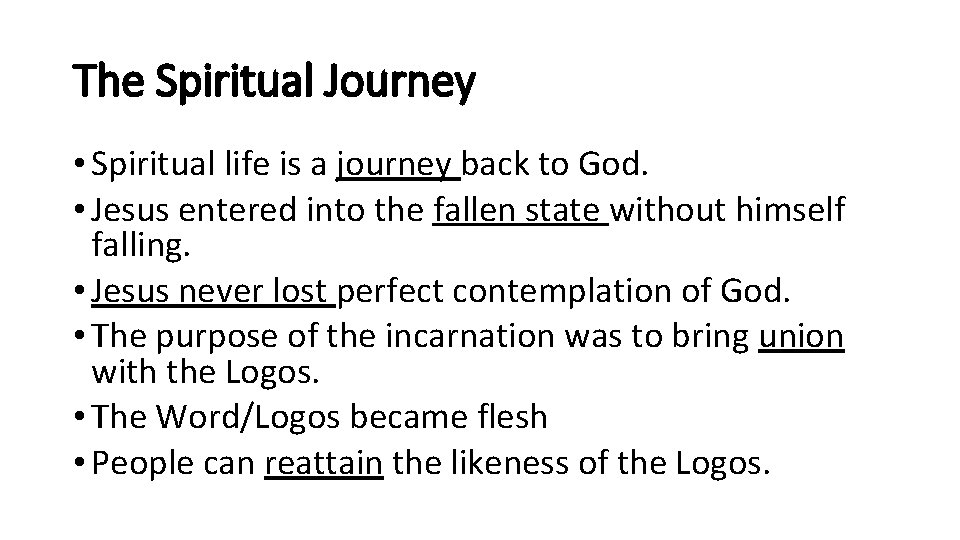
The Spiritual Journey • Spiritual life is a journey back to God. • Jesus entered into the fallen state without himself falling. • Jesus never lost perfect contemplation of God. • The purpose of the incarnation was to bring union with the Logos. • The Word/Logos became flesh • People can reattain the likeness of the Logos.
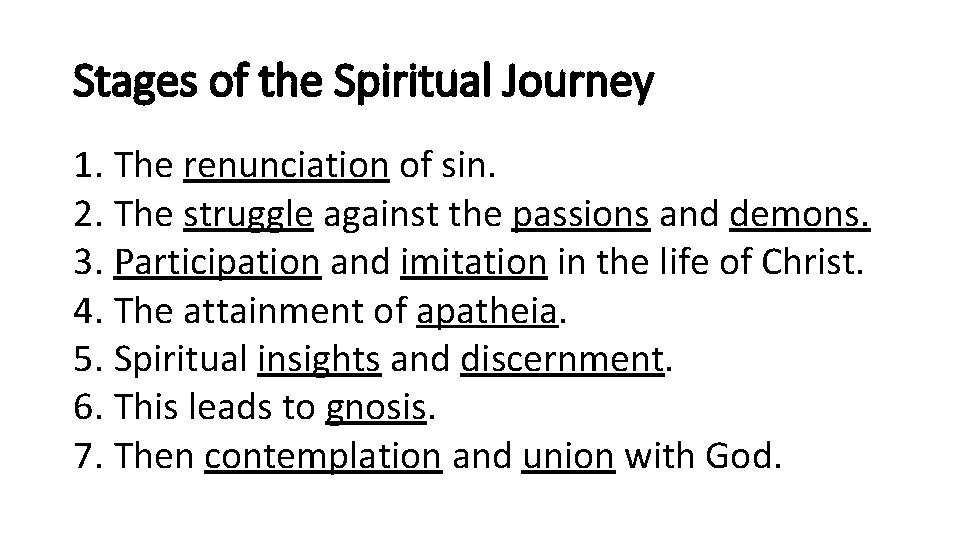
Stages of the Spiritual Journey 1. The renunciation of sin. 2. The struggle against the passions and demons. 3. Participation and imitation in the life of Christ. 4. The attainment of apatheia. 5. Spiritual insights and discernment. 6. This leads to gnosis. 7. Then contemplation and union with God.
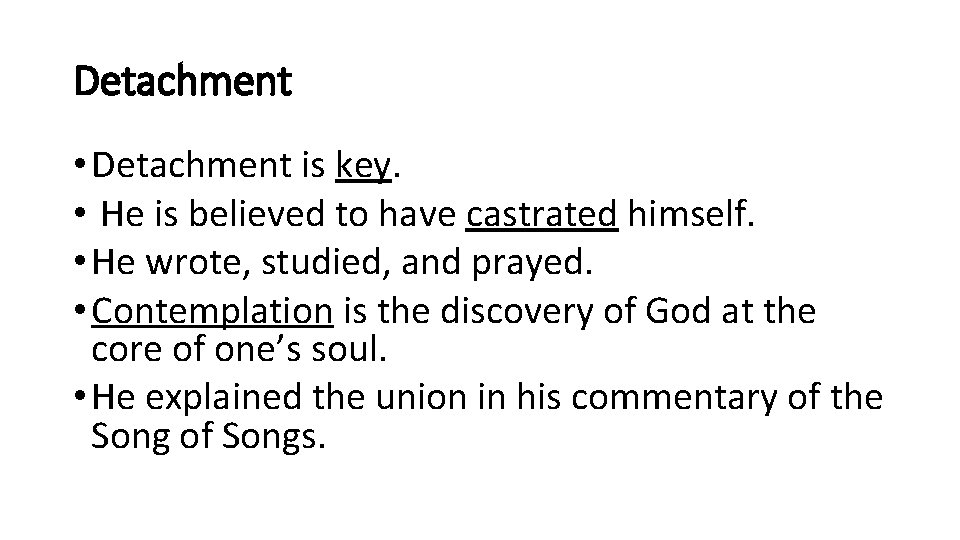
Detachment • Detachment is key. • He is believed to have castrated himself. • He wrote, studied, and prayed. • Contemplation is the discovery of God at the core of one’s soul. • He explained the union in his commentary of the Song of Songs.
2. Clement of Alexandria • Resources are scanty. • Born in Athens of Greek parents around 150. • Converted to Christianity. • Finally settled in Egypt as a student of Pantaenus. • Pantaenus was the first director of the Catechetical School. • Remained in Alexandria for 20 years. • Left Egypt around 202 during Septimius Severus’s persecution. • Died in Cappadocia in C. 215. • Wrote several books. • Taught about gnosis and apatheia.
• Exhortation to the Greeks was an introductory philosophical work for the unbaptized. • It attempted to show the reasonableness of the Christian faith. • Instructor, outlines the specific duties and ethics taught by the "Instructor" (Christ). • Miscellanies deals with advanced philosophy, ethics, and disciplined instruction for "Christian Gnostics“. • Clement has had no notable influence on the course of theology. • Scholars have found it no easy task to sum up the chief points of his teaching. • He lacks technical precision.
4. Tertullian (C. 155 -212) • Full name: Quintus Septimius Florens Tertullianus. • Born in Carthage, Roman North Africa (Tunisia). • Son of a centurion, and received solid education. • Might have worked as an advocate in Rome. • Converted after a stormy youth. • Full of zeal for the church. • It’s not agreed whether he was a priest or not. • He became a Montanist about 207. • He ended by founding his own sect, the Tertullianists.
Work • His work is mainly polemical, Apologetic, and ascetical. • Active during Emperor Septimus Severus who wanted to impose the imperial cult (193 -211). • Wrote To the Martyrs c. 197), encouraging the catechumens in prison. • His main apologetic work is Apologeticum, which was addressed to governors of the Provinces of Rome. • In it, he calls for the freedom of religion. • As a polemicist, he wrote against the Jews, the heretics, the pagans. • He combated the Gnostics: Against Marcion, Against Hermogenes, Against the Valentinians. • In Against Praxeas, he expounds the doctrine of the Trinity.
• He also wrote, On Baptism: a catechesis which deals with biblical typology, ritual, and doctrine of sacrament. • On Prayer: a commentary on Our Father, and characteristics of a Christian prayer. • On the Dress of Women and To My wife: he writes his wishes to his wife in the event of his death. • He is considered the Father of theological Latin. • He molded the Trinitarian formulations.
4. Irenaeus (130 AD-200 AD) • Born in Smyrna, Asia Minor. • He became the bishop of Lyons, France. • He is associated with the refutation of Gnosticism. • His major work is, Against all Heresies. • In this book, he sticks to the bible and Church traditions. • He affirmed unity, “one God, one Christ, one church, one faith. ” • Taught that no salvation outside God the Creator, his son, and the Holy Spirit. • The whole creation is good because it is the work of God.
• The human being is a pneumatized body. • It is inhabited by the holy spirit, who guarantees its incorruptibility. • Human beings are made in the image of God. • Humanity’s goal is to get into communion with God. • Human history was the preparation of the coming of Christ. • The cross of Christ was a replica of the Adamic tree of life. • The Eucharist is the last stage in the history of salvation. • He asserted the validity of the Jewish Bible (the Old Testament), which the Gnostics denied. • He asserted the validity of the two testaments.
5. Basil of Caesarea (329 -379) • One of the Cappadocian (present day Turkey) fathers. • His father, Basil the Elder was a teacher of rhetoric. • His mother was Emmelia. • They might have inherited the Christian faith from Basil’s grandmother, Macrina, the Elder. • He was baptized c. 327 AD. • Basil was initially educated by his father in Caesarea. • At 21, he went to Athens for studies.
• Met his friend from Cappadocia, Gregory of Nazianzus. • He toured Egyptian, Palestinian, and Mesopotamian monasteries soon afterwards. • Ascetic life permanently damaged his health. • Came back home to distribute his fortune to the poor. • He settled in solitude at Annesi, on the banks of Iris. • His friend, Gregory came to join him. • Together they composed the Philocalia (I Love Flowers. • Saint Basil also framed two monastic rules. • Was ordained priest in Caesarea. • Succeeded bishop Eusebius in 370 AD.
1. He was a social bishop. He preached against luxury. He built a veritable city, Basiliad, with a hospice and hospital. 2. He recommended communal life to avoid challenges of Anchorite life. Wrote two ascetic works, the Little Asceticon and the Great Asceticon, providing directives for communal life. 3. Is said to have given the word, “consubstantial” a new meaning (equality between Father and Son). 4. He was also a man of culture. In his homilies, he directed young people to read Greek poetry.
6. Gregory of Nazianzus (329 -390 AD) • Another Cappadocian Father. • His father was Gregory (the Elder), bishop of Nazianzus (Nenizi, South West of Caesarea). • His mother was Nonna, from whom he inherited his Christian faith. • His father ordained him priest, and wanted him to succeed him. • Gregory fled. • Came back for his father’s funeral, and gave a sermon, which has survived to this day. • Basil, his friend consecrated him bishop of a poor town called Sasimus, which he never visited. • Gregory took over in 374, after the death of his father. • Later, he withdrew to a life of solitude in Seleucia, Cyprus.
• In 379, the Christians of Constantinople made him head of their community. • He then wrote Five Theological Discourses, which defined orthodox faith in Christ and the Trinity. • In 381, at the council of Constantinople, Emperor Theodosius, recognized him as the bishop of Constantinople. • His authority was challenged, and he returned to Nazianzus. • Later withdrew to his family’s estate, where he continued writing. • He was a theologian who formulated belief in the Trinity. • He was also a humanist and poet.
7. Gregory of Nysa (335 -394 AD) • Born in Cappadocia (modern day Turkey). • The famous Saint Macrina was his sister. • Saint Basil was his brother. • Out of 9 siblings, 4 were made Saints. • Was trained in literature, philosophy, rhetoric, and theology. • Father was a teacher of rhetoric. • He and his wife entered monasteries. • His brother Basil made him bishop of Nyssa in 372.
• Was briefly arrested for allegations of church funds embezzlement. • Was cleared and restore to his office in 378. • He was an exemplary bishop and good theologian. • Basil and Gregory played a prominent part in the 2 nd Council of Constantinople (381). • Gregory of Nyssa, his brother, Basil, and friend Gregory of Nazianzus are known as Cappadocian Fathers. • Basil and Macrina died in 379.
• Against Eunomius, Gregory's four-book refutation of that last phase of the Arian heresy. • On the Work of the Six Days, Gregory's account of the creation of the world. • On the Making of Man, his account of the creation of humankind. • The Great Catechism, the most systematic statement of Gregory's philosophy of history • On the Soul and the Resurrection, a dialogue with Macrina detailing Gregory's eschatology. • Biblical commentaries on the life of Moses, the inscriptions of the Psalms, Ecclesiastes, the Song of Songs, the Beatitudes, and the Lord's Prayer. • Theological works on Trinitarian and Christological doctrine. • Shorter ascetic and moral treatises.
Arianism • Arianism attempted to make sense of the apparently conflicting Biblical portrayals of Christ. • E. G. , "I and the Father are one" (John 10: 30) seems to contradict "the Father is greater than I" (John 14: 28). • Arius postulated that Christ was neither divine nor human. • But something in between--a demigod, the oldest and most perfect created being, to be sure, but created nonetheless.
Methods of Biblical Interpretation of Gregory’s Time • Literal, as History. • Moral Guidance. • 3 (a) Mystical, (Revealed truths about Purgation of the Soul). • 3 (b) Mystical, (characters and situations having allegorical meanings). • 4. Anagogical, (text reflecting the end times/the soul’s full union with God).
The Fourfold Method of Interpretation • The literal teaches readers what to know. • The moral guides what to do. • The allegorical says what to believe. • The anagogical shows what to hope for. • (N. B) Some texts were believed to include all levels of interpretation.
Gregory: The Life of Moses (Allegorical) • He interpreted the story of Moses and Exodus allegorically. • Gives his understanding of the spiritual union with God. • For him much of the Exodus happened literally and historically. • Parts of it refer to the Christian Life. 1. Taking off the sandals: refers to the animal skin of sense perception.
2. The burning bush: God is first experienced as light. 3. Pharaoh: Represents the will, which should be trained to incline to the good. 4. The plagues: The work of the passions. Evil corrupts the clear waters of life. 5. Frogs: The evil in the heart. 6. Departure: The transience of life itself.
7. Eating with sandals on the feet: Life is a journey. 8. Eating with staff in the hand: The virtue of hope. 9. The despoiling of the Egyptians: Pagan learning. 10. Crossing the Red Sea: Baptism. 11. Death of Egyptian armies: Death of evil tendencies. 12. Death of Firstborns: Human sinfulness. 13. Moses ascending Mount Sinai: The ascent of the soul to unite with God.
On Mystical Experiences • At first, God reveals himself as light. • Second, God is known through enlightening experiences of his hidden truth. • Such experiences are limited. • God transcends perception. • God is absolutely incomprehensible. • One has spiritual senses that can perceive what the intellect cannot. • Humans have a faculty that can know God as he really is.
• Our language about God does not quite capture who God is. • Gregory thought of God as infinitely good. • God is so other, that speaking about God is problematic. • One can never experience God fully because he is finite. • Heaven: an ongoing penetration into the infinite God. • Created in the image of God: God is the archetype of the human being. • The final perfection of the human state is deification.
8. Saint Augustine of Hippo (354 -430) • Born in Thagaste (Eastern Algeria). • His father (non-Christian) was Patrick. • He was a minor local official. • Mother was Monica (Christian). • Augustine studied Greek, Latin, Greco-Roman history, politics, philosophy, and literature. • Excelled as a student. • At 17, he travelled to Carthage (Tunisia) for further studies. • At 20, he became a teacher in Carthage.
• Read Cicero’s Hortensius, which over-romanticized the pursuit of wisdom. • For 10 years searched for an intellectually compelling religion. • He joined Manicheanism. • In 384, he moved to Rome to join a group of intellectuals. • Later, Symmacus chose him to go to Milan to work as publicist and propagandist for the empire.
• Augustine became famous and wealthy. • Milan was Christian, and its bishop was St. Ambrose (340 -397). • August was impressed by bishop Ambrose. • Ambrose assigned him a mentor, Fr. Simplicianus. • The mentor asked him to read Platonic philosophy. • Claimed to have heard a mystical voice saying, “pick and read, ” Rom 13: 13 -14. • Was baptized. • Returned to Africa, where he became bishop of Hippo.
Manicheanism • Was founded by Mani. • Was born in southern Babylonia (now in Iraq). • Founded the religion when he was 24 years old. • Preached in Persia, was arrested, imprisoned, and after 26 days of trial, he died between 274 and 277). • His trial is called, The Passion of the Illuminator or Mani’s Crucifixion. • Believed that he was one of the prophets, like Adam, Zoroaster, Jesus, and Buddha. • He regarded himself as the carrier of a universal message destined to replace all other religions.
Teachings • Mani posited the existence of two Gods: one good and the other, bad. • The spirit was associated with the good God. • Matter was associated with the evil God. • All material things were corrupt. • All spiritual things were perfect. • He promoted missionary work. • His teachings spread to other parts of the world. • Was dualistic Gnosticism.
• This world is painful and radically evil. • The soul has been badly influenced by the flesh. • It’s now clouded with ignorance and lack of self-consciousness. • Salvation comes from the knowledge that one belongs to the transcendent God. • The sinner’s soul is condemned to rebirth in a succession of bodies. • At death the soul of the righteous person returns to Paradise. • The community was divided into the elect, who felt able to embrace a rigorous rule, and the hearers who supported the elect with works and alms.
Augustine’s Response 1. Manichaeism was illogical because a divided God was neither perfect nor omnipotent. 2. God is perfect, and Evil is caused by humanity’s misuse of creation. 3. Goodness was active and had tremendous powers, not just passive as Mani taught. 4. The emphasis in the power of evil prevented people to grow in holiness. Just avoiding evil would not increase one’s love for God.
Donatism • Bishop Aptunga, who apostatized during Diocletian's persecution ordained Caecilian as bishop of Carthage. • African bishops objected, and elected a different bishop, who was succeeded by Donatus. • The issue concerned the validity of sacraments when administered by a sinner. • The Donatists argued that one had to be holy and pure in order to validly administer sacraments.
Augustine’s Response 1. The church’s holiness depends on the holiness of its founder and purposes. 2. Sacraments are valid because of their inner purity and sanctity. 3. What makes a sacrament valid is its proper form and intention. 4. It’s Christ who baptizes.
Pelagianism • Was a rigorist movement started by Pelagius, and popularized by his followers. • He wanted to correct superstition and humanity’s passivity/hopelessness. • Argued that human being were capable of achieving salvation. • He denounced the doctrine of Original Sin. • For him, Adam was just a bad example. • Christ’s coming was not necessary, but served as an antidote to Adam’s bad example. • Infant baptism not necessary. • People were obligated to do all the good they could do. • Failure to do that was a sin.
Augustine’s Response 1. It was clear in scripture that Christ came to reconcile the world with God. 2. Eternal life cannot be merited. 3. Grace is a gift from God, that we don’t merit.
Augustinian Spirituality • Was ecclesial in nature. • Love of the church was important. • He taught, comforted, and guided his flock. • Interested in alleviating poverty in Hippo. • Created sort of monastery for his priests.
Augustine’s Asceticism • Practiced celibacy. • He slept little. • Never drank wine. • Lived on a vegetarian diet. • He recommended balance in fasting. • The body is good and should be cared for. • Apatheia never fully achievable because of original sin.
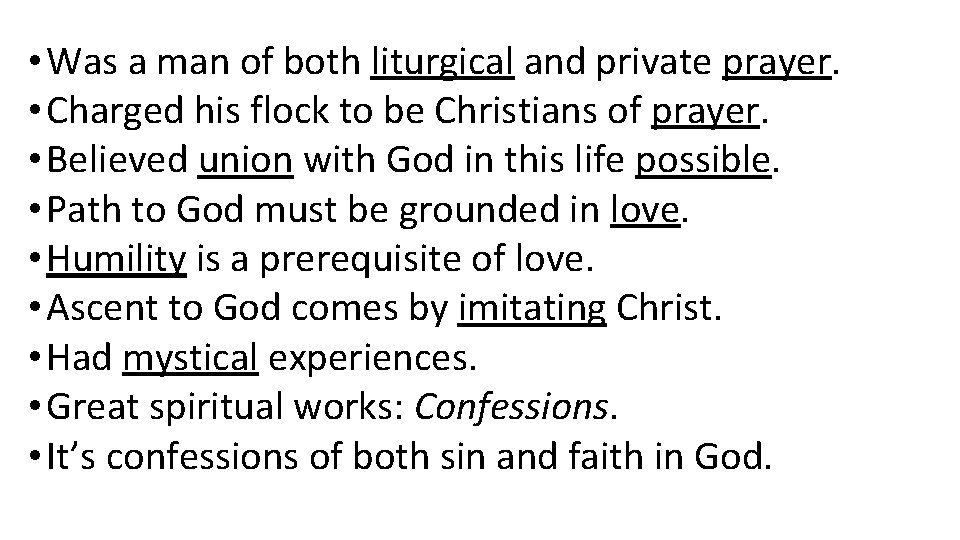
• Was a man of both liturgical and private prayer. • Charged his flock to be Christians of prayer. • Believed union with God in this life possible. • Path to God must be grounded in love. • Humility is a prerequisite of love. • Ascent to God comes by imitating Christ. • Had mystical experiences. • Great spiritual works: Confessions. • It’s confessions of both sin and faith in God.
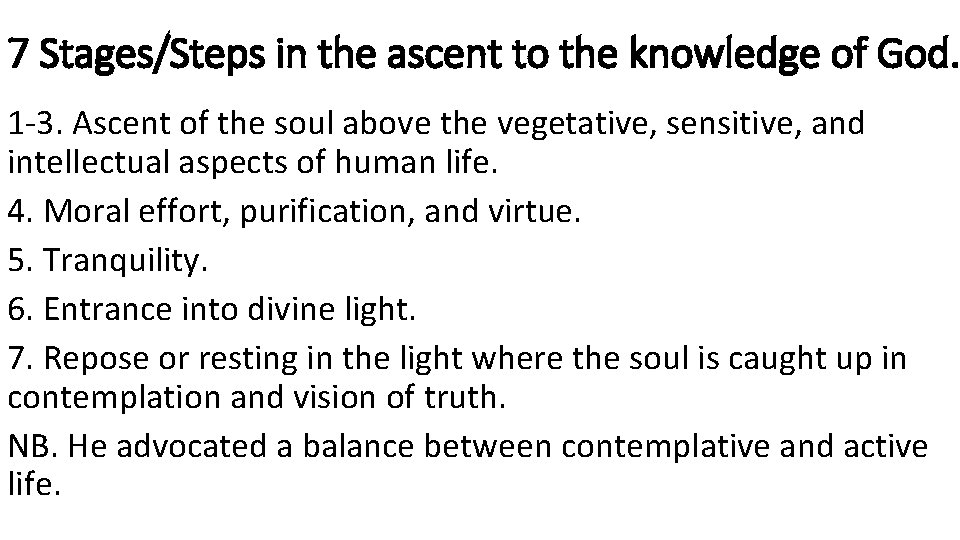
7 Stages/Steps in the ascent to the knowledge of God. 1 -3. Ascent of the soul above the vegetative, sensitive, and intellectual aspects of human life. 4. Moral effort, purification, and virtue. 5. Tranquility. 6. Entrance into divine light. 7. Repose or resting in the light where the soul is caught up in contemplation and vision of truth. NB. He advocated a balance between contemplative and active life.