
CHS Statistics Chapter 4 4 1 4 2
- Slides: 13
CHS Statistics Chapter 4 4. 1 -4. 2: Random Variables Objective: Use experimental and theoretical distributions to make judgments about the likelihood of various outcomes in uncertain situations
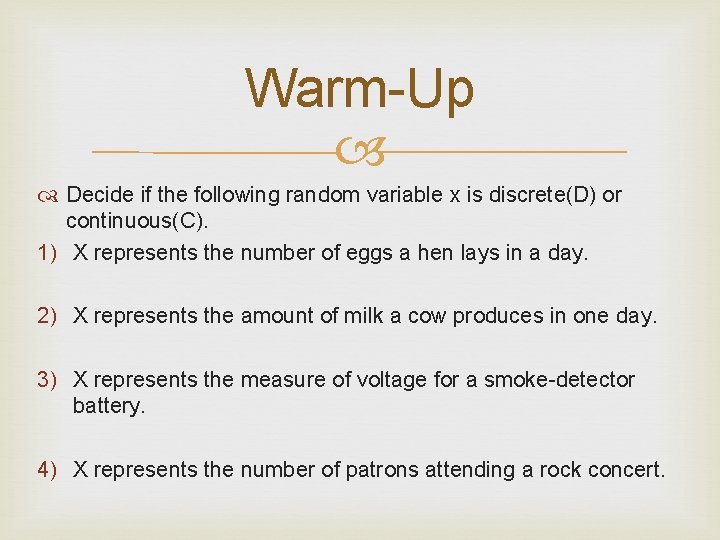
Warm-Up Decide if the following random variable x is discrete(D) or continuous(C). 1) X represents the number of eggs a hen lays in a day. 2) X represents the amount of milk a cow produces in one day. 3) X represents the measure of voltage for a smoke-detector battery. 4) X represents the number of patrons attending a rock concert.
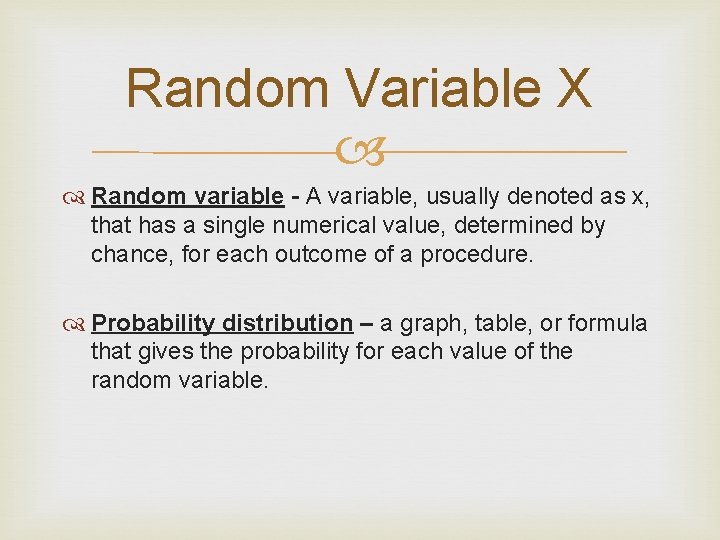
Random Variable X Random variable - A variable, usually denoted as x, that has a single numerical value, determined by chance, for each outcome of a procedure. Probability distribution – a graph, table, or formula that gives the probability for each value of the random variable.
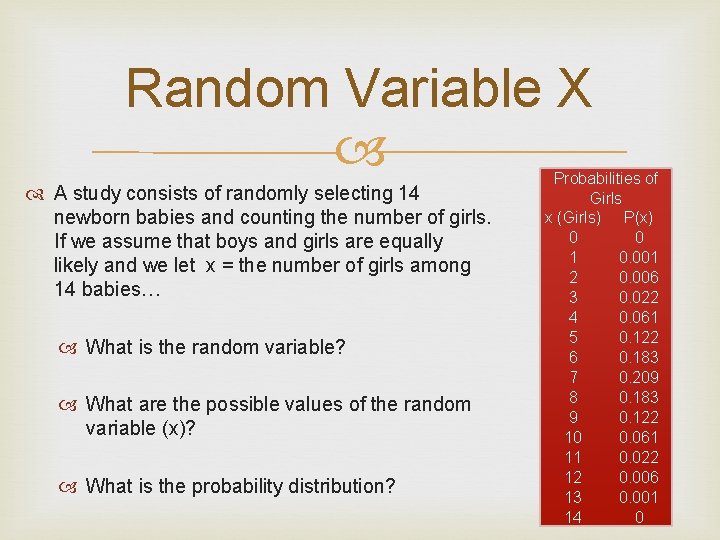
Random Variable X A study consists of randomly selecting 14 newborn babies and counting the number of girls. If we assume that boys and girls are equally likely and we let x = the number of girls among 14 babies… What is the random variable? What are the possible values of the random variable (x)? What is the probability distribution? Probabilities of Girls x (Girls) P(x) 0 0 1 0. 001 2 0. 006 3 0. 022 4 0. 061 5 0. 122 6 0. 183 7 0. 209 8 0. 183 9 0. 122 10 0. 061 11 0. 022 12 0. 006 13 0. 001 14 0
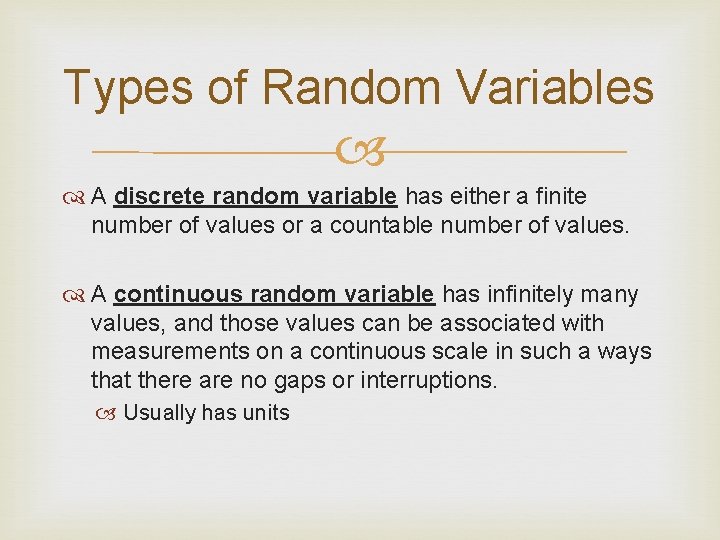
Types of Random Variables A discrete random variable has either a finite number of values or a countable number of values. A continuous random variable has infinitely many values, and those values can be associated with measurements on a continuous scale in such a ways that there are no gaps or interruptions. Usually has units
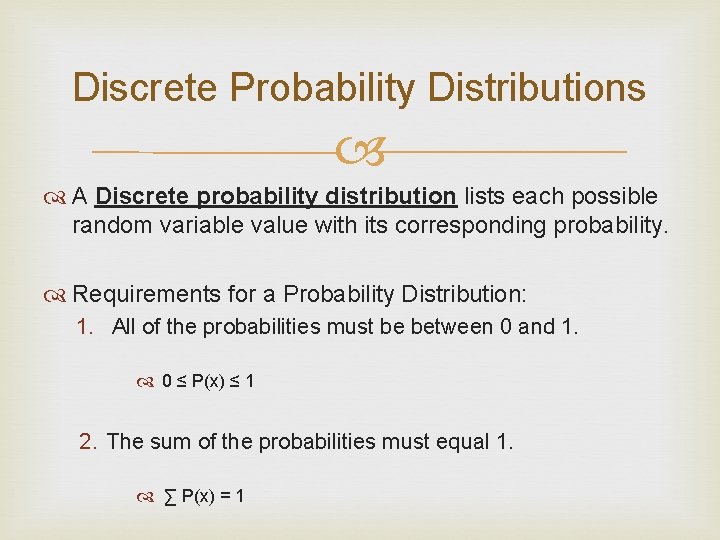
Discrete Probability Distributions A Discrete probability distribution lists each possible random variable value with its corresponding probability. Requirements for a Probability Distribution: 1. All of the probabilities must be between 0 and 1. 0 ≤ P(x) ≤ 1 2. The sum of the probabilities must equal 1. ∑ P(x) = 1
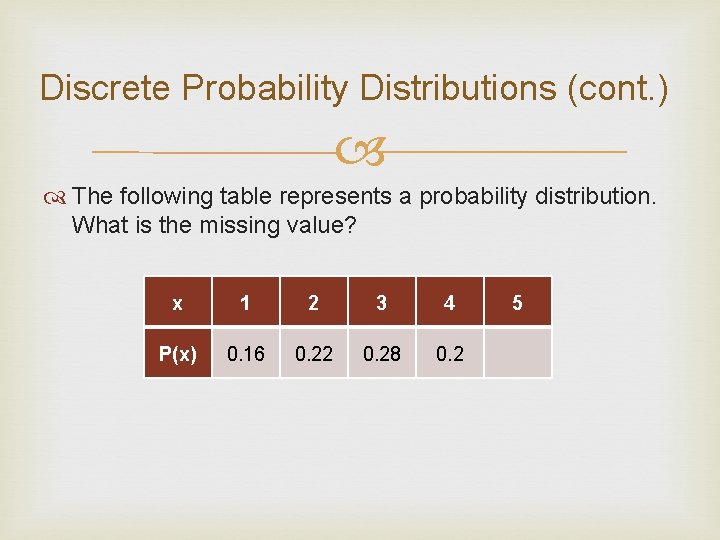
Discrete Probability Distributions (cont. ) The following table represents a probability distribution. What is the missing value? x 1 2 3 4 P(x) 0. 16 0. 22 0. 28 0. 2 5
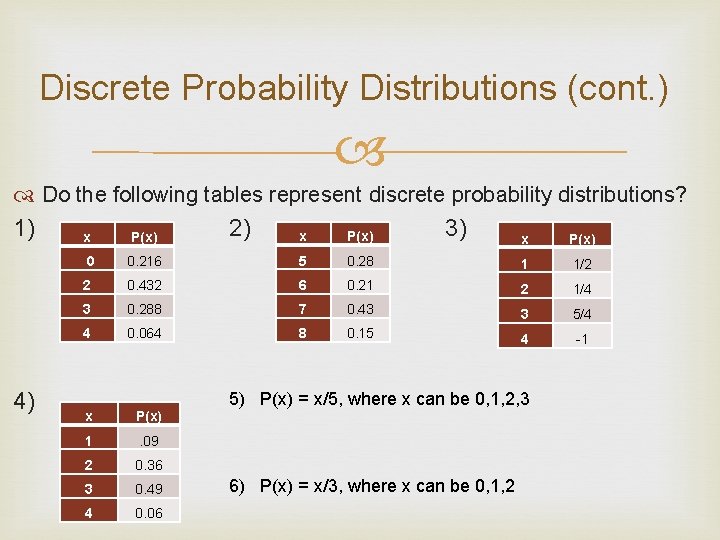
Discrete Probability Distributions (cont. ) Do the following tables represent discrete probability distributions? 1) 4) 2) x P(x) 0. 216 5 2 0. 432 3 4 x P(x) 0 3) x P(x) 0. 28 1 1/2 6 0. 21 2 1/4 0. 288 7 0. 43 3 5/4 0. 064 8 0. 15 4 -1 x P(x) 1 . 09 2 0. 36 3 0. 49 4 0. 06 5) P(x) = x/5, where x can be 0, 1, 2, 3 6) P(x) = x/3, where x can be 0, 1, 2
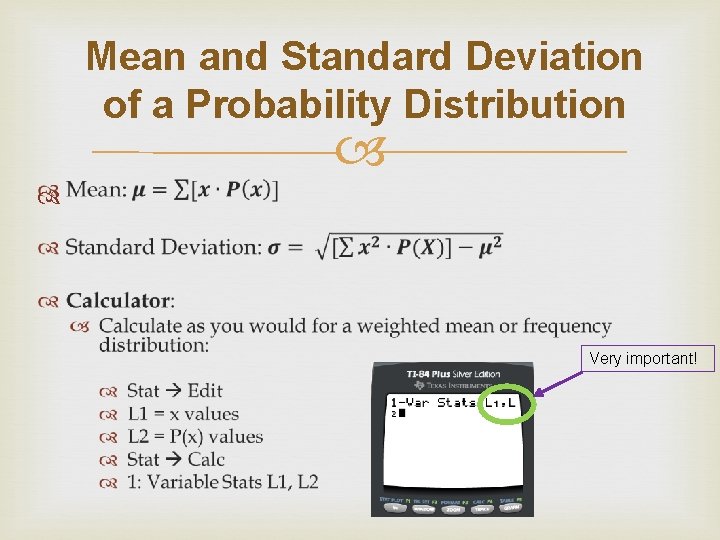
Mean and Standard Deviation of a Probability Distribution Very important!
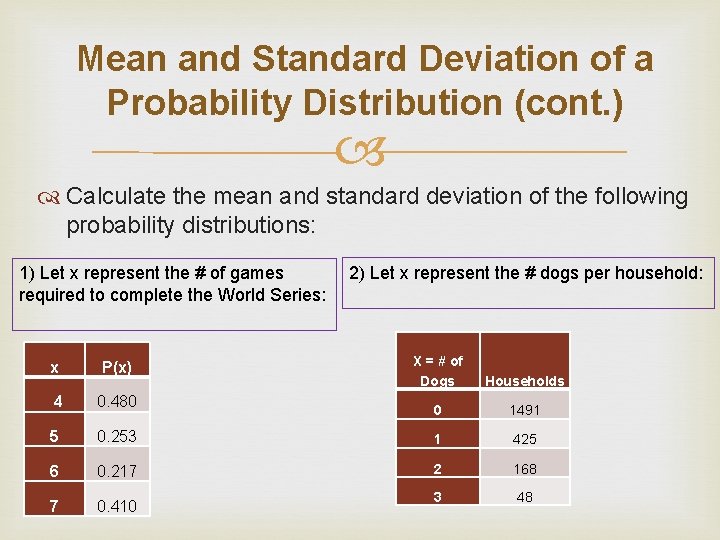
Mean and Standard Deviation of a Probability Distribution (cont. ) Calculate the mean and standard deviation of the following probability distributions: 1) Let x represent the # of games required to complete the World Series: 2) Let x represent the # dogs per household: X = # of Dogs Households 0 1491 0. 253 1 425 6 0. 217 2 168 7 0. 410 3 48 x P(x) 4 0. 480 5
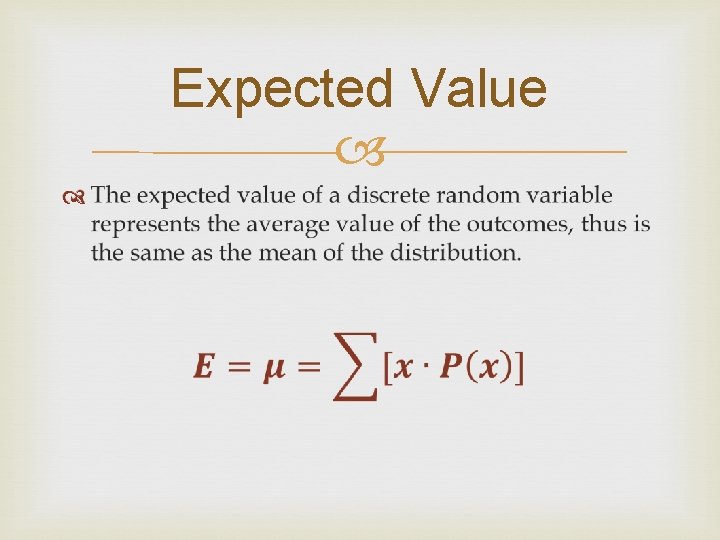
Expected Value
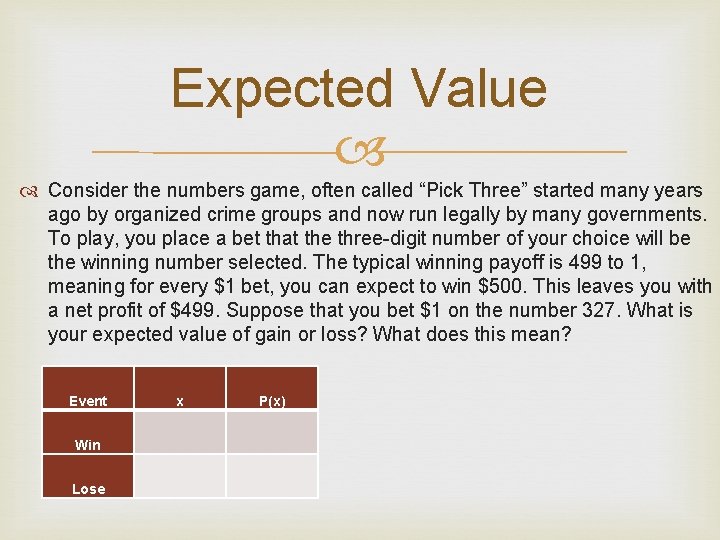
Expected Value Consider the numbers game, often called “Pick Three” started many years ago by organized crime groups and now run legally by many governments. To play, you place a bet that the three-digit number of your choice will be the winning number selected. The typical winning payoff is 499 to 1, meaning for every $1 bet, you can expect to win $500. This leaves you with a net profit of $499. Suppose that you bet $1 on the number 327. What is your expected value of gain or loss? What does this mean? Event Win Lose x P(x)
Assignment pp. 190 # 2 – 14 Even, 18 – 22 Even