
Chronicle 2005 Interdisciplinary Environmental Programs Opportunities and Challenges
- Slides: 22
Chronicle 2005 Interdisciplinary Environmental Programs: Opportunities and Challenges For Faculty and Students Stephanie Pfirman, Barnard College Sharon Hall, Arizona State University Tom Tietenberg, Colby College Diana Rhoten, Social Science Research Council and NSF
Background n Site visits to environmental programs at liberal arts colleges for the Andrew W. Mellon Foundation q n Council of Environmental Deans and Directors (CEDD) analyses q q n ES&T May 2005: Pfirman, Hall, Tietenberg, and PKAL Resource: Hall, Tietenberg and Pfirman Chronicle of Higher Education, February 2005: Pfirman, Collins, Lowes, and Michaels, and PKAL Resource “Interdisciplinary Hiring, Tenure and Promotion: Guidance for Individuals and Institutions” November 2, 2007 Women and interdisciplinarity q Rhoten and Pfirman, 2007, Research Policy, Inside Higher Education and upcoming Workshop November 12 -13, Columbia http: //www. barnard. edu/envsci/dept/pfirmanpage. htm
Exciting thinking often lies at the borders of academic disciplines, and neither scholarship nor teaching should be constrained by the boundaries of disciplinary training. [C]itizenship with its challenge of solving complex problems, and scholarship as an intellectual pursuit, cannot be limited by these [departmental] distinctions. UNC website
Exciting thinking often lies at the borders of academic disciplines, and neither scholarship nor teaching should be constrained by the boundaries of disciplinary training. [C]itizenship with its challenge of solving complex problems, and scholarship as an intellectual pursuit, cannot be limited by these [departmental] distinctions. UNC website
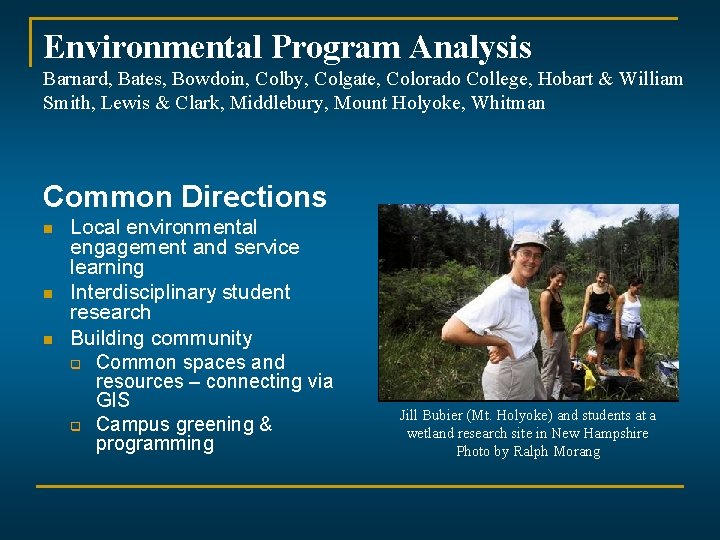
Environmental Program Analysis Barnard, Bates, Bowdoin, Colby, Colgate, Colorado College, Hobart & William Smith, Lewis & Clark, Middlebury, Mount Holyoke, Whitman Common Directions n n n Local environmental engagement and service learning Interdisciplinary student research Building community q Common spaces and resources – connecting via GIS q Campus greening & programming Jill Bubier (Mt. Holyoke) and students at a wetland research site in New Hampshire Photo by Ralph Morang
Common Challenges n Staffing courses q q n Cross-departmental commitments Team teaching Staffing activities q q q Balancing education and scholarship Program management Service learning Campus greening Student internships n Diversity q q n Faculty Students Junior people (women) in difficult positions …
Recommendations from Mellon Review n Institutions should take responsibility for interdisciplinary programs and faculty q q Invest in community building (on campus and off) Incentives and rewards for cross-departmental contributions Staff programs Institutionalize faculty career path ES&T May 2005: Pfirman, Hall, Tietenberg PKAL 2005: Hall, Tietenberg and Pfirman
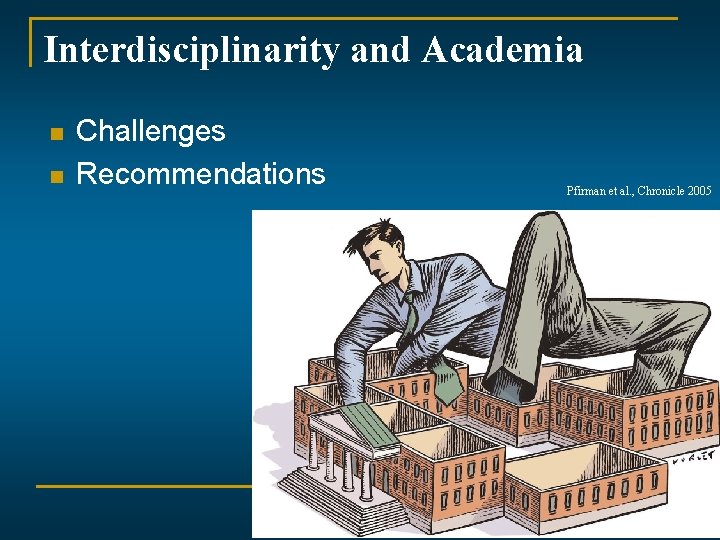
Interdisciplinarity and Academia n n Challenges Recommendations Pfirman et al. , Chronicle 2005
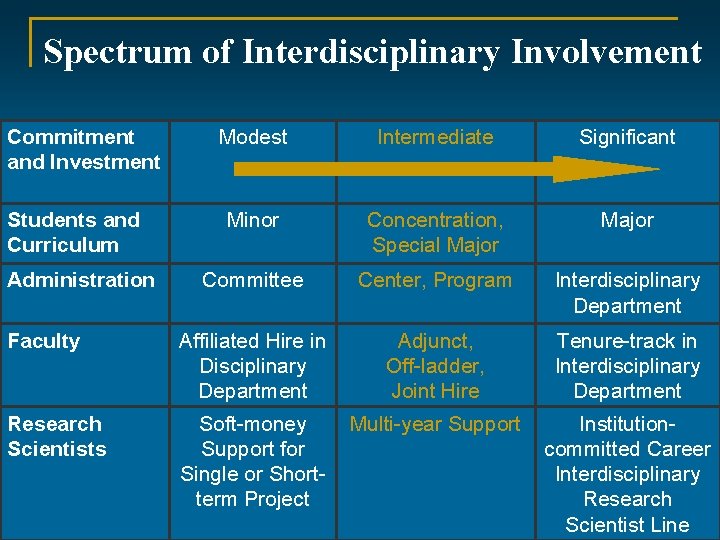
Spectrum of Interdisciplinary Involvement Commitment and Investment Modest Intermediate Significant Minor Concentration, Special Major Committee Center, Program Interdisciplinary Department Faculty Affiliated Hire in Disciplinary Department Adjunct, Off-ladder, Joint Hire Tenure-track in Interdisciplinary Department Research Scientists Soft-money Support for Single or Shortterm Project Multi-year Support Institutioncommitted Career Interdisciplinary Research Scientist Line Students and Curriculum Administration
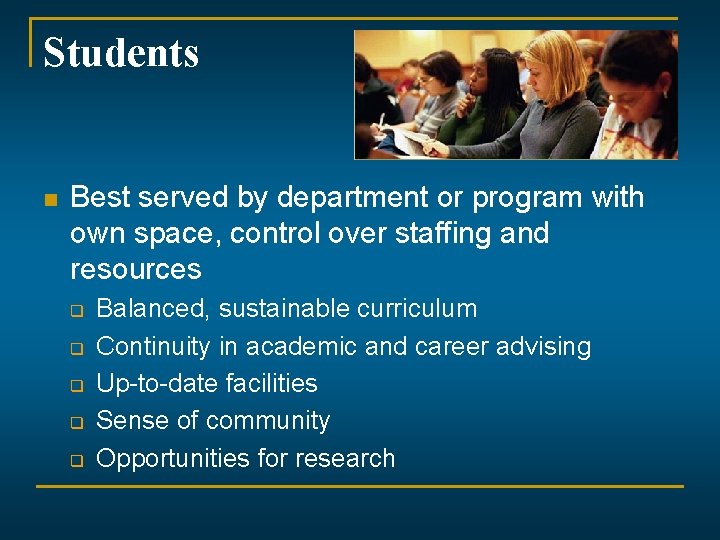
Students n Best served by department or program with own space, control over staffing and resources q q q Balanced, sustainable curriculum Continuity in academic and career advising Up-to-date facilities Sense of community Opportunities for research
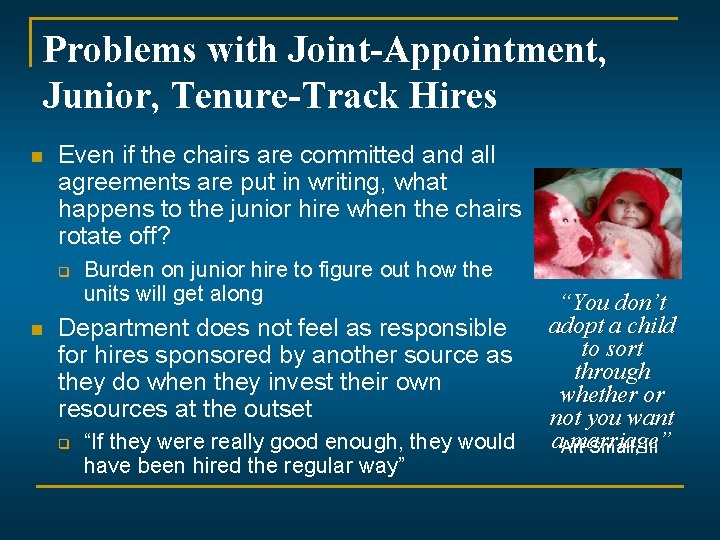
Problems with Joint-Appointment, Junior, Tenure-Track Hires n Even if the chairs are committed and all agreements are put in writing, what happens to the junior hire when the chairs rotate off? q n Burden on junior hire to figure out how the units will get along Department does not feel as responsible for hires sponsored by another source as they do when they invest their own resources at the outset q “If they were really good enough, they would have been hired the regular way” “You don’t adopt a child to sort through whether or not you want a. Art marriage” Small, III
But Junior, Joint Hires Are Not The Only Ones With Concerns n Graduate Students q n Reported that interdisciplinary activities have adverse effects on their careers, but they are convinced of its value Interdisciplinary Researchers – Biocomplexity Awardees q About 30 percent reported that their interdisciplinary affiliations had not helped or had hindered their careers Research by Rhoten on Biocomplexity Awardees; Rhoten , D. and A. Parker. 2004. Risks and Rewards of an Interdisciplinary Path. Science. Vol. 306: 2046 (December
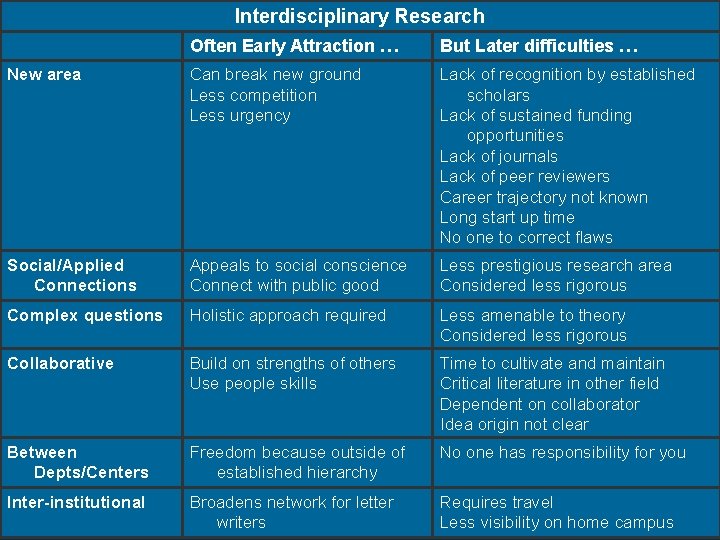
Interdisciplinary Research Often Early Attraction … But Later difficulties … New area Can break new ground Less competition Less urgency Lack of recognition by established scholars Lack of sustained funding opportunities Lack of journals Lack of peer reviewers Career trajectory not known Long start up time No one to correct flaws Social/Applied Connections Appeals to social conscience Connect with public good Less prestigious research area Considered less rigorous Complex questions Holistic approach required Less amenable to theory Considered less rigorous Collaborative Build on strengths of others Use people skills Time to cultivate and maintain Critical literature in other field Dependent on collaborator Idea origin not clear Between Depts/Centers Freedom because outside of established hierarchy No one has responsibility for you Inter-institutional Broadens network for letter writers Requires travel Less visibility on home campus
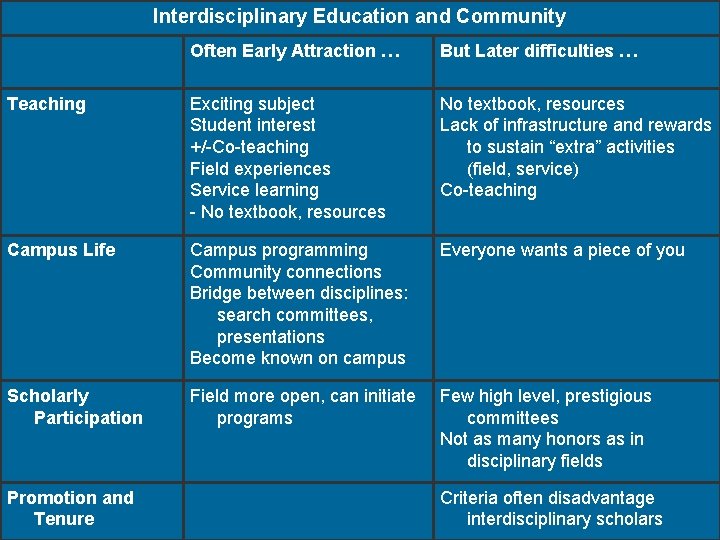
Interdisciplinary Education and Community Often Early Attraction … But Later difficulties … Teaching Exciting subject Student interest +/-Co-teaching Field experiences Service learning - No textbook, resources Lack of infrastructure and rewards to sustain “extra” activities (field, service) Co-teaching Campus Life Campus programming Community connections Bridge between disciplines: search committees, presentations Become known on campus Everyone wants a piece of you Scholarly Participation Field more open, can initiate programs Few high level, prestigious committees Not as many honors as in disciplinary fields Promotion and Tenure Criteria often disadvantage interdisciplinary scholars
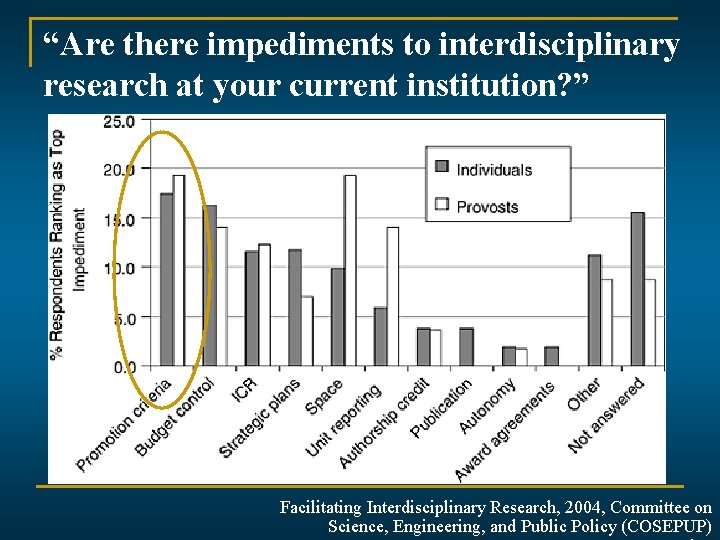
“Are there impediments to interdisciplinary research at your current institution? ” Facilitating Interdisciplinary Research, 2004, Committee on Science, Engineering, and Public Policy (COSEPUP)
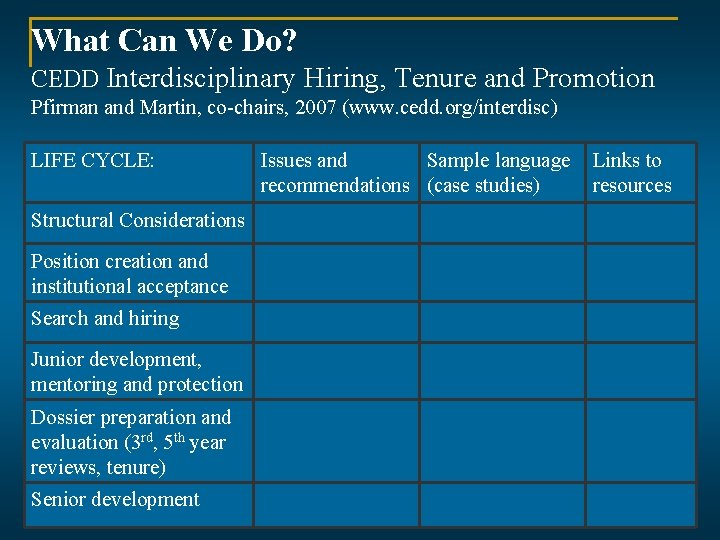
What Can We Do? CEDD Interdisciplinary Hiring, Tenure and Promotion Pfirman and Martin, co-chairs, 2007 (www. cedd. org/interdisc) LIFE CYCLE: Structural Considerations Position creation and institutional acceptance Search and hiring Junior development, mentoring and protection Dossier preparation and evaluation (3 rd, 5 th year reviews, tenure) Senior development Issues and Sample language recommendations (case studies) Links to resources
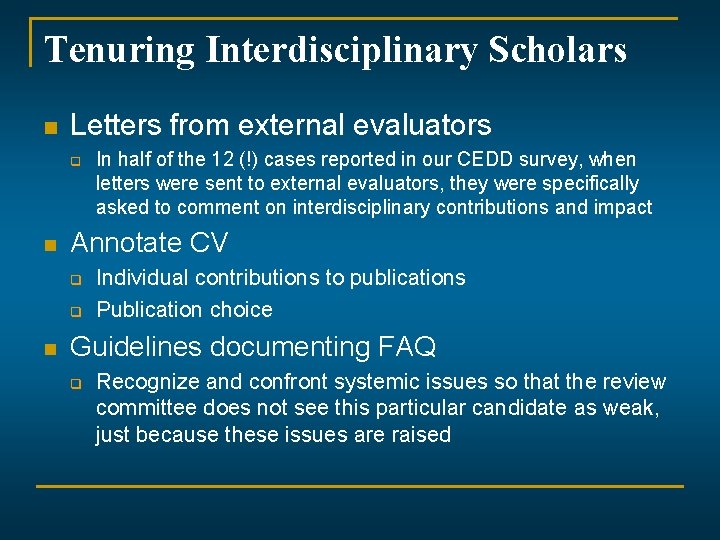
Tenuring Interdisciplinary Scholars n Letters from external evaluators q n Annotate CV q q n In half of the 12 (!) cases reported in our CEDD survey, when letters were sent to external evaluators, they were specifically asked to comment on interdisciplinary contributions and impact Individual contributions to publications Publication choice Guidelines documenting FAQ q Recognize and confront systemic issues so that the review committee does not see this particular candidate as weak, just because these issues are raised
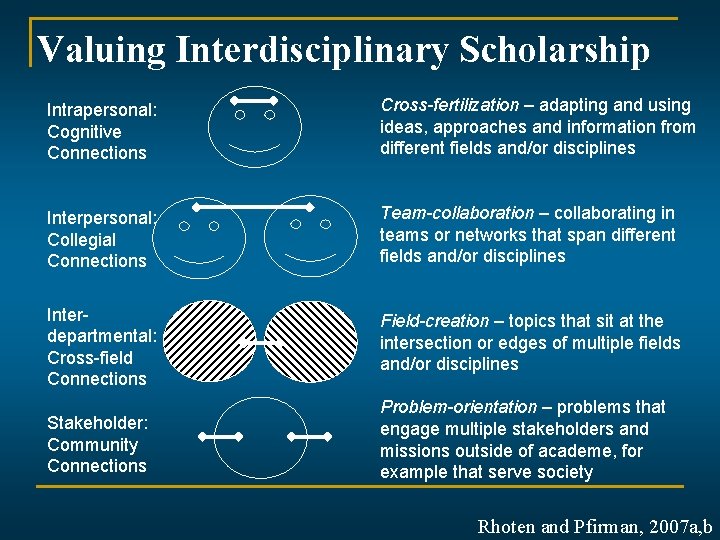
Valuing Interdisciplinary Scholarship Intrapersonal: Cognitive Connections Cross-fertilization – adapting and using ideas, approaches and information from different fields and/or disciplines Interpersonal: Collegial Connections Team-collaboration – collaborating in teams or networks that span different fields and/or disciplines Interdepartmental: Cross-field Connections Field-creation – topics that sit at the intersection or edges of multiple fields and/or disciplines Stakeholder: Community Connections Problem-orientation – problems that engage multiple stakeholders and missions outside of academe, for example that serve society Rhoten and Pfirman, 2007 a, b
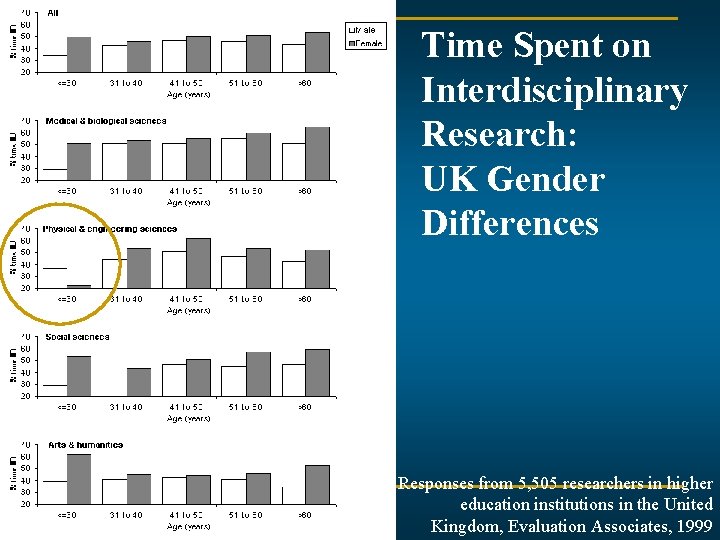
Time Spent on Interdisciplinary Research: UK Gender Differences Responses from 5, 505 researchers in higher education institutions in the United Kingdom, Evaluation Associates, 1999
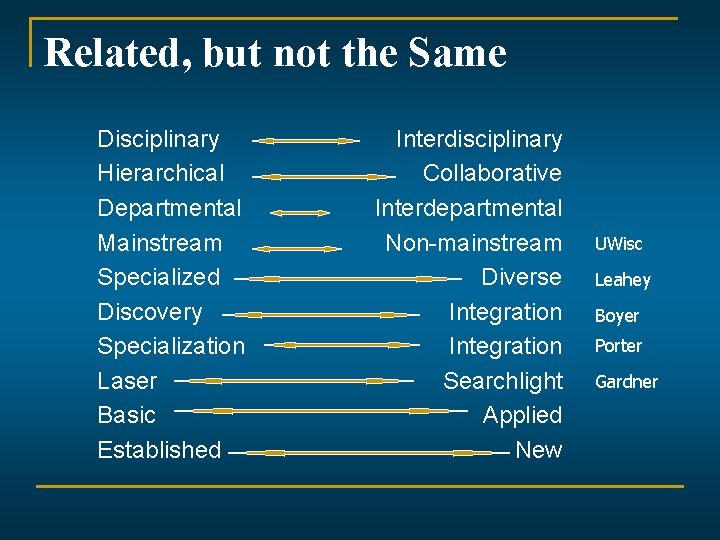
Related, but not the Same Disciplinary Hierarchical Departmental Mainstream Specialized Discovery Specialization Laser Basic Established Interdisciplinary Collaborative Interdepartmental Non-mainstream Diverse Integration Searchlight Applied New UWisc Leahey Boyer Porter Gardner
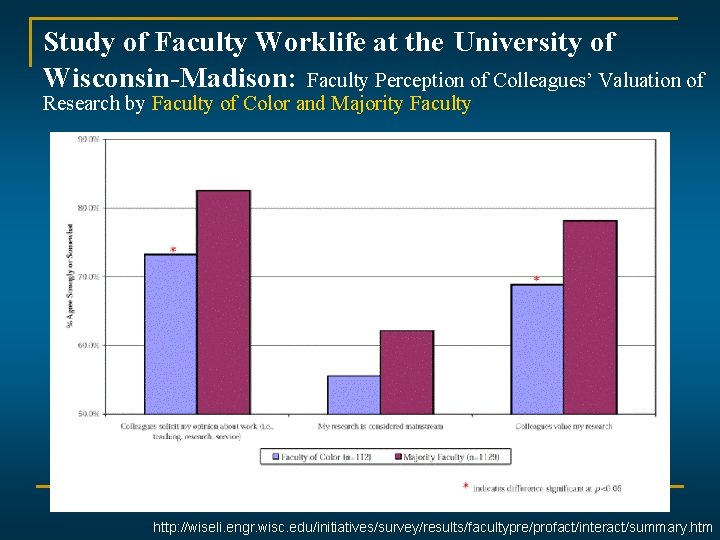
Study of Faculty Worklife at the University of Wisconsin-Madison: Faculty Perception of Colleagues’ Valuation of Research by Faculty of Color and Majority Faculty http: //wiseli. engr. wisc. edu/initiatives/survey/results/facultypre/profact/interact/summary. htm
Conclusions n Institutions have a responsibility to the people they hire and teach – q n They should create a culture, implement procedures, and allocate resources that will allow interdisciplinary scholars and students to thrive and prosper If women and minorities are indeed more attracted by interdisciplinary research q q Institutions interested in increasing their diversity may have a greater chance for success if they value interdisciplinary scholarship Institutions interested in increasing interdisciplinary research may have a greater chance for success if they involve women and minorities