
Chronic Wasting Disease An Overview NMFWA Fish and

- Slides: 11
Chronic Wasting Disease: An Overview NMFWA Fish and Wildlife Recreation Technical Session Norfolk, VA March 28, 2018 Matt Dunfee CWD Alliance Coordinator Wildlife Management Institute
The Basics: What CWD is one of several diseases known as transmissible spongiform encephalopathies (TSE’s). It is always fatal. It is not causes by a virus, bacteria, or other living agent. It is caused by a misfolded protein, called a prion. Prions are extremely difficult to destroy, and can exist outside the body for an undetermined (years) period. Prions are very difficult to detect, and thus far, cannot be reliably detected at all stages of CWD infection. CWD can exist in an animal for years before causing outward signs. There appears to be a species barrier between cervids and humans preventing CWD transmission.
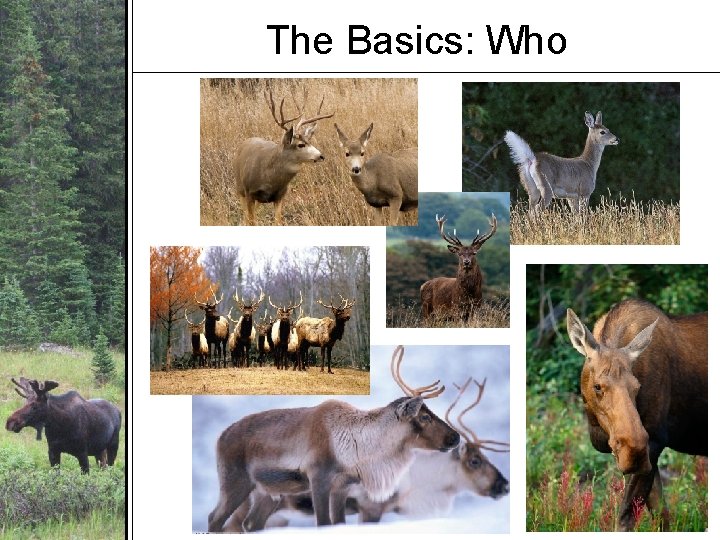
The Basics: Who
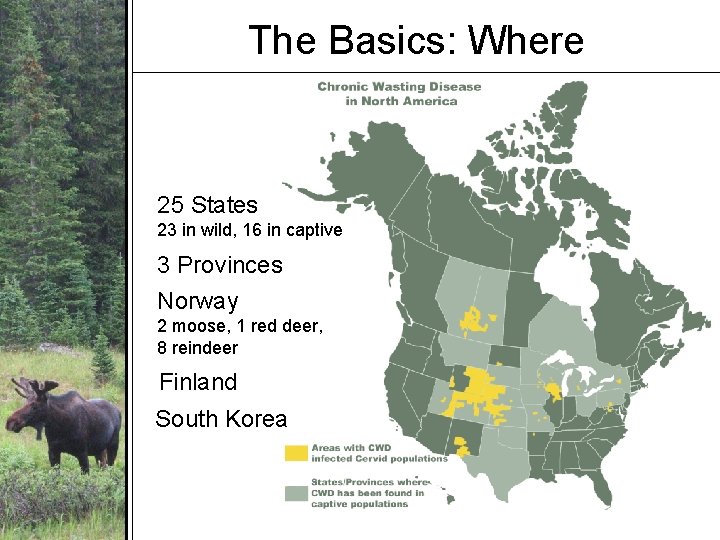
The Basics: Where 25 States 23 in wild, 16 in captive 3 Provinces Norway 2 moose, 1 red deer, 8 reindeer Finland South Korea
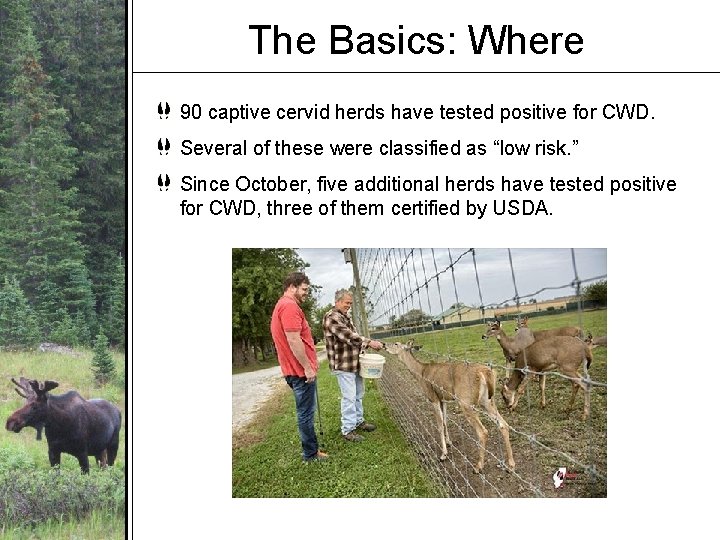
The Basics: Where 90 captive cervid herds have tested positive for CWD. Several of these were classified as “low risk. ” Since October, five additional herds have tested positive for CWD, three of them certified by USDA.
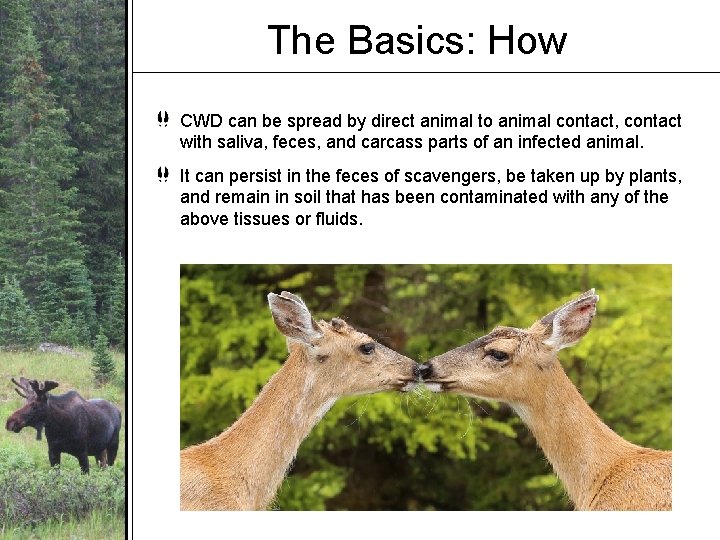
The Basics: How CWD can be spread by direct animal to animal contact, contact with saliva, feces, and carcass parts of an infected animal. It can persist in the feces of scavengers, be taken up by plants, and remain in soil that has been contaminated with any of the above tissues or fluids.
What Have We Learned Impacts of this disease are measured in decades, not years. Managers have failed to eradicate it or halt its spread where introduced in the wild (NY possible exception). If left unchecked, prevalence rates increase steadily, reaching over 40% in some areas. Population impacts have been documented in mule deer, white-tailed deer, and elk. Decontamination efforts of environments have been unsuccessful thus far. Older animals and males show highest prevalence rates. Early detection and rapid response is essential to longterm disease management.
Things Getting in the Way CWD is hard to understand. The “Tail of Two Agencies. ” Persistent movement of live cervids and their parts. Captive cervid industry opposition to CWD best management practices. Total elimination of federal funding for CWD surveillance, management, or research in wild cervids. Dwindling budgets of state agencies. Resistance by hunters to sacrifice traditions. Misinformation in media.
What Needs to Be Done Ideally, no movement of live cervids. Or, at a minimum, no unregulated or untracked movement. Continual education of hunters and wildlife watchers. Dramatically increased funding for CWD surveillance, management, and research. Political support for science-based CWD management on both sides of the fence. Fundamental changes in many honored traditions of North American big game hunting.
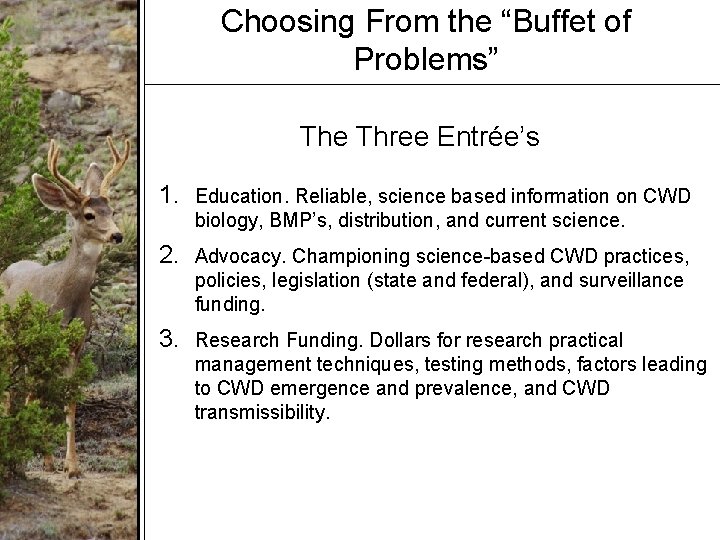
Choosing From the “Buffet of Problems” The Three Entrée’s 1. Education. Reliable, science based information on CWD biology, BMP’s, distribution, and current science. 2. Advocacy. Championing science-based CWD practices, policies, legislation (state and federal), and surveillance funding. 3. Research Funding. Dollars for research practical management techniques, testing methods, factors leading to CWD emergence and prevalence, and CWD transmissibility.
Thanks!