
Chronic Pelvic Pain Marvin L Stancil M D
- Slides: 48
Chronic Pelvic Pain Marvin L. Stancil, M. D. Associate Professor Obstetrics and Gynecology University of Nebraska Medical Center
Medical Student Objectives �Define chronic pelvic pain. �Cite the prevalence and common etiologies of chronic pelvic pain. �Describe the symptoms & physical exam findings associated with chronic pelvic pain. �Discuss the steps in the evaluation & management options for chronic pelvic pain. �Discuss the psychosocial issues associated with chronic pelvic pain.
Chronic Pelvic Pain Definition Chronic Pelvic Pain (CPP) is pain of apparent pelvic origin that has been present most of the time for the past six months and is affecting the patient’s quality of life
Chronic Pelvic Pain Definition § Difficult to diagnose § Difficult to treat § Difficult to cure Frustration for patient and physician
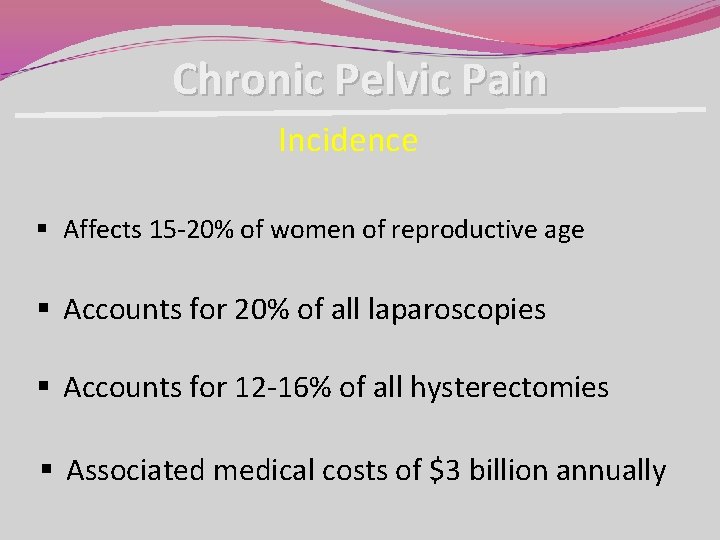
Chronic Pelvic Pain Incidence § Affects 15 -20% of women of reproductive age § Accounts for 20% of all laparoscopies § Accounts for 12 -16% of all hysterectomies § Associated medical costs of $3 billion annually
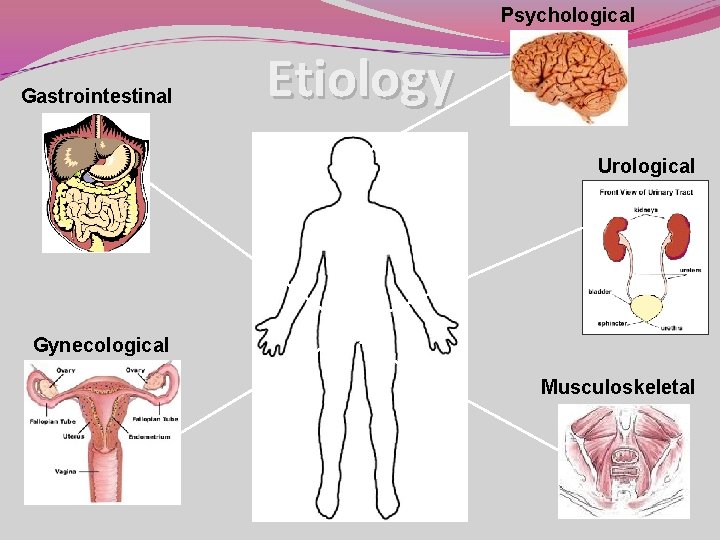
Psychological Gastrointestinal Etiology Urological Gynecological Musculoskeletal
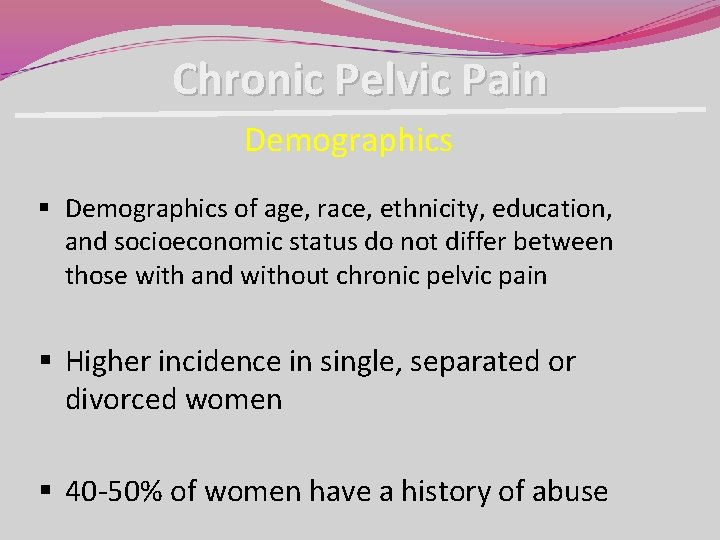
Chronic Pelvic Pain Demographics § Demographics of age, race, ethnicity, education, and socioeconomic status do not differ between those with and without chronic pelvic pain § Higher incidence in single, separated or divorced women § 40 -50% of women have a history of abuse
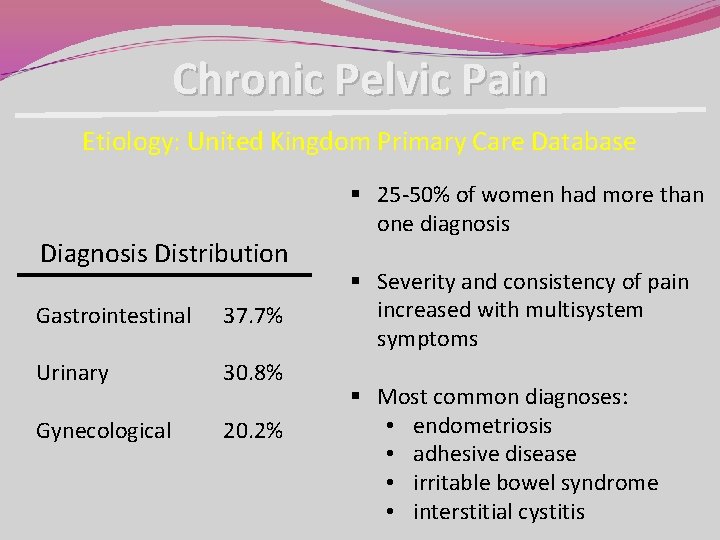
Chronic Pelvic Pain Etiology: United Kingdom Primary Care Database Diagnosis Distribution Gastrointestinal 37. 7% Urinary 30. 8% Gynecological 20. 2% § 25 -50% of women had more than one diagnosis § Severity and consistency of pain increased with multisystem symptoms § Most common diagnoses: • endometriosis • adhesive disease • irritable bowel syndrome • interstitial cystitis
Chronic Pelvic Pain Diagnosis Obtaining a COMPLETE and DETAILED HISTORY is the most important key to formulating a diagnosis
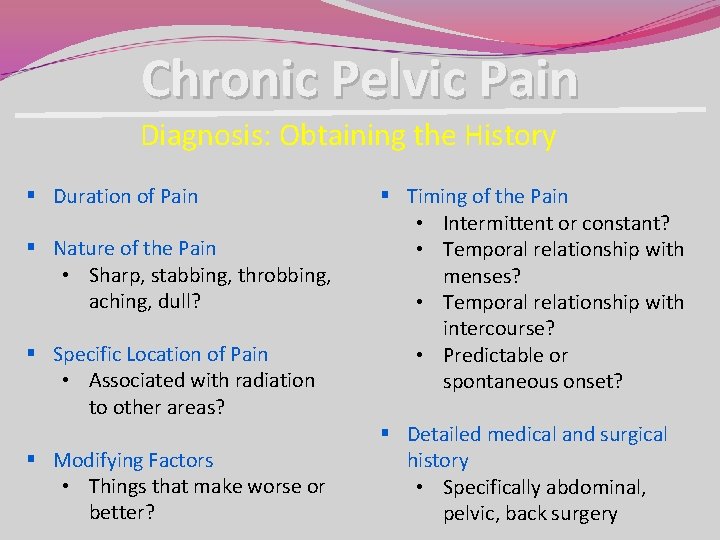
Chronic Pelvic Pain Diagnosis: Obtaining the History § Duration of Pain § Nature of the Pain • Sharp, stabbing, throbbing, aching, dull? § Specific Location of Pain • Associated with radiation to other areas? § Modifying Factors • Things that make worse or better? § Timing of the Pain • Intermittent or constant? • Temporal relationship with menses? • Temporal relationship with intercourse? • Predictable or spontaneous onset? § Detailed medical and surgical history • Specifically abdominal, pelvic, back surgery
Chronic Pelvic Pain Diagnosis: Obtaining the History Use the REVIEW OF SYSTEMS to obtain focused, detailed history of organ systems involved in the differential diagnosis
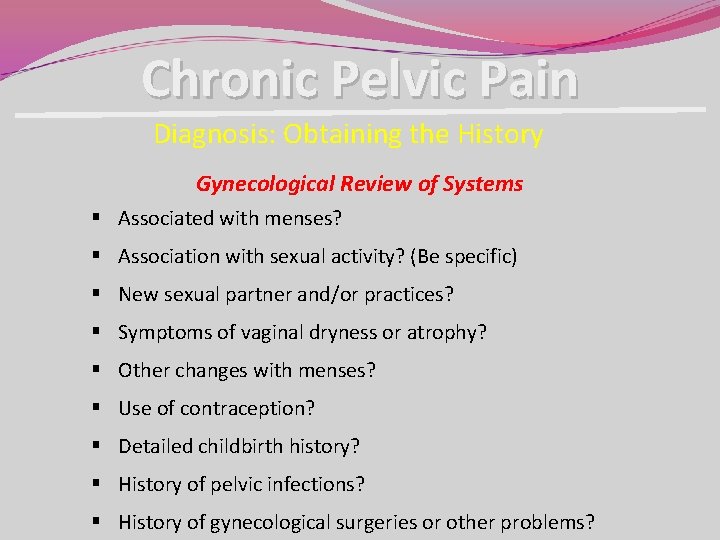
Chronic Pelvic Pain Diagnosis: Obtaining the History Gynecological Review of Systems § Associated with menses? § Association with sexual activity? (Be specific) § New sexual partner and/or practices? § Symptoms of vaginal dryness or atrophy? § Other changes with menses? § Use of contraception? § Detailed childbirth history? § History of pelvic infections? § History of gynecological surgeries or other problems?
Chronic Pelvic Pain Diagnosis: Obtaining the History Gastrointestinal Review of Systems § Regularity of bowel movements? § Diarrhea/ constipation/ flatus? § Relief with defecation? § History of hemorrhoids/ fissures/ polyps? § Blood in stools, melena, mucous? § Nausea, emesis or change in appetite? § Abdominal bloating? § Weight loss?
Chronic Pelvic Pain Diagnosis: Obtaining the History Urological Review of Systems § Pain with urination? § History of frequent or recurrent urinary tract infection? § Hematuria? § Symptoms of urgency or urinary incontinence? § Difficulty voiding? § History of nephrolithiasis?
Chronic Pelvic Pain Diagnosis: Obtaining the History Musculoskeletal Review of Systems § History of trauma? § Association with back pain? § Other chronic pain problems? § Association with position or activity? § Any abdominal wall complaints or surgery?
Chronic Pelvic Pain Diagnosis: Obtaining the History Psychological Review of Systems § History of verbal, physical or sexual abuse? § Diagnosis of psychiatric disease? § Onset associated with life stressors? § Exacerbation associated with life stressors? § Familial or spousal support?
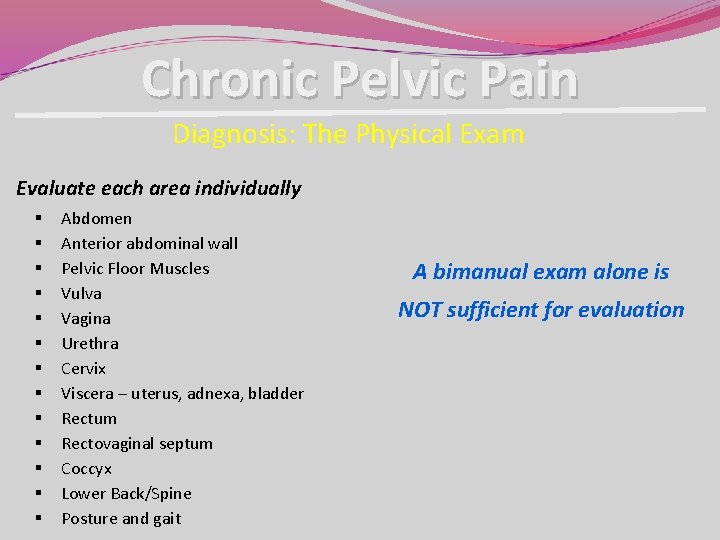
Chronic Pelvic Pain Diagnosis: The Physical Exam Evaluate each area individually § § § § Abdomen Anterior abdominal wall Pelvic Floor Muscles Vulva Vagina Urethra Cervix Viscera – uterus, adnexa, bladder Rectum Rectovaginal septum Coccyx Lower Back/Spine Posture and gait A bimanual exam alone is NOT sufficient for evaluation
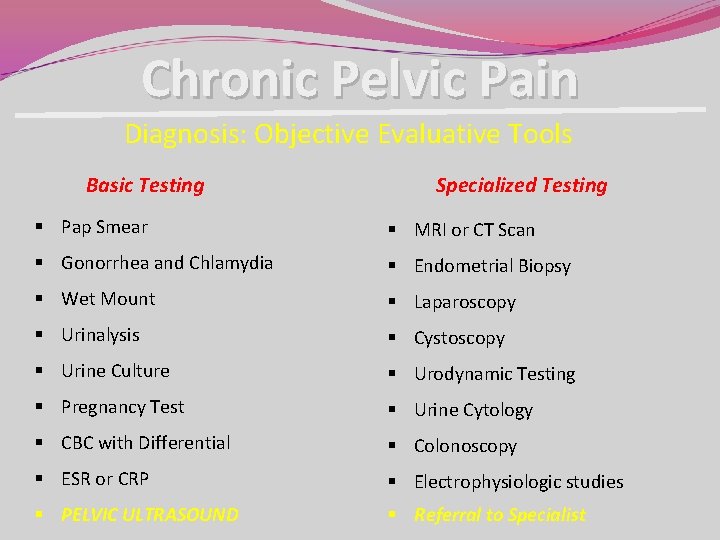
Chronic Pelvic Pain Diagnosis: Objective Evaluative Tools Basic Testing Specialized Testing § Pap Smear § MRI or CT Scan § Gonorrhea and Chlamydia § Endometrial Biopsy § Wet Mount § Laparoscopy § Urinalysis § Cystoscopy § Urine Culture § Urodynamic Testing § Pregnancy Test § Urine Cytology § CBC with Differential § Colonoscopy § ESR or CRP § Electrophysiologic studies § PELVIC ULTRASOUND § Referral to Specialist
Chronic Pelvic Pain Differential Diagnosis § The differential diagnosis for Chronic Pelvic Pain is extensive § Challenges the gynecologist to “think outside the uterus” § Diagnosis, evaluation and treatment plans: • Should align with pertinent positives and negatives from the History and Physical • Often requires an interdisciplinary approach
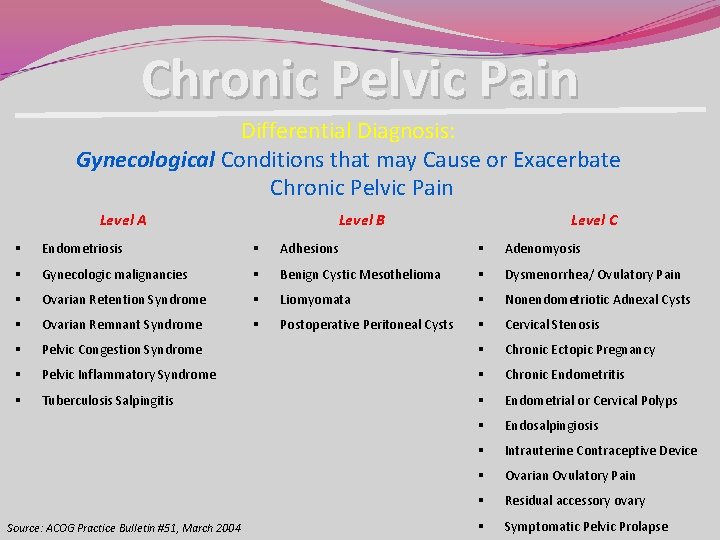
Chronic Pelvic Pain Differential Diagnosis: Gynecological Conditions that may Cause or Exacerbate Chronic Pelvic Pain Level B Level A Level C § Endometriosis § Adhesions § Adenomyosis § Gynecologic malignancies § Benign Cystic Mesothelioma § Dysmenorrhea/ Ovulatory Pain § Ovarian Retention Syndrome § Liomyomata § Nonendometriotic Adnexal Cysts § Ovarian Remnant Syndrome § Postoperative Peritoneal Cysts § Cervical Stenosis § Pelvic Congestion Syndrome § Chronic Ectopic Pregnancy § Pelvic Inflammatory Syndrome § Chronic Endometritis § Tuberculosis Salpingitis § Endometrial or Cervical Polyps § Endosalpingiosis § Intrauterine Contraceptive Device § Ovarian Ovulatory Pain § Residual accessory ovary § Symptomatic Pelvic Prolapse Source: ACOG Practice Bulletin #51, March 2004
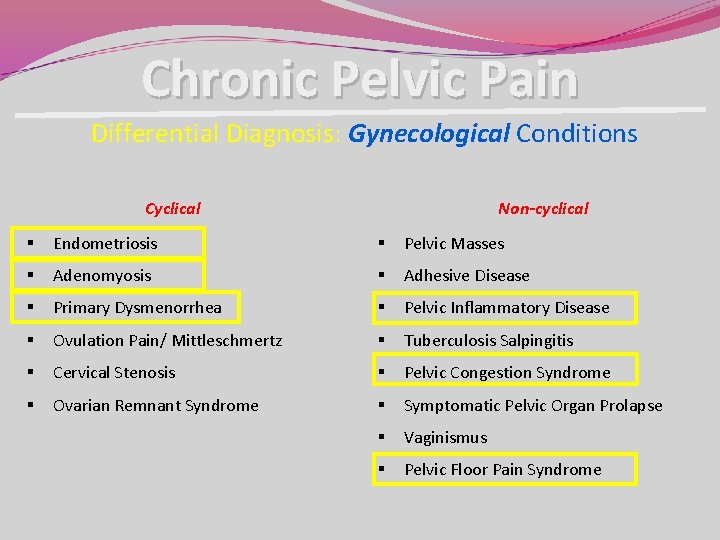
Chronic Pelvic Pain Differential Diagnosis: Gynecological Conditions Cyclical Non-cyclical § Endometriosis § Pelvic Masses § Adenomyosis § Adhesive Disease § Primary Dysmenorrhea § Pelvic Inflammatory Disease § Ovulation Pain/ Mittleschmertz § Tuberculosis Salpingitis § Cervical Stenosis § Pelvic Congestion Syndrome § Ovarian Remnant Syndrome § Symptomatic Pelvic Organ Prolapse § Vaginismus § Pelvic Floor Pain Syndrome
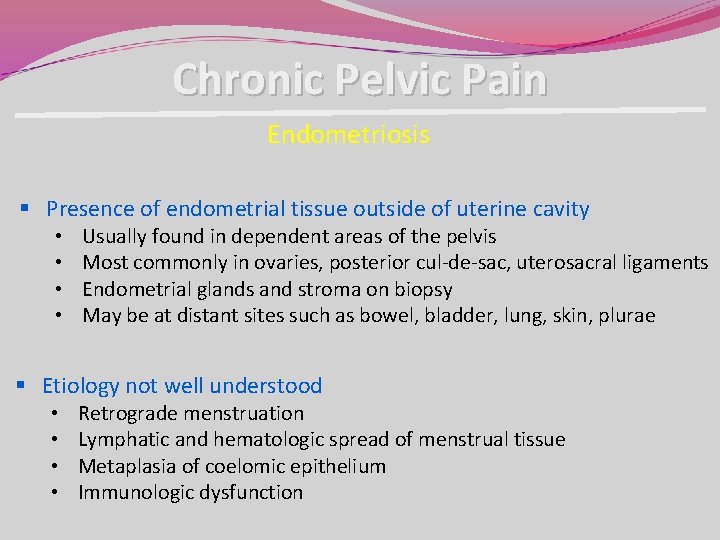
Chronic Pelvic Pain Endometriosis § Presence of endometrial tissue outside of uterine cavity • • Usually found in dependent areas of the pelvis Most commonly in ovaries, posterior cul-de-sac, uterosacral ligaments Endometrial glands and stroma on biopsy May be at distant sites such as bowel, bladder, lung, skin, plurae § Etiology not well understood • • Retrograde menstruation Lymphatic and hematologic spread of menstrual tissue Metaplasia of coelomic epithelium Immunologic dysfunction
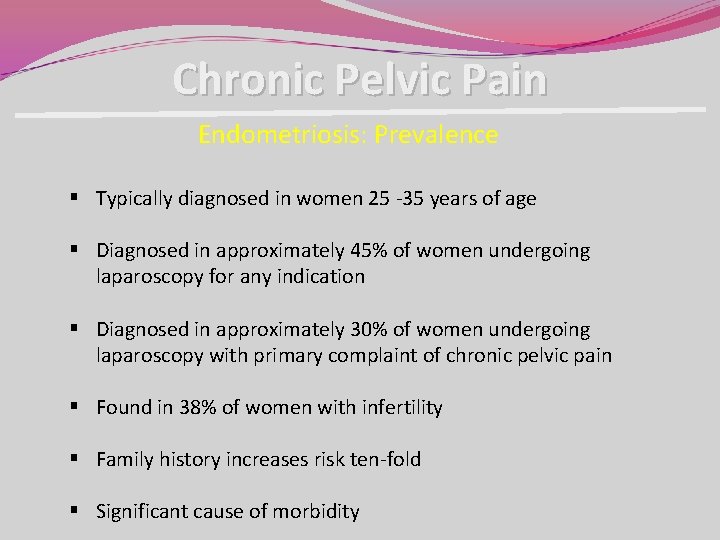
Chronic Pelvic Pain Endometriosis: Prevalence § Typically diagnosed in women 25 -35 years of age § Diagnosed in approximately 45% of women undergoing laparoscopy for any indication § Diagnosed in approximately 30% of women undergoing laparoscopy with primary complaint of chronic pelvic pain § Found in 38% of women with infertility § Family history increases risk ten-fold § Significant cause of morbidity
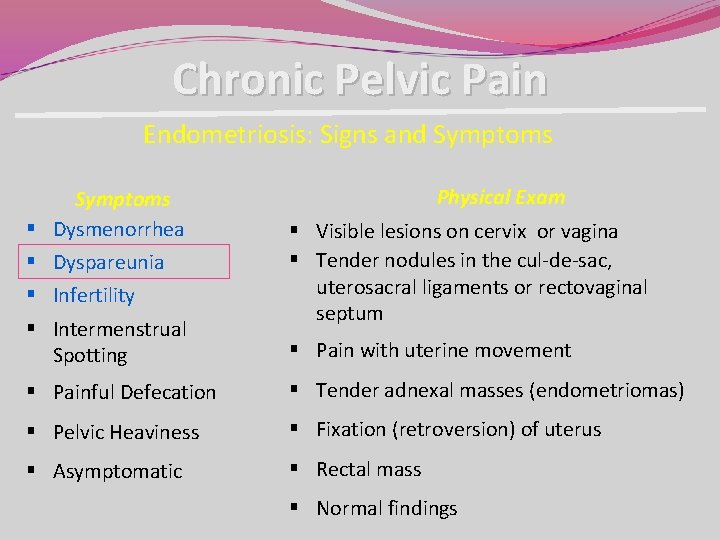
Chronic Pelvic Pain Endometriosis: Signs and Symptoms § Dysmenorrhea § Dyspareunia § Infertility § Intermenstrual Spotting Physical Exam § Visible lesions on cervix or vagina § Tender nodules in the cul-de-sac, uterosacral ligaments or rectovaginal septum § Pain with uterine movement § Painful Defecation § Tender adnexal masses (endometriomas) § Pelvic Heaviness § Fixation (retroversion) of uterus § Asymptomatic § Rectal mass § Normal findings
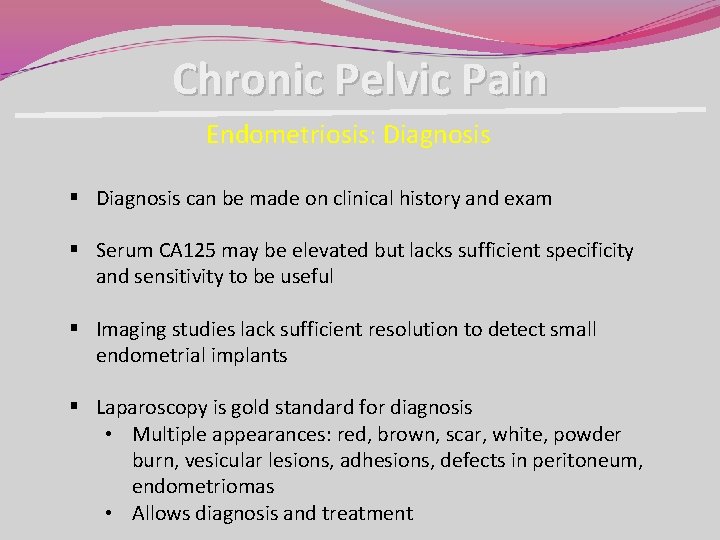
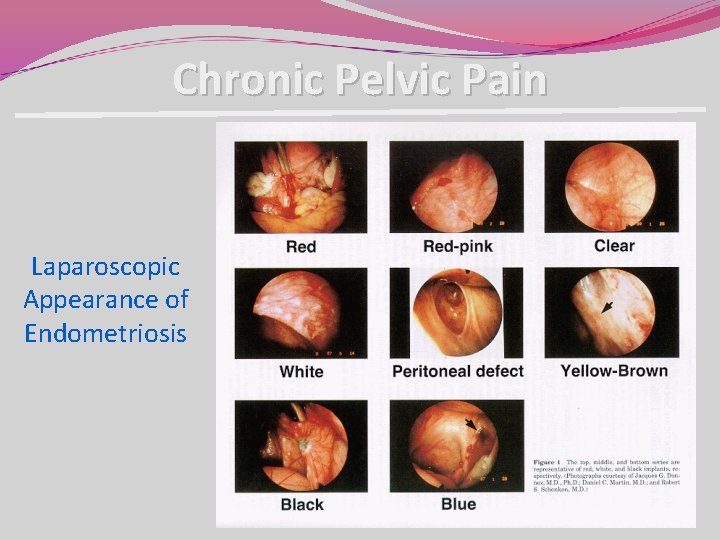
Chronic Pelvic Pain Endometriosis: Diagnosis § Diagnosis can be made on clinical history and exam § Serum CA 125 may be elevated but lacks sufficient specificity and sensitivity to be useful § Imaging studies lack sufficient resolution to detect small endometrial implants § Laparoscopy is gold standard for diagnosis • Multiple appearances: red, brown, scar, white, powder burn, vesicular lesions, adhesions, defects in peritoneum, endometriomas • Allows diagnosis and treatment
Chronic Pelvic Pain Laparoscopic Appearance of Endometriosis
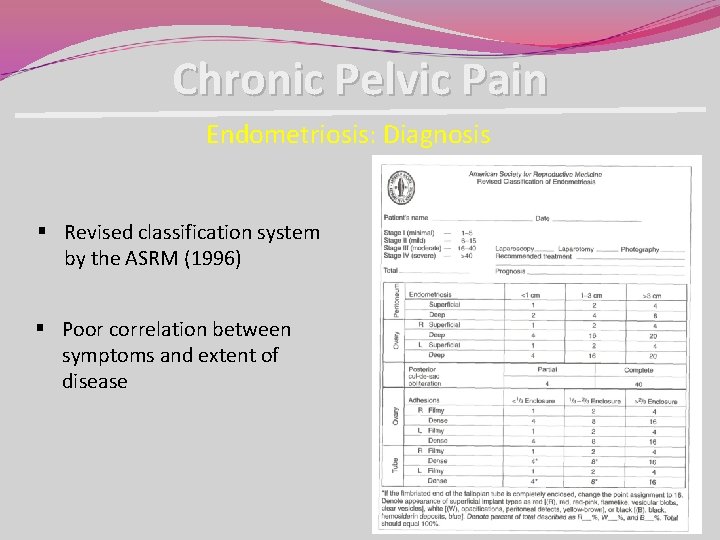
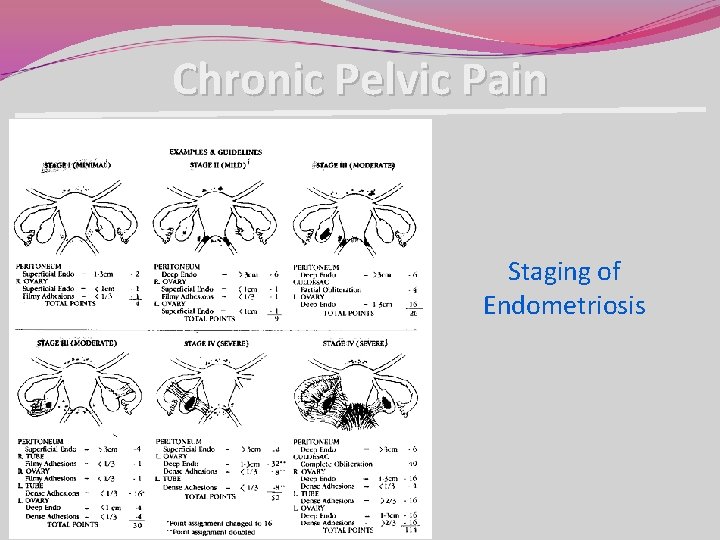
Chronic Pelvic Pain Endometriosis: Diagnosis § Revised classification system by the ASRM (1996) § Poor correlation between symptoms and extent of disease
Chronic Pelvic Pain Staging of Endometriosis
Chronic Pelvic Pain Endometriosis: Medical Treatment § NSAIDS for mild disease § First Line: Oral contraceptives § Suppress ovulation and menstruation § Cyclic or continuous therapy § Improves symptoms in up to 70 -80% § Second Line: Progestins, Gn. RH agonists, Danazol § Lupron Depot (x 6 -12 months) § Improves symptoms in up to 80 -85% § Side effects: hot flashes, vaginal dryness, insomnia, bone loss irritability § “Add back” estrogen +/- progestin
Chronic Pelvic Pain Endometriosis: Surgical Treatment § Laparoscopic Removal or Destruction § Treatment at time of diagnosis § Used in conjunction with medical therapy § Improves pain in up to 80 -90% of patients § Laparotomy (TAH/BSO) § Inadequate response to medical treatment or conservative surgical treatment with no desire for future fertility § May preserve ovaries in young women, but 30% with recurrent symptoms § Laparoscopic Uterosacral Nerve Ablation (LUNA), Presacral neurectomy § Involves transecting the nerve plexus at the base of the cervical-uterosacral ligament junction or retroperitoneum
Chronic Pelvic Pain Adenomyosis § Description: Presence of endometrial glands and stroma within the myometrium § Symptoms: Dysmenorrhea; Menorrhagia; Enlarged boggy uterus; typically affects women age 30 -40’s § Diagnosis: Pathology, MRI (ultrasound limited usefulness) § Treatment: Hysterectomy; usually when diagnosis is made
Chronic Pelvic Pain Primary Dysmenorrhea § Description: Pain associated with menses that usually begins 1 -3 days prior to the onset of menses; last 1 -3 days § Risk Factors: Nulliparity, Young Age, Heavy menses, Cigarette Smoking § Symptoms: Crampy lower abdominal pain; +/- nausea, emesis, diarrhea or headache, normal physical exam § Treatment: NSAIDS, Multivits with B-complex, Hormonal Therapy (OCPs, Ortho. Evra, Nuvaring, Mirena IUD, Depo. Provera. Usual improvement after childbirth.
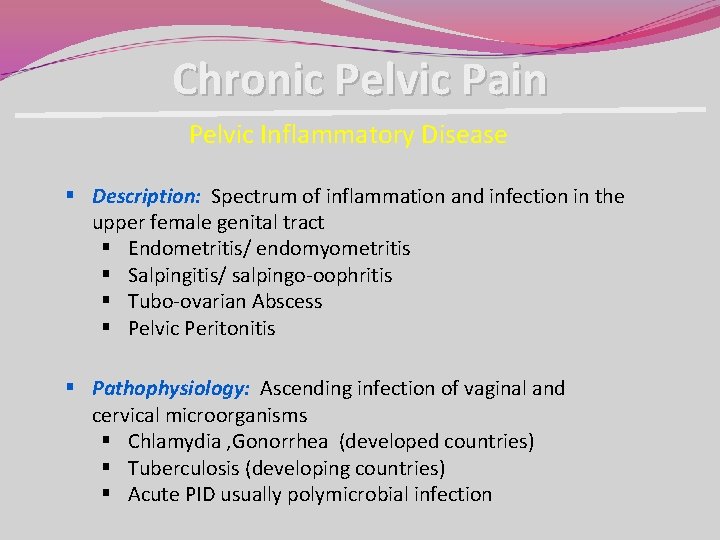
Chronic Pelvic Pain Pelvic Inflammatory Disease § Description: Spectrum of inflammation and infection in the upper female genital tract § Endometritis/ endomyometritis § Salpingitis/ salpingo-oophritis § Tubo-ovarian Abscess § Pelvic Peritonitis § Pathophysiology: Ascending infection of vaginal and cervical microorganisms § Chlamydia , Gonorrhea (developed countries) § Tuberculosis (developing countries) § Acute PID usually polymicrobial infection
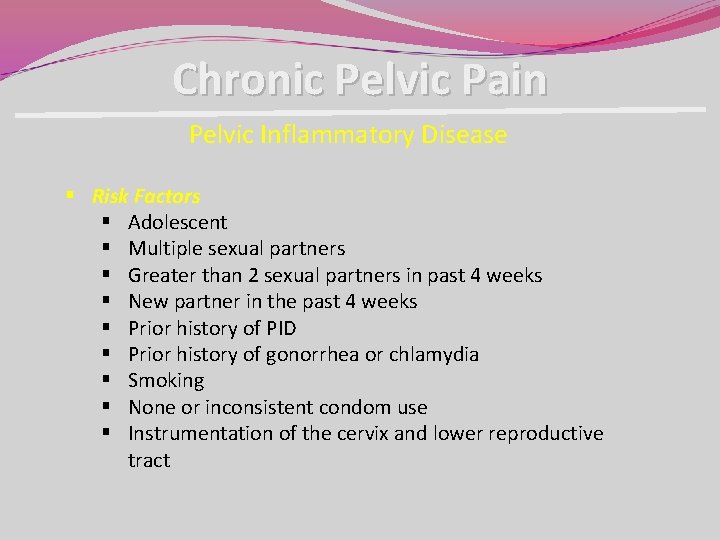
Chronic Pelvic Pain Pelvic Inflammatory Disease § Risk Factors § Adolescent § Multiple sexual partners § Greater than 2 sexual partners in past 4 weeks § New partner in the past 4 weeks § Prior history of PID § Prior history of gonorrhea or chlamydia § Smoking § None or inconsistent condom use § Instrumentation of the cervix and lower reproductive tract
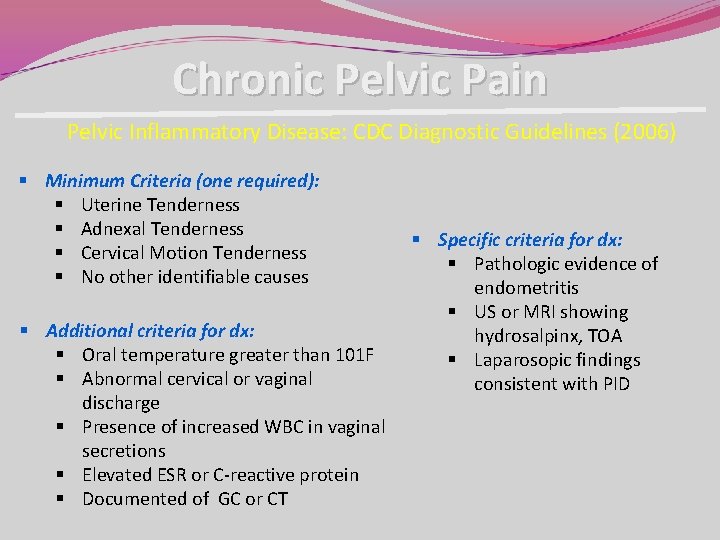
Chronic Pelvic Pain Pelvic Inflammatory Disease: CDC Diagnostic Guidelines (2006) § Minimum Criteria (one required): § Uterine Tenderness § Adnexal Tenderness § Cervical Motion Tenderness § No other identifiable causes § Additional criteria for dx: § Oral temperature greater than 101 F § Abnormal cervical or vaginal discharge § Presence of increased WBC in vaginal secretions § Elevated ESR or C-reactive protein § Documented of GC or CT § Specific criteria for dx: § Pathologic evidence of endometritis § US or MRI showing hydrosalpinx, TOA § Laparosopic findings consistent with PID
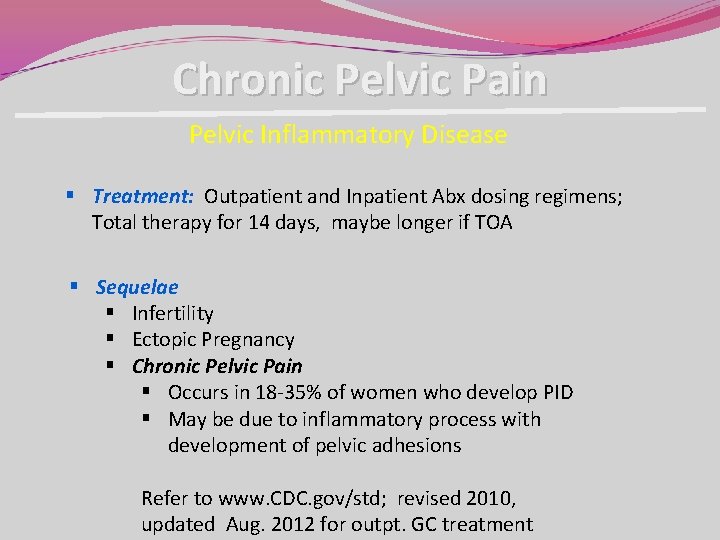
Chronic Pelvic Pain Pelvic Inflammatory Disease § Treatment: Outpatient and Inpatient Abx dosing regimens; Total therapy for 14 days, maybe longer if TOA § Sequelae § Infertility § Ectopic Pregnancy § Chronic Pelvic Pain § Occurs in 18 -35% of women who develop PID § May be due to inflammatory process with development of pelvic adhesions Refer to www. CDC. gov/std; revised 2010, updated Aug. 2012 for outpt. GC treatment
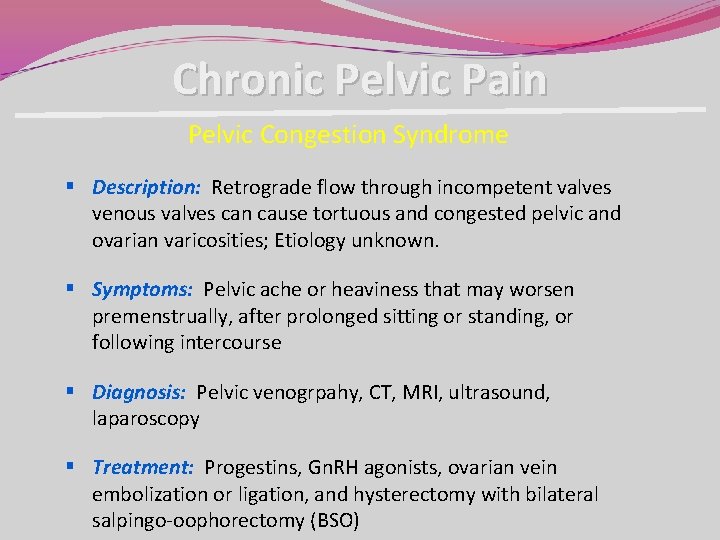
Chronic Pelvic Pain Pelvic Congestion Syndrome § Description: Retrograde flow through incompetent valves venous valves can cause tortuous and congested pelvic and ovarian varicosities; Etiology unknown. § Symptoms: Pelvic ache or heaviness that may worsen premenstrually, after prolonged sitting or standing, or following intercourse § Diagnosis: Pelvic venogrpahy, CT, MRI, ultrasound, laparoscopy § Treatment: Progestins, Gn. RH agonists, ovarian vein embolization or ligation, and hysterectomy with bilateral salpingo-oophorectomy (BSO)
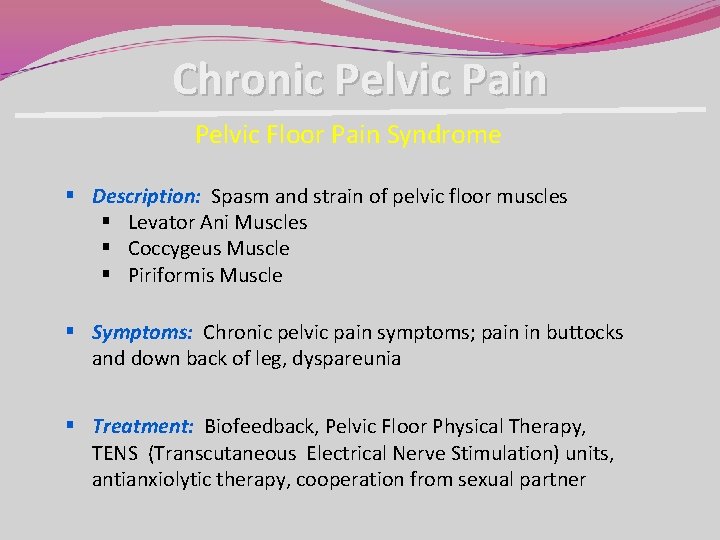
Chronic Pelvic Pain Pelvic Floor Pain Syndrome § Description: Spasm and strain of pelvic floor muscles § Levator Ani Muscles § Coccygeus Muscle § Piriformis Muscle § Symptoms: Chronic pelvic pain symptoms; pain in buttocks and down back of leg, dyspareunia § Treatment: Biofeedback, Pelvic Floor Physical Therapy, TENS (Transcutaneous Electrical Nerve Stimulation) units, antianxiolytic therapy, cooperation from sexual partner
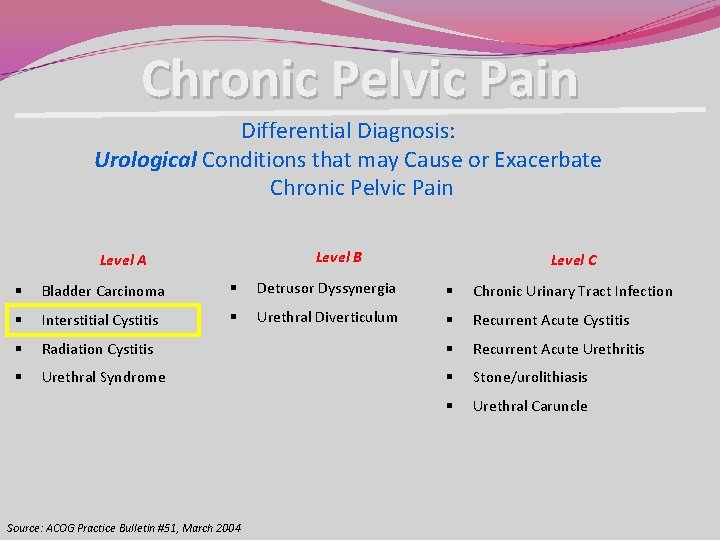
Chronic Pelvic Pain Differential Diagnosis: Urological Conditions that may Cause or Exacerbate Chronic Pelvic Pain Level B Level A Level C § Bladder Carcinoma § Detrusor Dyssynergia § Chronic Urinary Tract Infection § Interstitial Cystitis § Urethral Diverticulum § Recurrent Acute Cystitis § Radiation Cystitis § Recurrent Acute Urethritis § Urethral Syndrome § Stone/urolithiasis § Urethral Caruncle Source: ACOG Practice Bulletin #51, March 2004
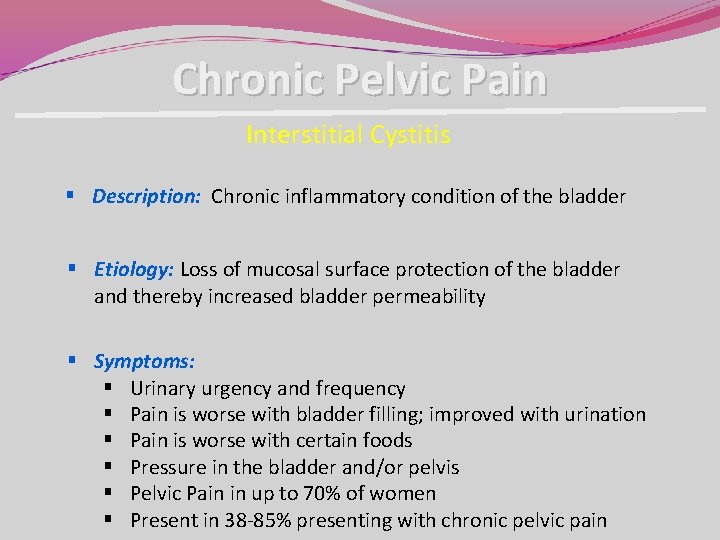
Chronic Pelvic Pain Interstitial Cystitis § Description: Chronic inflammatory condition of the bladder § Etiology: Loss of mucosal surface protection of the bladder and thereby increased bladder permeability § Symptoms: § Urinary urgency and frequency § Pain is worse with bladder filling; improved with urination § Pain is worse with certain foods § Pressure in the bladder and/or pelvis § Pelvic Pain in up to 70% of women § Present in 38 -85% presenting with chronic pelvic pain
Chronic Pelvic Pain Interstitial Cystitis § Diagnosis: § Cystoscopy with bladder distension § Intravesicular Potassium Sensitivity Test § Presence of glomerulations (Hunner Ulcers) § Treatment: § Avoidance of acidic foods and beverages § Antihistamines § Tricyclic antidepressants § Elmiron (pentosan polysulfate sodium) § Intravesical therapy: DMSO (dimethyl sulfoxide)
Chronic Pelvic Pain Differential Diagnosis: Gastrointestinal Conditions that may Cause or Exacerbate Chronic Pelvic Pain Level A § Colon Cancer § Constipation § Inflammatory Bowel Disease § Irritable Bowel Syndrome Source: ACOG Practice Bulletin #51, March 2004 Level B None Level C § § Colitis Chronic Intermittent Bowel Obstruction § Diverticular Disease
Chronic Pelvic Pain Irritable Bowel Syndrome (IBS) § Description: Chronic relapsing pattern of abdomino-pelvic pain and bowel dysfunction with diarrhea and/or constipation § Prevalence § Affects 12% of the U. S. population § 2: 1 prevalence in women: men § Peak age of 30 -40’s § Rare on women over 50 § Associated with elevated stress level § Symptoms § Diarrhea, constipation, bloating, mucousy stools § Symptoms of IBS found in 50 -80% women with CPP
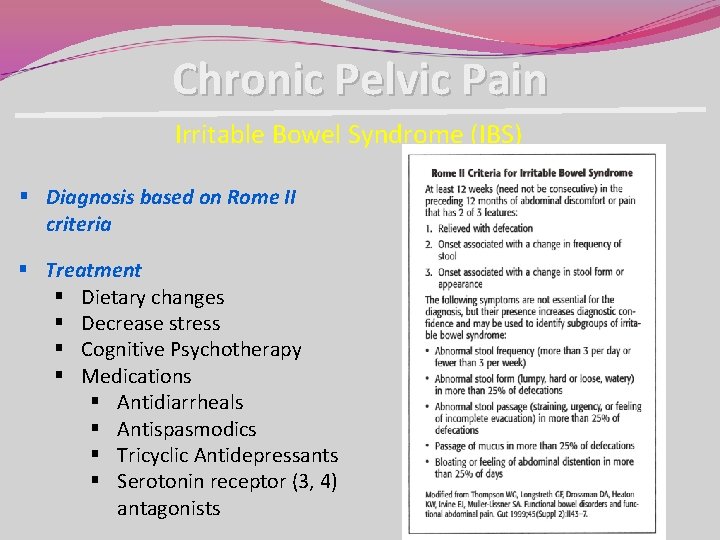
Chronic Pelvic Pain Irritable Bowel Syndrome (IBS) § Diagnosis based on Rome II criteria § Treatment § Dietary changes § Decrease stress § Cognitive Psychotherapy § Medications § Antidiarrheals § Antispasmodics § Tricyclic Antidepressants § Serotonin receptor (3, 4) antagonists
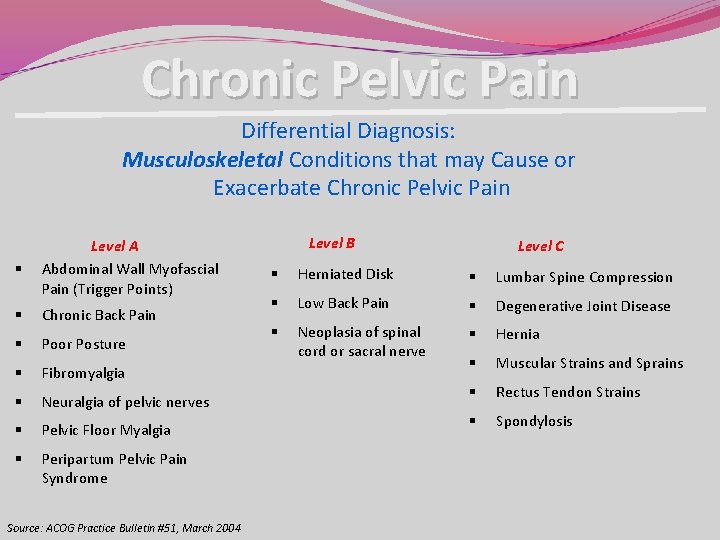
Chronic Pelvic Pain Differential Diagnosis: Musculoskeletal Conditions that may Cause or Exacerbate Chronic Pelvic Pain § Level A Abdominal Wall Myofascial Pain (Trigger Points) § Chronic Back Pain § Poor Posture § Fibromyalgia § Neuralgia of pelvic nerves § Pelvic Floor Myalgia § Peripartum Pelvic Pain Syndrome Source: ACOG Practice Bulletin #51, March 2004 Level B Level C § Herniated Disk § Lumbar Spine Compression § Low Back Pain § Degenerative Joint Disease § Neoplasia of spinal cord or sacral nerve § Hernia § Muscular Strains and Sprains § Rectus Tendon Strains § Spondylosis
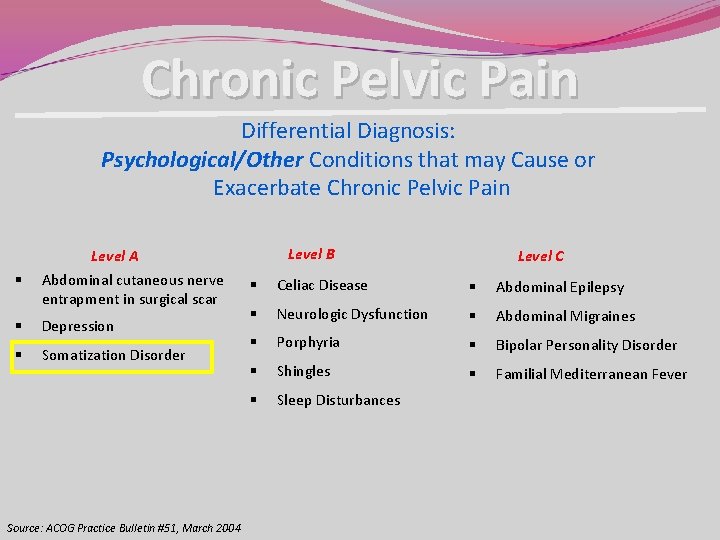
Chronic Pelvic Pain Differential Diagnosis: Psychological/Other Conditions that may Cause or Exacerbate Chronic Pelvic Pain § Level A Abdominal cutaneous nerve entrapment in surgical scar § Depression § Somatization Disorder Source: ACOG Practice Bulletin #51, March 2004 Level B Level C § Celiac Disease § Abdominal Epilepsy § Neurologic Dysfunction § Abdominal Migraines § Porphyria § Bipolar Personality Disorder § Shingles § Familial Mediterranean Fever § Sleep Disturbances
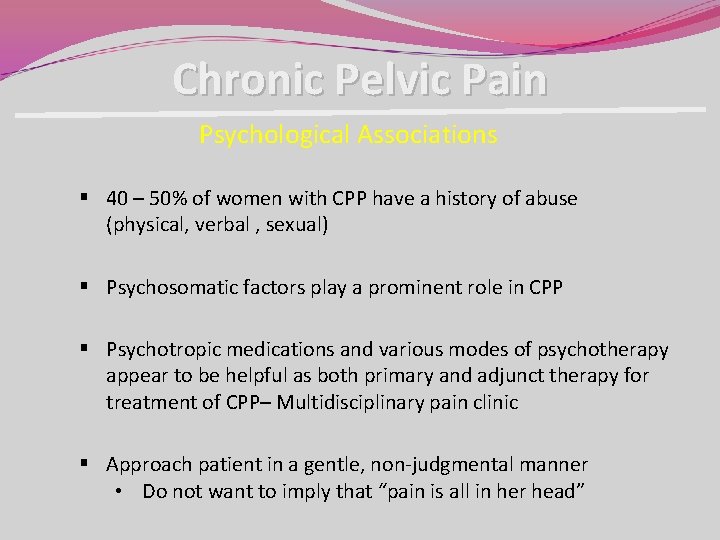
Chronic Pelvic Pain Psychological Associations § 40 – 50% of women with CPP have a history of abuse (physical, verbal , sexual) § Psychosomatic factors play a prominent role in CPP § Psychotropic medications and various modes of psychotherapy appear to be helpful as both primary and adjunct therapy for treatment of CPP– Multidisciplinary pain clinic § Approach patient in a gentle, non-judgmental manner • Do not want to imply that “pain is all in her head”
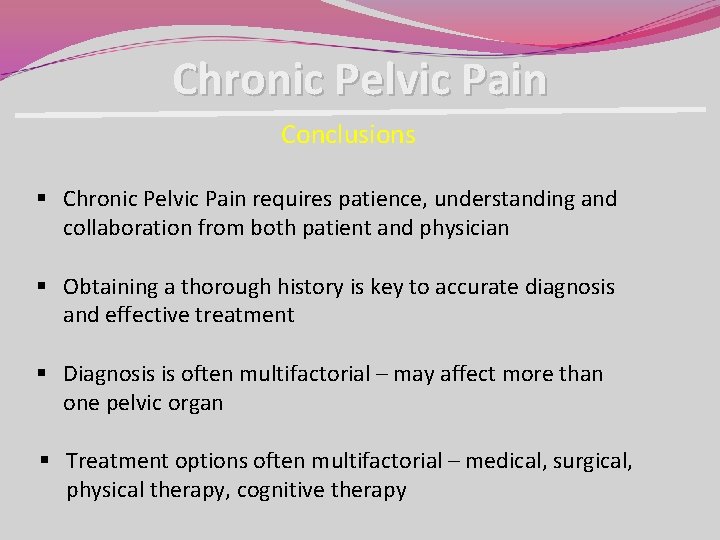
Chronic Pelvic Pain Conclusions § Chronic Pelvic Pain requires patience, understanding and collaboration from both patient and physician § Obtaining a thorough history is key to accurate diagnosis and effective treatment § Diagnosis is often multifactorial – may affect more than one pelvic organ § Treatment options often multifactorial – medical, surgical, physical therapy, cognitive therapy