
Chronic Obstructive Pulmonary Disease Chronic Disease Management KRISTEN
Chronic Obstructive Pulmonary Disease Chronic Disease Management KRISTEN MOUNCE, APRN, MSN, FNP-C CENTER FOR RESPIRATORY AND SLEEP MEDICINE/INDIANA INTERNAL MEDICINE CONSULTANTS

Disclosure I have no relevant financial relationships to disclose.
Objectives �Define COPD based on the Global Initiative for Chronic Obstructive Lung Disease (GOLD) parameters. �List two major risk factors for COPD. �Understand integrate evidence-based COPD practice recommendations and treatment guidelines. �Identify one of the benefits of referring for specialist involvement in COPD patient care.

COPD Burden �World Health Organization (WHO) estimates 65 million people globally with moderate to severe COPD, up to 210 million with COPD diagnosis 1. �WHO projects COPD deaths will increase globally by 30% in the next 10 years, becoming the 3 rd leading cause of death 1. �Affects men and women about equally now, with men plateauing and women still increasing 1. �Third leading cause of death in the US 2. � Only leading cause of death still increasing 3. � 120, 000 deaths annually in the United States (US) 4. �Accounts for estimated 15. 5 million office visits, 1. 5 million emergency visits, and 750, 000 hospitalizations minimum annually in US 3. �Majority of morbidity and mortality as well as healthcare costs occur from acute exacerbations 3.
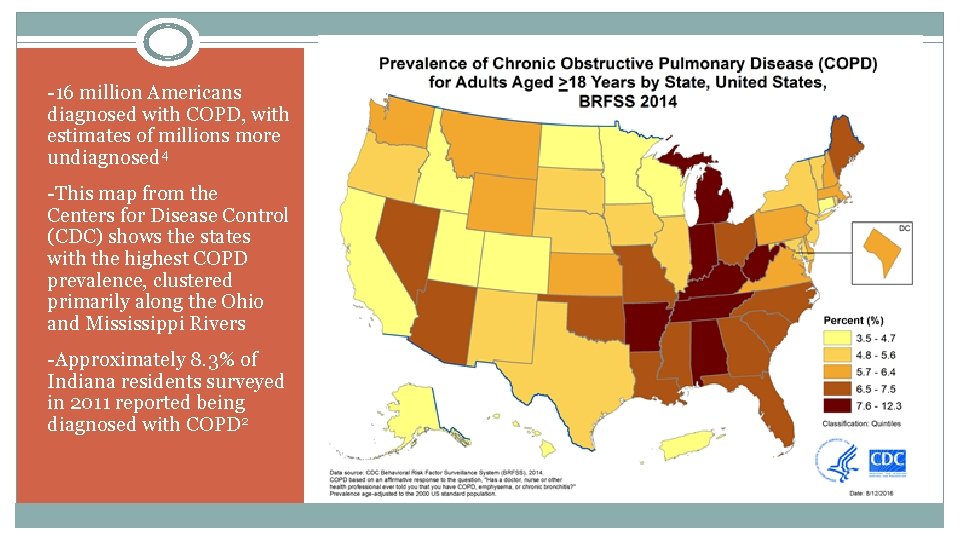
-16 million Americans diagnosed with COPD, with estimates of millions more undiagnosed 4 -This map from the Centers for Disease Control (CDC) shows the states with the highest COPD prevalence, clustered primarily along the Ohio and Mississippi Rivers -Approximately 8. 3% of Indiana residents surveyed in 2011 reported being diagnosed with COPD 2

COPD Definition �GOLD definition: "a common, https: //foundation. chestnet. org/patient-education-resources/copd/ -Emphysema: destruction of alveolar septa and formation of abnormally enlarged airspaces -Chronic bronchitis: cough productive of sputum for > 3 months x 2 years preventable and treatable disease that is characterized by persistent respiratory symptoms and airflow limitation that is due to airway and/or alveolar abnormalities usually caused by significant exposure to noxious particles or gases. ” 5 �Airway obstruction not fully reversible and progressive 6 �Abnormal inflammatory response to noxious stimuli
Risk Factors MAJOR RISK FACTORS 5 ADDITIONAL RISK FACTORS 5 �Tobacco smoking �Marijuana smoking �Outdoor air pollution �Genetic factors �Occupational exposures �Age and gender �Indoor air pollution �Lung growth and development �Airway hyper-reactivity
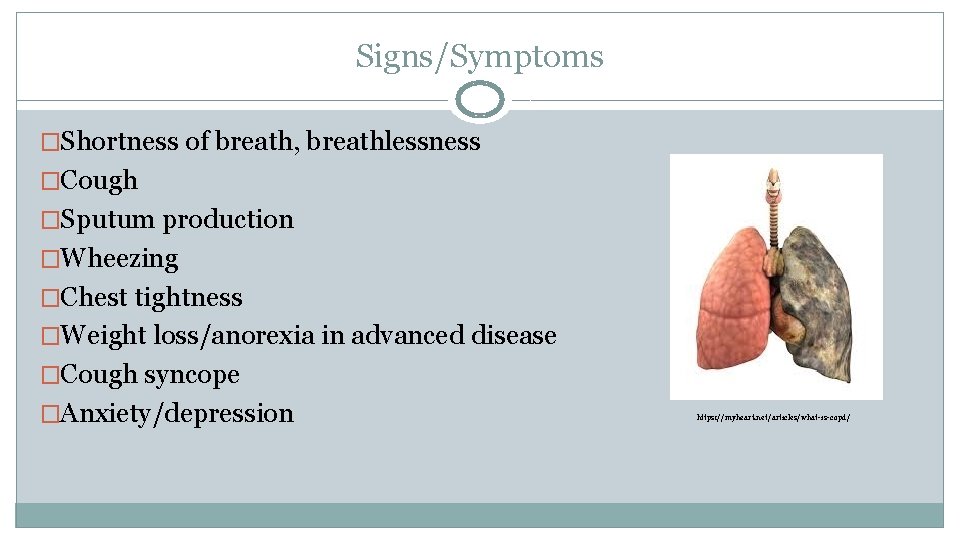
Signs/Symptoms �Shortness of breath, breathlessness �Cough �Sputum production �Wheezing �Chest tightness �Weight loss/anorexia in advanced disease �Cough syncope �Anxiety/depression https: //myheart. net/articles/what-is-copd/
Clinical Suspicion Triggers GOLD recommends considering COPD and performance of spirometry in any individual over age 40 with a history of risk factors and/or family history of COPD who has any of the following 5 : �progressively worsening dyspnea �persistent dyspnea �chronic cough, may be nonproductive �recurrent wheezing �chronic sputum production �recurrent lower respiratory tract infections
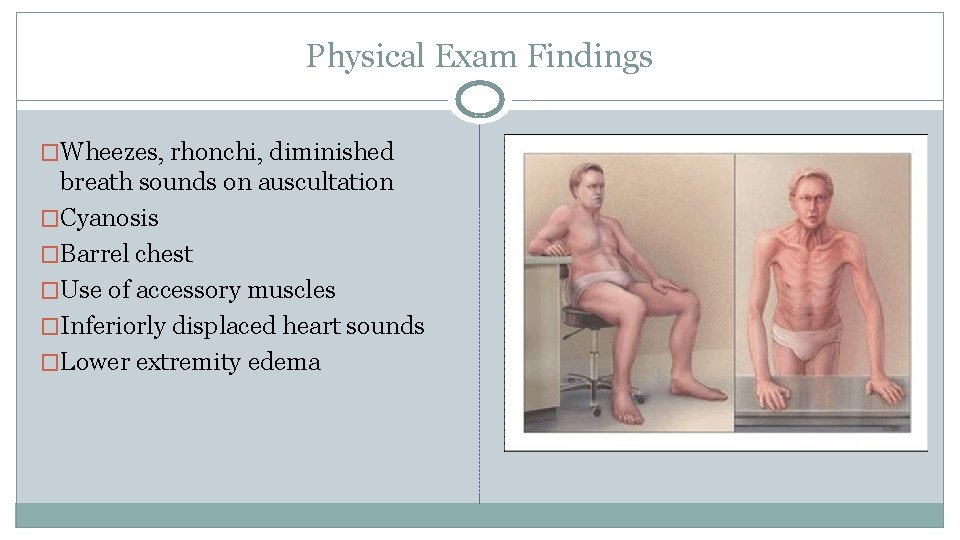
Physical Exam Findings �Wheezes, rhonchi, diminished breath sounds on auscultation �Cyanosis �Barrel chest �Use of accessory muscles �Inferiorly displaced heart sounds �Lower extremity edema
Co-morbidities �Heart Failure �Pulmonary Hypertension �Lung Cancer �Obstructive Sleep Apnea �Anxiety and Depression �Coronary Artery Disease �Polycythemia �Osteoporosis �Metabolic syndrome

COPD Diagnosis -Spirometry is required to diagnose COPD with persistent airflow limitation confirmed by FEV 1/FVC < 0. 70 postbronchodilation 5 -Staging/classification of airflow obstruction based on post-bronchodilator FEV 15 https: //goldcopd. org/wp-content/uploads/dlm_uploads/2016/12/wms-GOLD-2017 -Pocket-Guide-Final. pdf
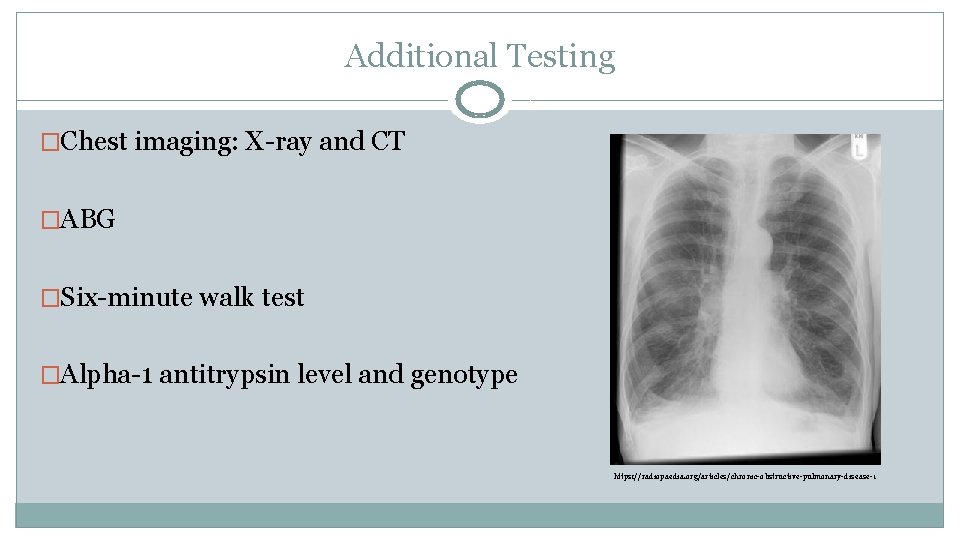
Additional Testing �Chest imaging: X-ray and CT �ABG �Six-minute walk test �Alpha-1 antitrypsin level and genotype https: //radiopaedia. org/articles/chronic-obstructive-pulmonary-disease-1
Treatment Goals No cure for COPD, but a manageable chronic medical condition with treatment goals including: Symptom management Reduce exacerbation frequency and severity Improve exercise tolerance and overall health status
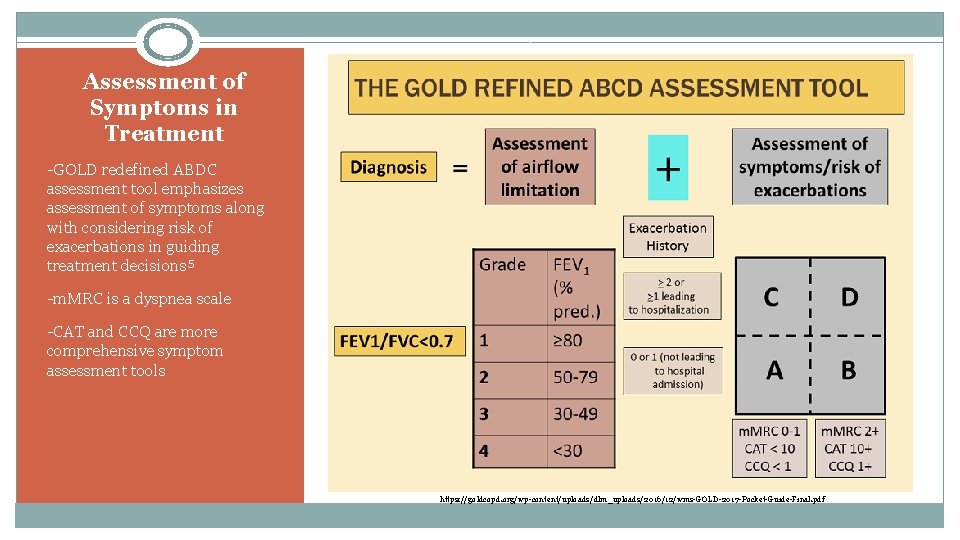
Assessment of Symptoms in Treatment -GOLD redefined ABDC assessment tool emphasizes assessment of symptoms along with considering risk of exacerbations in guiding treatment decisions 5 -m. MRC is a dyspnea scale -CAT and CCQ are more comprehensive symptom assessment tools https: //goldcopd. org/wp-content/uploads/dlm_uploads/2016/12/wms-GOLD-2017 -Pocket-Guide-Final. pdf
COPD Treatment �Pharmacological therapy �Exacerbation reduction �Tobacco cessation �Oxygen therapy �Exercise tolerance http: //www. ihpmi. org/ihp-copd
Pharmacologic Therapy �Bronchodilators: beta 2 -agonists, antimuscarinics, short and long acting, as well as methylxanthines �Inhaled corticosteroids �PDE 4 inhibitors �Mucolytics �Macrolide therapy �Oral glucocorticoids, primarily for acute symptom management 5
Exacerbations �Acute change in shortness of breath, cough, and/or sputum �Beyond normal day-to-day variations �Generally warrants a change in baseline pharmacological therapy �MILD: Symptoms present but no change in treatment is indicated �MODERATE: Managed with antibiotic and/or systemic corticosteroid �SEVERE: Requiring inpatient management
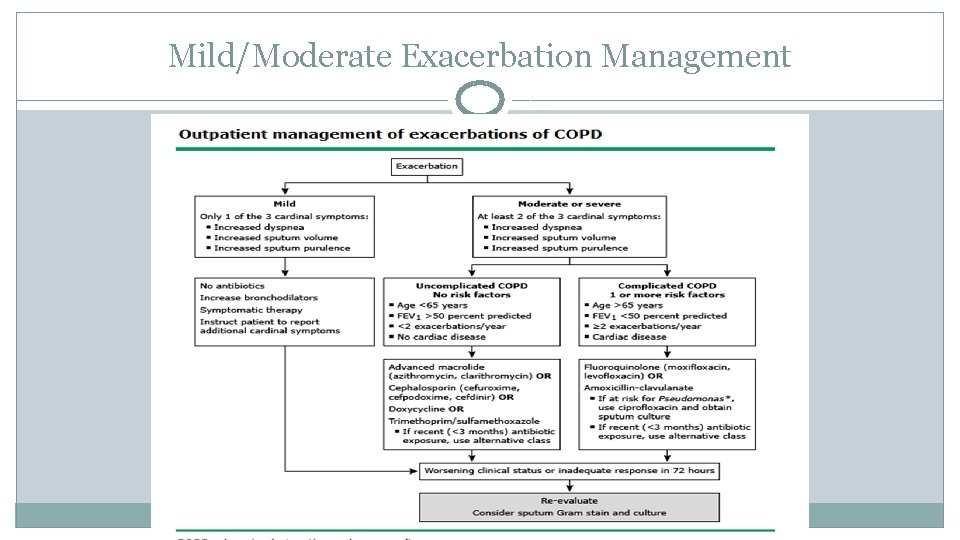
Mild/Moderate Exacerbation Management
Exacerbation Reduction �Tobacco cessation �Pulmonary rehab �Triple combination inhaled therapy �PDE 4 inhibitors �Macrolide therapy https: //copd. net/clinical/frequent-exacerbations/
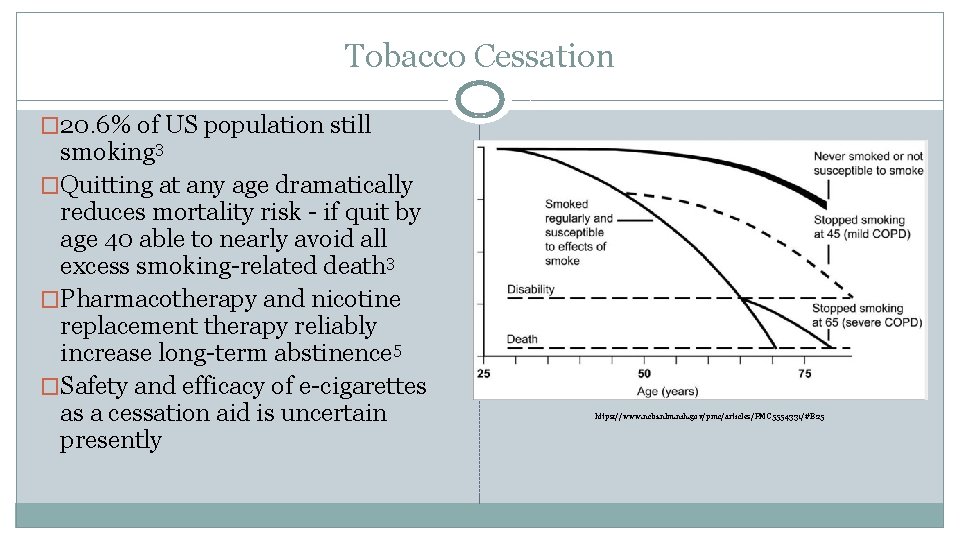
Tobacco Cessation � 20. 6% of US population still smoking 3 �Quitting at any age dramatically reduces mortality risk - if quit by age 40 able to nearly avoid all excess smoking-related death 3 �Pharmacotherapy and nicotine replacement therapy reliably increase long-term abstinence 5 �Safety and efficacy of e-cigarettes as a cessation aid is uncertain presently https: //www. ncbi. nlm. nih. gov/pmc/articles/PMC 5554331/#B 25
Cessation Interventions Pharmacologic Non-pharmacologic �Varenicline �Cessation counseling �Bupropion sustained release �Cessation programs �Nicotine replacement therapy �Support groups
Pulmonary Rehab �Structured program focused on education, support, and supervised exercise 4 �Outcomes include: Improvement in quality of life, exercise tolerance, and overall health status Exacerbation reduction, both frequency and severity �Recommended for all patients in GOLD Groups B, C, and D 5 �Recommended for exacerbation reduction in all patients with moderate to very severe COPD who have had an exacerbation within previous 4 weeks 6
Triple Combination Inhaled Therapy �New single-inhaler device available with triple therapy �IMPACT trial compared single-device triple to dual therapy 15% exacerbation reduction versus long-acting beta 2 agonist/inhaled corticosteroid 9 25% exacerbation reduction versus long-acting beta 2 agonist/anticholinergic 9 34% hospitalization reduction versus long-acting beta 2 agonist/anticholingeric 9
PDE 4 Inhibitors and Macrolide Therapy �PDE 4 Inhibitor therapy in patients with severe or very severe COPD with chronic bronchitis and history of exacerbation 17% exacerbation reduction when added to current bronchodilator therapy 10 Improves lung function 5 �Recent studies have shown long-term macrolide therapy reduces exacerbations rate 5
Additional Interventions in COPD Management �Vaccinations �Lung cancer screening CT �Patient education �Nutrition �Case management �Palliative care https: //www. himss. org/news/world-immunization-week-april-24 -30
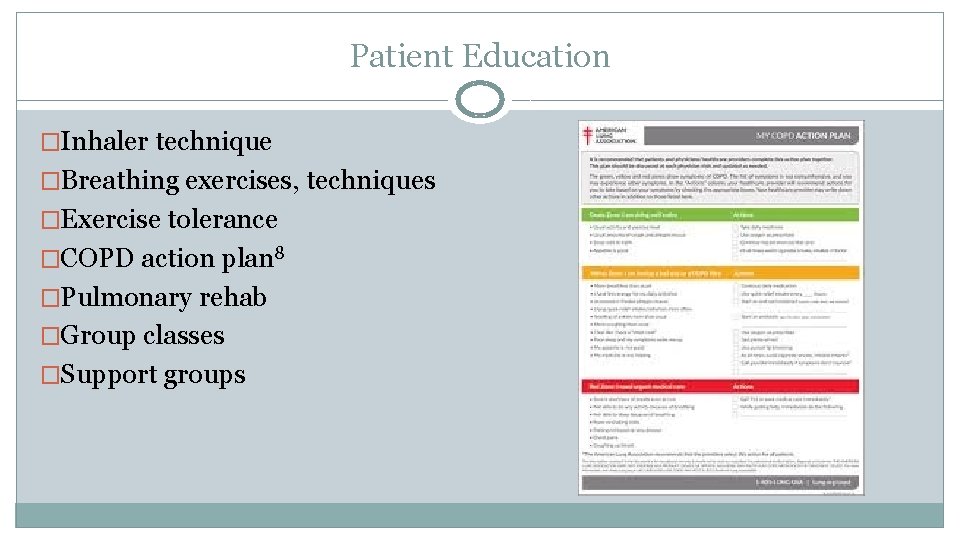
Patient Education �Inhaler technique �Breathing exercises, techniques �Exercise tolerance �COPD action plan 8 �Pulmonary rehab �Group classes �Support groups
Benefits of Pulmonary Referral �Confirm diagnosis �Assess for presence of other pathology such as asthma, interstitial lung disease, bronchiectasis �Optimize treatment, especially in patients with persistent symptoms despite escalating therapy or those with recurrent exacerbations �Manage supplemental oxygen therapy �Assess the need for more complex and expensive therapies 7 �Application of comprehensive care model
References 1. 2. 3. 4. 5. 6. 7. 8. 9. 10. World Health Organization (2018). Burden of COPD. Retrieved from http: //www. who. int/respiratory/copd/burden/en/ Centers for Disease Control. COPD Among Adults in Indiana. Retrieved from https: //www. cdc. gov/copd/maps/docs/pdf/IN_COPDFact. Sheet. pdf May, S. M. & Li, J. T. C. (2015). Burden of chronic obstructive pulmonary disease: Healthcare costs and beyond. Allergy and Asthma Proceedings 36(1). doi 10. 2500/aap. 2015. 36. 3812. Retrieved from https: //www. ncbi. nlm. nih. gov/pmc/articles/PMC 5554331/#B 25 American Thoracic Society (2017). COPD Today. Patient Information Series. Retrieved from http: //www. thoracic. org/patients/patient -resources/copd-today. pdf Global Initiative for Chronic Obstructive Lung Disease (2017). Pocket Guide to COPD Diagnosis, Management, and Prevention: A Guide for Health Care Professionals. Criner, G. J. et al. (2015). Prevention of Acute Exacerbation of COPD: American College of Chest Physicians and Canadian Thoracic Society Guideline. CHEST. 147(4): 883 -893. Retrieved from https: //journal. chestnet. org/article/S 0012 -3692(15)38940 -6/pdf National Clinical Guideline Centre (2010). Chronic Obstructive Pulmonary Disease: Management of COPD in Adults in Primary and Secondary Care. NICE Clinical Guidelines, No. 101. Retrieved from https: //www. ncbi. nlm. nih. gov/books/NBK 65029/ American Lung Association (2016). My COPD Action Plan. Retrieved from https: //www. lung. org/assets/documents/copd-action -plan. pdf Lipson, D. A. et al. (2018). Once-Daily Single-Inhaler Triple versus Dual Therapy in Patients with COPD. The New England Journal of Medicine. Retrieved from https: //www. nejm. org/doi/full/10. 1056/NEJMoa 1713901 Calverley, P. M. et al. (2009). Roflumilast in symptomatic chronic obstructive pulmonary disease: two randomised clinical trials. Lancet. 374: 658 -694.
Chronic Obstructive Pulmonary Disease Chronic Disease Management QUESTIONS?
- Slides: 30