
Chronic Medication Service Objectives To describe the background
Chronic Medication Service
Objectives • To describe the background and policy context for the introduction of the Chronic Medication Service • To outline the general elements of the Chronic Medication Service • To look at each of the three stages of the Chronic Medication Service • To share the plans being considered for implementation of the service

Background & Policy
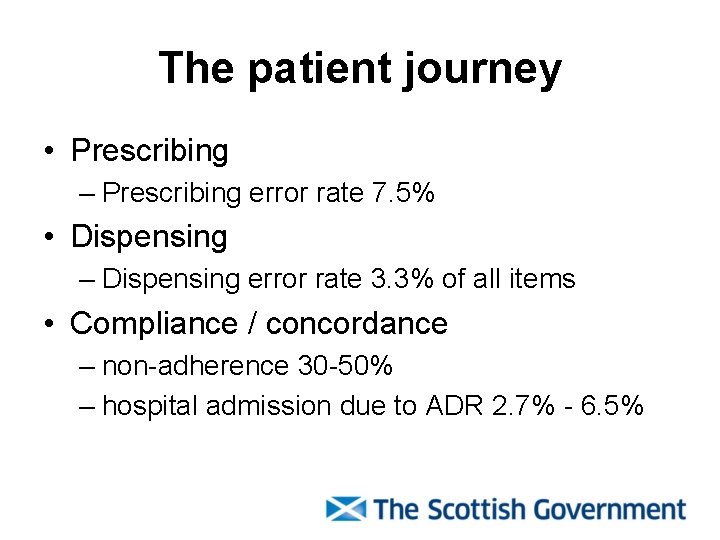
The patient journey • Prescribing – Prescribing error rate 7. 5% • Dispensing – Dispensing error rate 3. 3% of all items • Compliance / concordance – non-adherence 30 -50% – hospital admission due to ADR 2. 7% - 6. 5%
Building on existing evidence • Repeat dispensing pilots – Paper based trials – Reduce wastage – Improve access • Pharmaceutical Care Model Schemes – Care of the elderly – Chronic disease areas – Medication review
General Description of the Chronic Medication Service
Chronic Medication Service (CMS) Description Purpose • A system of personalised pharmaceutical care to patients with long term medical conditions. • To ensure patients obtain optimal therapeutic benefit from their medicines and minimise any predictable undesirable effects.
Purpose • Move focus from dispensing to clinical practice and quality • Patient centred, medicines focused • Building on what people already do • Based on a systematic approach • Document practice • Improve continuity of care
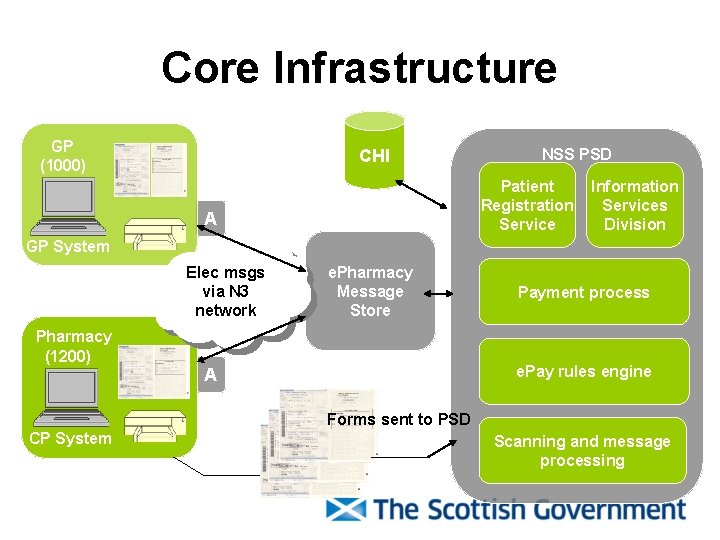
Core Infrastructure GP (1000) CHI NSS PSD Patient Registration Service A Information Services Division GP System Elec msgs via N 3 network Pharmacy (1200) e. Pharmacy Message Store Payment process e. Pay rules engine A Forms sent to PSD CP System Scanning and message processing

The Three Stages Of CMS
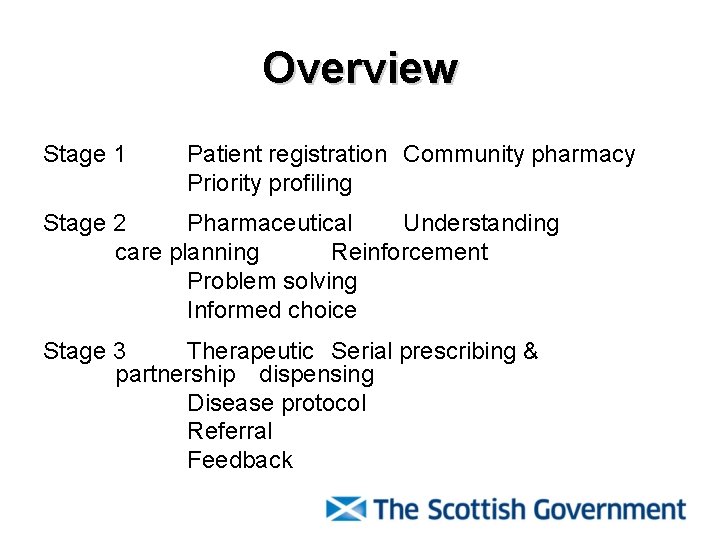
Overview Stage 1 Patient registration Community pharmacy Priority profiling Stage 2 Pharmaceutical Understanding care planning Reinforcement Problem solving Informed choice Stage 3 Therapeutic Serial prescribing & partnership dispensing Disease protocol Referral Feedback
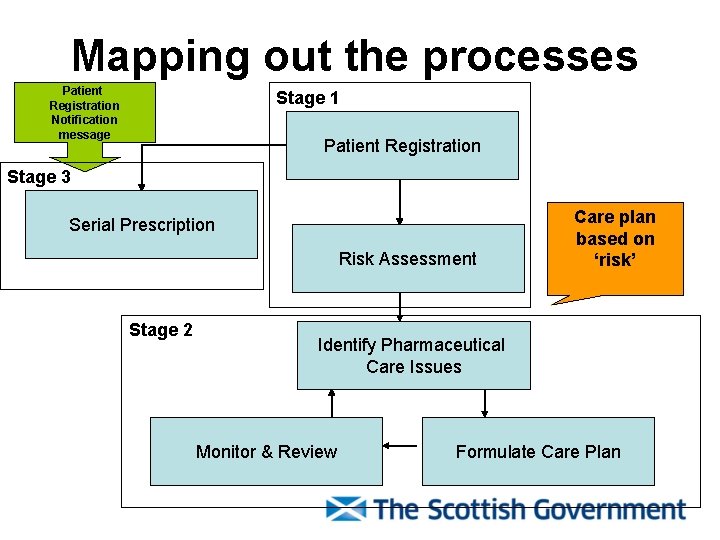
Mapping out the processes Patient Registration Notification message Stage 1 Patient Registration Stage 3 Serial Prescription Risk Assessment Stage 2 Care plan based on ‘risk’ Identify Pharmaceutical Care Issues Monitor & Review Formulate Care Plan
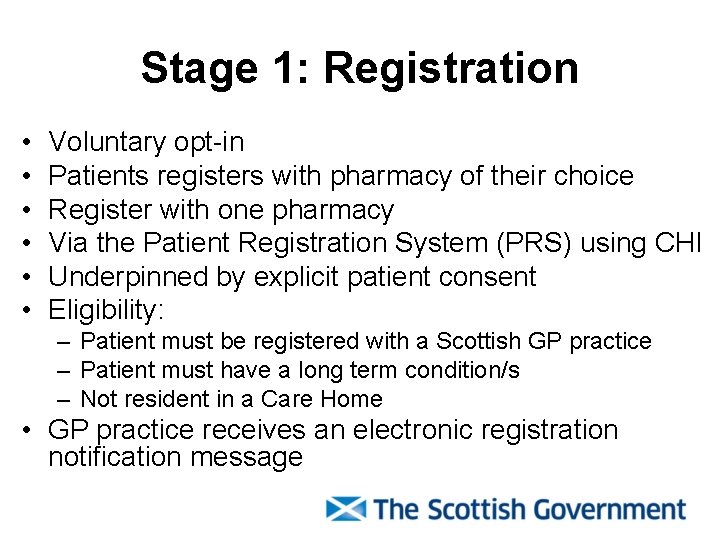
Stage 1: Registration • • • Voluntary opt-in Patients registers with pharmacy of their choice Register with one pharmacy Via the Patient Registration System (PRS) using CHI Underpinned by explicit patient consent Eligibility: – Patient must be registered with a Scottish GP practice – Patient must have a long term condition/s – Not resident in a Care Home • GP practice receives an electronic registration notification message
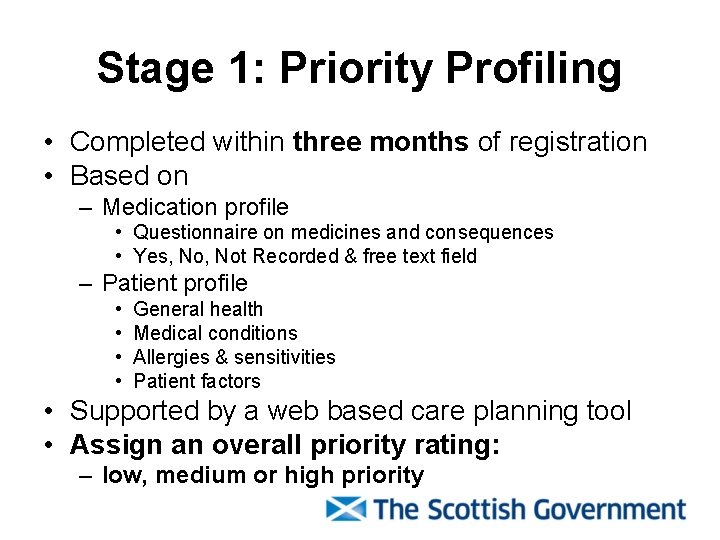
Stage 1: Priority Profiling • Completed within three months of registration • Based on – Medication profile • Questionnaire on medicines and consequences • Yes, Not Recorded & free text field – Patient profile • • General health Medical conditions Allergies & sensitivities Patient factors • Supported by a web based care planning tool • Assign an overall priority rating: – low, medium or high priority
Stage 2: Pharmaceutical Care Planning • The patient and pharmacist – discuss and assess the patient’s condition/s, medicine/s and general health – identify any issues / problems – establish desired outcomes – agree any actions to address them • The pharmacist – documents the issues, desired outcomes and actions using the care plan system – Monitors, reviews and updates the care package • Supported by a web based care planning tool
Web-based care Planning Tool
Pharmacy Care Record • Web based – a secure system (holds patient data) – fully robust (data recovery, data replication to a backup site) – username and password protected • Hosts the pharmaceutical care plan – priority profiling – pharmaceutical care plan • Build in additional applications e. g. PHS?
PCR Search Screen
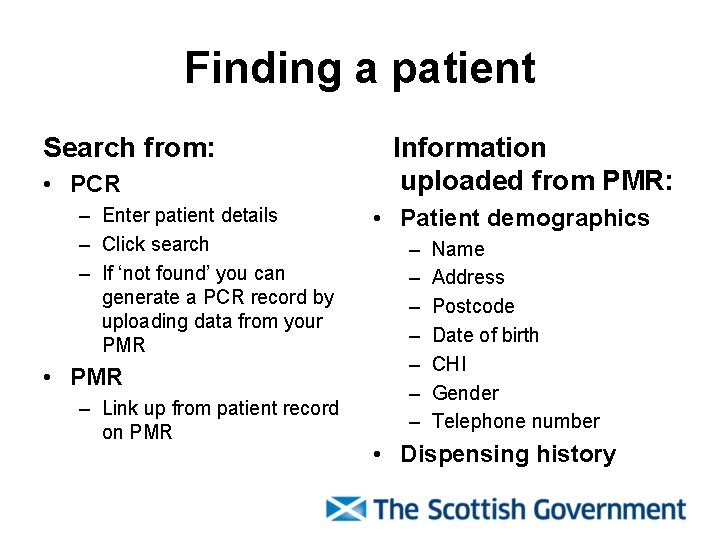
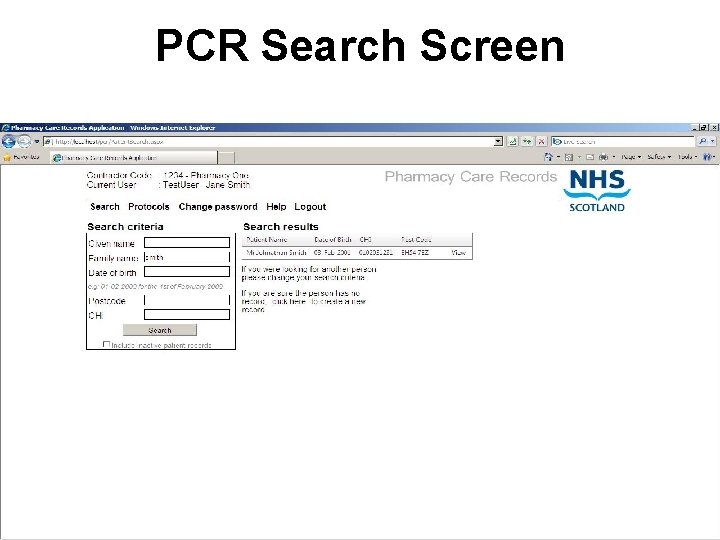
Finding a patient Search from: • PCR – Enter patient details – Click search – If ‘not found’ you can generate a PCR record by uploading data from your PMR • PMR – Link up from patient record on PMR Information uploaded from PMR: • Patient demographics – – – – Name Address Postcode Date of birth CHI Gender Telephone number • Dispensing history
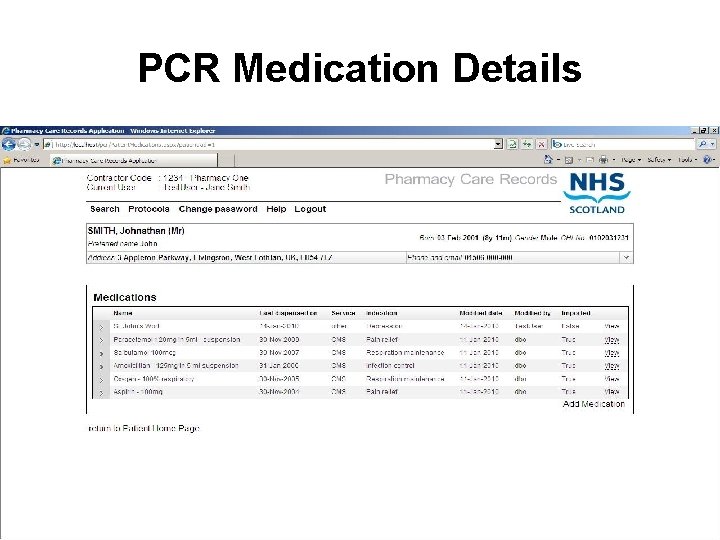
PCR Medication Details
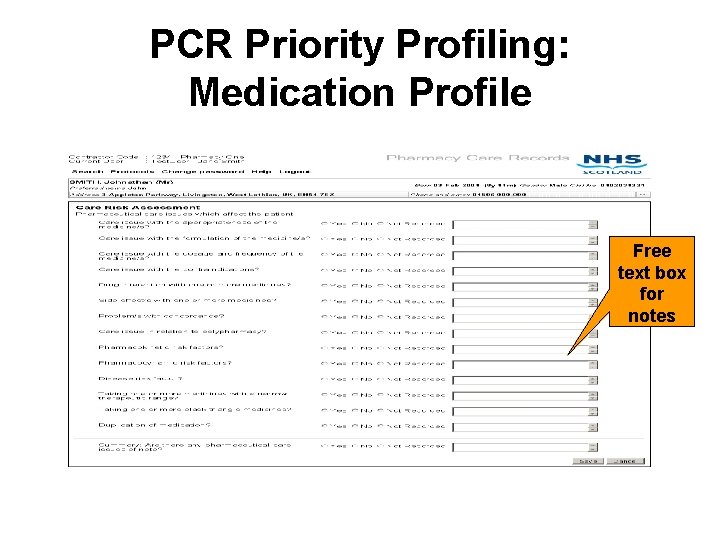
PCR Priority Profiling: Medication Profile Free text box for notes
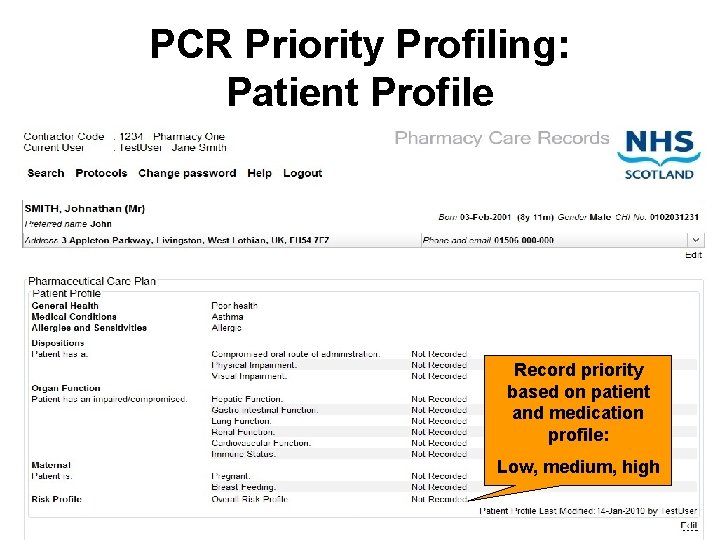
PCR Priority Profiling: Patient Profile Record priority based on patient and medication profile: Low, medium, high
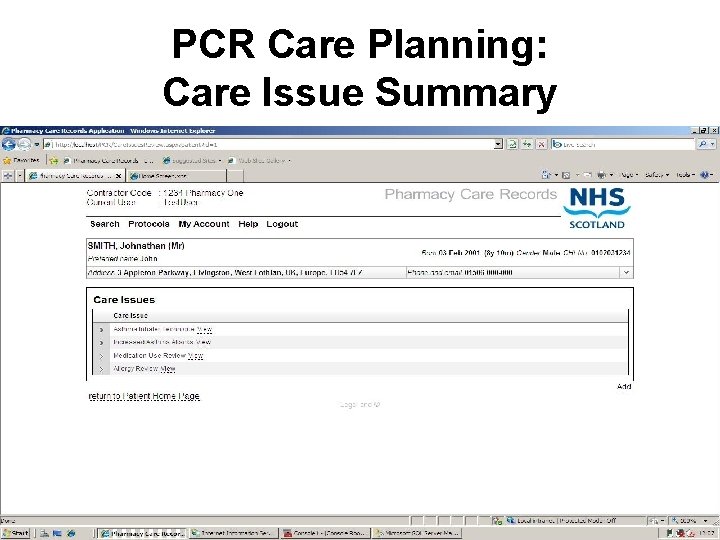
PCR Care Planning: Care Issue Summary
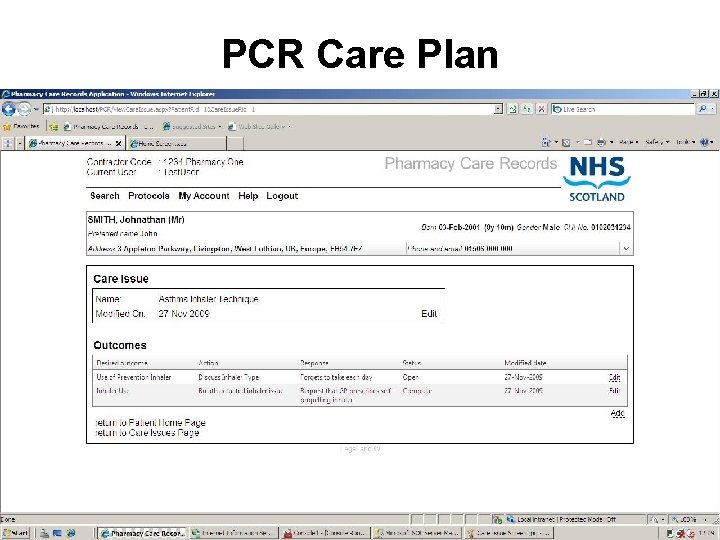
PCR Care Plan
Stage 3: Serial prescribing & dispensing • The patient’s GP – Eligibility based on age, medical and maternity exemptions – decides on their suitability for a 24 or 48 week serial prescription – selects dispensing intervals • The pharmacist – dispenses the prescription according to defined intervals – engages with the patient over the time period according to the disease specific protocols • Feedback – dispensing information with each dispensing episode – end of care treatment summary information • dispensing information and any specific relevant care information • can include a request for new serial prescription
Benefits • • Improved clinical outcomes Improved concordance Reduced wastage Easier patient journey Promotion of self care Better utilisation of the workforce Encourage team working
Further information… Establishing effective therapeutic partnerships: The Ritchie Report http: //www. scotland. gov. uk/Publications/ 2009/12/08131756/0 NES CMS Implementation Resource Pack: http: //www. nes. scot. nhs. uk/pharmacy/ne wcontract/cms. asp
Implementation
CMS Dates • Commence roll out from 1 April 2010 (final date still to be agreed) • Operationalise working processes from April – September 2010 • CMS ‘live’ from September 2010
Operationalisation Phase • ‘Bedding in’ stage • Phased from April to September • CPs familiarise themselves with e. CMS software – – Registration Care planning Serial dispensing Reporting • GPs familiarise themselves with e. CMS software – Serial prescribing – Managing end-of-care treatment summaries
Current position • All GP and Pharmacy IT system suppliers on course for April delivery • NSS PSD system changes in place – Patient Registration Service (PRS) – e. Pay • e. Pharmacy infrastructure in place – e. Pharmacy Message Store (e. PMS) – Pharmacy Care Record (PCR) • Early Adopter phase underway in NHS Fife
National Priorities for Next 2 Months • • • GP and Practice Manager NES Packs PCR User Manual PCR ‘test’ patients for training on PCR user name and password processes Identifying a process to issue user names and passwords • Finalising and distributing CMS patient leaflet • CMS disease specific protocols
Supporting Implementation Locally • Local awareness sessions • Identifying community pharmacists who require PCR user names & passwords • Issuing user names & passwords • Agreeing local working processes • Endorsing NES sponsored GP & CP workshops (May & June 2010) • Supporting practitioners during the implementation phase
Milestones • Agree final service specification – During March 2010 • Finalise national implementation plan – During March 2010 • Agree CMS start date – During March 2010 • Delivering CMS! – From April 2010

- Slides: 35