
Chronic kidney disease in people with type 2

- Slides: 21
Chronic kidney disease in people with type 2 diabetes – A learning resource for Primary Care SECTION A Introduction and overview of chronic kidney disease (CKD) in people with diabetes These slides were sponsored by Janssen and developed in conjunction with the BRS CKD Strategy Group, following an advisory board that was organised by Janssen. Bedrock Healthcare Communications provided editorial support to members of the advisory board in developing the slides. Janssen reviewed the content for technical accuracy. The content is intended for a UK healthcare professional audience only. JOB CODE PHGB/VOK/0914/0018 Date of preparation: January 2015
Objectives and background for this learning resource Introduction: This learning resource has been developed as part of a medical education initiative supported by Janssen. The content of this slide kit has been developed by an advisory board of renal physicians, GPs and specialist nurses. The panel of experts includes members of the British Renal Society Chronic Kidney Disease (CKD) Strategy Group. Bedrock Healthcare, a medical communications agency, has provided editorial support in developing the content; Janssen has reviewed the content for technical accuracy. Educational objectives: • To provide clear and applicable clinical guidance on chronic kidney disease (CKD) in people with type 2 diabetes to primary care healthcare professionals • To advise primary healthcare professionals on what people with diabetes need to know about their own condition with relation to CKD Usability objectives: • To provide essential, relevant and up to date information in concise presentations • To enable primary healthcare professionals to locate, select and use the content of the learning resource, as appropriate to their needs • To enable secondary care experts in CKD to refer their primary care colleagues to the resource 1
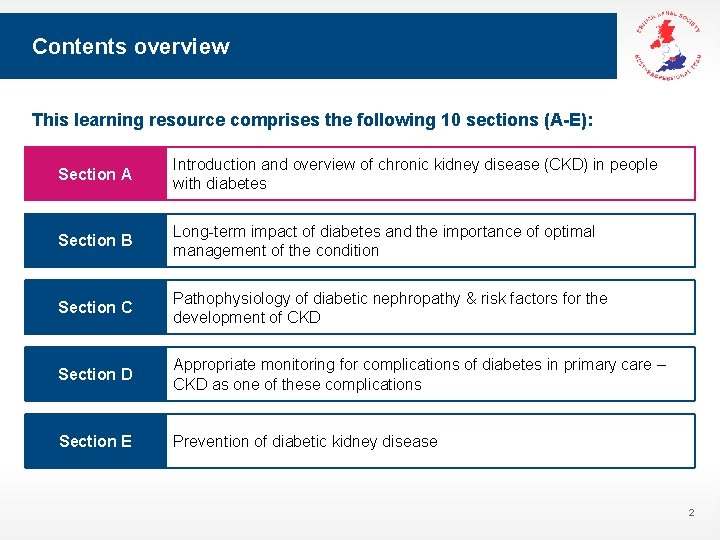
Contents overview This learning resource comprises the following 10 sections (A-E): Section A Introduction and overview of chronic kidney disease (CKD) in people with diabetes Section B Long-term impact of diabetes and the importance of optimal management of the condition Section C Pathophysiology of diabetic nephropathy & risk factors for the development of CKD Section D Appropriate monitoring for complications of diabetes in primary care – CKD as one of these complications Section E Prevention of diabetic kidney disease 2
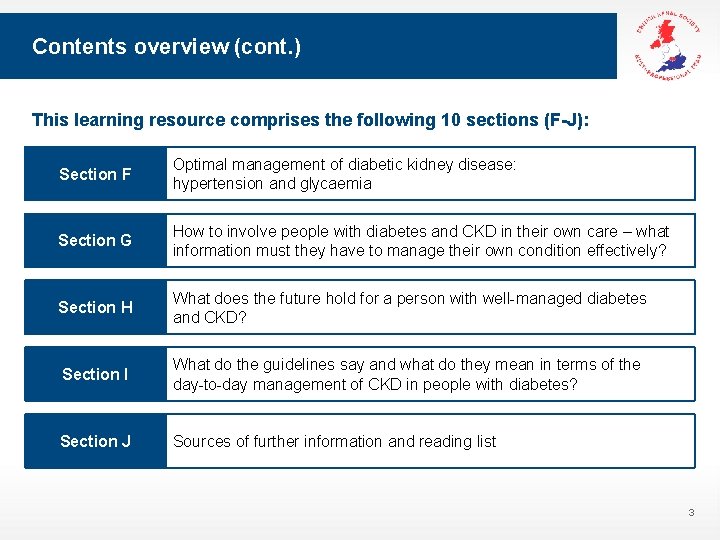
Contents overview (cont. ) This learning resource comprises the following 10 sections (F-J): Section F Optimal management of diabetic kidney disease: hypertension and glycaemia Section G How to involve people with diabetes and CKD in their own care – what information must they have to manage their own condition effectively? Section H What does the future hold for a person with well-managed diabetes and CKD? Section I What do the guidelines say and what do they mean in terms of the day-to-day management of CKD in people with diabetes? Section J Sources of further information and reading list 3
Introduction and overview of chronic kidney disease (CKD) in people with diabetes SECTION A
Section A – 3 key learning objectives • Objectives and background to this learning resource • Key definitions used throughout the learning resource • Overview of chronic kidney disease (CKD) in type 2 diabetes, including: – The scale of the problem – CKD in people with diabetes may be PREVENTABLE not inevitable – Outcomes for people with type 2 diabetes and CKD 5
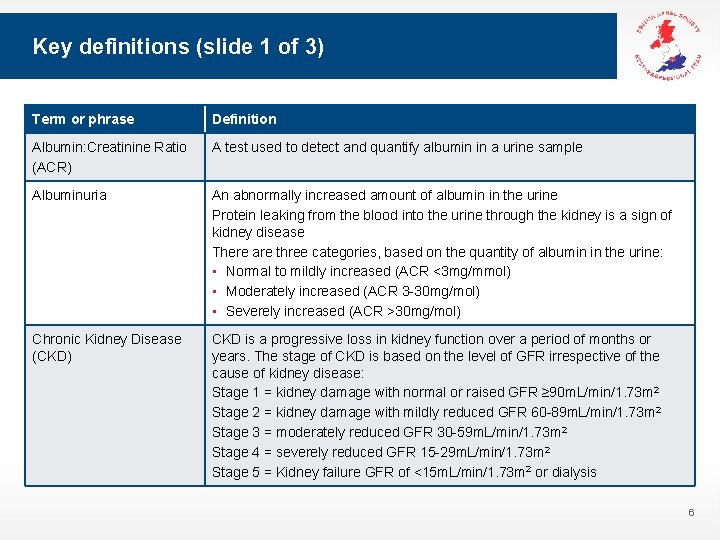
Key definitions (slide 1 of 3) Term or phrase Definition Albumin: Creatinine Ratio (ACR) A test used to detect and quantify albumin in a urine sample Albuminuria An abnormally increased amount of albumin in the urine Protein leaking from the blood into the urine through the kidney is a sign of kidney disease There are three categories, based on the quantity of albumin in the urine: • Normal to mildly increased (ACR <3 mg/mmol) • Moderately increased (ACR 3 -30 mg/mol) • Severely increased (ACR >30 mg/mol) Chronic Kidney Disease (CKD) CKD is a progressive loss in kidney function over a period of months or years. The stage of CKD is based on the level of GFR irrespective of the cause of kidney disease: Stage 1 = kidney damage with normal or raised GFR ≥ 90 m. L/min/1. 73 m 2 Stage 2 = kidney damage with mildly reduced GFR 60 -89 m. L/min/1. 73 m 2 Stage 3 = moderately reduced GFR 30 -59 m. L/min/1. 73 m 2 Stage 4 = severely reduced GFR 15 -29 m. L/min/1. 73 m 2 Stage 5 = Kidney failure GFR of <15 m. L/min/1. 73 m 2 or dialysis 6
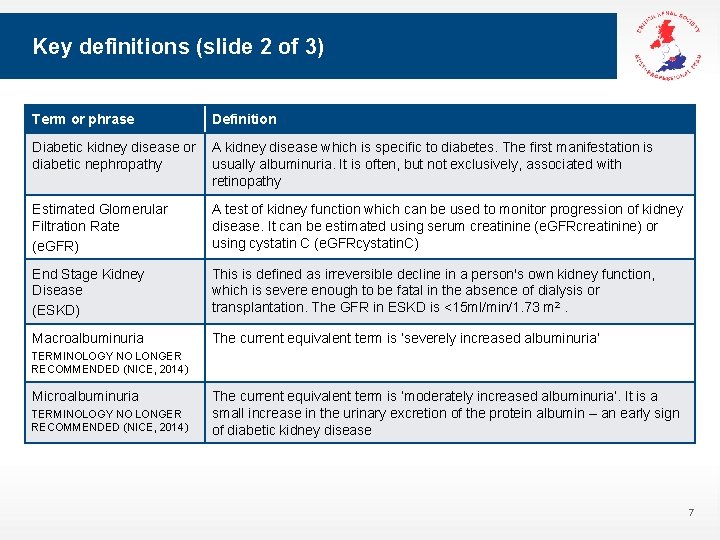
Key definitions (slide 2 of 3) Term or phrase Definition Diabetic kidney disease or diabetic nephropathy A kidney disease which is specific to diabetes. The first manifestation is usually albuminuria. It is often, but not exclusively, associated with retinopathy Estimated Glomerular Filtration Rate (e. GFR) A test of kidney function which can be used to monitor progression of kidney disease. It can be estimated using serum creatinine (e. GFRcreatinine) or using cystatin C (e. GFRcystatin. C) End Stage Kidney Disease (ESKD) This is defined as irreversible decline in a person's own kidney function, which is severe enough to be fatal in the absence of dialysis or transplantation. The GFR in ESKD is <15 ml/min/1. 73 m 2. Macroalbuminuria The current equivalent term is ‘severely increased albuminuria’ TERMINOLOGY NO LONGER RECOMMENDED (NICE, 2014) Microalbuminuria TERMINOLOGY NO LONGER RECOMMENDED (NICE, 2014) The current equivalent term is ‘moderately increased albuminuria’. It is a small increase in the urinary excretion of the protein albumin – an early sign of diabetic kidney disease 7
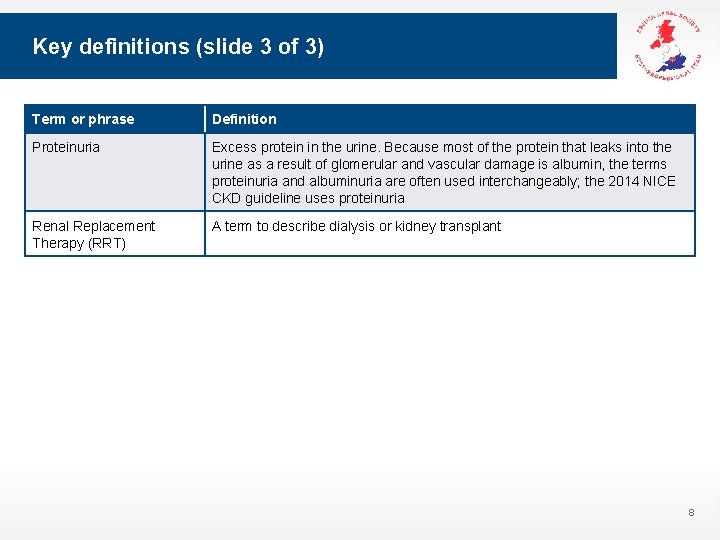
Key definitions (slide 3 of 3) Term or phrase Definition Proteinuria Excess protein in the urine. Because most of the protein that leaks into the urine as a result of glomerular and vascular damage is albumin, the terms proteinuria and albuminuria are often used interchangeably; the 2014 NICE CKD guideline uses proteinuria Renal Replacement Therapy (RRT) A term to describe dialysis or kidney transplant 8
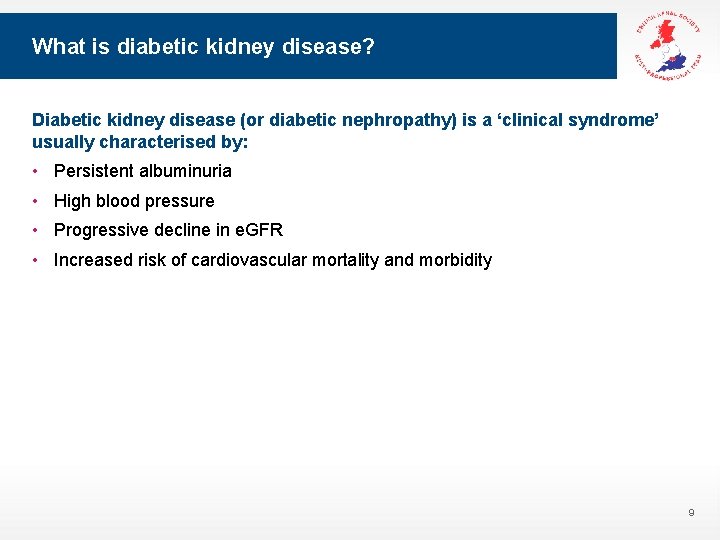
What is diabetic kidney disease? Diabetic kidney disease (or diabetic nephropathy) is a ‘clinical syndrome’ usually characterised by: • Persistent albuminuria • High blood pressure • Progressive decline in e. GFR • Increased risk of cardiovascular mortality and morbidity 9
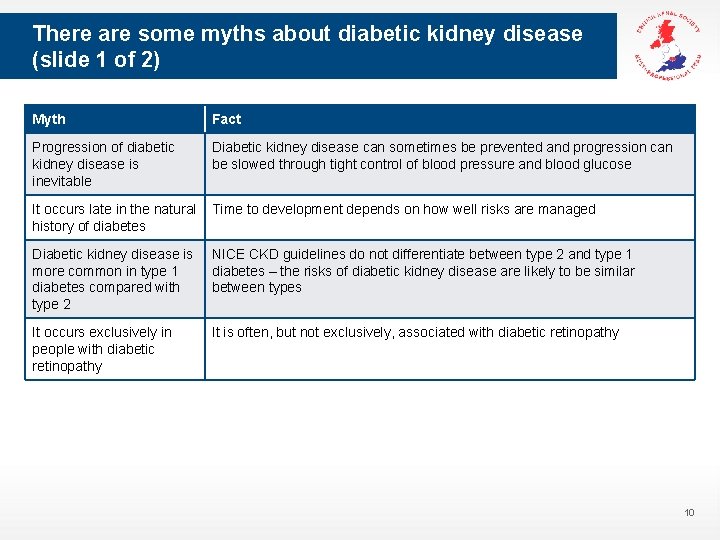
There are some myths about diabetic kidney disease (slide 1 of 2) Myth Fact Progression of diabetic kidney disease is inevitable Diabetic kidney disease can sometimes be prevented and progression can be slowed through tight control of blood pressure and blood glucose It occurs late in the natural history of diabetes Time to development depends on how well risks are managed Diabetic kidney disease is more common in type 1 diabetes compared with type 2 NICE CKD guidelines do not differentiate between type 2 and type 1 diabetes – the risks of diabetic kidney disease are likely to be similar between types It occurs exclusively in people with diabetic retinopathy It is often, but not exclusively, associated with diabetic retinopathy 10
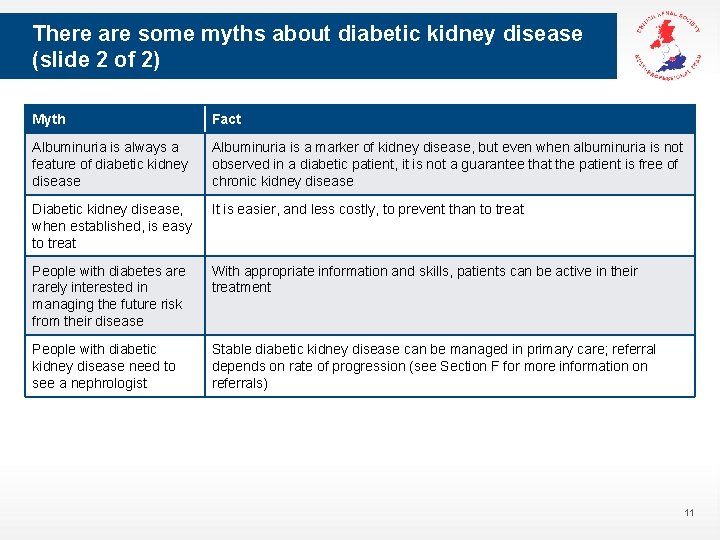
There are some myths about diabetic kidney disease (slide 2 of 2) Myth Fact Albuminuria is always a feature of diabetic kidney disease Albuminuria is a marker of kidney disease, but even when albuminuria is not observed in a diabetic patient, it is not a guarantee that the patient is free of chronic kidney disease Diabetic kidney disease, when established, is easy to treat It is easier, and less costly, to prevent than to treat People with diabetes are rarely interested in managing the future risk from their disease With appropriate information and skills, patients can be active in their treatment People with diabetic kidney disease need to see a nephrologist Stable diabetic kidney disease can be managed in primary care; referral depends on rate of progression (see Section F for more information on referrals) 11
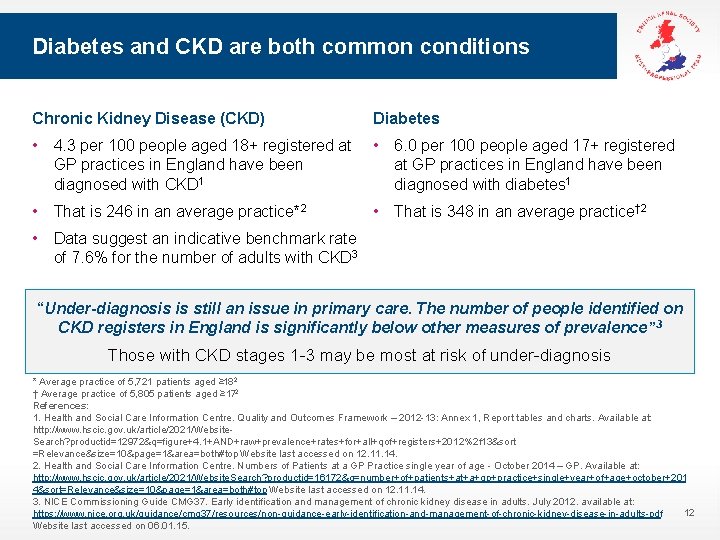
Diabetes and CKD are both common conditions Chronic Kidney Disease (CKD) Diabetes • 4. 3 per 100 people aged 18+ registered at GP practices in England have been diagnosed with CKD 1 • 6. 0 per 100 people aged 17+ registered at GP practices in England have been diagnosed with diabetes 1 • That is 246 in an average practice*2 • That is 348 in an average practice† 2 • Data suggest an indicative benchmark rate of 7. 6% for the number of adults with CKD 3 “Under-diagnosis is still an issue in primary care. The number of people identified on CKD registers in England is significantly below other measures of prevalence” 3 Those with CKD stages 1 -3 may be most at risk of under-diagnosis * Average practice of 5, 721 patients aged ≥ 182 † Average practice of 5, 805 patients aged ≥ 172 References: 1. Health and Social Care Information Centre. Quality and Outcomes Framework – 2012 -13: Annex 1, Report tables and charts. Available at: http: //www. hscic. gov. uk/article/2021/Website. Search? productid=12972&q=figure+4. 1+AND+raw+prevalence+rates+for+all+qof+registers+2012%2 f 13&sort =Relevance&size=10&page=1&area=both#top Website last accessed on 12. 11. 14. 2. Health and Social Care Information Centre. Numbers of Patients at a GP Practice single year of age - October 2014 – GP. Available at: http: //www. hscic. gov. uk/article/2021/Website. Search? productid=16172&q=number+of+patients+at+a+gp+practice+single+year+of+age+october+201 4&sort=Relevance&size=10&page=1&area=both#top Website last accessed on 12. 11. 14. 3. NICE Commissioning Guide CMG 37. Early identification and management of chronic kidney disease in adults. July 2012. available at: 12 https: //www. nice. org. uk/guidance/cmg 37/resources/non-guidance-early-identification-and-management-of-chronic-kidney-disease-in-adults-pdf Website last accessed on 06. 01. 15.
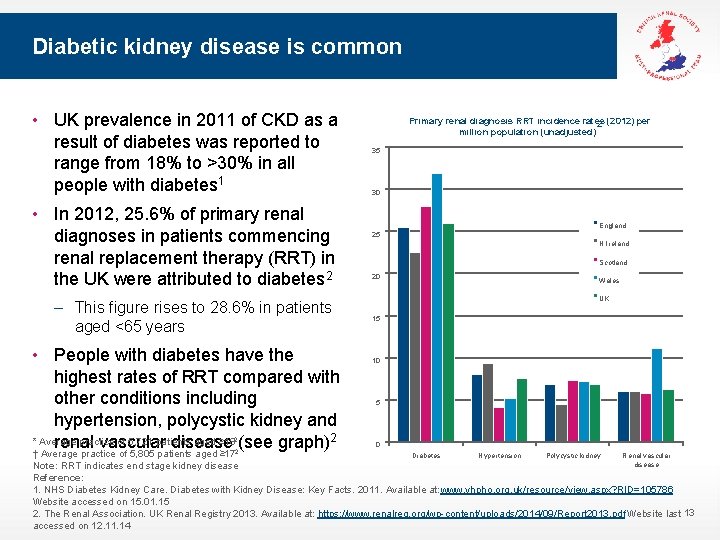
Diabetic kidney disease is common • UK prevalence in 2011 of CKD as a result of diabetes was reported to range from 18% to >30% in all people with diabetes 1 • In 2012, 25. 6% of primary renal diagnoses in patients commencing renal replacement therapy (RRT) in the UK were attributed to diabetes 2 – This figure rises to 28. 6% in patients aged <65 years • People with diabetes have the highest rates of RRT compared with other conditions including hypertension, polycystic kidney and * Average practice of 5, 721 patients aged ≥ 18 (see graph)2 renal vascular disease † Average practice of 5, 805 patients aged ≥ 17 2 2 Primary renal diagnosis RRT incidence rates (2012) per 2 million population (unadjusted) 35 30 England 25 N Ireland Scotland 20 Wales UK 15 10 5 0 Diabetes Hypertension Polycystic kidney Renal vascular disease Note: RRT indicates end stage kidney disease Reference: 1. NHS Diabetes Kidney Care. Diabetes with Kidney Disease: Key Facts. 2011. Available at: www. yhpho. org. uk/resource/view. aspx? RID=105786 Website accessed on 15. 01. 15 2. The Renal Association. UK Renal Registry 2013. Available at: https: //www. renalreg. org/wp-content/uploads/2014/09/Report 2013. pdf Website last 13 accessed on 12. 11. 14
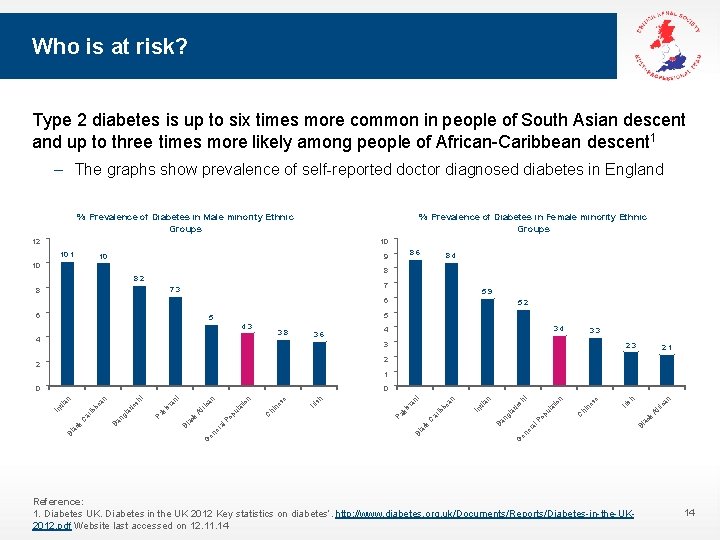
Who is at risk? Type 2 diabetes is up to six times more common in people of South Asian descent and up to three times more likely among people of African-Caribbean descent 1 – The graphs show prevalence of self-reported doctor diagnosed diabetes in England % Prevalence of Diabetes in Male minority Ethnic Groups % Prevalence of Diabetes in Female minority Ethnic Groups 12 10 10. 1 10 8. 6 9 10 8. 4 8 8. 2 7 7. 3 8 5. 9 6 6 5. 2 5 5 4. 3 3. 8 4 3. 6 3. 4 4 3. 3 3 2. 1 2 2 1 0 an sh ric se ne Iri Af k ac Bl Po al hi la pu la G en er C tio n i de sh an Ba ng di be ib ar C ac k In an i an st ki Bl Iri sh Pa C hi ne se n al en er Bl ac Po k pu Af la ric an st ki Pa tio an i i sh de la Ba ng G Bl ac k C ar ib In di be an an 0 Reference: 1. Diabetes UK. Diabetes in the UK 2012 Key statistics on diabetes’. http: //www. diabetes. org. uk/Documents/Reports/Diabetes-in-the-UK 2012. pdf Website last accessed on 12. 11. 14 14
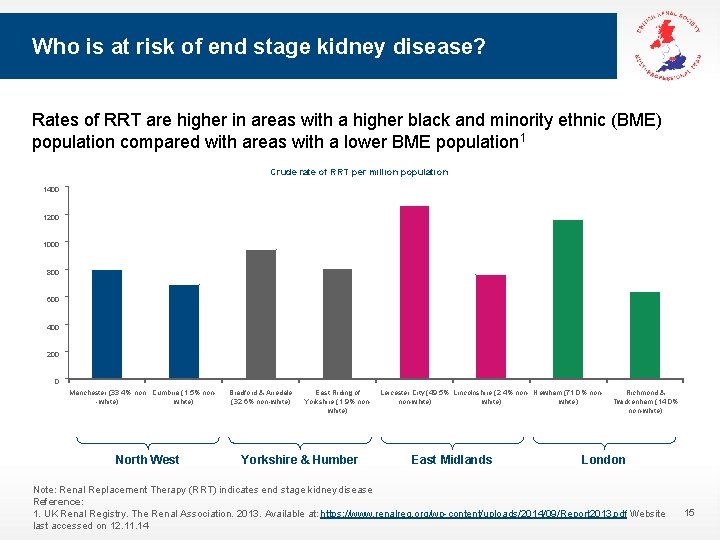
Who is at risk of end stage kidney disease? Rates of RRT are higher in areas with a higher black and minority ethnic (BME) population compared with areas with a lower BME population 1 Crude rate of RRT per million population 1400 1200 1000 800 600 400 200 0 Manchester (33. 4% non Cumbria (1. 5% non-white) North West Bradford & Airedale (32. 6% non-white) East Riding of Yorkshire (1. 9% nonwhite) Yorkshire & Humber Leicester City (49. 5% Lincolnshire (2. 4% non- Newham (71. 0% nonnon-white) East Midlands Richmond & Twickenham (14. 0% non-white) London Note: Renal Replacement Therapy (RRT) indicates end stage kidney disease Reference: 1. UK Renal Registry. The Renal Association. 2013. Available at: https: //www. renalreg. org/wp-content/uploads/2014/09/Report 2013. pdf Website last accessed on 12. 11. 14 15
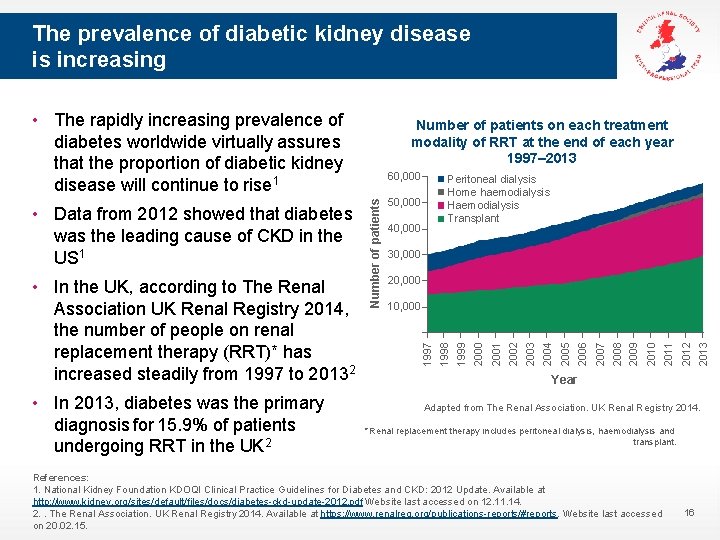
The prevalence of diabetic kidney disease is increasing • The rapidly increasing prevalence of diabetes worldwide virtually assures that the proportion of diabetic kidney disease will continue to rise 1 • In 2013, diabetes was the primary diagnosis for 15. 9% of patients undergoing RRT in the UK 2 50, 000 40, 000 Peritoneal dialysis Home haemodialysis Haemodialysis Transplant 30, 000 2013 2012 2011 2010 2008 2009 2007 2006 2005 2004 2002 2003 2001 2000 1999 10, 000 1997 1998 • In the UK, according to The Renal Association UK Renal Registry 2014, the number of people on renal replacement therapy (RRT)* has increased steadily from 1997 to 20132 60, 000 Number of patients • Data from 2012 showed that diabetes was the leading cause of CKD in the US 1 Number of patients on each treatment modality of RRT at the end of each year 1997– 2013 Year Adapted from The Renal Association. UK Renal Registry 2014. *Renal replacement therapy includes peritoneal dialysis, haemodialysis and transplant. References: 1. National Kidney Foundation KDOQI Clinical Practice Guidelines for Diabetes and CKD: 2012 Update. Available at http: //www. kidney. org/sites/default/files/docs/diabetes-ckd-update-2012. pdf Website last accessed on 12. 11. 14. 2. . The Renal Association. UK Renal Registry 2014. Available at https: //www. renalreg. org/publications-reports/#reports. Website last accessed on 20. 02. 15. 16
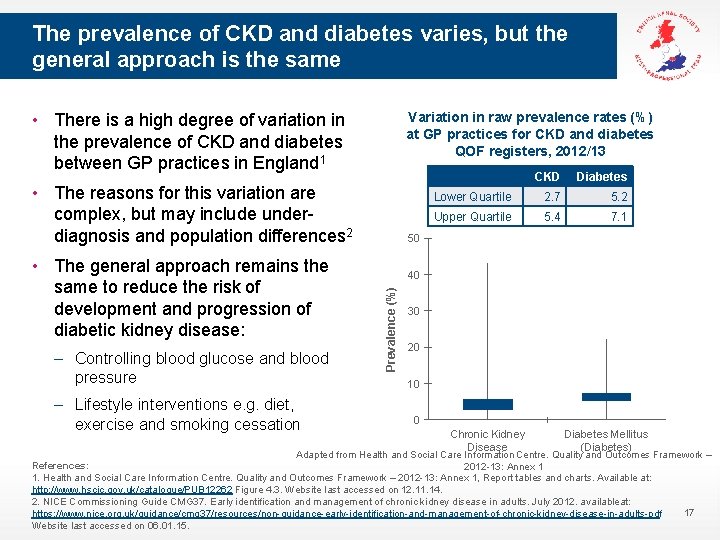
The prevalence of CKD and diabetes varies, but the general approach is the same • There is a high degree of variation in the prevalence of CKD and diabetes between GP practices in England 1 Variation in raw prevalence rates (%) at GP practices for CKD and diabetes QOF registers, 2012/13 • The reasons for this variation are complex, but may include underdiagnosis and population differences 2 – Controlling blood glucose and blood pressure – Lifestyle interventions e. g. diet, exercise and smoking cessation Diabetes Lower Quartile 2. 7 5. 2 Upper Quartile 5. 4 7. 1 50 40 Prevalence (%) • The general approach remains the same to reduce the risk of development and progression of diabetic kidney disease: CKD 30 20 10 0 Chronic Kidney Disease Diabetes Mellitus (Diabetes) Adapted from Health and Social Care Information Centre. Quality and Outcomes Framework – References: 2012 -13: Annex 1 1. Health and Social Care Information Centre. Quality and Outcomes Framework – 2012 -13: Annex 1, Report tables and charts. Available at: http: //www. hscic. gov. uk/catalogue/PUB 12262 Figure 4. 3. Website last accessed on 12. 11. 14. 2. NICE Commissioning Guide CMG 37. Early identification and management of chronic kidney disease in adults. July 2012. availableat: 17 https: //www. nice. org. uk/guidance/cmg 37/resources/non-guidance-early-identification-and-management-of-chronic-kidney-disease-in-adults-pdf Website last accessed on 06. 01. 15.
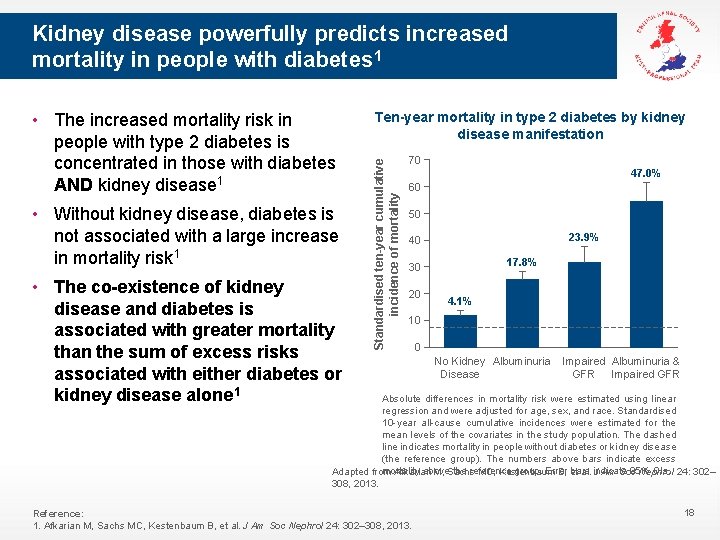
Kidney disease powerfully predicts increased mortality in people with diabetes 1 • Without kidney disease, diabetes is not associated with a large increase in mortality risk 1 • The co-existence of kidney disease and diabetes is associated with greater mortality than the sum of excess risks associated with either diabetes or kidney disease alone 1 Ten-year mortality in type 2 diabetes by kidney disease manifestation Standardised ten-year cumulative incidence of mortality • The increased mortality risk in people with type 2 diabetes is concentrated in those with diabetes AND kidney disease 1 70 47. 0% 60 50 23. 9% 40 17. 8% 30 20 4. 1% 10 0 No Kidney Albuminuria Disease Impaired Albuminuria & GFR Impaired GFR Absolute differences in mortality risk were estimated using linear regression and were adjusted for age, sex, and race. Standardised 10 -year all-cause cumulative incidences were estimated for the mean levels of the covariates in the study population. The dashed line indicates mortality in people without diabetes or kidney disease (the reference group). The numbers above bars indicate excess mortality above the reference group. Error bars 95% CIs. 24: 302– Adapted from Afkarian M, Sachs MC, Kestenbaum B, et al. indicate J Am Soc Nephrol 308, 2013. Reference: 1. Afkarian M, Sachs MC, Kestenbaum B, et al. J Am Soc Nephrol 24: 302– 308, 2013. 18
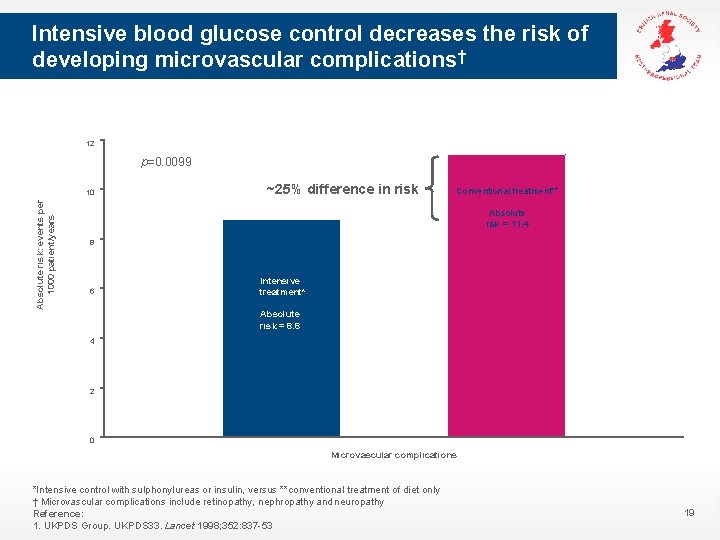
Intensive blood glucose control decreases the risk of developing microvascular complications† 12 p=0. 0099 Absolute risk: events per 1000 patient/years 10 ~25% difference in risk Conventional treatment** Absolute risk = 11. 4 8 6 Intensive treatment* Absolute risk = 8. 8 4 2 0 Microvascular complications *Intensive control with sulphonylureas or insulin, versus **conventional treatment of diet only † Microvascular complications include retinopathy, nephropathy and neuropathy Reference: 1. UKPDS Group. UKPDS 33. Lancet 1998; 352: 837 -53 19
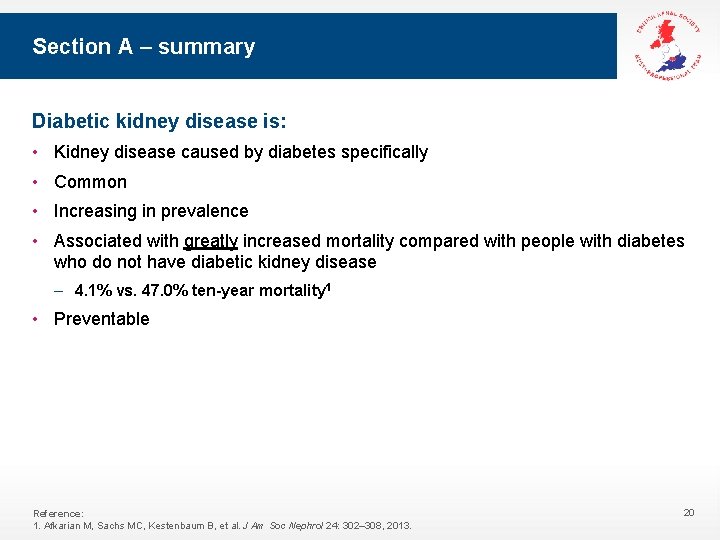
Section A – summary Diabetic kidney disease is: • Kidney disease caused by diabetes specifically • Common • Increasing in prevalence • Associated with greatly increased mortality compared with people with diabetes who do not have diabetic kidney disease – 4. 1% vs. 47. 0% ten-year mortality 1 • Preventable Reference: 1. Afkarian M, Sachs MC, Kestenbaum B, et al. J Am Soc Nephrol 24: 302– 308, 2013. 20