
Chronic exposure to volcanic air pollution 222 Rn
- Slides: 1
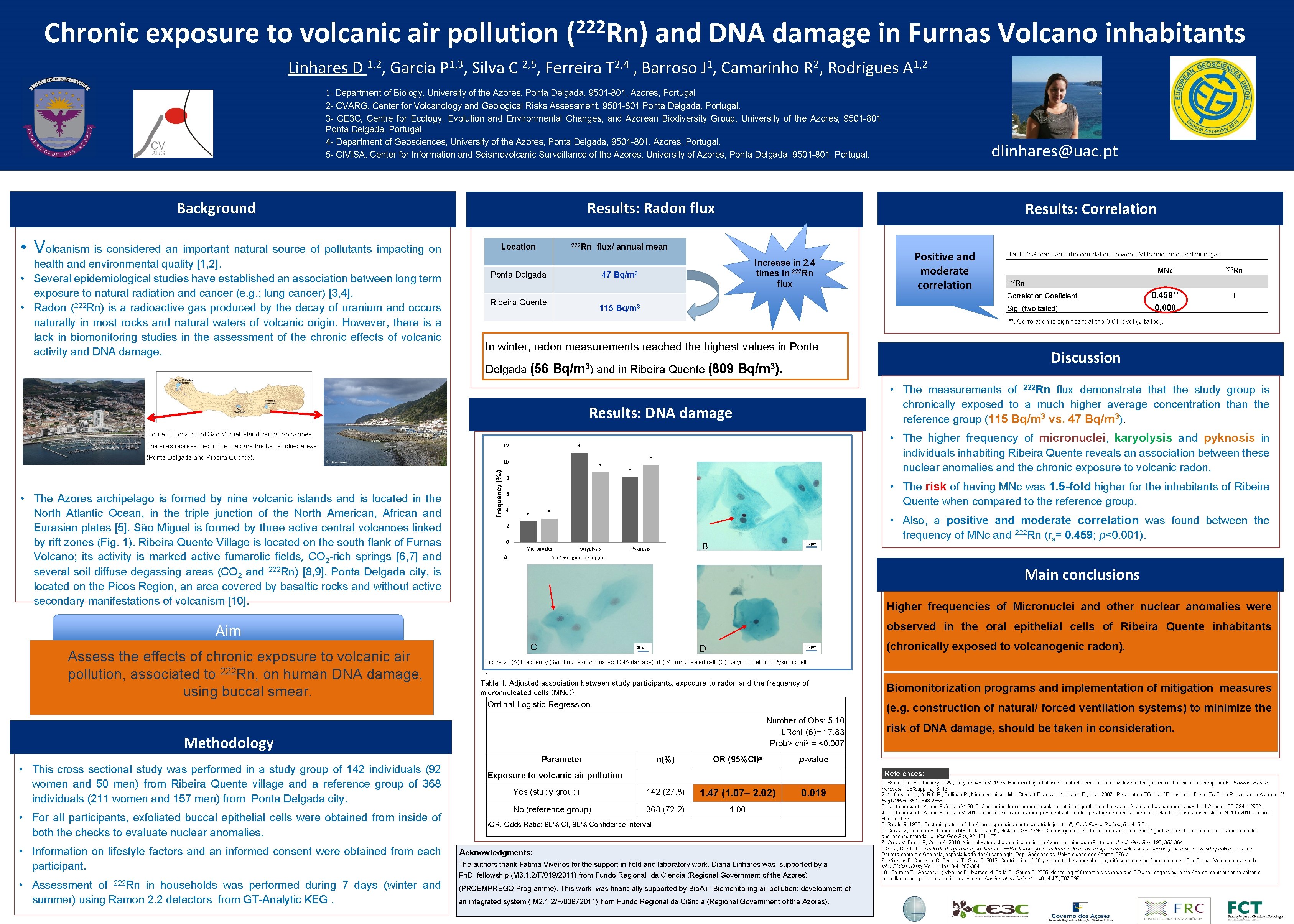
Chronic exposure to volcanic air pollution 222 ( Rn) and DNA damage in Furnas Volcano inhabitants Linhares D 1, 2, Garcia P 1, 3, Silva C 2, 5, Ferreira T 2, 4 , Barroso J 1, Camarinho R 2, Rodrigues A 1, 2 1 - Department of Biology, University of the Azores, Ponta Delgada, 9501 -801, Azores, Portugal 2 - CVARG, Center for Volcanology and Geological Risks Assessment, 9501 -801 Ponta Delgada, Portugal. 3 - CE 3 C, Centre for Ecology, Evolution and Environmental Changes, and Azorean Biodiversity Group, University of the Azores, 9501 -801 Ponta Delgada, Portugal. 4 - Department of Geosciences, University of the Azores, Ponta Delgada, 9501 -801, Azores, Portugal. 5 - CIVISA, Center for Information and Seismovolcanic Surveillance of the Azores, University of Azores, Ponta Delgada, 9501 -801, Portugal. Background Results: Radon flux • Volcanism is considered an important natural source of pollutants impacting on health and environmental quality [1, 2]. • Several epidemiological studies have established an association between long term exposure to natural radiation and cancer (e. g. ; lung cancer) [3, 4]. • Radon (222 Rn) is a radioactive gas produced by the decay of uranium and occurs naturally in most rocks and natural waters of volcanic origin. However, there is a lack in biomonitoring studies in the assessment of the chronic effects of volcanic activity and DNA damage. dlinhares@uac. pt Location 222 Rn flux/ annual mean Ponta Delgada 47 Ribeira Quente Results: Correlation Increase in 2. 4 times in 222 Rn flux Bq/m 3 Positive and moderate correlation 115 Bq/m 3 In winter, radon measurements reached the highest values in Ponta The sites represented in the map are the two studied areas 12 (Ponta Delgada and Ribeira Quente). Frequency (‰) * 8 * * 1 Discussion • The risk of having MNc was 1. 5 -fold higher for the inhabitants of Ribeira Quente when compared to the reference group. 6 4 * * 2 0 Micronuclei A Karyolysis Reference group 15 µm B Pyknosis • Also, a positive and moderate correlation was found between the frequency of MNc and 222 Rn (rs= 0. 459; p<0. 001). Study group Main. Conclusions conclusions Higher frequencies of Micronuclei and other nuclear anomalies were observed in the oral epithelial cells of Ribeira Quente inhabitants Aim C D 15 µm (chronically exposed to volcanogenic radon). Figure 2. (A) Frequency (‰) of nuclear anomalies (DNA damage); (B) Micronucleated cell; (C) Karyolitic cell; (D) Pyknotic cell . Table 1. Adjusted association between study participants, exposure to radon and the frequency of micronucleated cells (MNc)). Ordinal Logistic Regression Biomonitorization programs and implementation of mitigation measures (e. g. construction of natural/ forced ventilation systems) to minimize the Methodology • Assessment of 222 Rn in households was performed during 7 days (winter and summer) using Ramon 2. 2 detectors from GT-Analytic KEG. 0. 459** 0. 000 • The higher frequency of micronuclei, karyolysis and pyknosis in individuals inhabiting Ribeira Quente reveals an association between these nuclear anomalies and the chronic exposure to volcanic radon. * 10 • The Azores archipelago is formed by nine volcanic islands and is located in the North Atlantic Ocean, in the triple junction of the North American, African and Eurasian plates [5]. São Miguel is formed by three active central volcanoes linked by rift zones (Fig. 1). Ribeira Quente Village is located on the south flank of Furnas Volcano; its activity is marked active fumarolic fields, CO 2 -rich springs [6, 7] and several soil diffuse degassing areas (CO 2 and 222 Rn) [8, 9]. Ponta Delgada city, is located on the Picos Region, an area covered by basaltic rocks and without active secondary manifestations of volcanism [10]. • Information on lifestyle factors and an informed consent were obtained from each participant. Correlation Coeficient • The measurements of 222 Rn flux demonstrate that the study group is chronically exposed to a much higher average concentration than the reference group (115 Bq/m 3 vs. 47 Bq/m 3). Figure 1. Location of São Miguel island central volcanoes. • For all participants, exfoliated buccal epithelial cells were obtained from inside of both the checks to evaluate nuclear anomalies. 222 Rn **. Correlation is significant at the 0. 01 level (2 -tailed). Results: DNA damage • This cross sectional study was performed in a study group of 142 individuals (92 women and 50 men) from Ribeira Quente village and a reference group of 368 individuals (211 women and 157 men) from Ponta Delgada city. MNc 222 Rn Sig. (two-tailed) Delgada (56 Bq/m 3) and in Ribeira Quente (809 Bq/m 3). Assess the effects of chronic exposure to volcanic air pollution, associated to 222 Rn, on human DNA damage, using buccal smear. Table 2. Spearman’s rho correlation between MNc and radon volcanic gas Number of Obs: 5 10 LRchi 2(6)= 17. 83 Prob> chi 2 = <0. 007 Parameter n(%) OR (95%CI)a risk of DNA damage, should be taken in consideration. p-value References: Exposure to volcanic air pollution Yes (study group) 142 (27. 8) 1. 47 (1. 07– 2. 02) No (reference group) 368 (72. 2) 1. 00 0. 019 OR, Odds Ratio; 95% CI, 95% Confidence Interval a Acknowledgments: The authors thank Fátima Viveiros for the support in field and laboratory work. Diana Linhares was supported by a Ph. D fellowship (M 3. 1. 2/F/019/2011) from Fundo Regional da Ciência (Regional Government of the Azores) (PROEMPREGO Programme). This work was financially supported by Bio. Air- Biomonitoring air pollution: development of an integrated system ( M 2. 1. 2/F/00872011) from Fundo Regional da Ciência (Regional Government of the Azores). 1 - Brunekreef B. , Dockery D. W. , Krzyzanowski M. 1995. Epidemiological studies on short-term effects of low levels of major ambient air pollution components. Environ. Health Perspect. 103(Suppl. 2), 3– 13. 2 - Mc. Creanor J. , M. R. C. P. , Cullinan P. , Nieuwenhuijsen MJ. , Stewart-Evans J. , Malliarou E. , et al. 2007. Respiratory Effects of Exposure to Diesel Traffic in Persons with Asthma. N Engl J Med 357: 2348 -2358. 3 - Kristbjornsdottir A. and Rafnsson V. 2013. Cancer incidence among population utilizing geothermal hot water: A census-based cohort study. Int J Cancer 133: 2944– 2952. 4 - Kristbjornsdottir A. and Rafnsson V. 2012. Incidence of cancer among residents of high temperature geothermal areas in Iceland: a census based study 1981 to 2010. Environ Health 11: 73. 5 - Searle R. 1980. Tectonic pattern of the Azores spreading centre and triple junction”, Earth Planet Sci Lett, 51: 415 -34. 6 - Cruz J V, Coutinho R, Carvalho MR, Oskarsson N, Gislason SR. 1999. Chemistry of waters from Furnas volcano, São Miguel, Azores: fluxes of volcanic carbon dioxide and leached material. J Volc Geo Res, 92, 151 -167. 7 - Cruz JV, Freire P, Costa A. 2010. Mineral waters characterization in the Azores archipelago (Portugal). J Volc Geo Res, 190, 353 -364. 8 -Silva, C. 2013. Estudo da desgaseificação difusa de 222 Rn: Implicações em termos de monitorização sismovulcânica, recursos geotérmicos e saúde pública. Tese de Doutoramento em Geologia, especialidade de Vulcanologia, Dep. Geociências, Universidade dos Açores, 376 p. 9 - Viveiros F, Cardellini C, Ferreira T. ; Silva C. 2012. Contribution of CO 2 emited to the atmosphere by diffuse degassing from volcanoes: The Furnas Volcano case study. Int J Global Warm, Vol. 4, Nos. 3 -4, 287 -304. 10 - Ferreira T. ; Gaspar JL. ; Viveiros F, Marcos M, Faria C. ; Sousa F. 2005 Monitoring of fumarole discharge and CO 2 soil degassing in the Azores: contribution to volcanic surveillance and public health risk assesment. Ann. Geophys- Italy, Vol. 48, N. 4/5, 787 -796.