
Chronic Compartment Syndrome of the Lower Leg in
- Slides: 1
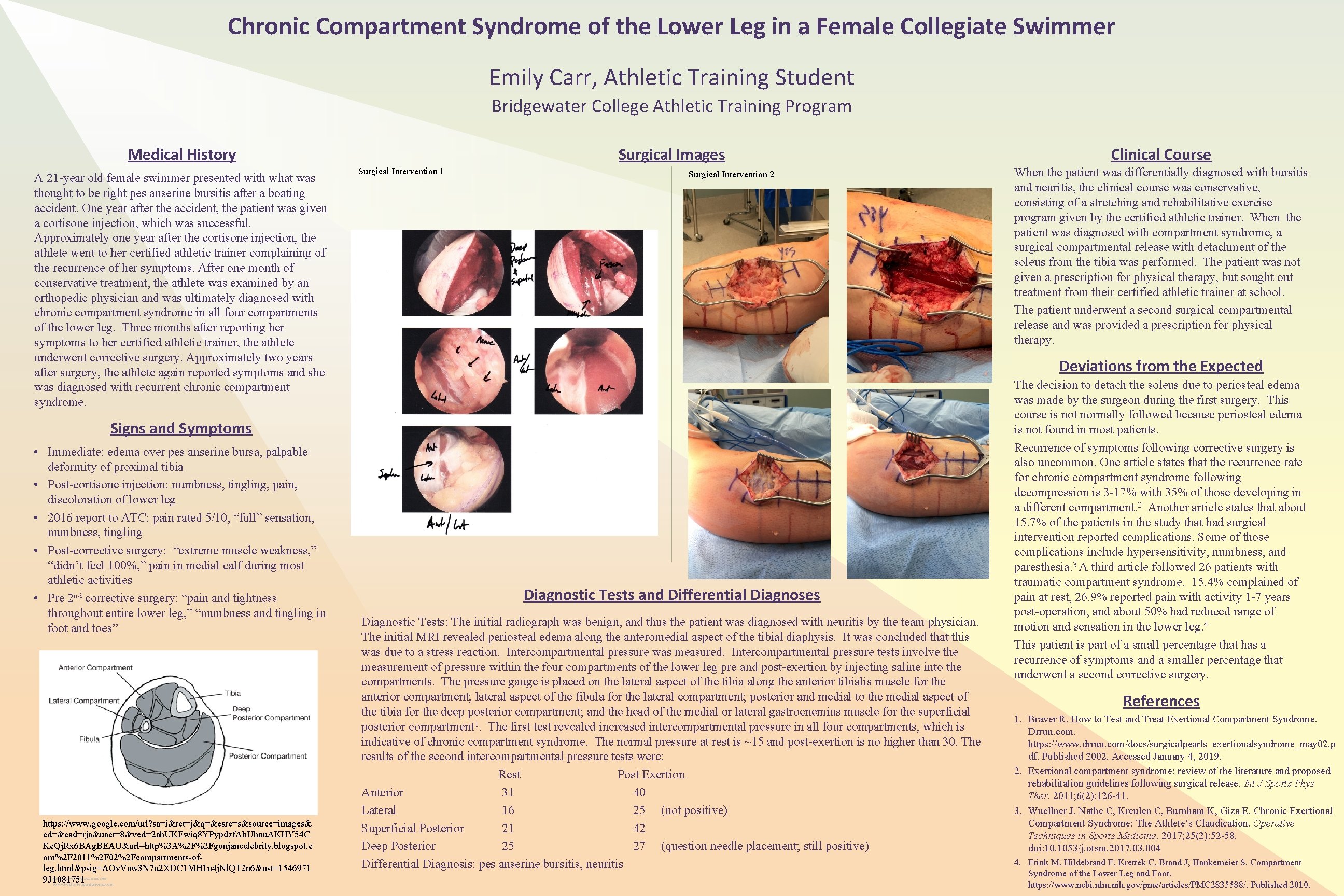
Chronic Compartment Syndrome of the Lower Leg in a Female Collegiate Swimmer Emily Carr, Athletic Training Student Bridgewater College Athletic Training Program Medical History A 21 -year old female swimmer presented with what was thought to be right pes anserine bursitis after a boating accident. One year after the accident, the patient was given a cortisone injection, which was successful. Approximately one year after the cortisone injection, the athlete went to her certified athletic trainer complaining of the recurrence of her symptoms. After one month of conservative treatment, the athlete was examined by an orthopedic physician and was ultimately diagnosed with chronic compartment syndrome in all four compartments of the lower leg. Three months after reporting her symptoms to her certified athletic trainer, the athlete underwent corrective surgery. Approximately two years after surgery, the athlete again reported symptoms and she was diagnosed with recurrent chronic compartment syndrome. Surgical Images Surgical Intervention 1 Surgical Intervention 2 https: //www. google. com/url? sa=i&rct=j&q=&esrc=s&source=images& cd=&cad=rja&uact=8&ved=2 ah. UKEwiq 8 YPypdzf. Ah. Uhnu. AKHY 54 C Kc. Qj. Rx 6 BAg. BEAU&url=http%3 A%2 F%2 Fgonjancelebrity. blogspot. c om%2 F 2011%2 F 02%2 Fcompartments-ofleg. html&psig=AOv. Vaw 3 N 7 u 2 XDC 1 MH 1 n 4 j. Nl. QT 2 n 6&ust=1546971 931081751 www. Poster. Presentations. com RESEARCH POSTER PRESENTATION DESIGN © 2015 When the patient was differentially diagnosed with bursitis and neuritis, the clinical course was conservative, consisting of a stretching and rehabilitative exercise program given by the certified athletic trainer. When the patient was diagnosed with compartment syndrome, a surgical compartmental release with detachment of the soleus from the tibia was performed. The patient was not given a prescription for physical therapy, but sought out treatment from their certified athletic trainer at school. The patient underwent a second surgical compartmental release and was provided a prescription for physical therapy. Deviations from the Expected Signs and Symptoms • Immediate: edema over pes anserine bursa, palpable deformity of proximal tibia • Post-cortisone injection: numbness, tingling, pain, discoloration of lower leg • 2016 report to ATC: pain rated 5/10, “full” sensation, numbness, tingling • Post-corrective surgery: “extreme muscle weakness, ” “didn’t feel 100%, ” pain in medial calf during most athletic activities • Pre 2 nd corrective surgery: “pain and tightness throughout entire lower leg, ” “numbness and tingling in foot and toes” Clinical Course Diagnostic Tests and Differential Diagnoses Diagnostic Tests: The initial radiograph was benign, and thus the patient was diagnosed with neuritis by the team physician. The initial MRI revealed periosteal edema along the anteromedial aspect of the tibial diaphysis. It was concluded that this was due to a stress reaction. Intercompartmental pressure was measured. Intercompartmental pressure tests involve the measurement of pressure within the four compartments of the lower leg pre and post-exertion by injecting saline into the compartments. The pressure gauge is placed on the lateral aspect of the tibia along the anterior tibialis muscle for the anterior compartment; lateral aspect of the fibula for the lateral compartment; posterior and medial to the medial aspect of the tibia for the deep posterior compartment; and the head of the medial or lateral gastrocnemius muscle for the superficial posterior compartment 1. The first test revealed increased intercompartmental pressure in all four compartments, which is indicative of chronic compartment syndrome. The normal pressure at rest is ~15 and post-exertion is no higher than 30. The results of the second intercompartmental pressure tests were: Rest Post Exertion Anterior 31 40 Lateral 16 25 (not positive) Superficial Posterior 21 42 Deep Posterior 25 27 (question needle placement; still positive) Differential Diagnosis: pes anserine bursitis, neuritis The decision to detach the soleus due to periosteal edema was made by the surgeon during the first surgery. This course is not normally followed because periosteal edema is not found in most patients. Recurrence of symptoms following corrective surgery is also uncommon. One article states that the recurrence rate for chronic compartment syndrome following decompression is 3 -17% with 35% of those developing in a different compartment. 2 Another article states that about 15. 7% of the patients in the study that had surgical intervention reported complications. Some of those complications include hypersensitivity, numbness, and paresthesia. 3 A third article followed 26 patients with traumatic compartment syndrome. 15. 4% complained of pain at rest, 26. 9% reported pain with activity 1 -7 years post-operation, and about 50% had reduced range of motion and sensation in the lower leg. 4 This patient is part of a small percentage that has a recurrence of symptoms and a smaller percentage that underwent a second corrective surgery. References 1. Braver R. How to Test and Treat Exertional Compartment Syndrome. Drrun. com. https: //www. drrun. com/docs/surgicalpearls_exertionalsyndrome_may 02. p df. Published 2002. Accessed January 4, 2019. 2. Exertional compartment syndrome: review of the literature and proposed rehabilitation guidelines following surgical release. Int J Sports Phys Ther. 2011; 6(2): 126 -41. 3. Wuellner J, Nathe C, Kreulen C, Burnham K, Giza E. Chronic Exertional Compartment Syndrome: The Athleteʼs Claudication. Operative Techniques in Sports Medicine. 2017; 25(2): 52 -58. doi: 10. 1053/j. otsm. 2017. 03. 004 4. Frink M, Hildebrand F, Krettek C, Brand J, Hankemeier S. Compartment Syndrome of the Lower Leg and Foot. https: //www. ncbi. nlm. nih. gov/pmc/articles/PMC 2835588/. Published 2010.