
Chromosomes and Mitosis Objectives describe location and appearance
Chromosomes and Mitosis Objective(s): describe location and appearance of chromosomes and chromosome movement during mitosis.
Concepts on chromosomes • Chromosomes are thread-like structures and they contain the genes. They exist in pairs in what is called homologues. • Homologous Chromosomes Diploid cells have two copies of each chromosome (except the sex chromosomes). Each pair of chromosomes is homologous. • A chromatid is a single DNA strand. ( one of the two strands of a duplicated chromosome joined at the centromere). Double-stranded chromosomes have two chromatids; normally, each one is identical to the other.
• The centromere is the point where the two chromatids are attached Or the sister chromatids are attached at a point called centromere. • Each of the two sister chromatids has a kinetochore The kinetochore is a structure of proteins in the chromosomes at the centromere which is used to move the chromosome during cell division.


If chromosomes are split into two their number will double because each chromatid is identical. The separated chromatid becomes a single strand chromosome.

• DNA replication then occurs which will make the single-stranded chromosome produce a second chromatid. • Diploid: Diploid cells (2 n) have two complete sets of chromosomes. The body cells of animals are diploid. • Haploid: Haploid cells (n) have one complete set of chromosomes. In animals, gametes (sperm and eggs) are haploid.
Cell Division HOW DO CELLS DIVIDE?
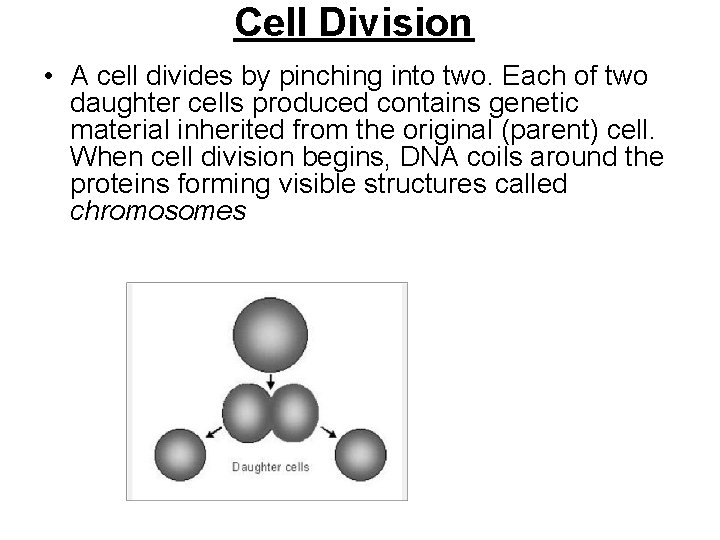
Cell Division • A cell divides by pinching into two. Each of two daughter cells produced contains genetic material inherited from the original (parent) cell. When cell division begins, DNA coils around the proteins forming visible structures called chromosomes
Cell Division WHY DO CELLS DIVIDE?
• To reproduce: Single-celled organisms divide to reproduce. Some cells of multicellular organisms must divide to produce sex cells (gametes). • To increase in size: Cell division in multicellular organisms enables the organism to grow larger while the cells remain small • It also helps in the replacement and repair of old and worn out cells
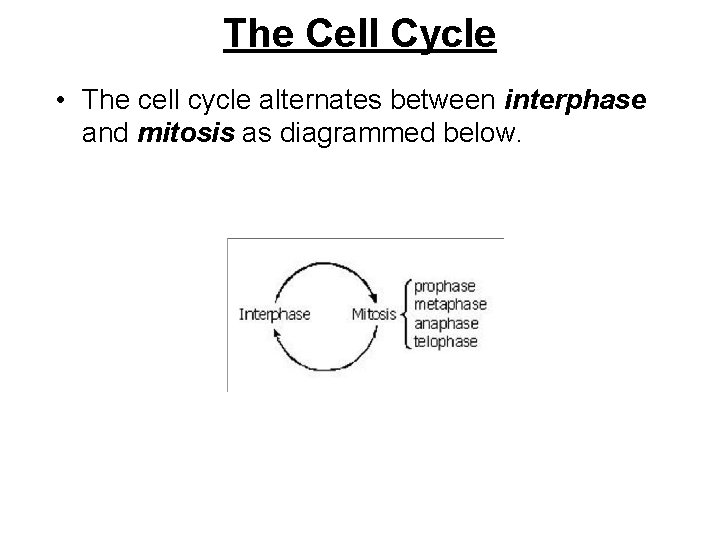
The Cell Cycle • The cell cycle alternates between interphase and mitosis as diagrammed below.
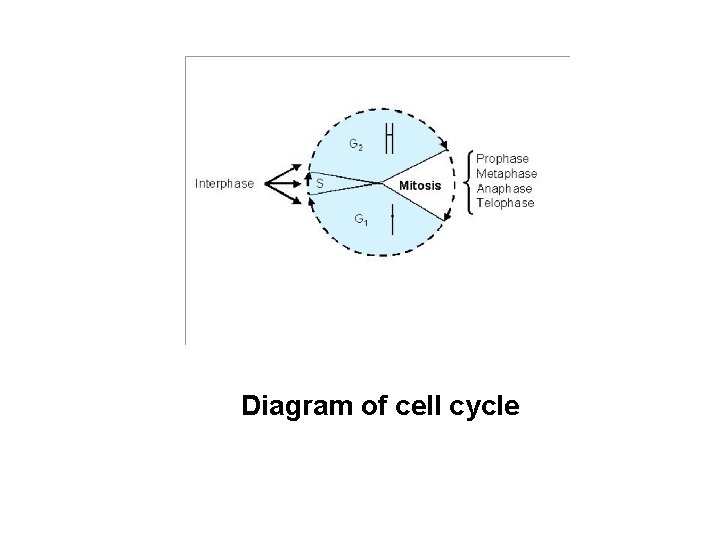
Diagram of cell cycle

• Interphase has 3 subphases. These are G 1 (‘first gap’), the S phase ( ‘synthesis’) and G 2 ( ‘second gap’). • Mitosis has 4 stages. These are Prophase, Metaphase, Anaphase and Telophase. Interphase • This is the non-dividing phase. • During interphase, the nucleus is visible and the chromosomes are uncoiled and not visible.
Interphase includes G 1, S and G 2. G 1 • Each chromosome has one chromatid. • The cell grows in size. • Synthesis of organelles occurs S • This is where DNA synthesis or replication occurs. G 2 • Each chromosome has two chromatids. • The synthesis of enzymes and other proteins in preparation for mitosis occurs during this period.
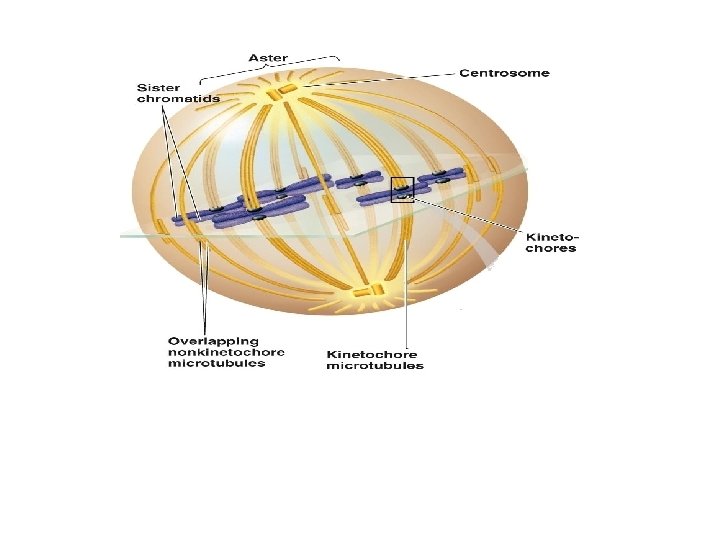
Structures that facilitate the cell division process. • Spindle fibres: a system of microtubules needed to move the chromosomes. • The kinetochore is a structure of proteins in the centromere to which spindle fibres are attached during mitosis. • Kinetochore microtubules: spindle fibres that attach to the kinetochores and move the chromosomes to the center of the cell. • Non. Kinetochore Microtubule: Spindle fibre that is not attached to the kinetochore
• Centrosome: an area of the cell where the spindle fibres develop from. Each centrosome of an animal cell has two centrioles. • Asters: short microtubules that radiate from the centrosomes. • The entire complex of centrosomes, kinetochore, asters, and spindle fibers is called the spindle apparatus.
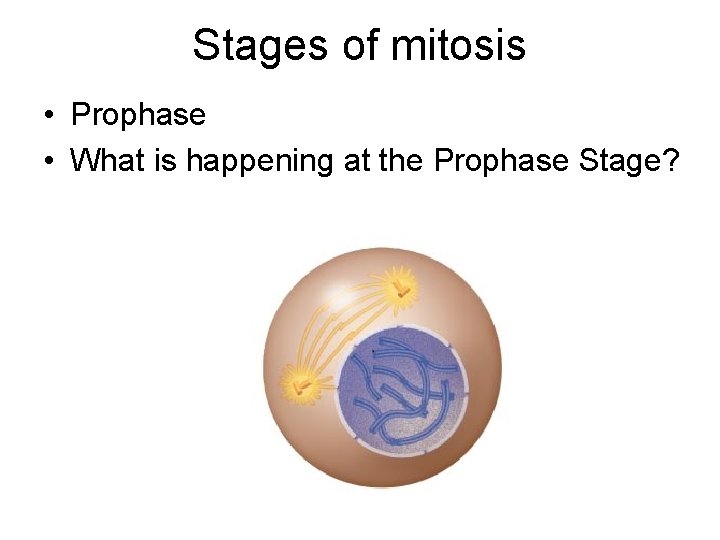
Stages of mitosis • Prophase • What is happening at the Prophase Stage?

STAGES OF MITOSIS • PROPHASE • The chromosomes coil and become visible under light microscope. • The chromosomes are randomly placed in the cell. • The nuclear membrane disintegrates. • Nucleolus disappears. • The spindle apparatus forms
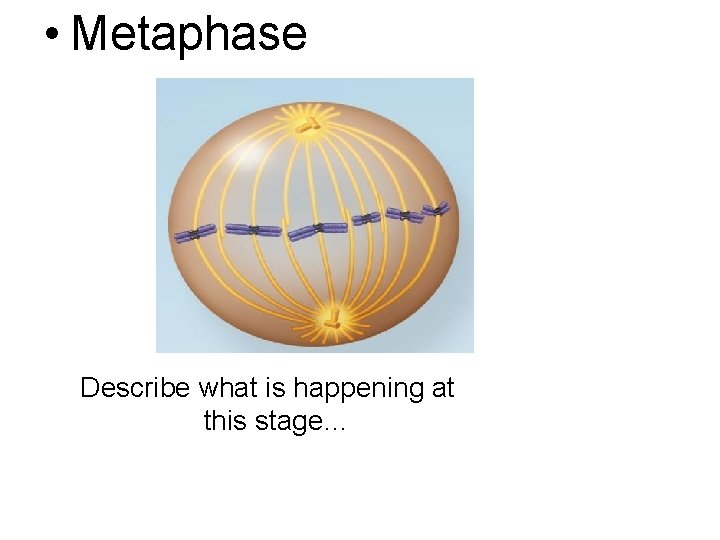
• Metaphase Describe what is happening at this stage…
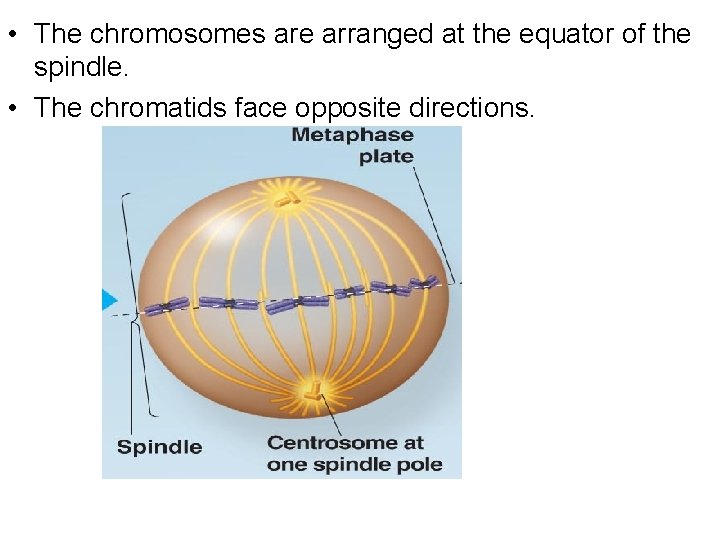
• The chromosomes are arranged at the equator of the spindle. • The chromatids face opposite directions.
• Anaphase Describe the features of this stage…
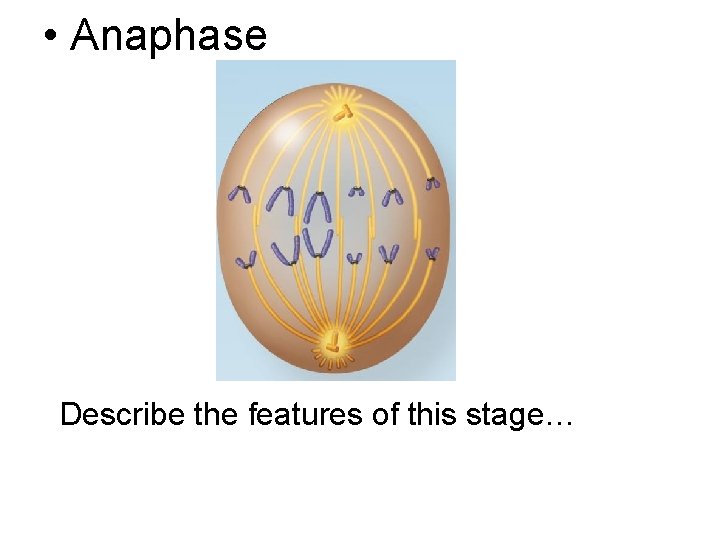
• The two sister chromatids separate. Each chromatid then becomes a chromosome. • Each chromosome then begins to move towards opposite ends of the cell • The cell elongates as the non kinetochore microtubules lengthen. • By the end of Anaphase, the two ends of the cell will have equal number of chromosomes.
• Telophase • What is happening to the cell at the Telophase?
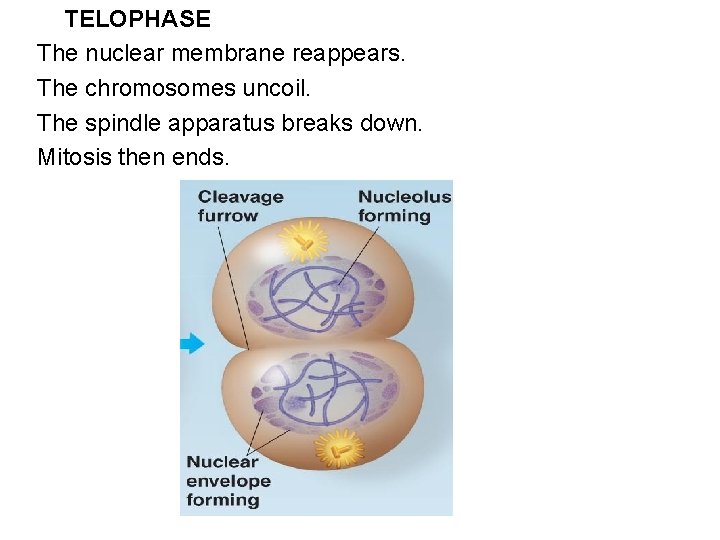
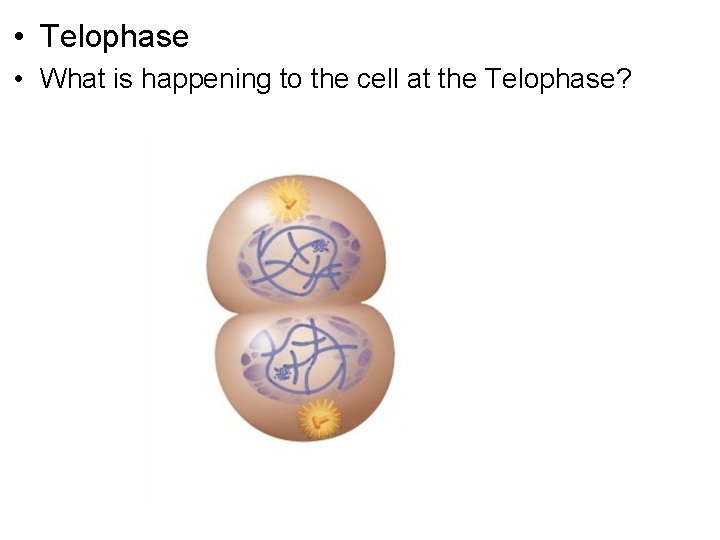
TELOPHASE The nuclear membrane reappears. The chromosomes uncoil. The spindle apparatus breaks down. Mitosis then ends.
Cytokinesis • The cytoplasm then divides in a process called cytokinesis. The cells then become two. • Cytokinesis differs in organisms. • In animal cells, a constriction called cleavage furrow is formed along the equator. The constriction deepens and cuts the cell into two daughter cells. • In plant cells, vesicles coalesce (come together) to form a cell plate. Materials are further added to the cell plate which forms a new cell wall. Thus a new cell forms.
- Slides: 26