
Chromosomes and Meiosis J Gilbert DNA and Chromosomes

Chromosomes and Meiosis J. Gilbert
DNA and Chromosomes Some Interesting Facts: • The DNA molecule in a single human cell is 99 cm long, so is 10 000 times longer than the cell in which it resides (<100 mm) • Since an adult human has about 1014 cells, all the DNA in one human would stretch about 1014 m, which is a thousand times the distance between the Earth and the Sun. 1/13/2022 J. Gilbert 2
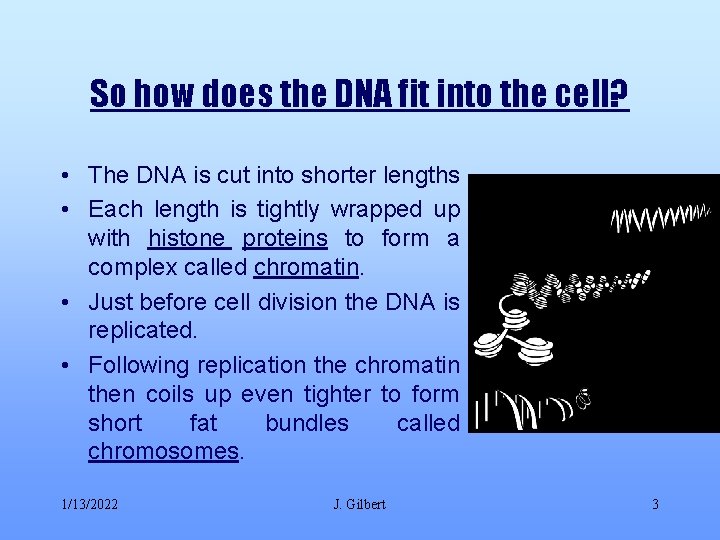
So how does the DNA fit into the cell? • The DNA is cut into shorter lengths • Each length is tightly wrapped up with histone proteins to form a complex called chromatin. • Just before cell division the DNA is replicated. • Following replication the chromatin then coils up even tighter to form short fat bundles called chromosomes. 1/13/2022 J. Gilbert 3
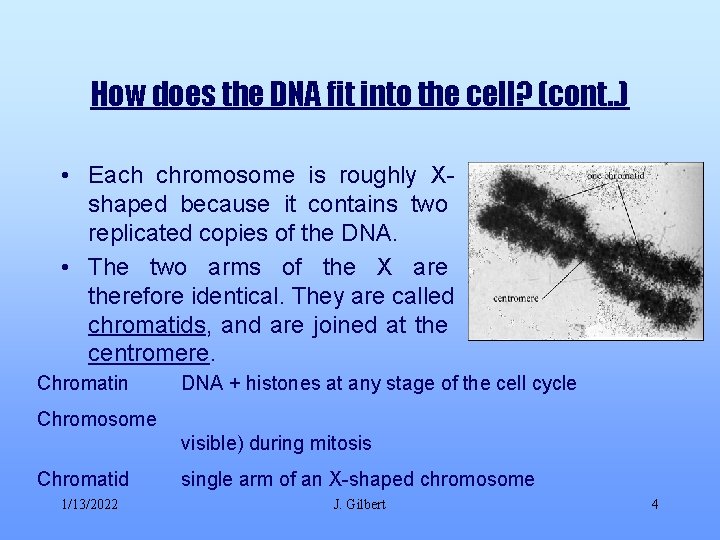
How does the DNA fit into the cell? (cont. . ) • Each chromosome is roughly Xshaped because it contains two replicated copies of the DNA. • The two arms of the X are therefore identical. They are called chromatids, and are joined at the centromere. Chromatin DNA + histones at any stage of the cell cycle Chromosome visible) during mitosis Chromatid 1/13/2022 single arm of an X-shaped chromosome J. Gilbert 4

Homologous Chromosomes • Chromosomes come in pairs called homologous pairs (‘same shaped’) • The homologous pairs are the maternal (inherited from the mother) and paternal (inherited from the father) versions of the same chromosome, so they have the same sequence of genes. 1/13/2022 J. Gilbert 5
Homologous Chromosomes (cont…) • One pair of chromosomes is different in males and females. • These are called the sex chromosomes, and are nonhomologous in one of the sexes. • In humans the sex chromosomes are homologous in females (XX) and non-homologous in males (XY). (In birds it is the other way round!) • The non-sex chromosomes are sometimes called autosomes, so humans have 22 pairs of autosomes, and 1 pair of sex chromosomes. 1/13/2022 J. Gilbert 6
Meiosis • A form cell division that produces gametes • Two important functions: – To form haploid cells with half the number of chromosomes – To re-arrange the chromosomes with a unique combination of genes • There are two successive divisions, without DNA replication in between 1/13/2022 J. Gilbert 7
Meiosis in detail http: //www. thelifewire. com/content/ch 09 xe 02. htm OR go to www. thelifewire. com Click on ‘animated tutorials’ Scroll down to ‘ 9. 2 Meiosis’ 1/13/2022 J. Gilbert 8
- Slides: 8