
Chromosomes and Cell Reproduction Chromosome Structure Chromosomes are




- Slides: 56
Chromosomes and Cell Reproduction
Chromosome Structure Chromosomes are the coiled up version of DNA. They consist of DNA and proteins: histones and nonhistones Chromosome Packing Animation
Point of Confusion: Chromatin vs. Chromatid vs. Chromosome What is the Difference? ? ? sister chromatids centromere single-stranded chromosomes double-stranded chromosomes
Chromatids are attached at the center called a centromere. Sister Chromatids
What is a Kinetochore? Kinetochore Animation
Centrosome & Centrioles oh the definitions… Centrioles: ANIMAL CELLS ONLY Nonmembrane-bound organelles that occur in pairs just outside the nucleus of animal cells. Each centriole is composed of a cylinder or ring of 9 sets of microtubule triplets with none in the middle (9 + 0 pattern). During cell division a pair of centrioles moves to each end of the cell, forming the poles of the mitotic spindle. Centrioles also give rise to basal bodies that control the origin of cilia and flagella in motile cells of protists. In cross section, flagella and cilia have 9 sets of microtubule doublets surrounding a pair of single microtubules in the center (9 + 2 pattern). This characteristic pattern also occurs in motile cells of higher organisms, such as human sperm. Centrosome: In animal cells the centrosome includes a pair of centrioles surrounded by radiating strands of microtubules called the aster. The microtubule organizing centre that forms the mitotic spindle in dividing cells.
In Plants there is no Centriole They use MTOCs: Microtuble Organizing Centers Plant cells create mitotic spindle fibers and have a centrosome they lack centrioles.
What are spindle fibers made of? Microtubles grow from the centrosomes n n Polar Microtubles: Attach to other polar microtubles spaning the cell. Kinetochore microtubles: attach to the kinetochore. Breakdown From Here. Microtubule formation and disassembly
A gene is a segment of DNA that codes for a protein or RNA molecule which guide the development of traits.
Cell Types Somatic Cells Gametes
Chromosome Numbers Types: Autosomes and Sex Chromosomes (XX or XY). Humans: 22 pair of homologous chromosomes and 1 pair of sex chromosomes.
Chromosome Numbers All of the cells in the body, other than gametes are Diploid (2 n=46 in humans). Gametes contain only one set of chromosomes: Haploid (n=23 in humans).
Different species have different numbers of chromosomes.
Change in chromosome number Humans who are missing even one of the 46 chromosomes usually do not survive. Humans with more than two copies of a chromosome, result in a condition called trisomy.
Abnormalities in chromosome number can be detected by analyzing a karyotype. Nondisjunction during the production of gametes results in gametes having more or less chromosomes than normal. Pictures called karyotypes can detect problems after conception.
How do Prokaryotes divide? They divide by binary fission. Their DNA is circular and usually only has one strand. No Mitosis!!!
Bacterial cells divide to reproduce Binary fission is a form of asexual reproduction that produces identical offspring: Mitosis
The Cell Cycle: for Eukaryotes Fig 12. 5, 12. 4, 12. 17 The cell cycle is a repeating sequence of cellular growth and division during the life of an organism. A cell spends 90 percent of its time in the first three phases of the cycle.
I’m working here! Time to divide & multiply!
Key checkpoints at which feedback signals from the cell can trigger the next phase of the cell cycle (green light). Overview of the cell cycle Cell Cycle Movie/ Game
Checkpoint control system 3 major checkpoints: n G 1/S: Called “Restriction Point” can DNA synthesis begin? n G 2/M has DNA synthesis been completed correctly? commitment to mitosis n spindle checkpoint are all chromosomes attached to spindle? can sister chromatids separate correctly?
G 1/DNA Synthesis checkpoint G 1/S checkpoint is most critical n primary decision point “restriction point” n if cell receives “GO” signal, it divides internal signals: cell growth (size), cell nutrition external signals: “growth factors” n if cell does not receive signal, it exits cycle & switches to G 0 phase non-dividing, working state
G 0 phase n n non-dividing, differentiated state most human cells in G 0 phase § liver cells § in G 0, but can be “called back” to cell cycle by external cues § nerve & muscle cells § highly specialized § arrested in G 0 & can never divide
What molecules control cell division? 2 types of molecules control n n Cyclins oscillating levels during cell division. Cycline dependent kinasis or CDKs First CDK discovered was MPF/ p-phase promotor factor.
When control is lost: cancer Fig 12. 19, 12. 20 Cancer is the uncontrolled growth of cells due to loss of contact inhibition / density-dependent inhibition. n Overcrowding and tumors Mutations in genes that control cell division may result in cancer. n n If Telomerase ends are left on DNA, cells don’t die after 50 or so divisions. (Built in destruction control) He. La Cells: Most widely used cancer cell line. Named after a woman 40 years ago with cervical cancer Immortal. Each cell has 70 -80 chromosomes instead of 46. Hit the Cancer Biology Documentary Link
Why do cells have to divide? They outgrow their nuclear capacity. n n Surface area to volume ratio Metabolism Some cells are large. How do they overcome the problem? n Multinucleated Human skeletal muscle cells Paramecium (2 nuclei) Slime Mold Fungus (1000’s of nuclei)
The Phases of Mitosis pg 232 -233 (How to make a clone) Interphase Prophase Metaphase Anaphase Telophase The Jazzy Version of Mitosis MITOSIS Cytokinesis I Prefer My Awesome Teacher…Cool!
Prophase 1. Chromosomes coil and become visible. CENTRIOLES MITOTIC SPINDLE NUCLEAR ENVELOPE 2. Nuclear envelope & nucleolus breaks down. 3. Mitotic Spindle fibers begin to form. CENTROMERE HOMOLOGUES
Metaphase 1. Chromosomes line up along the equator of the cell. 2. Spindle fibers attach to kinetochore. 3. Centrioles migrate to the poles of the cell.
Anaphase 1. Spindle fibers begin to shorten. 2. Chromatids separate. 3. Chromatids begin moving toward the poles of the cell.
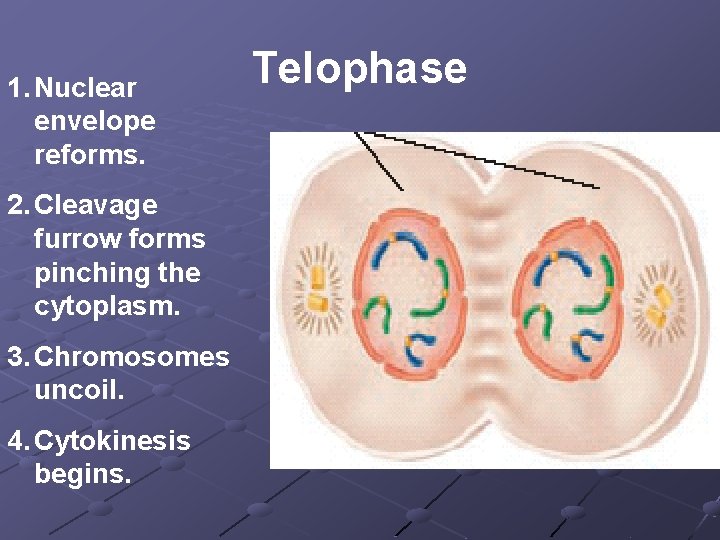
1. Nuclear envelope reforms. 2. Cleavage furrow forms pinching the cytoplasm. 3. Chromosomes uncoil. 4. Cytokinesis begins. Telophase
Cytokinesis Fig 12. 9 During telophase, cytokinesis occurs. During cytokinesis, the cytoplasm of the cell is divided in half, and the cell membrane grows to enclose each cell.
Cleavage In Action Actin and Myosin in a ring formation contract causing cleavage.
How does a cell plate form in plants? In Telophase: Golgi apparatus filled with cell wall materials move by microtubles to the middle of the cell and fuse.
Plants do not separate. Middle Lamella holds cells together. n Sticky
Meiosis Fig. 13. 7 & 13. 8 USA 300, 000 strong and growing Meiosis produces gametes and reduces the number in chromosomes in half. The following presents mitosis on the left and the corresponding meiosis phase on the right…. notice the First Link First differences. Theory of Inheritance of Genes
A forest from the trees moment Meiosis 1 n n Reduction Division: Process by which homologous chromosomes separate. Each Chromosome pairs up precisely with its homologue. Meiosis 2 n n Separation of sister chromatids. Similar to Mitosis.
Prophase I Genetic Recombination: Crossover Synaptomeal Complex: Pairing of homologues (Synapsis) The Longest Phase
Chiasmata (pl) Chiasma (s) Genetics The point of contact between paired chromatids during meiosis, resulting in a cross-shaped configuration and representing the cytological manifestation of crossing over.
Metaphase I Chromosomes line up on metaphase plate. (double file) Spindle fibers attach at kinetochore.
Anaphase I Homologous chromosomes separate
Telophase & Cytokinesis Telophase I & Cytokinesis I Each pole has the monoploid number of chromosomes May or may not go interphase.
None Prophase II
None Metaphase II
None Anaphase II
None Telophase II & Cytokinesis II
Formation of Gametes Spermatogenesis spermatids
Oogenesis OVUM Third Link Comparison of OOGENESIS & SPERMATOGENISIS
So How Do Mitosis and Meiosis Compare? . Comparison of Mitosis and Meiosis
Types of Reproduction Sexual and Asexual n n Sexual: Meiosis Asexual: Binary fission
What are three ways genetic Did you know? A man and a woman variation is produced? Can create 64 trillion Independent Assortment n different offspring? Meiosis 1: random separation of homologous chromosomes. 50% maternal or paternal C (2^23) Crossover n n n Recombinant chromosomes are produced Humans: 2 -3 crossovers/chromosome pair Random Fertilization n n Human Ovum = 8 million chromosomal combos Human Sperm = 8 million chromosomal combos Fertilization = 8 million X 8 million recombinations possible.