
Chromosome Nomenclature Types Structure Chromosomes The term chromosome
- Slides: 38
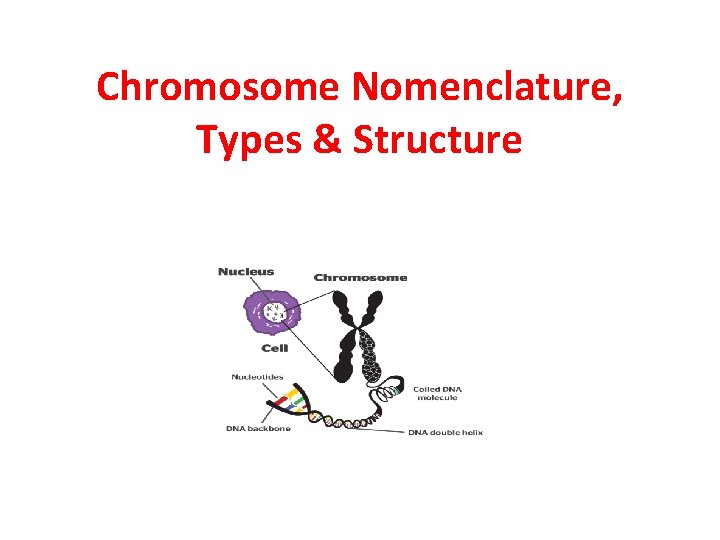
Chromosome Nomenclature, Types & Structure
Chromosomes • The term chromosome was coined by W. Waldeyer in 1888. • Their structures varies in different organisms like they are circular in bacteria but linear in eukaryotic organisms, however there number remains constant for a species.
• Size of Chromosomes • The size varies from species to species or even within the same species. • The size of chromosome is normally measured at mitotic metaphase stage where they obtained their maximum volume. • In most of the organisms, their size range from 0. 1 to 30 μm in length and 0. 2 to 2. 0 μm in thickness.
• Organisms with less number of chromosomes contain relatively larger sized chromosomes. • In general, chromosomes in case of plants are larger in size than in animals. • Among plants, cells of monocots contain larger chromosomes than cells of dicot plants.
• Shape of chromosomes • Shape is changeable from phase to phase during cell growth and cell division i. e. the interphase chromosomes occur in the form of thin, coiled, elastic, contractile thread like structure (a kind of chromatin threads). • However, during metaphase and anaphase they become thick and filamentous.
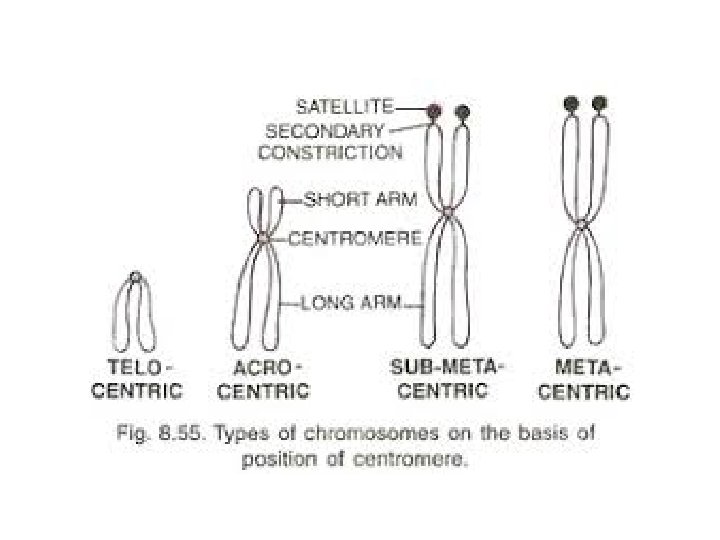
• A chromosome has two arms which are held together at a point called centromere. • The position of this centromere varies that provides different shapes. • If the centromere is present at the centre giving two equal arms then the chromosome will assume 'V' shape. • But if the centromere is slightly away from the centre with one arm is shorter than the other arm assumes an 'L' shape or 'J' shape, however, when the centromere is present on the terminal point having only one arm and other arm is absent, they assumes a 'I' shape.
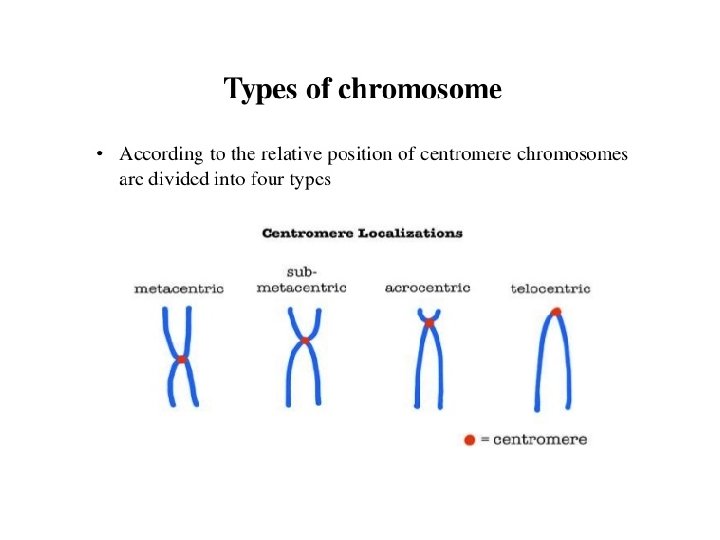
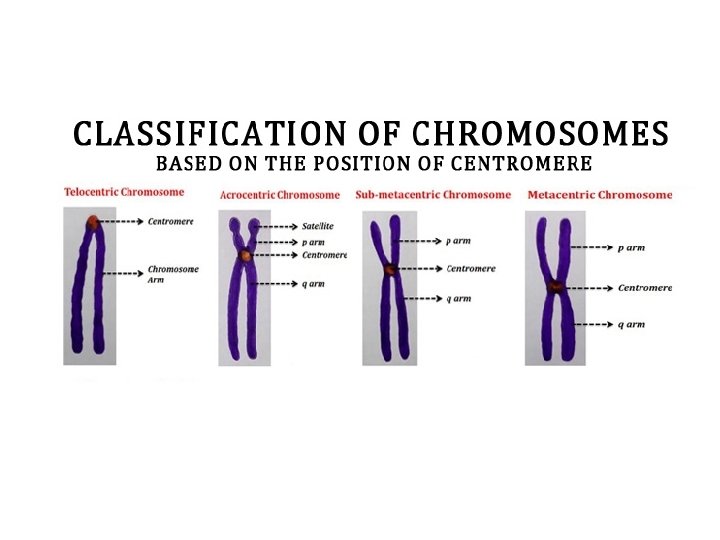
• Types of chromosomes: • Based on the position of the centromeres chromosomes are of four types: • • 1. 2. 3. 4. Telocentric Acrocentric Sub-metacentric Metacentric
• 1. Telocentric where centromere present on the proximal end. They look like rod shaped • 2. Acrocentric where centromere present near one end, thus one arm is very short while the other arm is ver long. They also appear as rod shaped • 3. Sub-metacentric where centromere occur near the centre resulting in two unequal arms, so they appear as L or J shaped) • 4. Metacentric chromosomes where centromere occur in centre thereby forming two equal arms becoming V shaped.
• Based on functions, they are two types: • (1) Autosomes and • (2) Sex chromosomes.
• (1) Autosomes: • Found in all the body cells and they decide the somatic characters of the organism. • In humans, there are 46 chromosomes out of which 44 are autosomes and the remaining two are sex chromosomes.
• (2) Sex chromosomes: • Involved in the sex determination. • In both animals and plants, these chromosomes are found different in both structure and functions. • In human males there are two sex chromosomes as XY and in human female there are two sex chromosomes as XX.
• Unusual of Chromosomes: • Beside these normal chromosomes, certain animals and plants possess one or more chromosomes which are quite different from the normal chromosomes in their basic structure, size and shape. • These chromosomes are called unusual chromosomes, examples B-chromosomes. of • The other name of B-chromosomes is accessory and supernumerary chromosomes. • These chromosomes are actually extra chromosomes that are found in certain individuals especially in plants like in case of maize.
• Special types of chromosomes: • Found in certain specialized eukaryotic cells. • They are very large in size and hence called as giant chromosomes. • They are of two types • (1) Polytene chromosomes and • (2) Lamp brush chromosomes
• (1) Polytene chromosomes • First discovered by C. G. Balbiani in the year 1881 in the salivary glands of drosophila. • Hence called as salivary gland chromosomes. • They have an extremely large puff in the center called as Chromosomal puff or Balbiani ring. • Along their body, they have alternat light bands (clear zones) and dark bands respectively like in a zebra.
• (2) Lamp brush chromosomes • First discovered by Flemming in the year 1882. • They got this name as they resemble the shape of a brush. • They are generally seen in the diplotene stage of the meiotic prophase in the oocytes of Salamandor and in the giant nuclei of the unicellular algae Acetabularia. • They have an extremely condensed central axis from which lateral loops made up of DNA extend outwards. • This is due to the intense RNA synthesis.
• Number of chromosomes • Each species of plants and animals has a definite constant somatic and gametic number of chromosomes. • The somatic or body cells contain 2 diploid set of chromosomes which is represented as 2 n. • This diploidy is achieved by the union of two haploid male and female gametes in sexual reproduction.
• The Gametic chromosome number is the number of chromosomes found in the gametes of a species. • It is precisely one half of the somatic number and is represented by n commonly called as haploid number. • So somatic chromosome number is commonly known as the diploid number. • The total number of genes present in a haploid set of chromosomes is called genome. • Therefore one haploid set has one genome, whereas, the diploid cell will have two genomes.
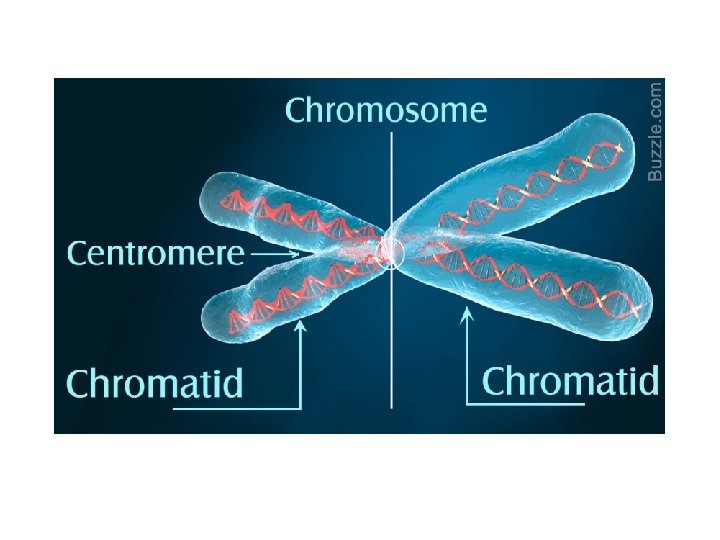
• Structure of Chromosomes: • A typical chromosome has similar structures called chromatids. • Since they are similar, they are called sister chromatids. • The chromatids are connected to the center part called centromere. • A centromere is a spherical structure which is a network is protein fibres.
• The centromeres vary in number in different chromosomes. • A chromosome with only one centromere is called monocentric and that one with many centromeres is called polycentric.
• The structure of chromosome varies during various phases of cell cycle, thus, various term are used to define the structure of chromosomes: • 1. Chromonemata: During mitotic prophase, when the chromosomal material becomes visible as very thin filaments, they are called as chromonemata. • Chromonemata is actually an earlier stage of chromatid that consists of a single linear DNA molecule with associated proteins. It is gene bearing portion.
• 2. Chromatids: • At mitotic metaphase each chromosome consists of 2 symmetrical or similar structures called as chromatids. • Since they are similar, they are called sister chromatids. • Each chromatid contains a single DNA molecule. • Both chromatids are connected to the center part called centromere and become separated at beginning of anaphase when sister chromatids of a chromosome migrate to opposite pole.
• 3. Chromomere: • These are regions of tightly folded DNA. • These are bead like accumulations of chromatin material visible along interphase chromosome. • Chromomere become clearly visible in polytene chromosome where they become aligned side-byside constituting chromosome beeds. • However, at metaphase, the chromosomes are tightly coiled therefore, these chromomeres become invisible.
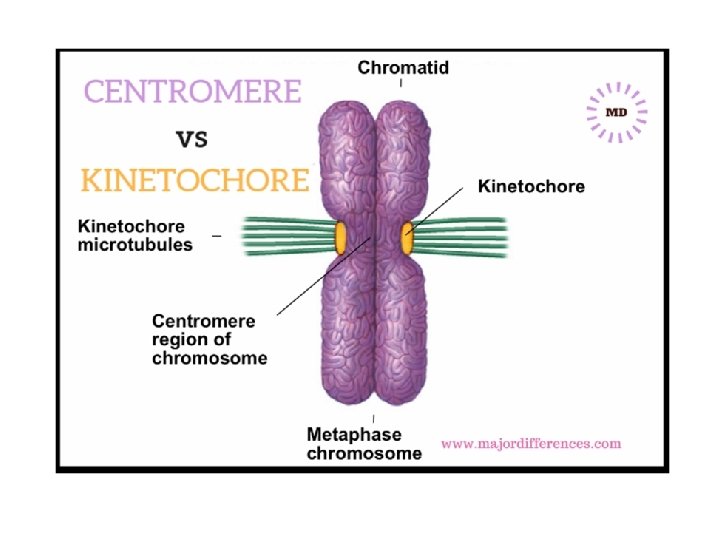
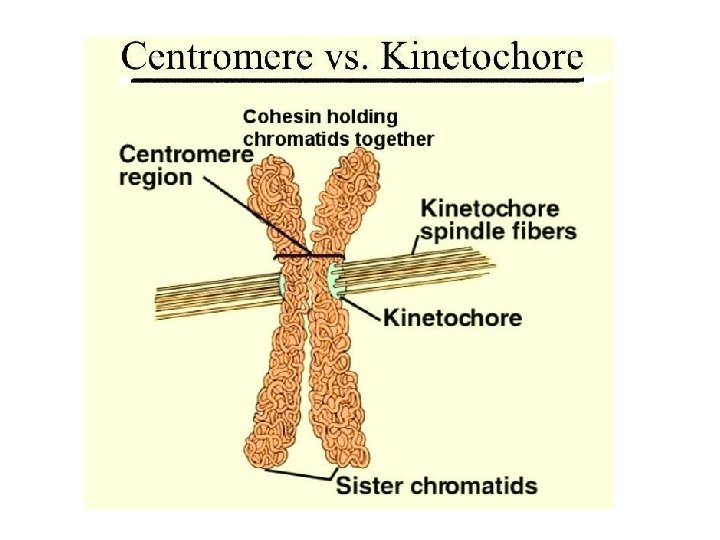
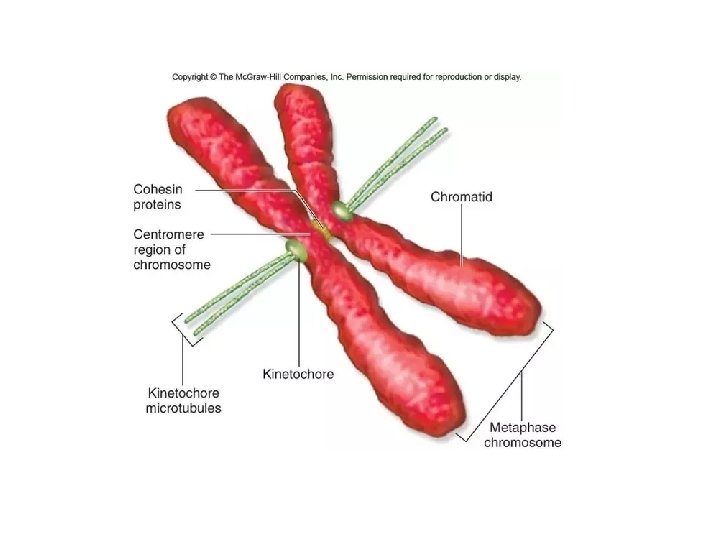
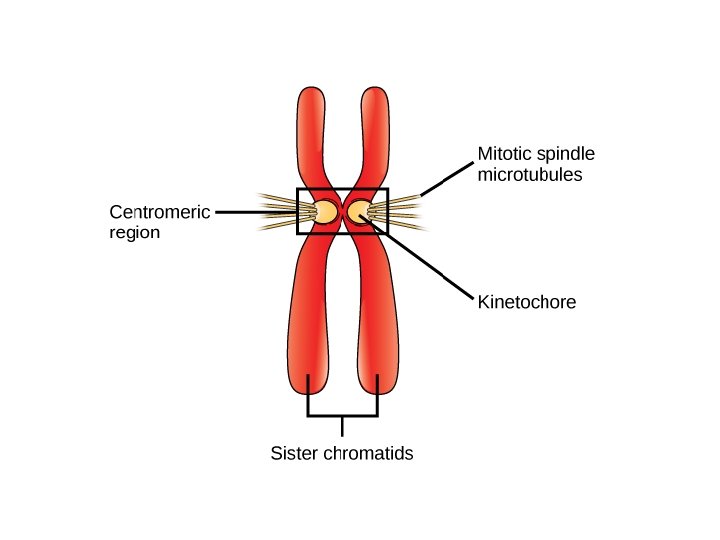
• 4. Centromere & Kinetochore: • There are of two types of constrictions, primary and secondary constrictions. • The primary constriction is made up of centromere and kinetochore. • A centromere is a spherical structure contain a network is protein fibres. • Centromeres vary in number in different chromosomes i. e. chromosome with only one centromere is called monocentric while with many is called polycentric.
• Centromere consists of specific DNA sequences with special proteins forming kinetochores. • So, kinetochore is a plate or cup like disc situated upon primary constriction or centromere. • Centromere is the region to which are attached the fibres of mitotic spindle and allows the chromatids to move. • So during mitosis, 4 -40 microtubules of mitotic spindle become attached to kinetochore and provide the force for chromosomal movement. • If the centromere is damaged, then the chromosome cannot move in the anaphase stage.
• 5. Telomeres: • Each extremity of chromosomes has a polarity and therefore it prevents other chromosomal segments to be fused with it. • The chromosomal ends are known as Telomeres. If a chromosome breaks, the broken ends can fuse with other chromosome due to lack of the Telomeres.
• 6. Secondary Constriction: • In addition to primary constriction or centromere the chromosomes may have some more constrictions at any point on the chromosomes. • All such constrictions other than the primary constriction are called secondary constrictions.
• 7. Nucleolar organizers: There are certain secondary constrictions that contain genes coding for 5. 8 s, 18 s and 28 s ribosomal RNA that induce formation of nucleoli. • Such secondary constriction that gives rise to the nucleoli formation are called as nucleolar organizers. • In human beings nucleolar organizers are located in secondary constrictions of chromosomes 13, 14, 15, 21, and 22 all of which are acrocentric and have satellites.
• A small structure attached to the lateral end of the chromosome by a secondary constriction is called satellite and such chromosomes with the satellite are called SAT-chromosomes. • Centromere is another lateral structure attached to the chromosome. • It gives stability to the chromosome.
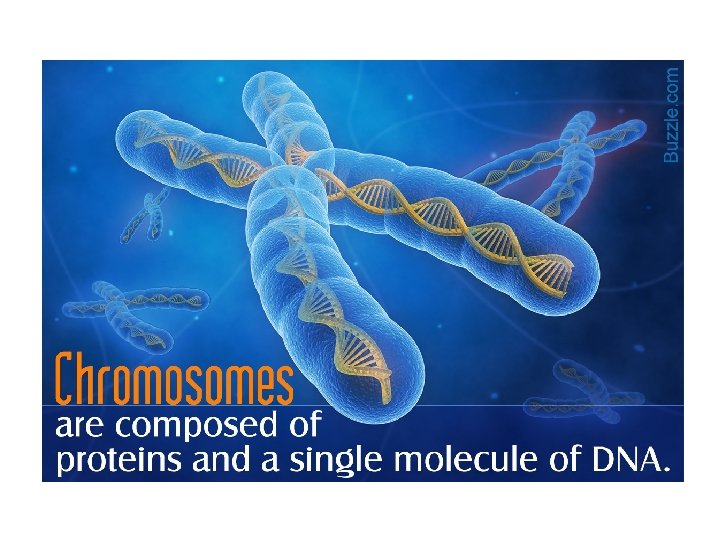
• A typical chromosome has the satellite at its one end and the centromere at the other end. • A chromosome is made up of DNA, RNA, histone and non-histone protons and some of them also have metallic ions like Ca 2+ and Mg 2+.