
Chromosomal mutations 1 A mutation is a change




- Slides: 26
Chromosomal mutations 1 • A mutation is a change in the DNA • Generally, mutations are considered at the gene level, but some types of mutations involve addition, loss, or change of DNA at the chromosomal level. • We basically consider two types of change: – Change in chromosome number – Change in chromosome structure Definition: Autosomes vs. sex chromosomes
Change in chromosome number • An incorrect number of a particular chromosome is aneuploidy. – Correct number is euploidy. – Only one chromosome is monosomy. – Three chromosomes is trisomy. • Plants are more tolerant of aneuploidies – Animals tend not be be, esp. humans. • Aneuploidies can be autosomal or X/Y • Aneuploidies arise from non-disjunction 2
Human aneuploidies • Of sex chromosomes: – XXY, XYY, XO, XXX – XO is only human monosomy that is viable. • Partial monosomy in an autosome – Cri-du-chat syndrome, 46, 5 p • Chromosome # 5 missing part of p arm • Various anatomic malformations and retardation • Malformed larynx produces cat-like cry • About 1/ 50, 000 live births 3
Sex chromosome aneuploides • 47, XXY Klinefelter syndrome – male in appearance, but some feminization; sterile. – slow to learn, but not retarded. – XXXY etc. similar, but more severe symptoms • 45, XO Turner syndrome – Monosomy, the only one occurring in humans – female, sterile, short webbed neck, broad chest, short. – majority aren’t born 4
Other sex chromosome aneuploidies • 47, XXX – Some phenotypically normal – Others, sterility, mental retardation • 47, XYY – 1965 study: higher number of inmates with XYY – revisited: no real correlation with criminal behavior – taller than average, average IQ – Possible learning difficulties, highly active, fast growing as children. 5
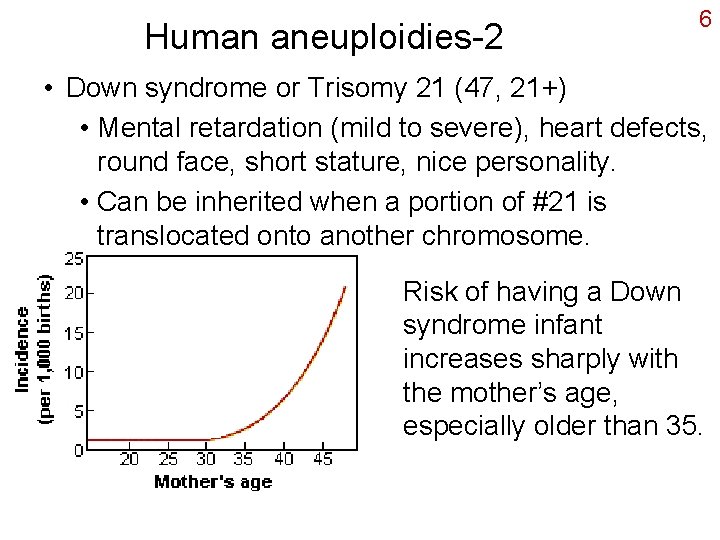
Human aneuploidies-2 6 • Down syndrome or Trisomy 21 (47, 21+) • Mental retardation (mild to severe), heart defects, round face, short stature, nice personality. • Can be inherited when a portion of #21 is translocated onto another chromosome. Risk of having a Down syndrome infant increases sharply with the mother’s age, especially older than 35.
Complications in understanding how Trisomy 21 comes about 7 • Mothers older than 35 have rapidly increasing risk. – 95% of non-disjunctions occur with the ovum. • Most Down syndrome babies are born to women younger than 35 because those are the ages that most women have children. • Dogma: all your oocytes are present at birth; meiosis is arrested in Prophase I and not completed until adulthood, once a month. – Conclusion: after 35 years, eggs start to go bad. – New data: adult mice have egg stem cells, produce new oocytes. In humans, new eggs from ovary cell culture.
Other human trisomies 8 • Only two : Patau syndrome and Edwards syndrome – mostly females, 1 in about 8, 000 live births. – Eventually fatal, usually within a year – Both associated with advanced maternal age • Patau syndrome Trisomy 13 (47, 13+) – Med. life expect. 2. 5 days, only 5% surviving >6 mo. – severe neurological problems; facial abnormalities, malformed organ systems, polydactyly. • Edwards syndrome Trisomy 18 (47, 18+) – elongated skull, low malformed ears, webbed neck, bad hips, heart, and lungs. – avg age at death = 4 mo. 5 -10% live beyond 1 year.
Not just Mom 9 • Recent studies show that as men age, the DNA in their sperm has more mutations and broken strands – Increased risk of dwarfism in offspring – Increased risk of autism
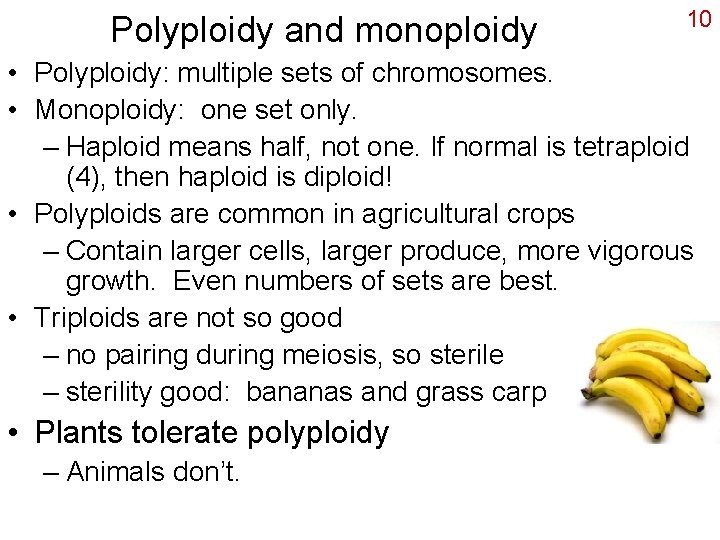
Polyploidy and monoploidy 10 • Polyploidy: multiple sets of chromosomes. • Monoploidy: one set only. – Haploid means half, not one. If normal is tetraploid (4), then haploid is diploid! • Polyploids are common in agricultural crops – Contain larger cells, larger produce, more vigorous growth. Even numbers of sets are best. • Triploids are not so good – no pairing during meiosis, so sterile – sterility good: bananas and grass carp • Plants tolerate polyploidy – Animals don’t.
Endoreduplication: 11 • Mitosis (or meiosis) without cell division doubles the number of chromosomes. – Occurs in certain tissues of some animals – Rare in mammals – Widespread in plants – When occurring in reproductive cells of plants, can result in new species with a new number of chromosomes
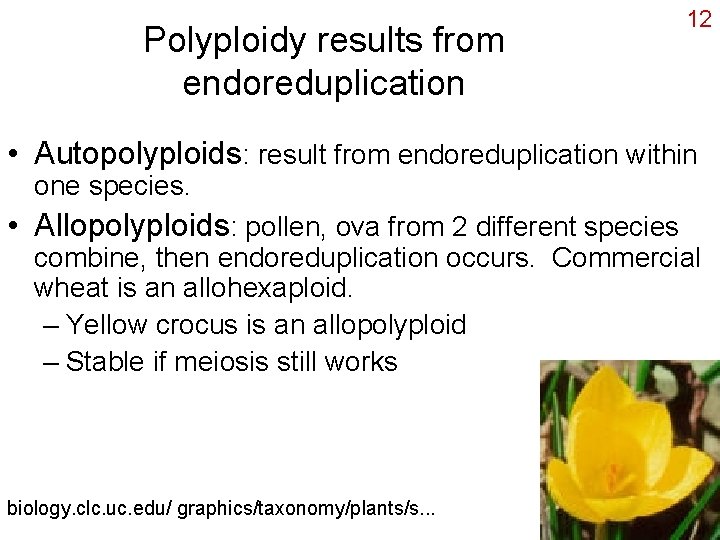
Polyploidy results from endoreduplication 12 • Autopolyploids: result from endoreduplication within one species. • Allopolyploids: pollen, ova from 2 different species combine, then endoreduplication occurs. Commercial wheat is an allohexaploid. – Yellow crocus is an allopolyploid – Stable if meiosis still works biology. clc. uc. edu/ graphics/taxonomy/plants/s. . .
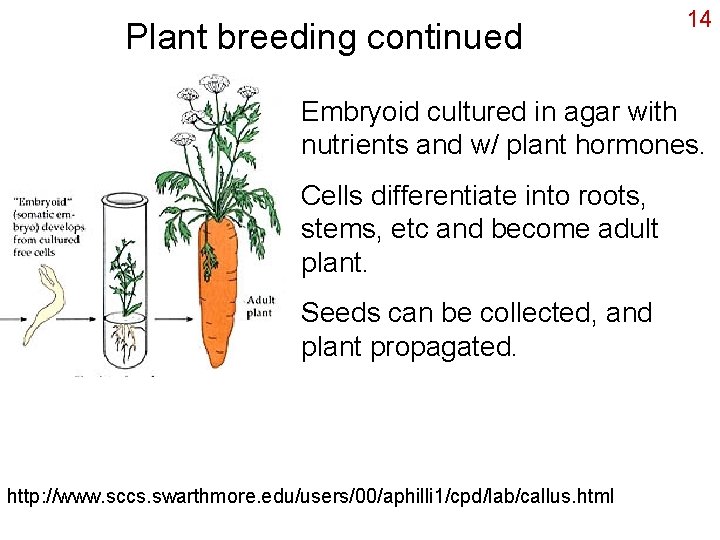
Monoploids can be used in plant breeding 13 • How to make a plant with the traits you want: • Cold shock anthers- this stimulates haploid pollen grains to begin dividing. Forms an embryoid. – embryoid is a small mass of undeveloped tissue that you can grow in culture. – with monoploids, there is NO masking of recessive traits as in diploids, so you can see what you’re getting. • Convert monoploid to diploid by treating with colchicine (a microtubule inhibitor) – messes up mitosis, leads to endoreduplication in some cells; chromosome number doubles from mono to diploid.
Plant breeding continued 14 Embryoid cultured in agar with nutrients and w/ plant hormones. Cells differentiate into roots, stems, etc and become adult plant. Seeds can be collected, and plant propagated. http: //www. sccs. swarthmore. edu/users/00/aphilli 1/cpd/lab/callus. html
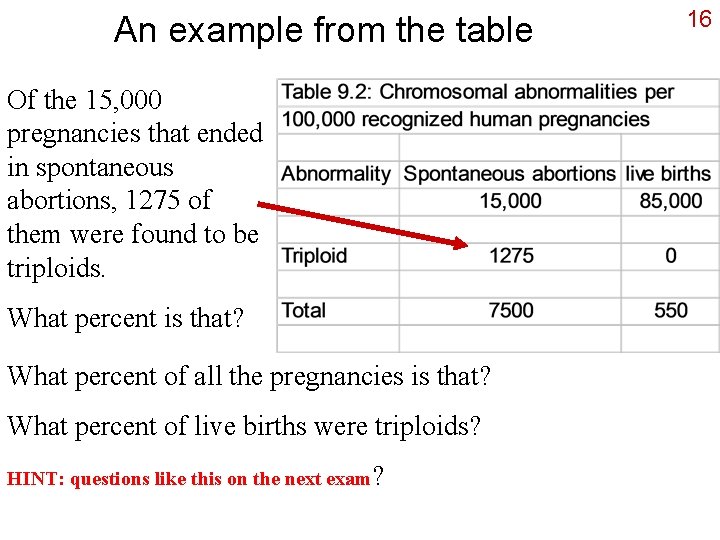
Chromosome irregularities of various kinds cause problems in humans. 15 • Excerpt from table; this table will be on the next exam. • Of 100, 000 pregnancies, 15, 000 ended in spontaneous abortion, 85, 000 in live births. • The Table lists various chromosomal abnormalities; roughly half the spontaneous abortions resulted from chromosomal abnormalities; only 550 of 85, 000 live births had them.
An example from the table Of the 15, 000 pregnancies that ended in spontaneous abortions, 1275 of them were found to be triploids. What percent is that? What percent of all the pregnancies is that? What percent of live births were triploids? HINT: questions like this on the next exam? 16
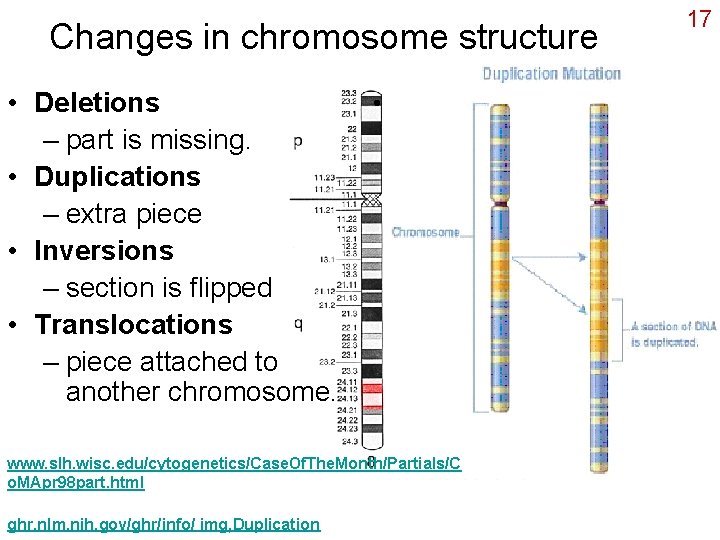
Changes in chromosome structure • Deletions – part is missing. • Duplications – extra piece • Inversions – section is flipped • Translocations – piece attached to another chromosome. • www. slh. wisc. edu/cytogenetics/Case. Of. The. Month/Partials/C o. MApr 98 part. html ghr. nlm. nih. gov/ghr/info/ img, Duplication 17
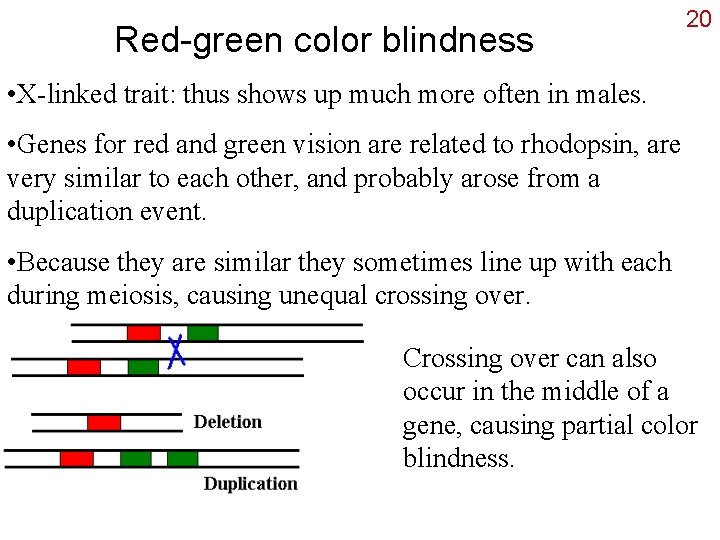
Deletions are bad • Deletions mean that DNA is missing – whatever genes were in that region are gone – if two copies are needed, there’s trouble – If the remaining allele is lethal, there’s trouble – the bigger the deletion, the more likely it will be serious. • Deletions often accompany duplications – Duplications are caused by unequal crossing over – if some chromosome gets 2, another gets 0 18
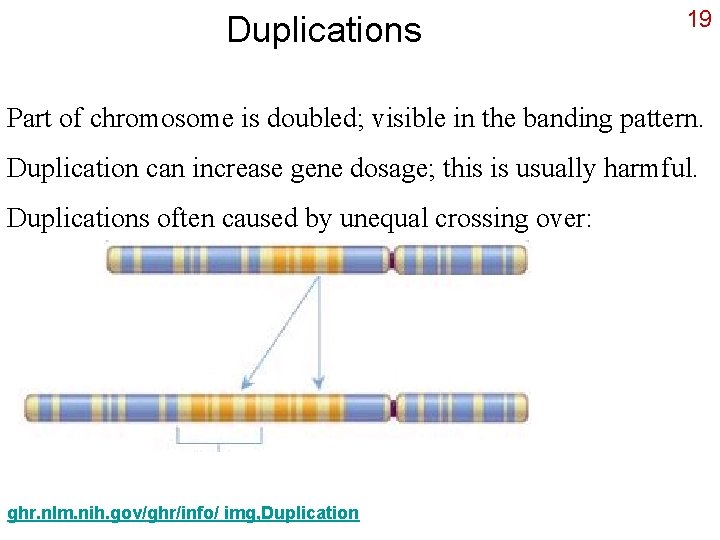
Duplications 19 Part of chromosome is doubled; visible in the banding pattern. Duplication can increase gene dosage; this is usually harmful. Duplications often caused by unequal crossing over: ghr. nlm. nih. gov/ghr/info/ img, Duplication
Red-green color blindness 20 • X-linked trait: thus shows up much more often in males. • Genes for red and green vision are related to rhodopsin, are very similar to each other, and probably arose from a duplication event. • Because they are similar they sometimes line up with each during meiosis, causing unequal crossing over. Crossing over can also occur in the middle of a gene, causing partial color blindness.
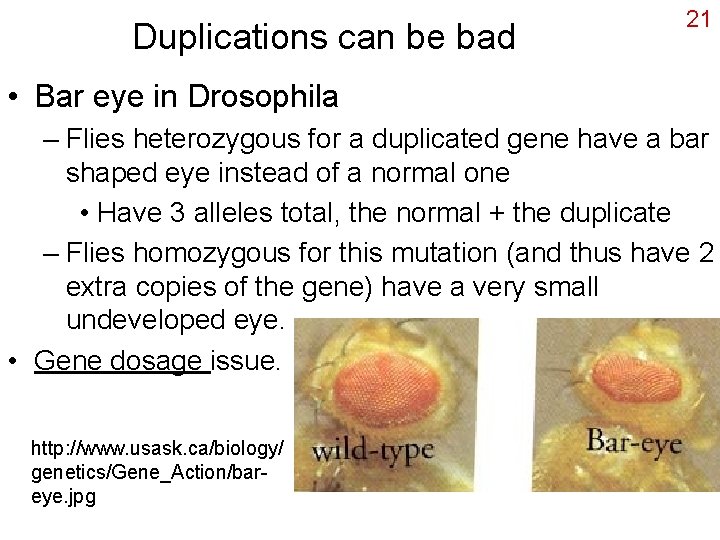
Duplications can be bad 21 • Bar eye in Drosophila – Flies heterozygous for a duplicated gene have a bar shaped eye instead of a normal one • Have 3 alleles total, the normal + the duplicate – Flies homozygous for this mutation (and thus have 2 extra copies of the gene) have a very small undeveloped eye. • Gene dosage issue. http: //www. usask. ca/biology/ genetics/Gene_Action/bareye. jpg
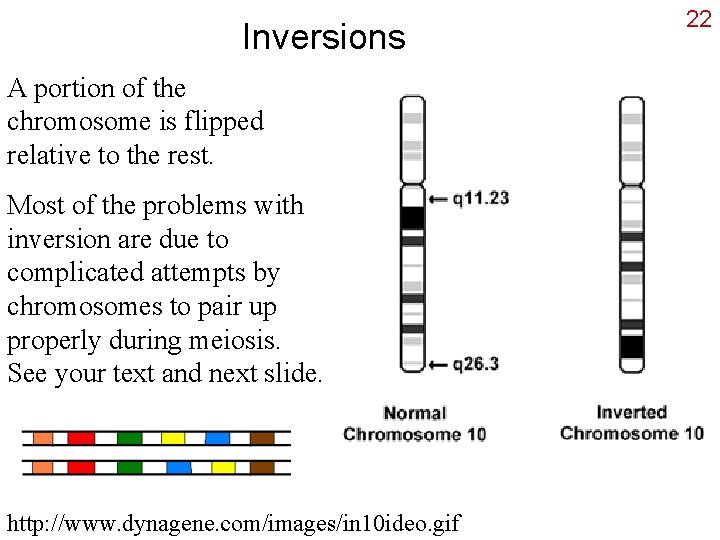
Inversions A portion of the chromosome is flipped relative to the rest. Most of the problems with inversion are due to complicated attempts by chromosomes to pair up properly during meiosis. See your text and next slide. http: //www. dynagene. com/images/in 10 ideo. gif 22
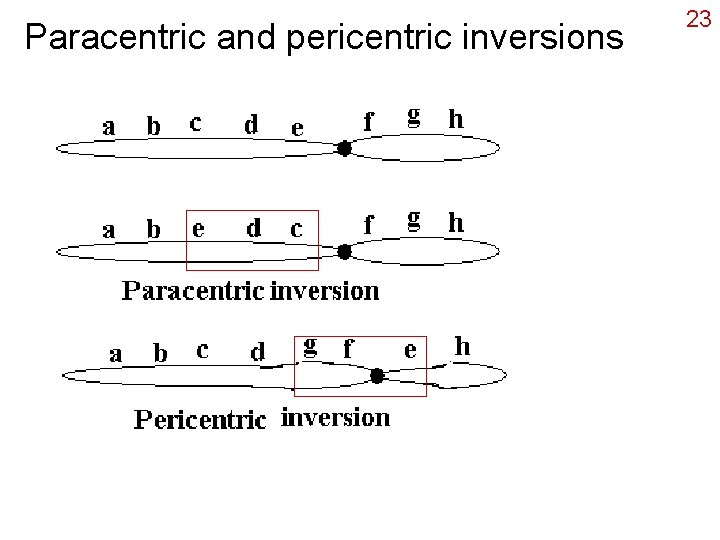
Paracentric and pericentric inversions 23
Problems with inversions in meiosis Duplications, deletions, and dicentric and acentric chromosomes can result from funny pairing and subsequent crossing over. www. mun. ca/. . . /Drosophila_inversion_loop. htm 24
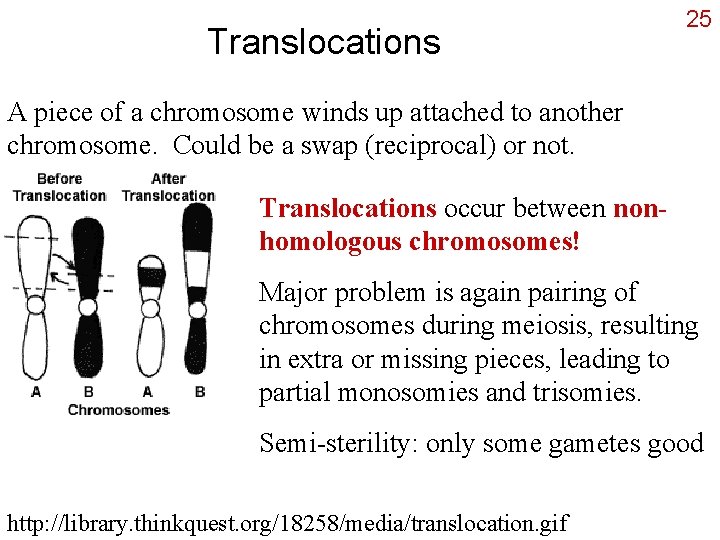
Translocations 25 A piece of a chromosome winds up attached to another chromosome. Could be a swap (reciprocal) or not. Translocations occur between nonhomologous chromosomes! Major problem is again pairing of chromosomes during meiosis, resulting in extra or missing pieces, leading to partial monosomies and trisomies. Semi-sterility: only some gametes good http: //library. thinkquest. org/18258/media/translocation. gif
Non-reciprocal translocations 26 Piece of one chromosome breaks off, attaches to another chromosome. Creates partial trisomies, monosomies, which are generally fatal. Robertsonian translocation: fusion of chromosomes near the centromere. One animation shows two centromeres, the other shows none. Definition describes fusion of centromeres. http: //www. pdx. edu/~newmanl/Robertsonian. gif http: //www. tokyo-med. ac. jp/genet/chm/rst. gif Cases of inherited Down syndrome involve translocation of part of Chromosome #21 to, typically, #14.