
Chromiums Crowning Achievement Breaking Dinitrogens Triple Bond Scientific
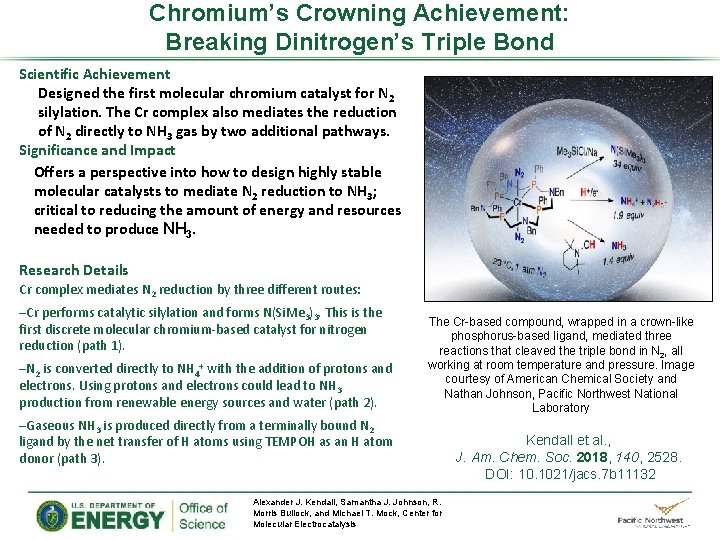
Chromium’s Crowning Achievement: Breaking Dinitrogen’s Triple Bond Scientific Achievement Designed the first molecular chromium catalyst for N 2 silylation. The Cr complex also mediates the reduction of N 2 directly to NH 3 gas by two additional pathways. Significance and Impact Offers a perspective into how to design highly stable molecular catalysts to mediate N 2 reduction to NH 3; critical to reducing the amount of energy and resources needed to produce NH 3. Research Details Cr complex mediates N 2 reduction by three different routes: –Cr performs catalytic silylation and forms N(Si. Me 3)3. This is the first discrete molecular chromium-based catalyst for nitrogen reduction (path 1). –N 2 is converted directly to NH 4+ with the addition of protons and electrons. Using protons and electrons could lead to NH 3 production from renewable energy sources and water (path 2). The Cr-based compound, wrapped in a crown-like phosphorus-based ligand, mediated three reactions that cleaved the triple bond in N 2, all working at room temperature and pressure. Image courtesy of American Chemical Society and Nathan Johnson, Pacific Northwest National Laboratory –Gaseous NH 3 is produced directly from a terminally bound N 2 ligand by the net transfer of H atoms using TEMPOH as an H atom donor (path 3). Alexander J. Kendall, Samantha J. Johnson, R. Morris Bullock, and Michael T. Mock, Center for Molecular Electrocatalysis Kendall et al. , J. Am. Chem. Soc. 2018, 140, 2528. DOI: 10. 1021/jacs. 7 b 11132
- Slides: 1