
CHROMATOGRAPHY WHAT The art of separation HOW Modes



- Slides: 28
CHROMATOGRAPHY WHAT The art of separation HOW Modes of separation Most common types of chromatography APPLICATIONS IN BCH LABS BCH 3356 Molecular Biology Lab BCH 3346 Metabolism/Enzymology Lab
CHROMATOGRAPHY The components Can you identify the different components of a chromatograph?
CHROMATOGRAPHY The sequence (1) Sample loading; (2) Separation; (3) Collection of fractions
CHROMATOGRAPHY WHAT The art of separation HOW Modes of separation Most common types of chromatography APPLICATIONS IN BCH LABS BCH 3356 Molecular Biology Lab BCH 3346 Metabolism/Enzymology Lab
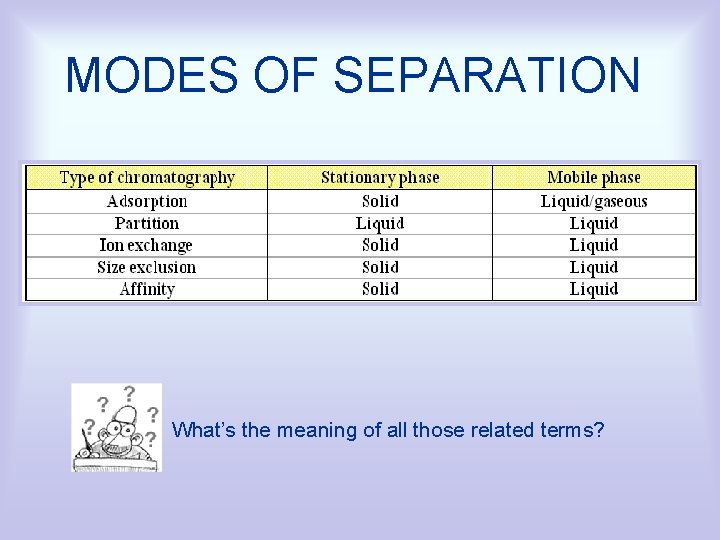
MODES OF SEPARATION What’s the meaning of all those related terms?
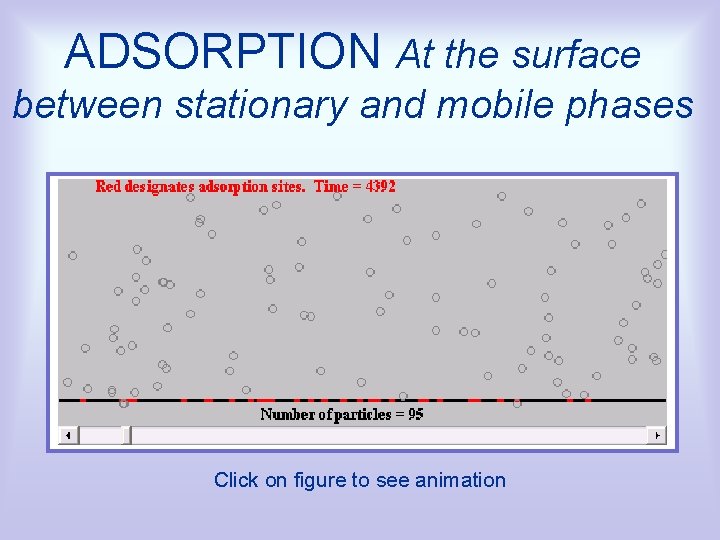
ADSORPTION At the surface between stationary and mobile phases Click on figure to see animation
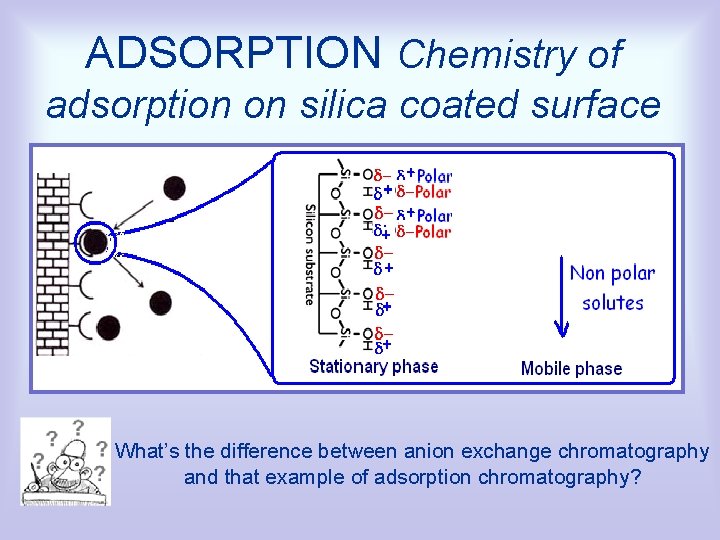
ADSORPTION Chemistry of adsorption on silica coated surface What’s the difference between anion exchange chromatography and that example of adsorption chromatography?
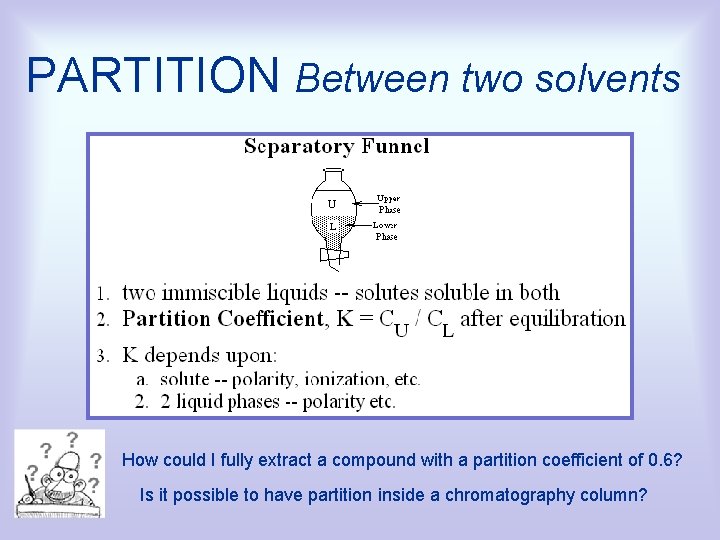
PARTITION Between two solvents How could I fully extract a compound with a partition coefficient of 0. 6? Is it possible to have partition inside a chromatography column?
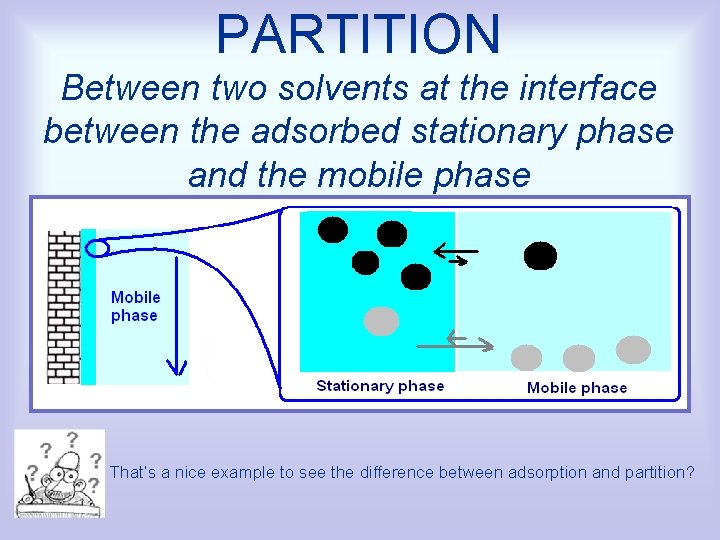
PARTITION Between two solvents at the interface between the adsorbed stationary phase and the mobile phase That’s a nice example to see the difference between adsorption and partition?
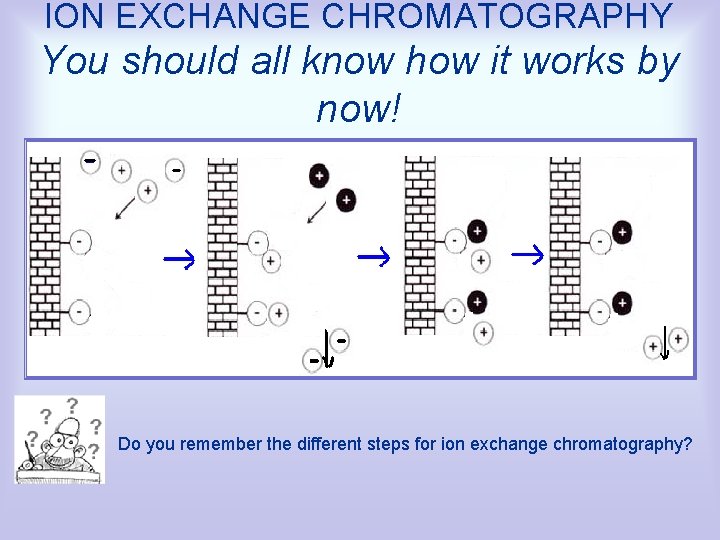
ION EXCHANGE CHROMATOGRAPHY You should all know how it works by now! Do you remember the different steps for ion exchange chromatography?
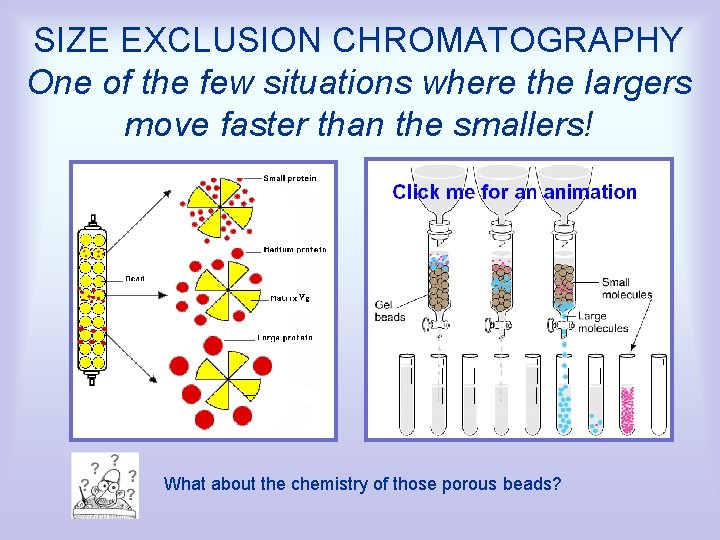
SIZE EXCLUSION CHROMATOGRAPHY One of the few situations where the largers move faster than the smallers! What about the chemistry of those porous beads?
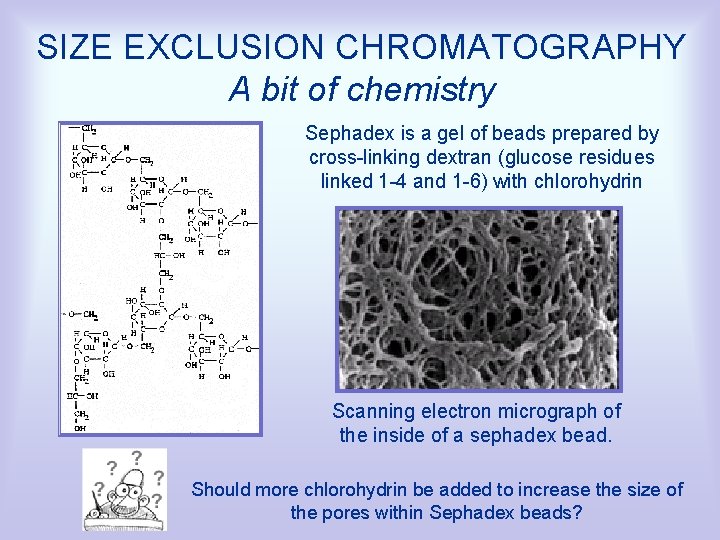
SIZE EXCLUSION CHROMATOGRAPHY A bit of chemistry Sephadex is a gel of beads prepared by cross-linking dextran (glucose residues linked 1 -4 and 1 -6) with chlorohydrin Scanning electron micrograph of the inside of a sephadex bead. Should more chlorohydrin be added to increase the size of the pores within Sephadex beads?
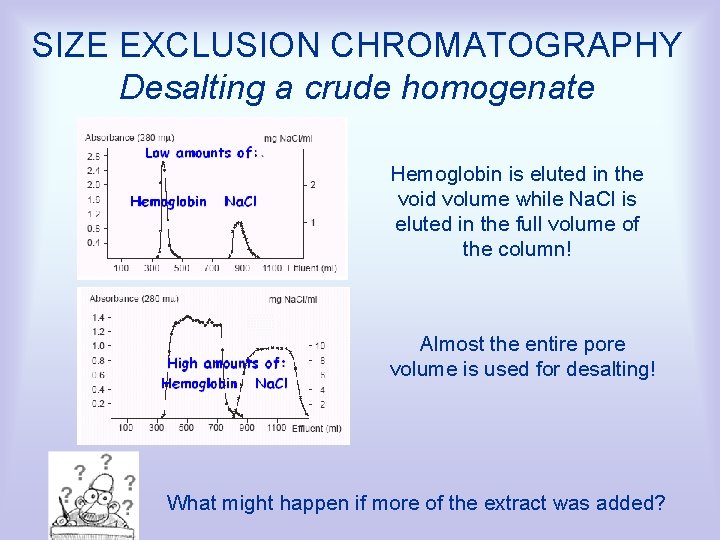
SIZE EXCLUSION CHROMATOGRAPHY Desalting a crude homogenate Hemoglobin is eluted in the void volume while Na. Cl is eluted in the full volume of the column! Almost the entire pore volume is used for desalting! What might happen if more of the extract was added?
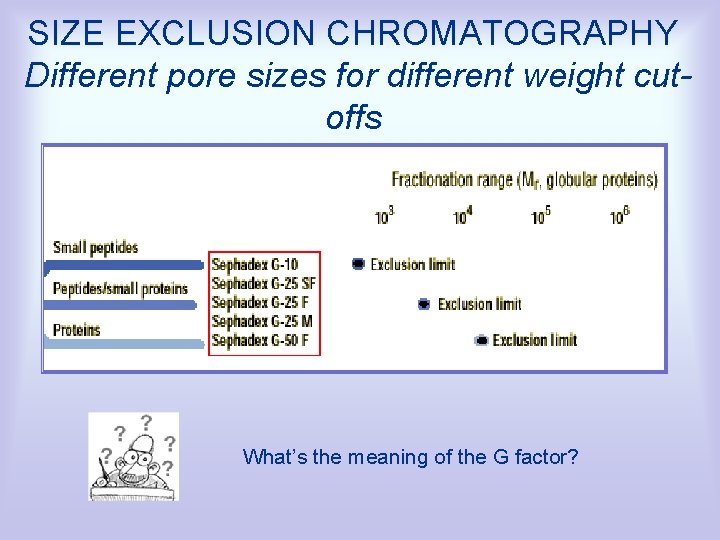
SIZE EXCLUSION CHROMATOGRAPHY Different pore sizes for different weight cutoffs What’s the meaning of the G factor?
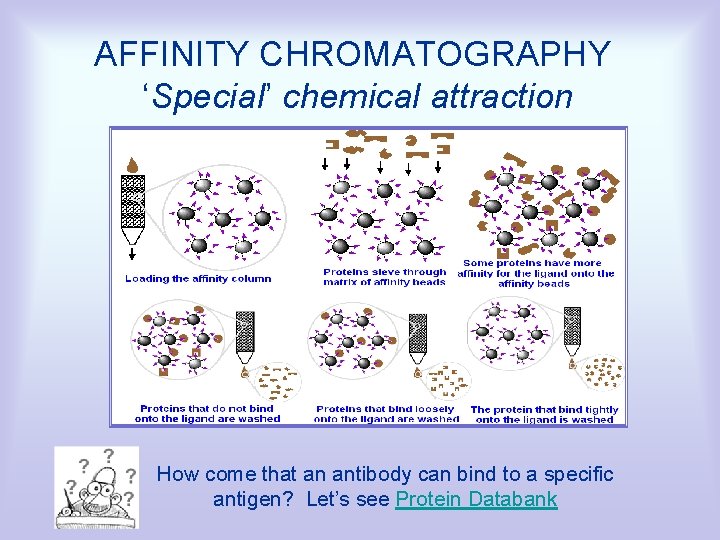
AFFINITY CHROMATOGRAPHY ‘Special’ chemical attraction How come that an antibody can bind to a specific antigen? Let’s see Protein Databank
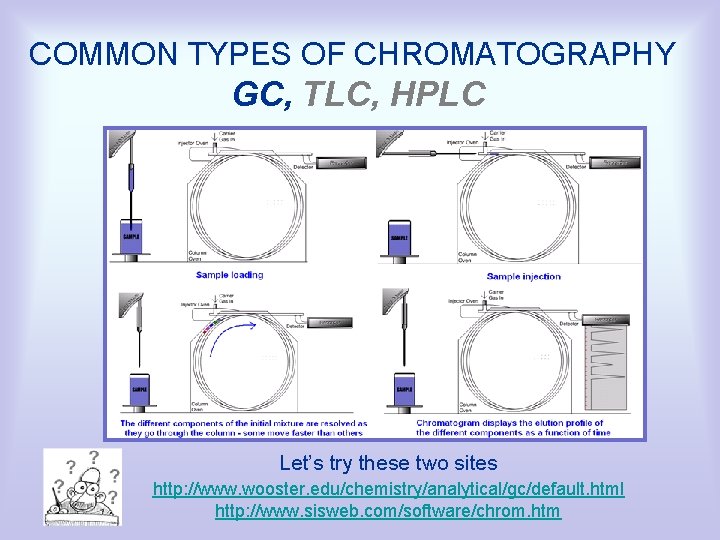
COMMON TYPES OF CHROMATOGRAPHY GC, TLC, HPLC Let’s try these two sites http: //www. wooster. edu/chemistry/analytical/gc/default. html http: //www. sisweb. com/software/chrom. htm
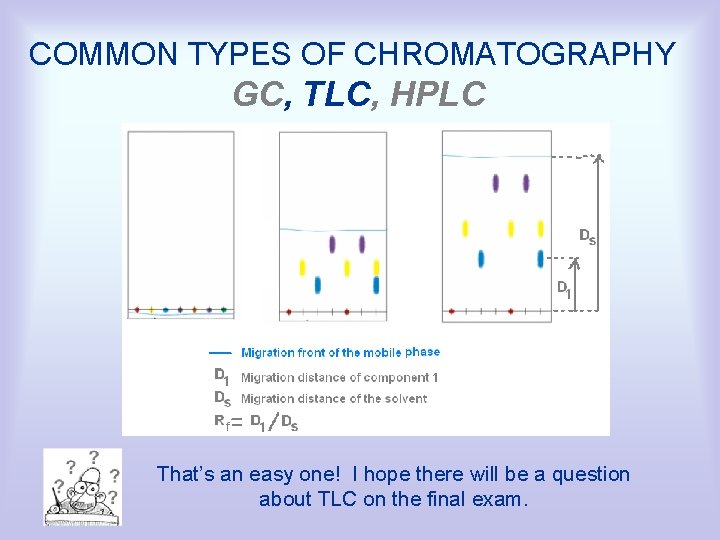
COMMON TYPES OF CHROMATOGRAPHY GC, TLC, HPLC That’s an easy one! I hope there will be a question about TLC on the final exam.
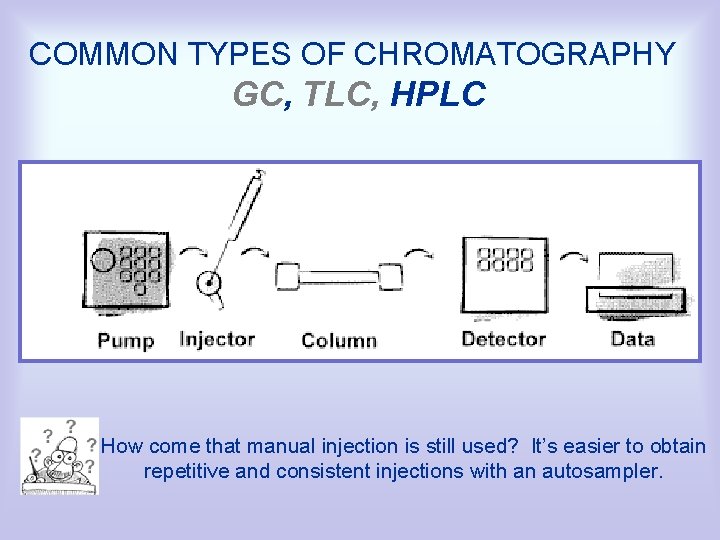
COMMON TYPES OF CHROMATOGRAPHY GC, TLC, HPLC How come that manual injection is still used? It’s easier to obtain repetitive and consistent injections with an autosampler.
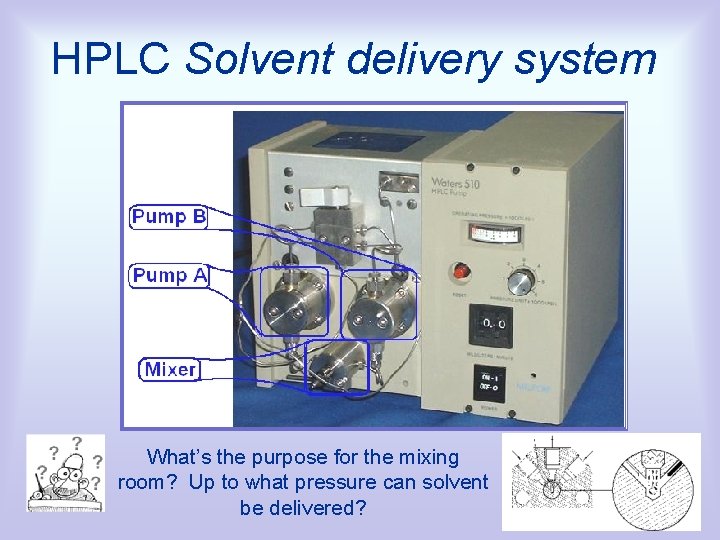
HPLC Solvent delivery system What’s the purpose for the mixing room? Up to what pressure can solvent be delivered?
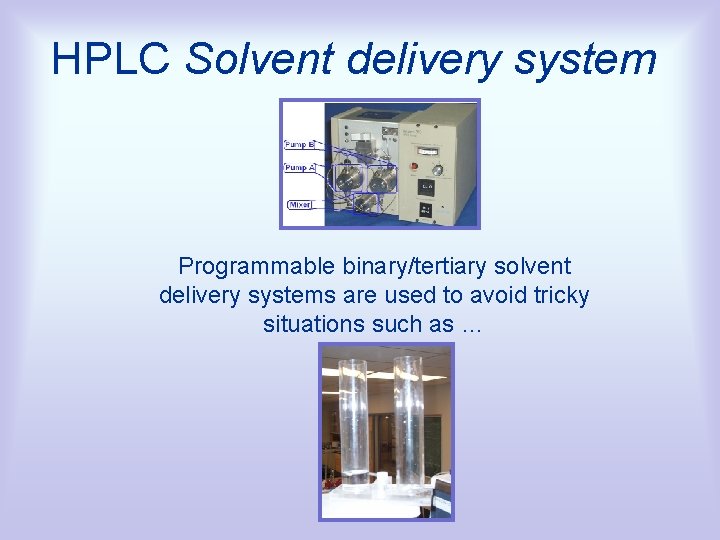
HPLC Solvent delivery system Programmable binary/tertiary solvent delivery systems are used to avoid tricky situations such as …
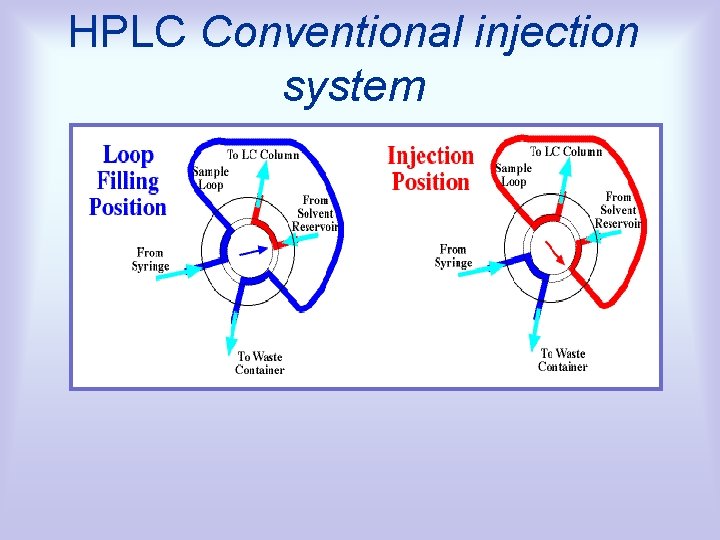
HPLC Conventional injection system
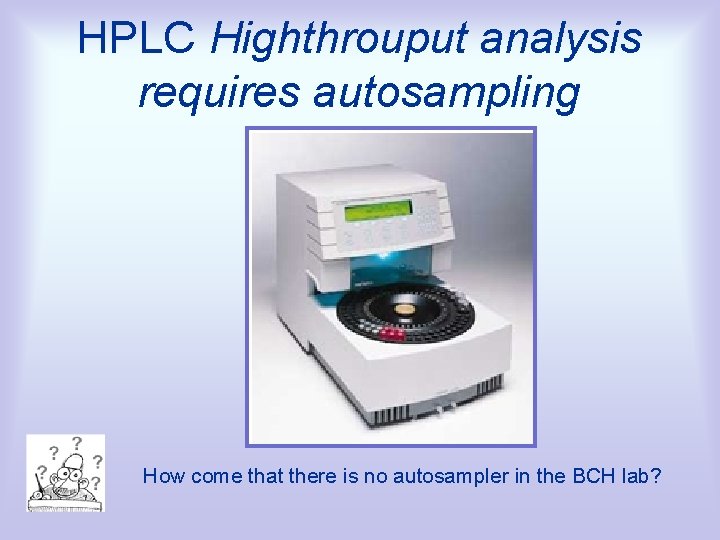
HPLC Highthrouput analysis requires autosampling How come that there is no autosampler in the BCH lab?
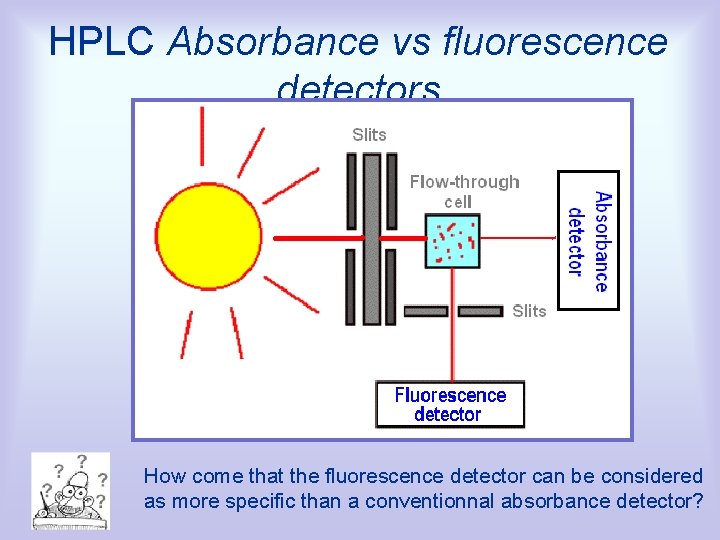
HPLC Absorbance vs fluorescence detectors How come that the fluorescence detector can be considered as more specific than a conventionnal absorbance detector?
CHROMATOGRAPHY WHAT The art of separation HOW Modes of separation WHY Most common types of chromatography APPLICATIONS IN BCH LABS BCH 3356 Molecular Biology Lab BCH 3346 Metabolism/Enzymology Lab
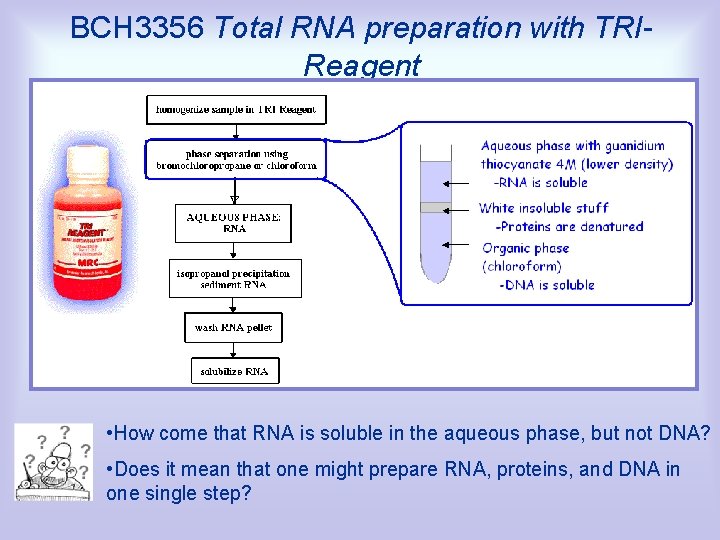
BCH 3356 Total RNA preparation with TRIReagent • How come that RNA is soluble in the aqueous phase, but not DNA? • Does it mean that one might prepare RNA, proteins, and DNA in one single step?
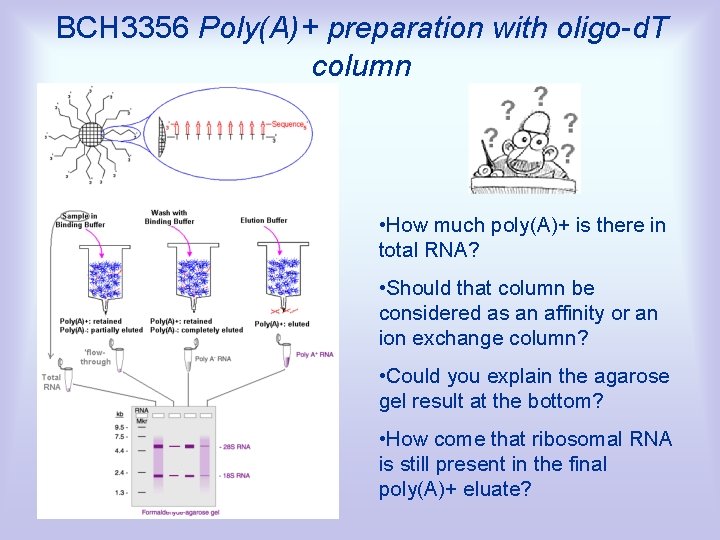
BCH 3356 Poly(A)+ preparation with oligo-d. T column • How much poly(A)+ is there in total RNA? • Should that column be considered as an affinity or an ion exchange column? • Could you explain the agarose gel result at the bottom? • How come that ribosomal RNA is still present in the final poly(A)+ eluate?
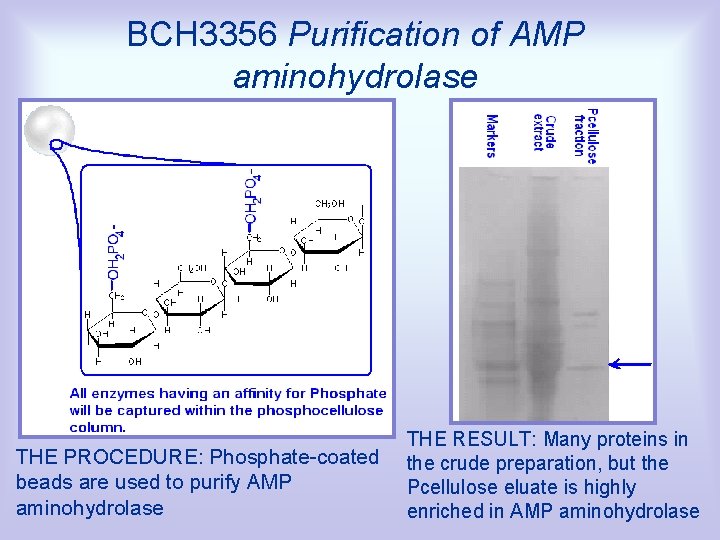
BCH 3356 Purification of AMP aminohydrolase THE PROCEDURE: Phosphate-coated beads are used to purify AMP aminohydrolase THE RESULT: Many proteins in the crude preparation, but the Pcellulose eluate is highly enriched in AMP aminohydrolase