
Chromatography Identification of free amino acids by TLC
Chromatography ‘’Identification of free amino acids by TLC using silica gel plates’’ cls 281 LAB. #4 1442/2020

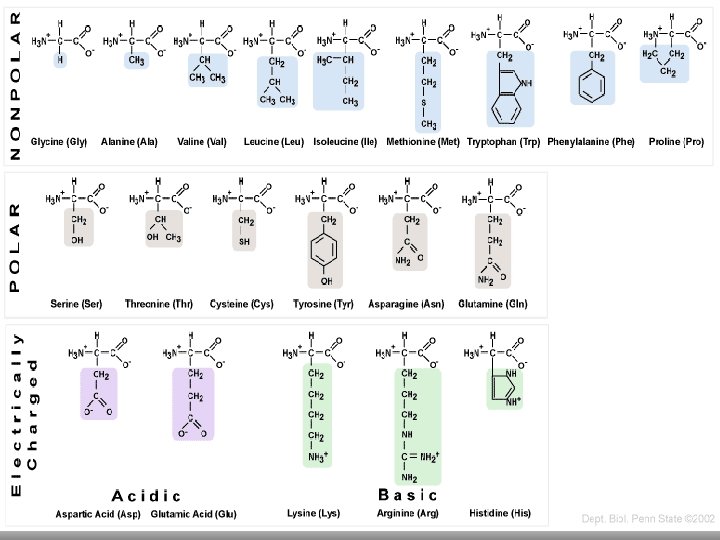
Amino acids: are the building blocks of peptides and proteins. They possess two functional groups—the carboxylic acid group gives the acidic character, and the amino group provides the basic character.
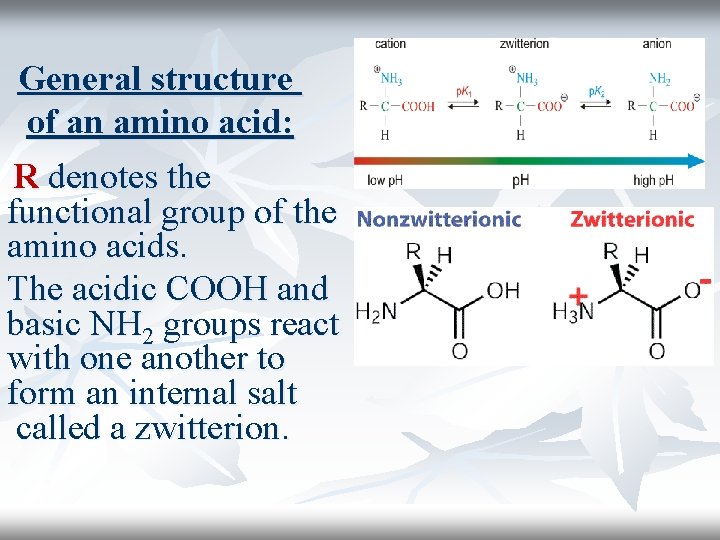
General structure of an amino acid: R denotes the functional group of the amino acids. The acidic COOH and basic NH 2 groups react with one another to form an internal salt called a zwitterion.
There are 20 amino acids derived from proteins. Of the 20 amino acids, 11 can be synthesized in the body. That leaves nine amino acids that you need to get directly from your diet. Those nine amino acids are called "essential amino acids. "

ØSome amino acids are polar(hydrophilic) e. g. Serine, tyrosine. And some are nonpolar (hydrophobic) e. g. Glycine, alanine. The different side chains, and the solubilities provided by these side chains, affect their rate of migration in thin-layer chromatography (TLC).
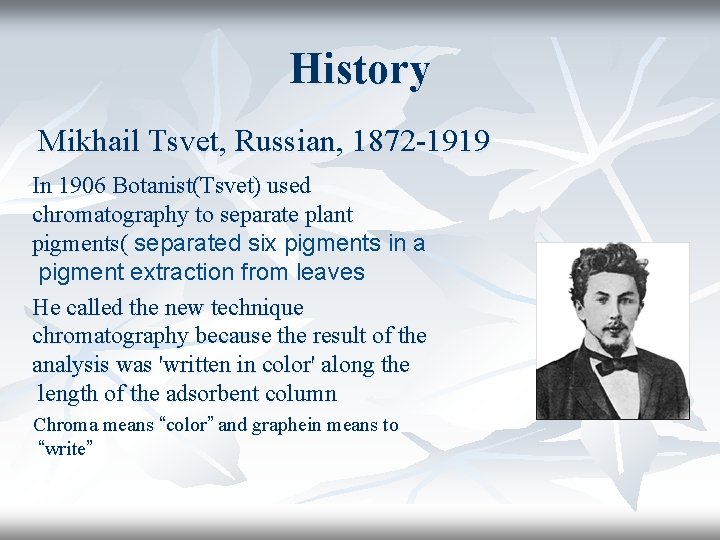
History Mikhail Tsvet, Russian, 1872 -1919 In 1906 Botanist(Tsvet) used chromatography to separate plant pigments( separated six pigments in a pigment extraction from leaves He called the new technique chromatography because the result of the analysis was 'written in color' along the length of the adsorbent column Chroma means “color” and graphein means to “write”
Importance Chromatography has application in every branch of the physical and biological sciences 12 Nobel prizes were awarded between 1937 and 1972 alone for work in which chromatography played a vital role
Chromatography: Ø is the collective term for a set of laboratory techniques for the separation of mixtures of substances into their components. Ø It is a physical method of separation in which the components to be separated are distributed between two phases: one of which is stationary (stationary phase) while the other (the mobile phase) moves through it in a definite direction.
Chromatography Is a technique used to separate and identify the components of a mixture. Works by allowing the molecules present in the mixture to distribute themselves between a stationary and a mobile medium. (difference in absorbance and adsorbance and dissolving degree ) Molecules that spend most of their time in the mobile phase are carried along faster.
Classification according to the packing of the stationary phase: 1 - Thin layer chromatography (TLC): the stationary phase is a thin layer supported on glass, plastic or aluminium plates. 2 - Paper chromatography (PC): the stationary phase is a thin film of liquid supported on an inert support. 3 - Column chromatography (CC): stationary phase is packed in a glass column.
Classification of chromatography according to mobile phase: 1 - Liquid chromatography: mobile phase is a liquid. (LLC, LSC). 2 - Gas chromatography : mobile phase is a gas. (GSC, GLC).
Classification according to the force of separation: 1 - Adsorption chromatography. 2 - Partition chromatography. 3 - Ion exchange chromatography. 4 - Gel filtration chromatography. 5 - Affinity chromatography.

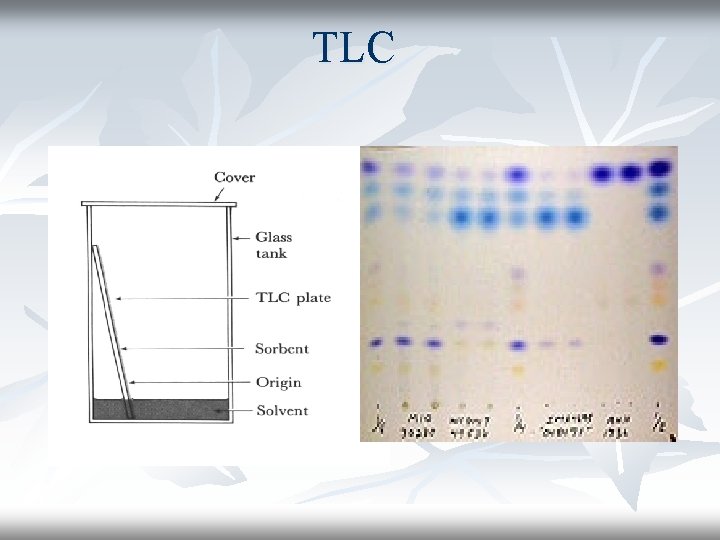
Thin layer chromatography (TLC) is a method for identifying substances and testing the purity of compounds. TLC is a useful technique because it is relatively quick and requires small quantities of material.
Separations in TLC involve distributing a mixture of two or more substances between a stationary phase and a mobile phase. The stationary phase: is a thin layer of adsorbent (usually silica gel or alumina) coated on a plate. The mobile phase: is a developing liquid which travels up the stationary phase, carrying the samples with it. Components of the samples will separate on the stationary phase according to how much they adsorb on the stationary phase versus how much they dissolve in the mobile phase.
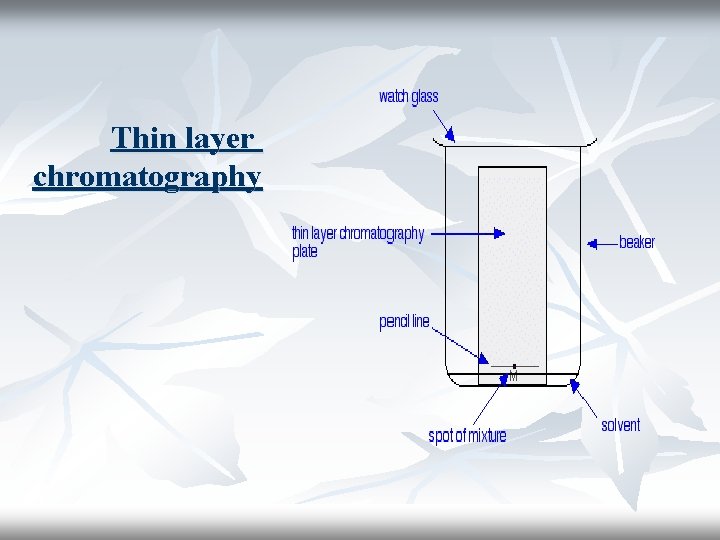
Thin layer chromatography
TLC
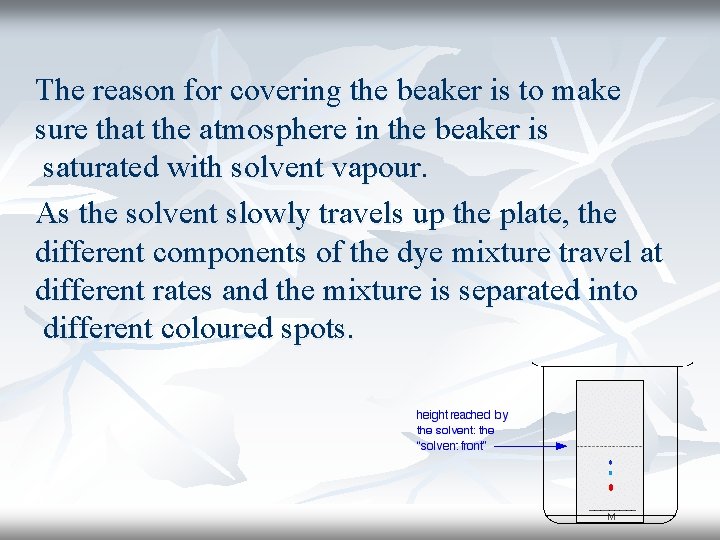
The reason for covering the beaker is to make sure that the atmosphere in the beaker is saturated with solvent vapour. As the solvent slowly travels up the plate, the different components of the dye mixture travel at different rates and the mixture is separated into different coloured spots.
Method: 1 -Preparation of the silica gel plates. 2 -A pencil line is drawn near the bottom of the plate and a small drop of a solution of the mixture is placed on it. 3 -When the spot of mixture is dry, the plate is stood in a shallow layer of solvent in a covered beaker. Solvents generally used: 1 -96% ethanol-water and 2 -n-butanol-acetic acid-water
When the solvent front is about 15 cm, remove the plate and dry it. 4. 5. locate the a. a by spraying with the ninhydrin solution. 6. place the plate in a drying oven at 110⁰c, 10 minutes.
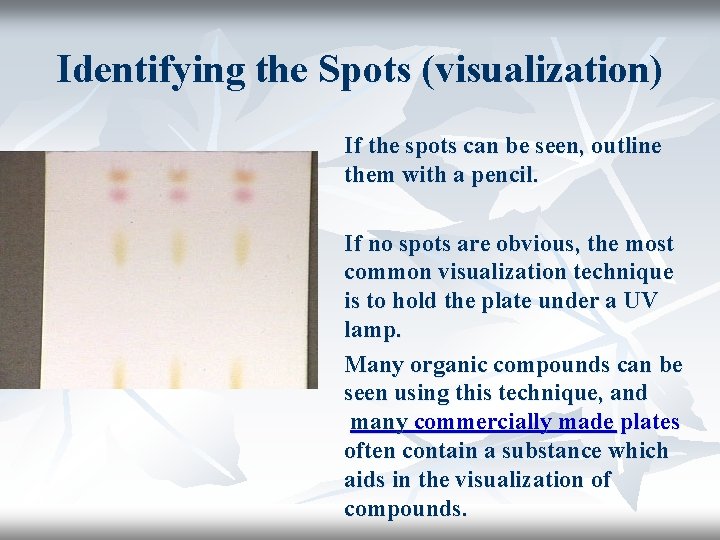
Identifying the Spots (visualization) If the spots can be seen, outline them with a pencil. If no spots are obvious, the most common visualization technique is to hold the plate under a UV lamp. Many organic compounds can be seen using this technique, and many commercially made plates often contain a substance which aids in the visualization of compounds.
Visualizing Agents Alkaloids: Dragendorff’s reagent Cardiac glycosides: Antimony trichloride Sugar: Aniline phthalate Amino acids: Ninhydrin
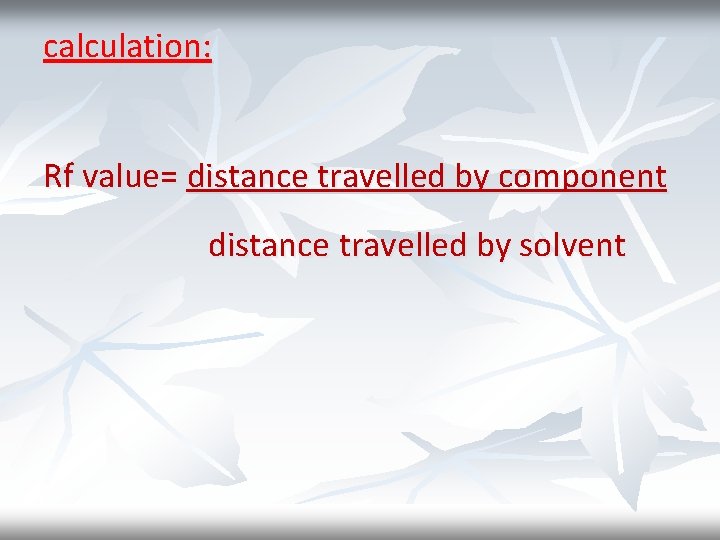
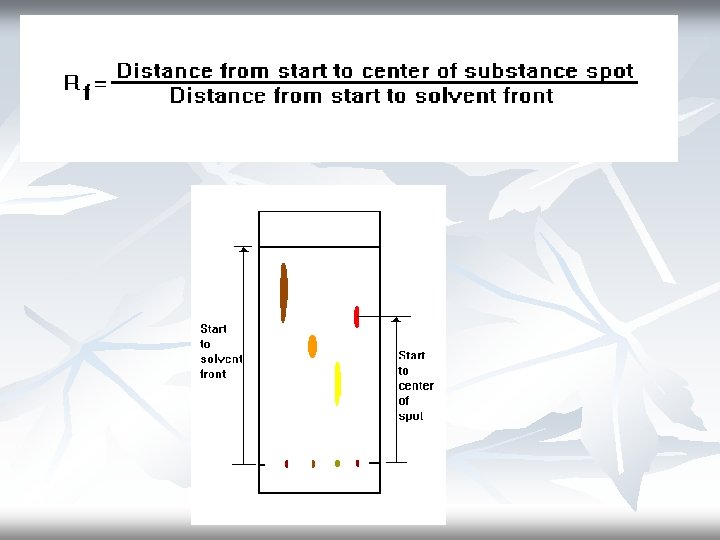
calculation: Rf value= distance travelled by component distance travelled by solvent
Interpreting the Data The Rf (retention factor) value for each spot should be calculated. It is characteristic for any given compound on the same stationary phase using the same mobile phase for development of the plates. Hence, known Rf values can be compared to those of unknown substances to aid in their identifications.
(Note: Rf values often depend on the temperature and the solvent used in the TLC experiment. the most effective way to identify a compound is to spot known substances – authentic - next to unknown substances on the same plate. ) In addition, the purity of a sample may be estimated from the chromatogram. An impure sample will often develop as two or more spots, while a pure sample will show only one spot
Small groups discussion What are the criteria that the amino acids separate from each other based on using chromatography techniques?
Summary A TLC plate is a sheet of glass, metal, or plastic which is coated with a thin layer of a solid adsorbent (usually silica or alumina). A small amount of the mixture to be analyzed is spotted near the bottom of this plate. The TLC plate is then placed in a shallow pool of a solvent in a developing chamber so that only the very bottom of the plate is in the liquid. This liquid, or the eluent, is the mobile phase, and it slowly rises up the TLC plate by capillary action. As the solvent moves past the spot that was applied, an equilibrium is established for each component of the mixture between the molecules of that component which are adsorbed on the solid and the molecules which are in solution.
In principle, the components will differ in solubility and in the strength of their adsorption to the adsorbent and some components will be carried farther up the plate than others. When the solvent has reached the top of the plate, the plate is removed from the developing chamber, dried, and the separated components of the mixture are visualized. If the compounds are colored, visualization is straightforward. Usually the compounds are not colored, so a UV lamp is used to visualize the plates.
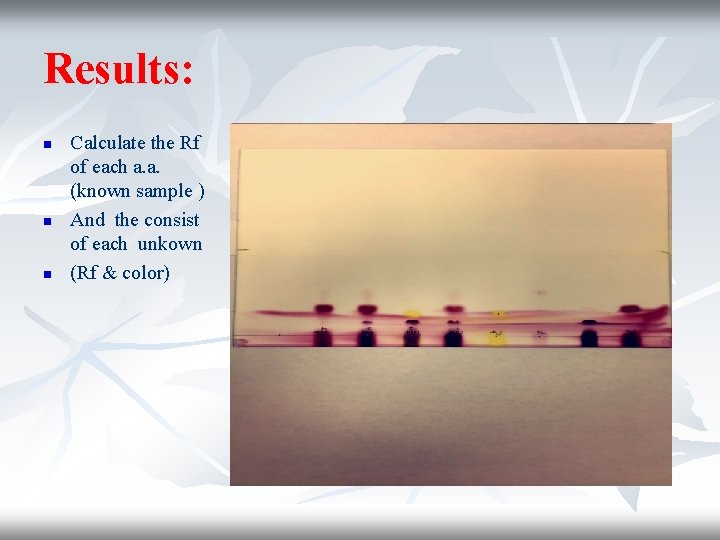
Results: n n n Calculate the Rf of each a. a. (known sample ) And the consist of each unkown (Rf & color)
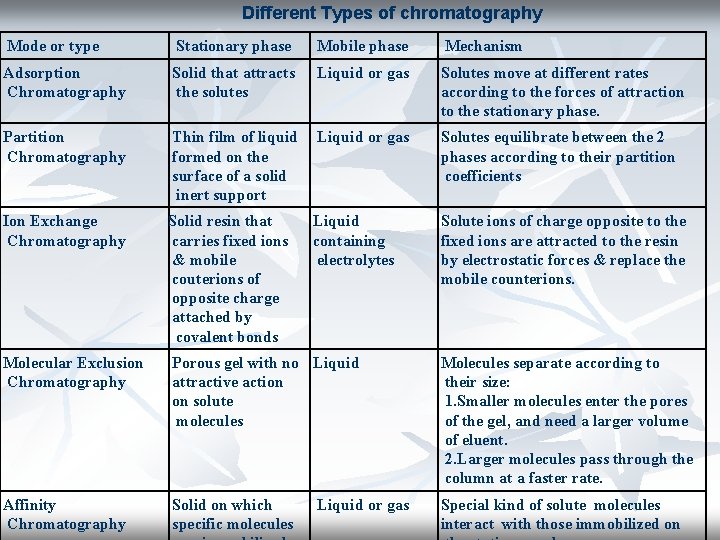
Different Types of chromatography Mode or type Stationary phase Mobile phase Mechanism Adsorption Chromatography Solid that attracts the solutes Liquid or gas Solutes move at different rates according to the forces of attraction to the stationary phase. Partition Chromatography Thin film of liquid formed on the surface of a solid inert support Liquid or gas Solutes equilibrate between the 2 phases according to their partition coefficients Ion Exchange Chromatography Solid resin that carries fixed ions & mobile couterions of opposite charge attached by covalent bonds Liquid containing electrolytes Solute ions of charge opposite to the fixed ions are attracted to the resin by electrostatic forces & replace the mobile counterions. Molecular Exclusion Chromatography Porous gel with no Liquid attractive action on solute molecules Molecules separate according to their size: 1. Smaller molecules enter the pores of the gel, and need a larger volume of eluent. 2. Larger molecules pass through the column at a faster rate. Affinity Chromatography Solid on which specific molecules Special kind of solute molecules interact with those immobilized on Liquid or gas
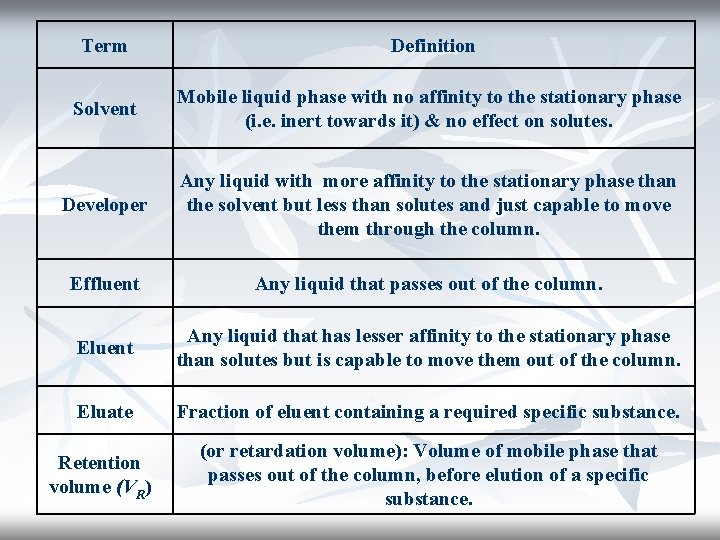
Term Definition Solvent Mobile liquid phase with no affinity to the stationary phase (i. e. inert towards it) & no effect on solutes. Developer Any liquid with more affinity to the stationary phase than the solvent but less than solutes and just capable to move them through the column. Effluent Any liquid that passes out of the column. Eluent Any liquid that has lesser affinity to the stationary phase than solutes but is capable to move them out of the column. Eluate Fraction of eluent containing a required specific substance. Retention volume (VR) (or retardation volume): Volume of mobile phase that passes out of the column, before elution of a specific substance.
- Slides: 32