
CHROMATOGRAPHY Chromatography It is a physical method of
- Slides: 7
CHROMATOGRAPHY • Chromatography : It is a physical method of separation in which the components to be separated are distributed between two phases, one of which is stationary (stationary phase) while the other (the mobile phase) moves in a definite direction. • The history of chromatography begins during the mid-19 th century. Chromatography, literally "color writing", was used - and named - in the first decade of the 20 th century, primarily for the separation of plant pigments such as chlorophyll. • New types of chromatography developed during the 1930 s and 1940 s made the technique useful for many types of separation process. • Some related techniques were developed during the 19 th century, but the first true chromatography is usually attributed to Russian botanist Mikhail Semyonovich Tsvet, who used columns of calcium carbonate for separating plant pigments during the first decade of the 20 th century during his research of chlorophyll.
• Chromatography became developed substantially as a result of the work of Archer John Porter Martin and Richard Laurence Millington Synge during the 1940 s and 1950 s. • They established the principles and basic techniques of partition chromatography, and their work encouraged the rapid development of several types of chromatography method: paper chromatography, gas chromatography, and what would become known as high performance liquid chromatography. • Since then, the technology has advanced rapidly. • Researchers found that the main principles of Tsvet's chromatography could be applied in many different ways, resulting in the different varieties of chromatography described below. • Simultaneously, advances continually improved the technical performance of chromatography, allowing the separation of increasingly similar molecules.
Chromatography terms • Analyte: It is the substance that is to be separated during chromatography. • Analytical chromatography : It is the technique used to determine the existence and possibly also the concentration of analyte(s) in a sample. • A bonded phase : it is a stationary phase that is covalently bonded to the support particles or to the inside wall of the column tubing. • The effluent is the mobile phase leaving the column. • An immobilized phase is a stationary phase which is immobilized on the support particles, or on the inner wall of the column tubing. • The mobile phase is the phase which moves in a definite direction. It may be a liquid (LC and CEC), a gas (GC), or a supercritical fluid (supercriticalfluid chromatography, SFC). • A better definition: The mobile phase consists of the sample being separated/analyzed and the solvent that moves the sample through the column. In the case of HPLC the mobile phase consists of a non-polar solvent(s) such as hexane in normal phase or polar solvents in reverse phase chromotagraphy and the sample being separated. The mobile phase moves through the chromatography column (the stationary phase) where the sample interacts with the stationary phase and is separated.
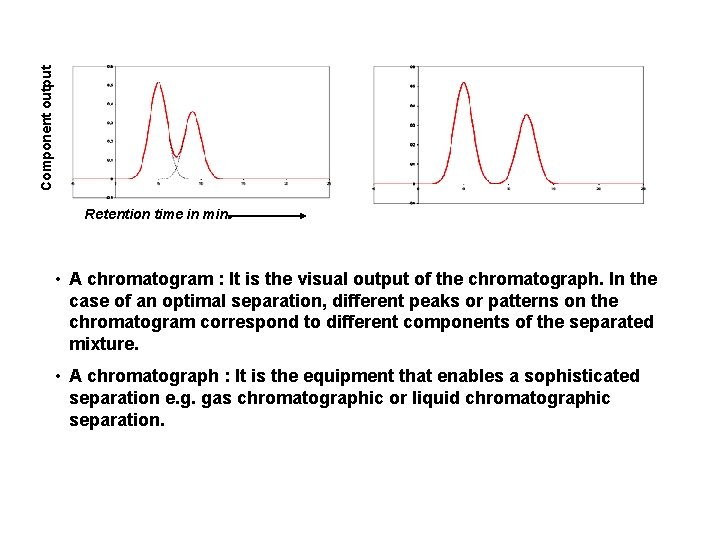
Component output Retention time in min. • A chromatogram : It is the visual output of the chromatograph. In the case of an optimal separation, different peaks or patterns on the chromatogram correspond to different components of the separated mixture. • A chromatograph : It is the equipment that enables a sophisticated separation e. g. gas chromatographic or liquid chromatographic separation.
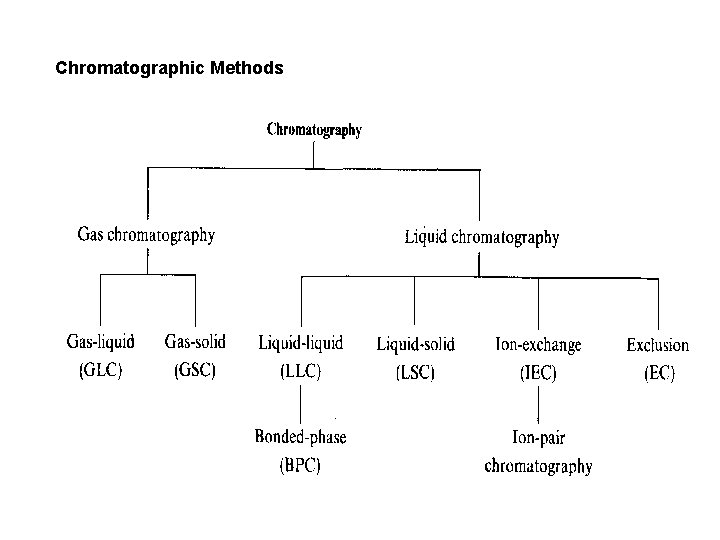
Chromatographic Methods
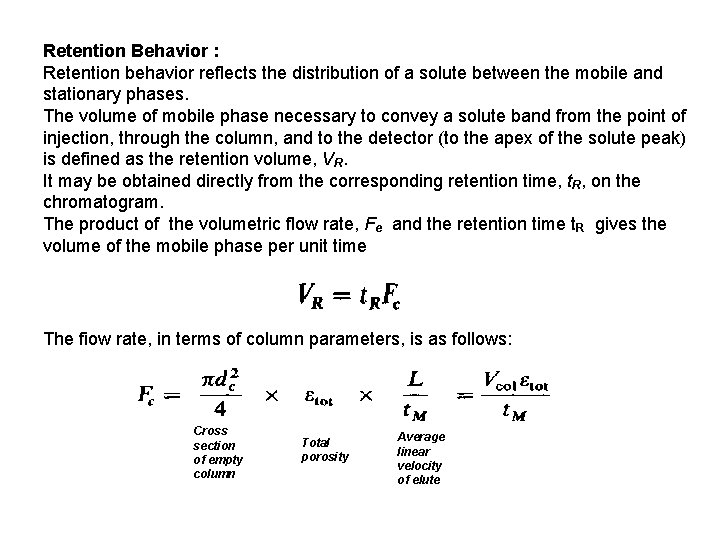
Retention Behavior : Retention behavior reflects the distribution of a solute between the mobile and stationary phases. The volume of mobile phase necessary to convey a solute band from the point of injection, through the column, and to the detector (to the apex of the solute peak) is defined as the retention volume, VR. It may be obtained directly from the corresponding retention time, t. R, on the chromatogram. The product of the volumetric flow rate, Fe and the retention time t. R gives the volume of the mobile phase per unit time The fiow rate, in terms of column parameters, is as follows: Cross section of empty column Total porosity Average linear velocity of elute
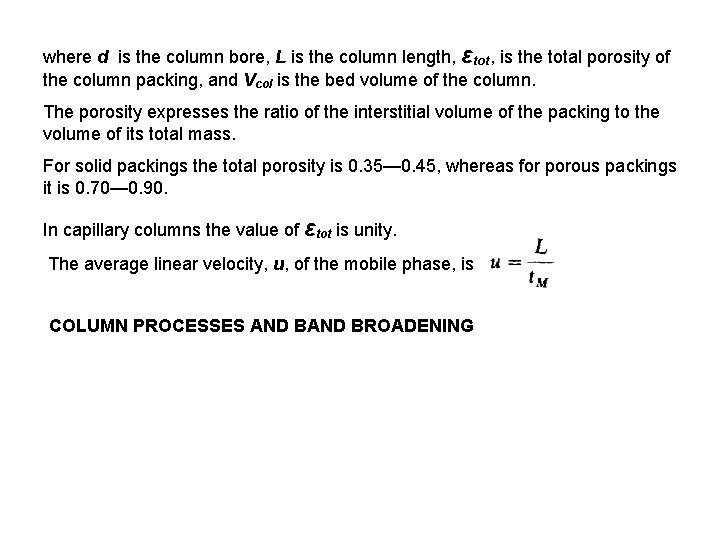
where d is the column bore, L is the column length, εtot, is the total porosity of the column packing, and Vcol is the bed volume of the column. The porosity expresses the ratio of the interstitial volume of the packing to the volume of its total mass. For solid packings the total porosity is 0. 35— 0. 45, whereas for porous packings it is 0. 70— 0. 90. In capillary columns the value of εtot is unity. The average linear velocity, u, of the mobile phase, is COLUMN PROCESSES AND BROADENING