
Christianity One of the three main universalizing religions


- Slides: 30
Christianity
• One of the three main universalizing religions • Monotheistic • Its parent religion is “Judaism” • Divided into branches, denomination, and sects – Branches: large and fundamental division – Denomination: division of a branch that unites a number of local congregations in a single legal and administrative body – Sect: a relatively small group that has broken away from an established denomination
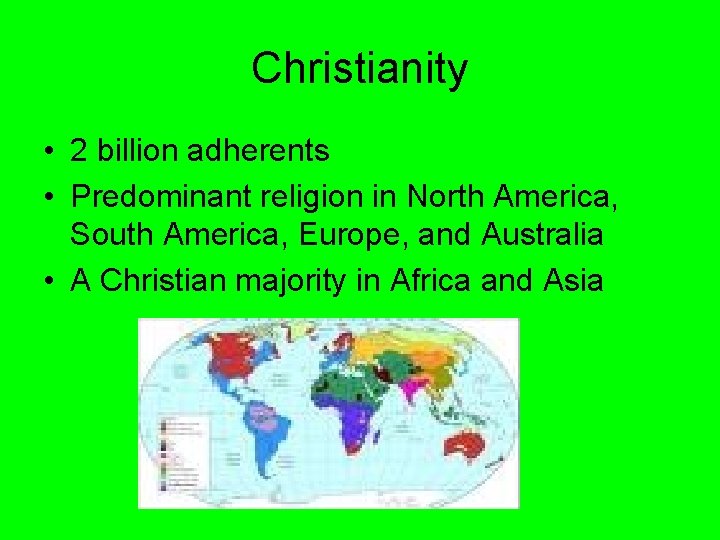
Christianity • 2 billion adherents • Predominant religion in North America, South America, Europe, and Australia • A Christian majority in Africa and Asia
Branches of Christianity • Three major branches – Roman Catholic (52%) – Protestant (21%) – Eastern Orthodox (10%) • 22% do not belong to churches within the three major branches • 90% of people in Western Hemisphere are Christian – 93% are Roman Catholic in Latin America – 23% are Roman Catholic in North America
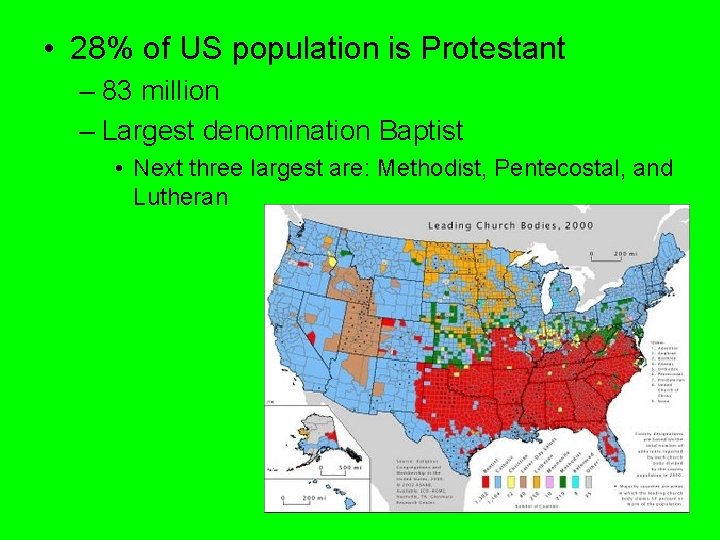
• 28% of US population is Protestant – 83 million – Largest denomination Baptist • Next three largest are: Methodist, Pentecostal, and Lutheran
Smaller Branches of Christianity • Isolated from other branches early in Christianity’s development – Differences in doctrine – Result of Islamic control in SW Asia and North Africa • Africa – Coptic Church of Egypt – Ethiopian Church • Syria – Armenian Church – Important in diffusing Christianity to South and East Asia – Significant role in regional conflicts
Smaller Branches of Christianity • Marionites – Small Christian sect – Prominent role in political unrest – Clustered in Lebanon • The Church of Jesus Christ of Latter-Day Saints – Mormons – 3% of Americans – Clustered in Utah
Origin of Christianity • Jesus is son of God – Placed on earth to teach people how to live according to God’s plan • Founded on teachings of Jesus – – – Born in Bethlehem between 8 and 4 B. C. Died crucified in Jerusalem about 30 A. D. Raised as a Jew Traveled for three years throughout Judea Preached the coming of the Kingdom of God Four gospels of Christian Bible • Matthew, Mark, Luke, and John • Documented miracles and Jesus’ extraordinary deeds • Referred to as Christ, Hebrew for “messiah”
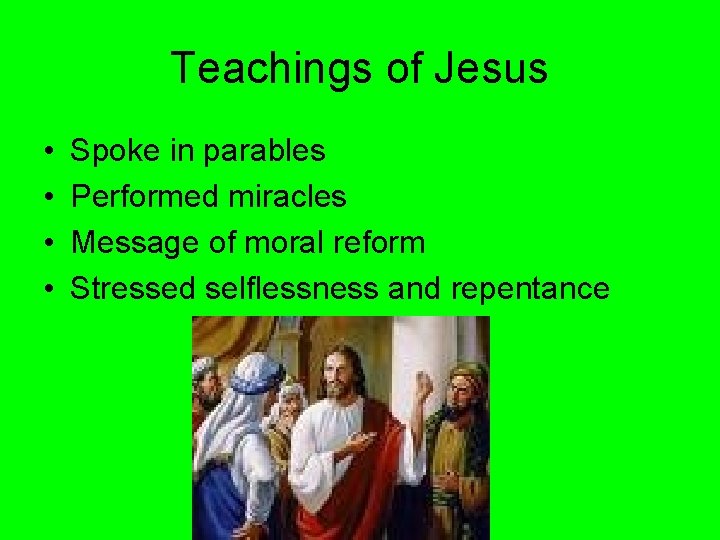
Teachings of Jesus • • Spoke in parables Performed miracles Message of moral reform Stressed selflessness and repentance
• Third year of his mission, he was betrayed by Judas • Shared the Last Supper with his disciples in Jerusalem • Jesus was arrested and put to death • Third day after his death, his tomb was found empty • He was seen by his disciples and others for 40 days until his ascension to heaven • Christians believed that Jesus died to atone for human sins and that he was raised from the dead by God and his resurrection provides people with hope for salvation • God’s strength can overcome the worst sins
The Bible • Divided into New Testament and Old Testament • Contained Hebrew bible in O. T. and gospels of Jesus and his teachings in N. T. • 27 books chosen as 4 gospels for N. T. • 21 epistles and Revelation of Saint John in N. T.
Roman Catholics • Claims most adherents of any denomination • Centered in Rome • Teaches the infallibility of the Pope in interpreting Jesus’ teachings • Power peaked in Middle Ages
Middle Ages • Church controlled sources of knowledge and worked in conjunction with monarchs • Black Death (1300’s) caused Europeans to question role of religion • Division followed in 1400 and 1500’s with Martin Luther, John Huss, John Calvin
• Roman Catholics accept teachings of the Bible – As well as the interpretation by Pope • God conveys his grace to humanity through the seven sacraments – Baptism, Confirmation, Penance, Anointing the sick, Matrimony, Holy Orders, and Eucharist • To Roman Catholics, Eucharist literally and miraculously become the body and blood of Jesus (transubtantiation)
Division of the Church • Roman Empire fell (5 th century) • Constantinople became heart of Byzantine Empire and new center of Christianity – Spread into the Balkan Peninsula • Divide in East/West Christianity recognized in 1054 B. C. when the church split
Eastern Orthodoxy • Compromises the faith and practices of a collection of churches that arose in Eastern part of Roman Empire • Accept seven sacraments but reject added doctrines by Roman Catholic church • Suffered major defeats when: – Turks defeated Serbs in 1389 – Turks took Constantinople in 1453 – Suppression of church of Soviet Union – Today experiencing a revival in former Soviet areas
Protestantism • Originated with principles of Reformation in 16 th century • Movement started with Martin Luther posting 95 theses on a church in Wittenberg on October 31, 1517 • Challenged Roman Catholic theology • Individuals had responsibility for achieving personal salvation through direct communication with God • Grace is achieved through faith rather than through sacraments
Diffusion of Christianity • Combination of relocation, expansion, and hierarchal • First diffused from hearth in Palestine through relocation – Missionaries carried the teachings of Jesus along the Roman Empire’s protected routes • Spread through contagious diffusion through daily contact between believers in the towns and nonbelievers in the surrounding countryside
• Dominance of Christianity throughout Roman Empire during 4 th century by hierarchical diffusion – Acceptance of religion by Emperor – Emperor Constantine encouraged the spread of Christianity in 313 A. D. • Since 1500 A. D. Migration and Missionary Activity – Extended Christianity throughout world – Through permanent resettlement of Europeans (ex. Spain settling Latin America) – Achieved by conversion of indigenous population and by intermarriage
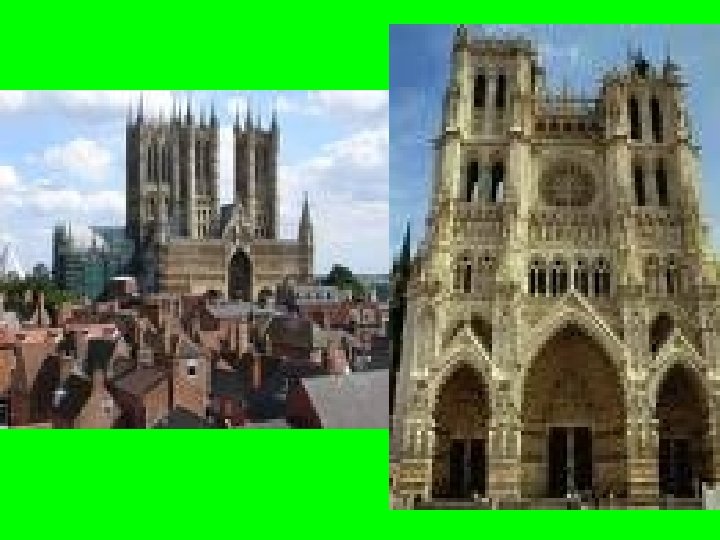
Landscape of Christianity • Cultural landscape of Christianity’s branches reflect the changes in faith over time • Medieval Europe: the cathedral or monastery were the focus of life – Church center of town – All activities (festivals, etc) took place in the shadow of the Church
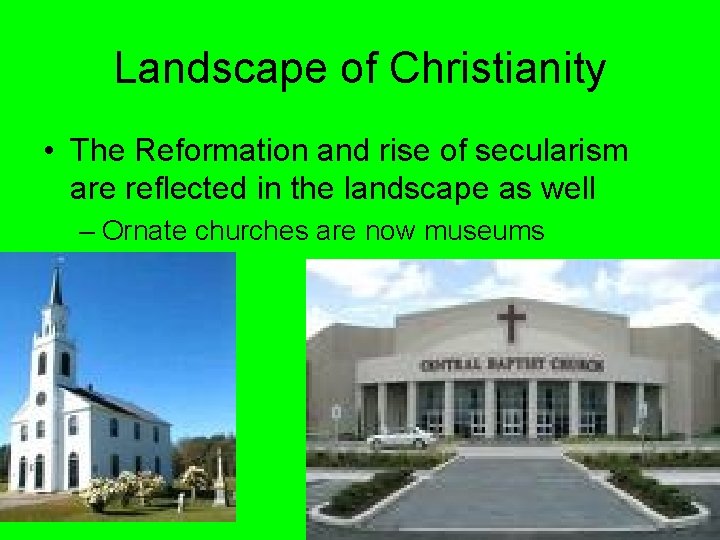
Landscape of Christianity • The Reformation and rise of secularism are reflected in the landscape as well – Ornate churches are now museums
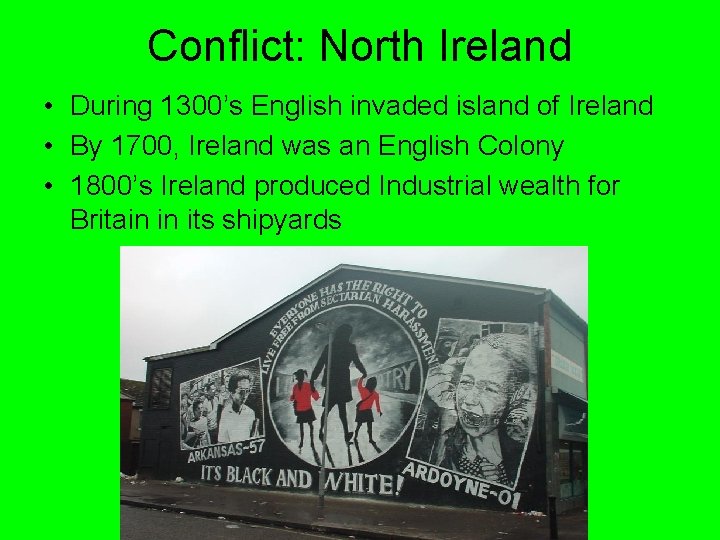
Conflict: North Ireland • During 1300’s English invaded island of Ireland • By 1700, Ireland was an English Colony • 1800’s Ireland produced Industrial wealth for Britain in its shipyards
• During “invasion” Protestant English migrated to Ireland • 1700’s protestants were given power by the English – Irish Catholics were treated harshly – British Protestants took Irish land their right to own property or to participate in government • 1800’s: Irish Catholics began reinvigorating their heritage and strengthen their resolve against the British
• 1900’s Catholics rebelled against Protestant British • North Ireland officially became part of Great Britain • Protestant majority had political and economic advantages • Catholics angered • Irish Republican Army responded by attacking Protestants • British troops brought in 1968
• Catholics and Protestants in Northern Ireland segregated their lives and homes from one another • Marked in cultural landscape – Each group lives in clustered neighborhoods – Celebrates important Catholic/Prot dates – Concept of Activity Space • Each group separated themselves in daily activities • Example: Catholics would only go to Catholic grocery store even if farther than closest store, read different newspapers, etc.
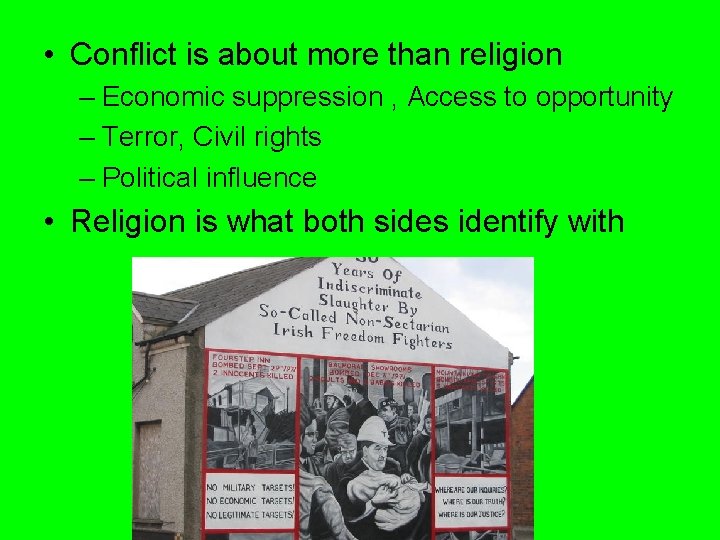
• Conflict is about more than religion – Economic suppression , Access to opportunity – Terror, Civil rights – Political influence • Religion is what both sides identify with
Fundamentalist Christians • Roman Catholic church has resisted innovation – Birth control – Role of women in church bureaucracy – Some sects still hold mass in Latin – Example: Holy Family Church- does not recognize Pope because they do not follow original theology, holds mass in Latin
Protestant Fundamentalists • Range from tiny churches to enormous ware-house style churches • Active in political and social areas – Argue for prayer in school – Teaching of “creationism” – Ban on abortion – Outlawing homosexual activities