
Christianity in the United States of America Map
- Slides: 15
Christianity in the United States of America
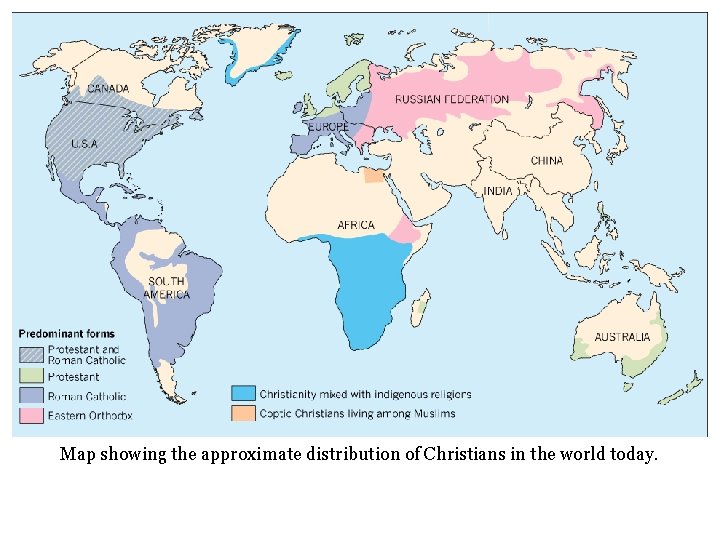
Map showing the approximate distribution of Christians in the world today.
Puritanism & Early US religion • After Henry VIII breaks England away from the Catholic Church, he changes very little • Hardcore people want to change a lot more and purify Anglicanism of it antiquated, Catholic-based traditions – Also buy into some bits of Calvinism (Original Sin, Predestination) – These people become known as Puritans • Annoy the Anglicans enough that, to avoid persecution, England finally suggests they get on a boat and go • Make landfall on in modern day Massachusetts (1620) and settle second English colony and eventually most of New England – Try to set up “heaven on earth; ” preach hellfire and brimstone • cf. Jonathan Edwards’ “Sinners in the Hands of an Angry God” or Hawthorne’s Scarlet Letter – Base much of law around strict reading of scripture – Incredibly intolerant of other religions (and schisms within their own) – Will ease up over the next 100 years • State of Maryland later founded as safe haven for Catholics • Ironically the Southern US was settled not for religious reasons but economic opportunity
Freedom of Religion • Church comes under further critique during the Enlightenment – By the end, much of Europe’s educated has stopped literally believing the word of the Bible • Once the states decide to become a unified country, not 13 countries of their own, the question of freedoms arises • Most of the leadership of the three most populous states— Virginia, Pennsylvania, and Massachusetts—are students of new Enlightenment ideas coming out of Europe – Most are also deist and therefor not religious – See history of religious conflict in Europe and want to avoid it – Buy into Voltaire: • Religion is used as a fog to make personal and political gains • Deism becomes the order of the day among the elite; Educated begin to looks at what the Bible “really” says (i. e. Jefferson Bible) based on “logic” • Virginia, led by Thomas Jefferson, adopts the Virginia Statutes of Religious Freedom which allows people to worship whom/whatever they want – Become model for the First Amendment
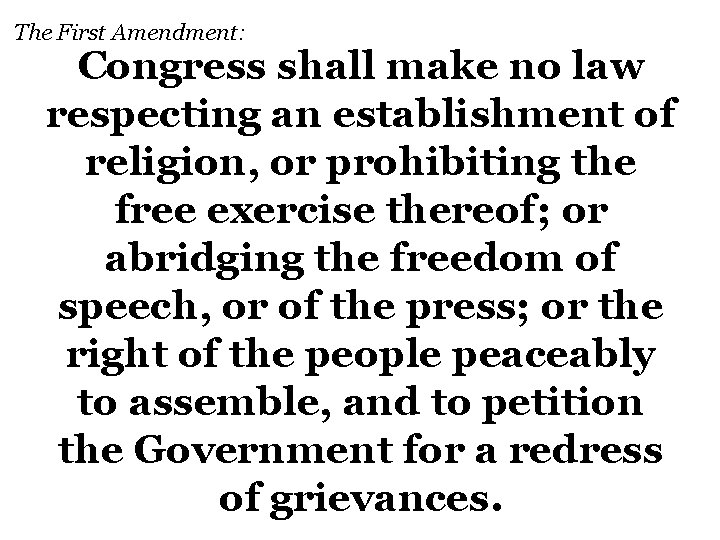
The First Amendment: Congress shall make no law respecting an establishment of religion, or prohibiting the free exercise thereof; or abridging the freedom of speech, or of the press; or the right of the people peaceably to assemble, and to petition the Government for a redress of grievances.
Second Great Awakening from Writings of the Wesley brothers (pp. 1193 -1197) • Most of US is still Christian; despite lack of state religion – Way more Protestants than Catholic • During early 19 th century series of religious revivals begin in Midwest and spread through rest of the US – Subscribed to the idea all people could be saved through revival, repentance, and conversion – Involving traveling ministers preaching sermons in large tents – Mass conversions common; church membership soars – Dovetails with adventurous idea of Manifest Destiny • Most successful (ie largest growth) was Methodist, particularly in South – Offshoot of Anglicanism—apostate and lapsed Anglicans convert in droves – Many slaves are also influenced during this era, forming their own churches (when possible) like the AME • These will become bastions of the black community after the Civil War • Baptist and Mormonism (both unique) to America founded now • Baptists take root in South, Mormons in the West • Examine, using direct evidence, the Wesley brothers’ new ideas about Christianity and a Christians role in the world and relationship with God.
• The AME Founded in 1816, but traces its roots back to 1787 this is the most popular historic black church in the United States – Stands for African Methodist Episcopalian • African because it was founded by former Africans, Methodist in the denomination it affiliates with, but Episcopalian with its hierarchy and systems of order it uses. • Founded to break away from white Methodists (slavery was a touchy subject, etc. )—>first Protestant church founded along racial lines • Main beliefs are similar to other parts of Christianity—summed up in the Apostle’s Creed —but there is emphasis on Africa’s impact on the religion as well as deconstructing white, imperialist notions of religion and Christianity. • Mainly restricted to the North and Midwest prior to the Civil War and fairly small – South wouldn’t let this many slaves congregate in one place • Most important movement is during Reconstruction serves as a pillar of the “new” black community; grows exponentially in size then – Becomes a symbol of what was oppressed earlier that now the Southerns have to allow – Eventually some black southerns split into their own form of S. Baptism • Now it is one of the most popular religion amongst black Americans, with 13 districts based in the US and 7 in Africa (2. 5 million members), and while it notes it is not exclusively for people of black and/or African descent 99% of members are that – As of 2012 it’s in full communion with the United Methodist Church • Perfect example of impact religion can have on community. Discuss: why? • This is what was attacked by Dylan Roof in Charleston in 2015
The Church of Jesus Christ of Latter-Day Saints • After seeing the religions of the Second Great Awakening and pondering which one to join, Joseph Smith had a vision from God—first time 1820 Manchester, NY • Vision told him where to find a series of gold plates which would tell him the next divine revelation of Christianity – Known as the Book of Mormon – Believed to be uncorrupted (unlike the Old and New Testaments which lost a lot in translation and were miscopied) – Published in 1830 • Smith and his followers face incredible persecution, eventually deciding to head west to find a place to practice their religion in peace • Move originally to Illinois • Smith killed in a riot in Carthage—followers decide to move more • Brigham Young leads remaining followers to Utah, which becomes the epicenter of the LDS church
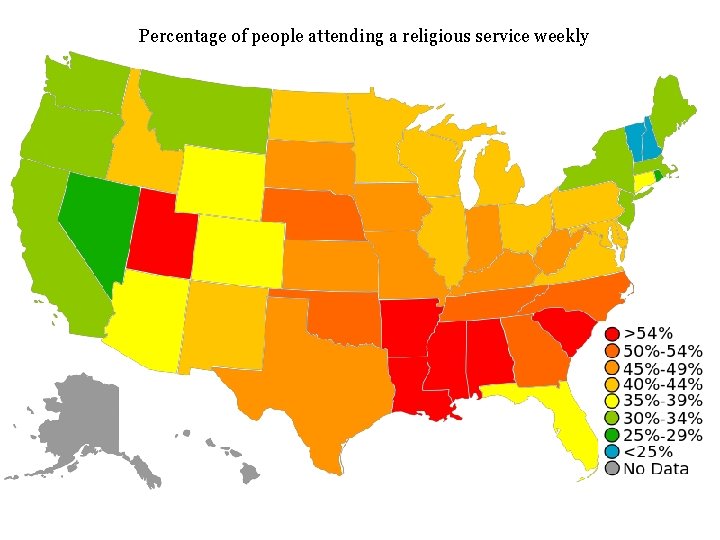
Percentage of people attending a religious service weekly
19 th century Christianity in Europe & USA • By 19 th century tacit divide between Catholics and Protestants still exists – Protestants have started to pride themselves on the so-called Protestant Work Ethic (i. e. if they work really hard everything will be better) • Very generally, Protestants tend to exist in Northern and Western Europe—richer Europe—and Catholics are Eastern and Southern— poorer Europe • Social Darwinism only fuels this claiming Protestants are hardened by their work ethic and geography and therefor superior – Christianity becomes seen as the sympathetic outlet to “help” the less fortunate (cf. Irish Potato Famine, White Man’s Burden, etc. ) • People are told to be Christian but now that means tacit help for the poor, not the missionary and service days of earlier – Many Christians claim to be “going through the motions” • Old social disparities and ceilings lead to mass Catholic immigration to the New World – most notably NYC and Boston, Irish and Italians – Adds to religious diversity of the US
Religion in American politics • Depending on Po. V this has been happening for a while • cf. City upon a Hill, Massachusetts Bay, etc. • Yet in Treaty of Tripoli signed 1797: “The government of the United States of America is not in any sense founded on the Christian religion. ” • Yet Federalist repeatedly accused Jefferson of being an atheist in 1800… • As the country become more sectionally divided, religion (and some old world religious squabbles) tacitly entered life • Particularly involving Irish and Italian Catholics in the NE—part religious, part simple nationalism/racism • That coupled, with increase in poverty as seen during industrial urbanization, led to Christianity becoming a political focus for many • Actually began in England with the Whig Party, Gladstone and Victoria, all of whom used text from Jesus to justify government help for the poor • Eventually this turns to the idea of Prohibition (nb: the US in the only country in the history of humanity to actively ban its currently most intoxicating substance) – First major example since the ratification of the First Amendment of the country as whole legislating morality • Begun by the Woman’s Christian Temperance Union • Pitted regional and religious differences—mainly Protestant Rep. in the North and Dems in the South in favor (Catholics and German Lutherans opposed) • General idea comes to an early headway most notably in Scopes
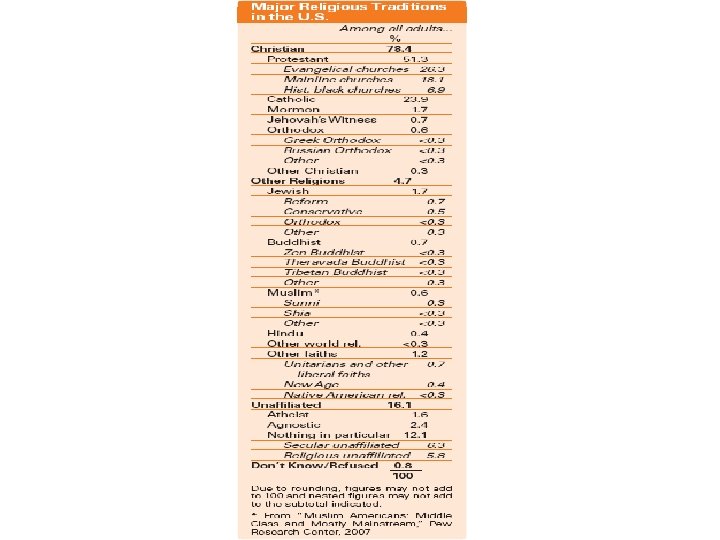
America, a Christian nation? • For many, the “mechanical” religions on a weekly Sabbath was common through the 1950 s – This means you had a glut of people who went because it was, “the right thing” or they “felt guilty” but were not into the beliefs—but they couldn’t say that • Changes with social liberalization of the 1960 s – New movements in science, social sciences, the arts and social acceptance allow this • Americans start to care a lot less about each others religion—no more “I won’t hire Jews or Catholics” – Key denominations like Catholicism also undergo international reforms (Vatican II) – Rest of the Western World also sees a dramatic decline in attendance and involvement in Christianity – Many immigrants tend to focus more on social acceptance and less on religious preservation • Reaction begins to occur in 1980 s (neo-cons and Moral Majority) and compound with “family values movement of the 1990 s – Religious Renaissance is generally based in and around GOP – Make certain political issues religious (i. e. abortion) • Today America is as divided religiously as it is politically Northeast and West less religious, save Utah and South and Midwest more religious
The First Amendment: Congress shall make no law respecting an establishment of religion, or prohibiting the free exercise thereof; or abridging the freedom of speech, or of the press; or the right of the people peaceably to assemble, and to petition the Government for a redress of grievances.