
Chris Schmidt istockphoto The German Health Care System
- Slides: 11
©Chris Schmidt - istockphoto The German Health Care System and the Federal Joint Committee (G-BA) Dr. Tilo Mandry – Health – Made in Germany – Santiago de Chile 26. 12. 2021
Basic principles of the German health care system Germany has about 82 million inhabitants • 72 million (50 million members) are covered by statutory health insurance (remaining are privately insured) • currently approx. 190 (+50) insurance companies www. gtai. com
Basic principles of the German health care system II today‘s characteristics: • share of premiums between employee and employer • self-administration / self-government • Mo. H sets general rules, details regulated by selfgoverning bodies • free choice of sickness-funds and providers • comprehensive benefit catalogue • opting out of statutory insurance above annual income of 49, 000€ for three years in a row (one year in future? ) www. gtai. com
Basic principles of the German health care system III § today‘s characteristics (cont. ): § working solidarity principle, i. e. § no surcharge for age or risk § low salary = low payment § contributions for unemployed & welfare recipients paid by public funds § highly developed infrastructure, no waiting lists in hospitals § problems: aging society, innovations, costs (> especially for hospitals and pharmaceuticals) www. gtai. com
The Federal Joint Committee (G-BA) G-BA is 1. the main decision-making body in the German health care system, 2. authorised by law to issue legally binding directives but not a subordinate authority 3. Legal Basis: Social Code (Book V) 4. established in the year 2004, but predecessor committees dating back to the 1920 s, 5. represents physicians, hospitals, sickness funds and patients. www. gtai. com
What does the G-BA do? The G-BA issues directives and guidelines. It thus determines the benefit package for: 1. Ambulatory and hospital care 2. Dental care 3. Psychotherapy 4. Diagnostic and therapeutic procedures and interventions 5. Quality assurance 6. Disease management programmes for chronic diseases 7. Pharmaceuticals, Vaccines and Medical Devices 8. … www. gtai. com
What does the G-BA NOT do? 1. Contracts between single payers (e. g. sickness funds) and providers or manufacturers 2. Regulation of premiums 3. Risk adjustment among the sickness funds 4. Payment of doctors 5. Determination of the amount paid for procedures, interventions or pharmaceuticals 6. DRGs www. gtai. com
“Who” is the G-BA? • Health care providers Federal association of office-based doctors Federal hospitals’ associaton • Health care payers Federal association of sickness funds Representatives of sickness funds • Three Impartial Members • Patients’ representatives Non-voting members www. gtai. com
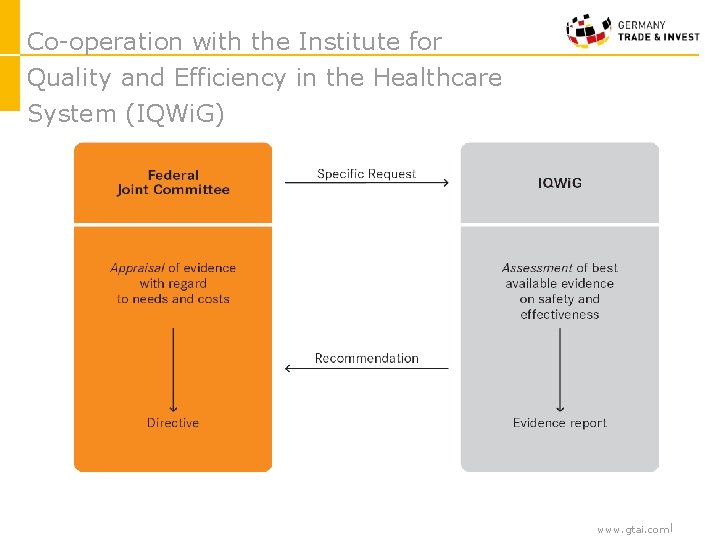
Co-operation with the Institute for Quality and Efficiency in the Healthcare System (IQWi. G) www. gtai. com
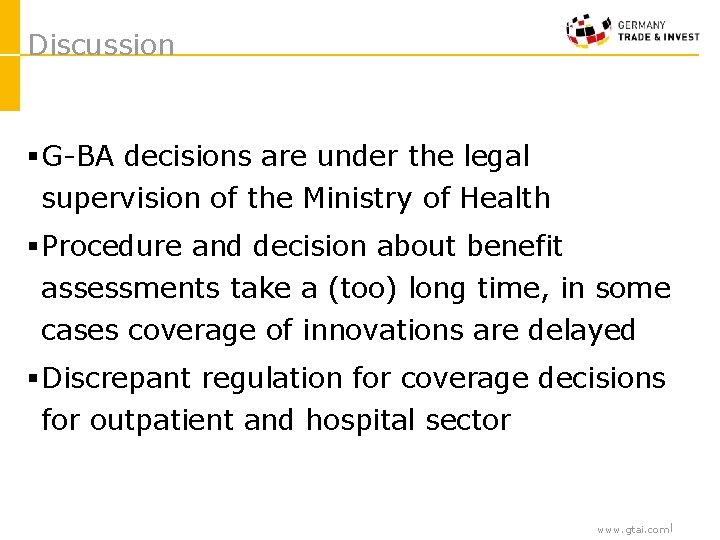
Discussion § G-BA decisions are under the legal supervision of the Ministry of Health § Procedure and decision about benefit assessments take a (too) long time, in some cases coverage of innovations are delayed § Discrepant regulation for coverage decisions for outpatient and hospital sector www. gtai. com
©Chris Schmidt - istockphoto Thank you! tilo. mandry@gtai. com www. health-made-in-germany. com