
CHPTER SEVEN The CrossMatch compatibility testing CH Acknowledgements
CHPTER -SEVEN The Cross-Match (compatibility testing) CH
Acknowledgements n Addis Ababa University n Jimma University n Hawassa University n Haramaya University n University of Gondor n American Society for clinical Pathology n Center for Disease Control and Prevention Ethiopia
Content Ø Ø Ø Cross matching Types of Cross Match Steps for compatibility testing Choice of Blood for cross-match Procedure for cross-match
Learning Objectives At the end of this chapter, the student will be able to: Ø Explain the cross-match and its primary purpose. Ø Describe the constituents of the major and minor cross match. Ø Select appropriate blood for cross-match. Ø List the types of antibodies that can be encountered at various phases of a cross-match. Ø Perform cross matching
7. 1 Cross-Matching n n n It is a test to determine the compatibility between recipient’s blood and donor’s blood. It is a procedure performed before transfusion to select donor’s blood that will not cause any adverse reaction, (hemolysis /agglutination) The test is important to see whethere is danger or not if the donor’s blood is transfused to the recipient. ¨ helps the patient to receive maximum benefit from the transfusion of red cells

Cross-Matching… n Main purpose is to prevent a transfusion reaction that may result due to: ¨ Unexpected antibodies in the patient’s /donor’s serum ¨ Some ABO incompatibilities and ¨ Technical or labeling errors (clerical errors)
Cross Matching… n Transfusion reaction – is the term used to describe the clinical effects caused by the destruction of red cells of recipient by the donor’s antibodies or a donor’s red cell’s by the recipient antibodies during an incompatible transfusion.
Cross-matching… n Will not: ¨ prevent immunization of the patient ¨ guarantee ¨ detect normal survival of transfused erythrocytes all unexpected antibodies in a patient’s serum.
7. 2 Types of Cross Match Major and Minor crossmatch Major cross-match: n involves mixing recipient’s serum with the donor’s red cells. n is much more critical for assuring safe transfusion than the minor compatibility test. n called major b/c the Abs in the recipient’s serum are most likely to destroy the donor’s RBC
Types…. Minor cross match: n Involves mixing the donor’s serum with patient’s red cells n Called minor because ¨ any Ab in the donor’s serum will be diluted by the large volume of the recipient’s blood ¨ the destructed RBCs of the patient may be compensated by the transfused RBC of the donors

7. 3. Steps for compatibility testing n Accurate Patient Identification n Proper sample collection and handling n Review of the recipient’s past blood bank records n Careful ABO/Rh determination n Antibody screening of the recipient (cross
Steps for… n In cases when the recipient possess a clinically significant Antibody, donor units must be: ¨ Screened for the corresponding Ag and should be negative ¨ Cross- matched
Steps for…. n Finally, during the actual transfusion : ¨ careful ¨ post observation of the recipient’s vital signs and transfusion hematocrit and Heamoglobin levels must be considered.
7. 4. Choice of Blood for cross-match n The blood selected for cross-match should be of the same ABO and Rh (D) group as that of the recipient. n However, Rh positive recipients may receive either Rh positive or Rh negative blood.
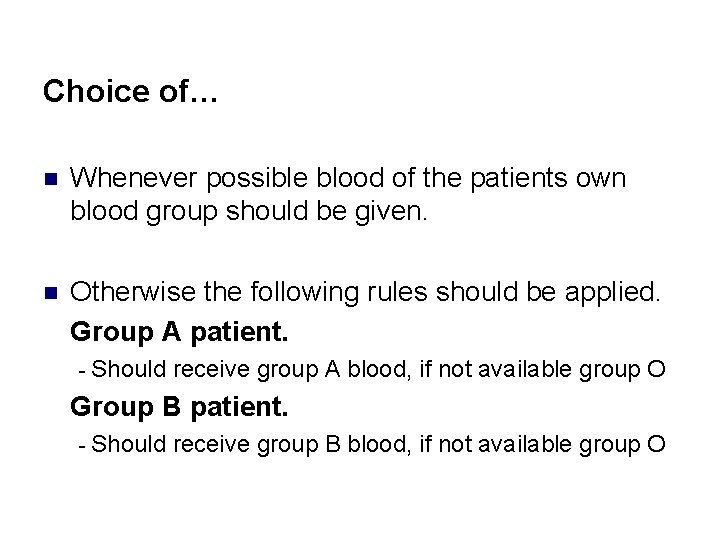
Choice of… n Whenever possible blood of the patients own blood group should be given. n Otherwise the following rules should be applied. Group A patient. - Should receive group A blood, if not available group O Group B patient. - Should receive group B blood, if not available group O
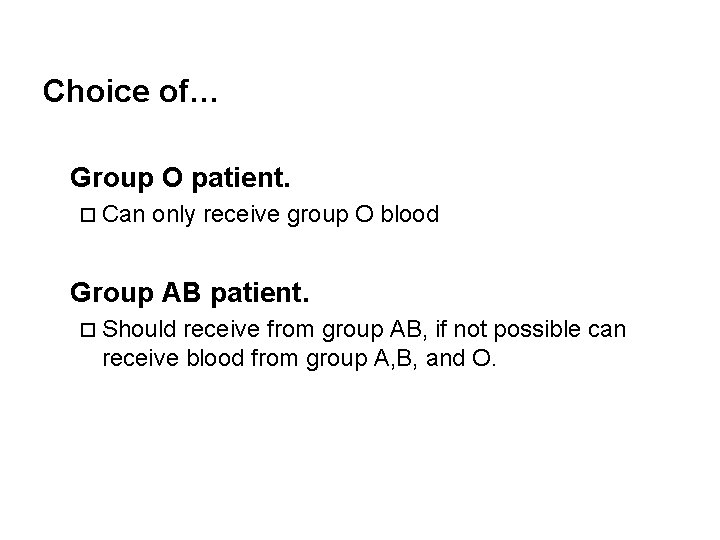
Choice of… Group O patient. ¨ Can only receive group O blood Group AB patient. ¨ Should receive from group AB, if not possible can receive blood from group A, B, and O.
Choice of… n When cross-matching is carried out, the serum is tested against the cells. n The serum should be fresh, that is not more than 48 hours old, to make sure that it contains complement.
Choice of… n When deciding on methods for cross-matching, the following conditions are required for Ag-Ab reactions. ¨ The right Temperature. ¨ Suitable surrounding medium ¨ Antigen-Antibody ratio etc. .
Choice of… n The safe cross-matching of blood requires that the donor’s cells be mixed with the patient’s serum in three separate tubes, using : 1. Saline 2. Albumin 3. Anti-human globulin reagents
1. Saline tube n n n The red cells from the donor are suspended in saline and mixed with the patient’s serum. show the presence of any complete antibodies Agglutination in the saline tube is usually caused by: anti-A or anti-B antibodies and ¨ Occasionally by Lewis, MNSs, Lutheran and kell antibodies. ¨
2. Albumin tube n n The red cells from the donor’s suspended in saline, are mixed with the patient’s serum, and albumin is added. The tube is incubated at 370 C shows the presence of any incomplete antibodies the antibodies react in albumin or any other protein medium
Albumin tube… n Agglutination in the albumin tube is often caused by: the rhesus antibodies, ¨ Lewis, MNSs, Lutheran and P antibodies, and ¨ occasionally by anti-kell. ¨ n Reaction caused by anti- A or anti- B antibodies usually occur in albumin as well as in saline.
3. Anti-human globulin tube n A more concentrated suspension of red cells is mixed with the patient’s serum and incubated at 370 C and then AHG is added. n A postive test detects the presence of antibodies of: ¨ rhesus, n kell, kidd, S and Lewis Anti globulin is essential for detection anti-Duffy
7. 5. Procedure for cross-match 7. 5. 1. Standard cross-match n Is cross-match that is performed in three tubes (Saline, albumin and AHG) within 45 to 60 minutes n Clinical significance detects unexpected (irregular) antibodies in the recipient/ donor serum
Cross match (Standard)… Principle n Serum of the recipient / donor is tested against the red cells of the donor/ recipient under different conditions in order to establish their compatibility
Cross match…. Type of specimen n n Serum (plasma) not older than 48 hrs Washed cells (20 -30% and 2 -5%)
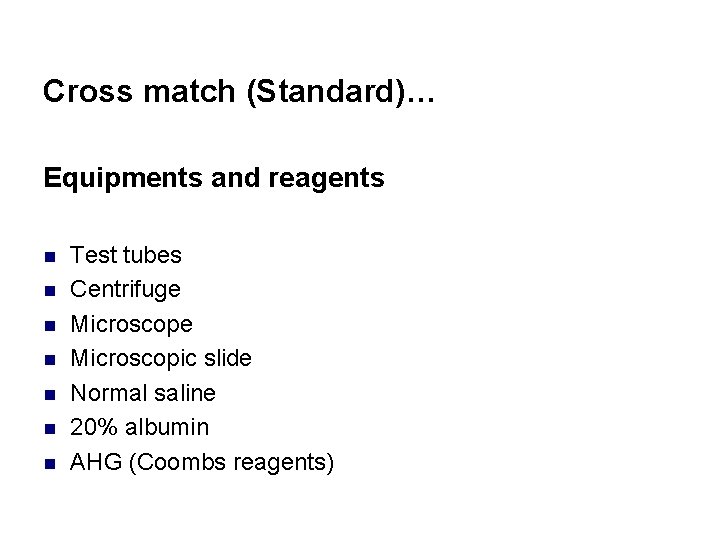
Cross match (Standard)… Equipments and reagents n n n n Test tubes Centrifuge Microscopic slide Normal saline 20% albumin AHG (Coombs reagents)
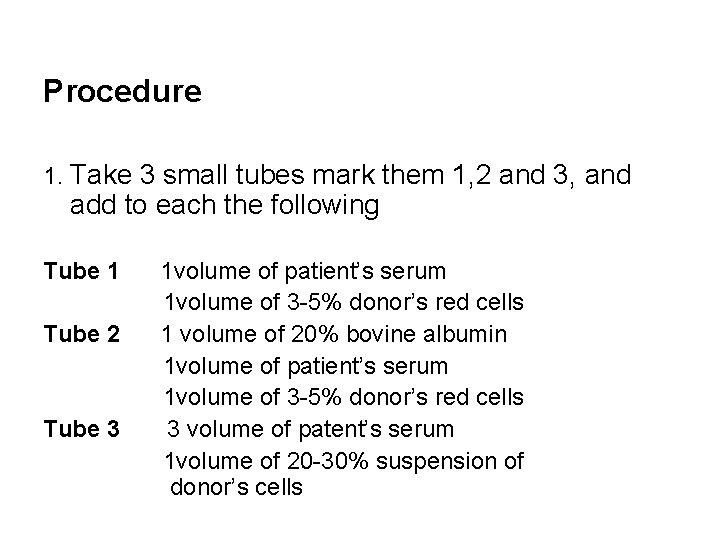
Procedure 1. Take 3 small tubes mark them 1, 2 and 3, and add to each the following Tube 1 Tube 2 Tube 3 1 volume of patient’s serum 1 volume of 3 -5% donor’s red cells 1 volume of 20% bovine albumin 1 volume of patient’s serum 1 volume of 3 -5% donor’s red cells 3 volume of patent’s serum 1 volume of 20 -30% suspension of donor’s cells
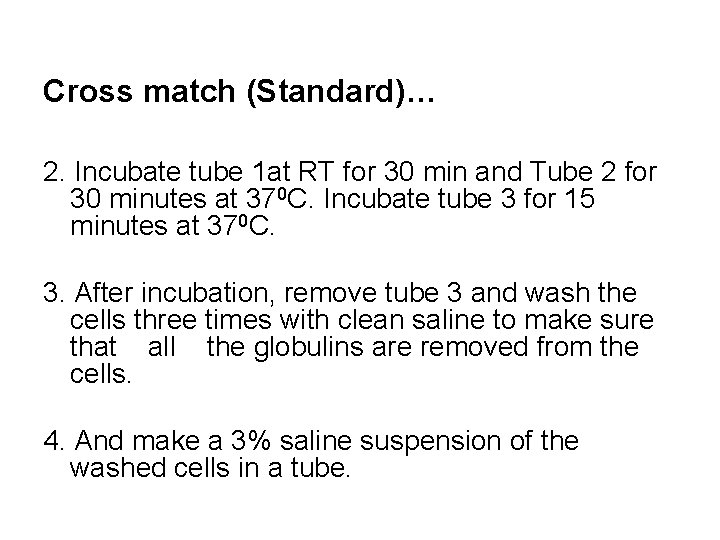
Cross match (Standard)… 2. Incubate tube 1 at RT for 30 min and Tube 2 for 30 minutes at 370 C. Incubate tube 3 for 15 minutes at 370 C. 3. After incubation, remove tube 3 and wash the cells three times with clean saline to make sure that all the globulins are removed from the cells. 4. And make a 3% saline suspension of the washed cells in a tube.
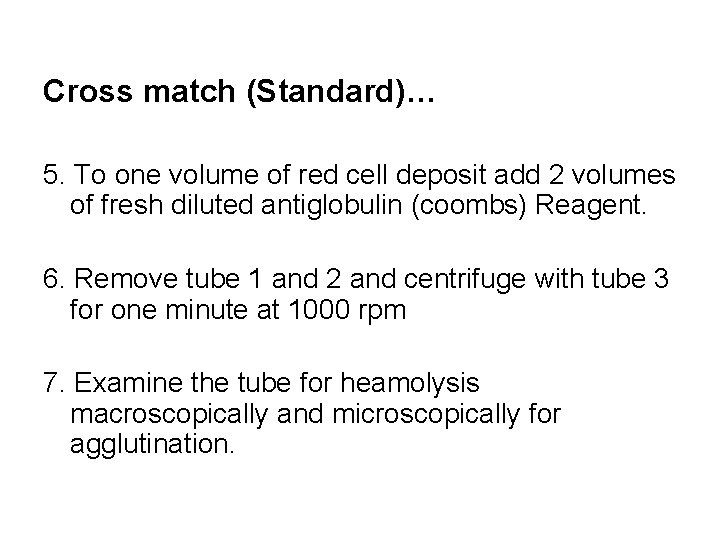
Cross match (Standard)… 5. To one volume of red cell deposit add 2 volumes of fresh diluted antiglobulin (coombs) Reagent. 6. Remove tube 1 and 2 and centrifuge with tube 3 for one minute at 1000 rpm 7. Examine the tube for heamolysis macroscopically and microscopically for agglutination.
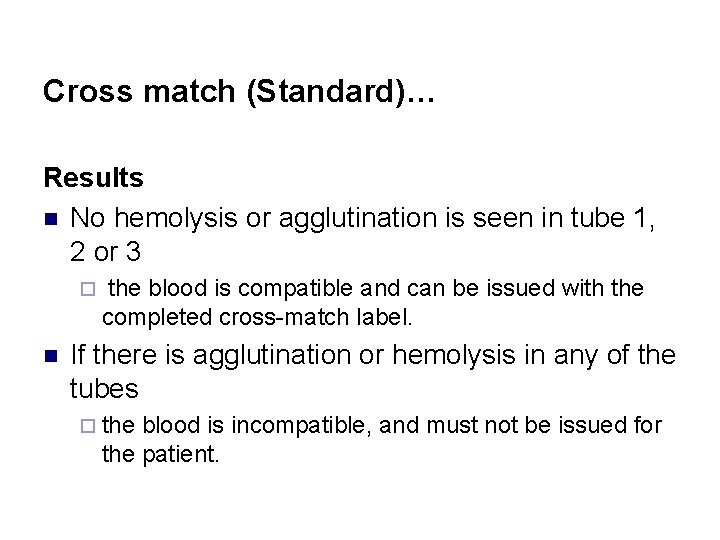
Cross match (Standard)… Results n No hemolysis or agglutination is seen in tube 1, 2 or 3 ¨ n the blood is compatible and can be issued with the completed cross-match label. If there is agglutination or hemolysis in any of the tubes ¨ the blood is incompatible, and must not be issued for the patient.
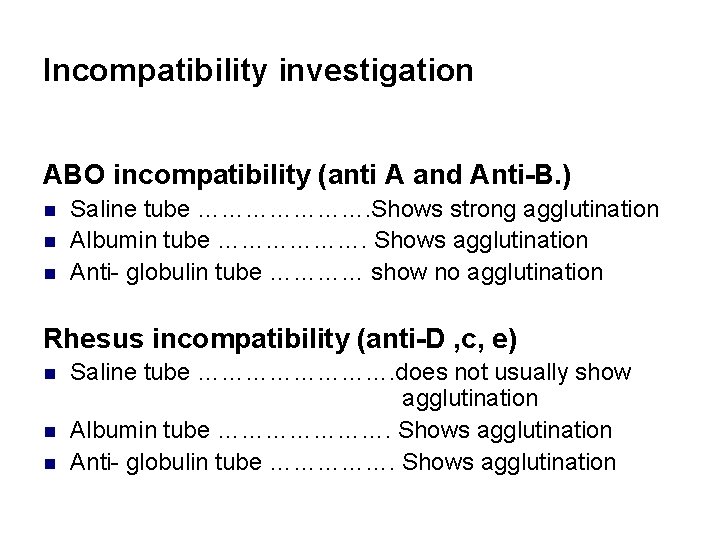
Incompatibility investigation ABO incompatibility (anti A and Anti-B. ) n n n Saline tube …………………. Shows strong agglutination Albumin tube ………………. Shows agglutination Anti- globulin tube ………… show no agglutination Rhesus incompatibility (anti-D , c, e) n n n Saline tube …………. does not usually show agglutination Albumin tube …………………. Shows agglutination Anti- globulin tube ……………. Shows agglutination
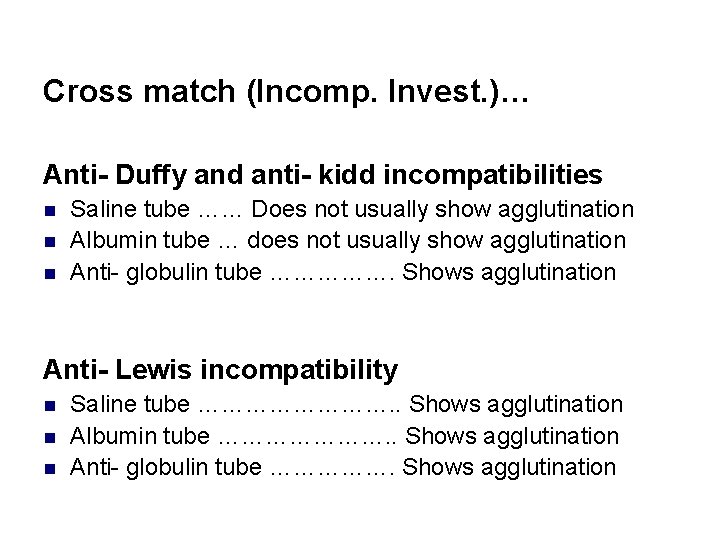
Cross match (Incomp. Invest. )… Anti- Duffy and anti- kidd incompatibilities n n n Saline tube …… Does not usually show agglutination Albumin tube … does not usually show agglutination Anti- globulin tube ……………. Shows agglutination Anti- Lewis incompatibility n n n Saline tube …………. . Shows agglutination Albumin tube …………………. . Shows agglutination Anti- globulin tube ……………. Shows agglutination
7. 5. 2 Emergency cross match n Performed when there is no enough time to perform the standard cross match n Takes about 25 to 30 minutes and n Does not include antiglobulin test.
Cross match (Emergency)… Principle n Serum of the recipient / donor is tested against the red cells of the donor/ recipient in saline and albumin medium in order to establish their compatibility
Cross match (Emergency)… Type of specimen ¨ Serum (plasma) not older than 48 hrs ¨ Washed cells (2 -5%)
Cross match (Emergency)… Equipments and reagents n n n Test tubes Centrifuge Microscopic slide Normal saline 20% albumin
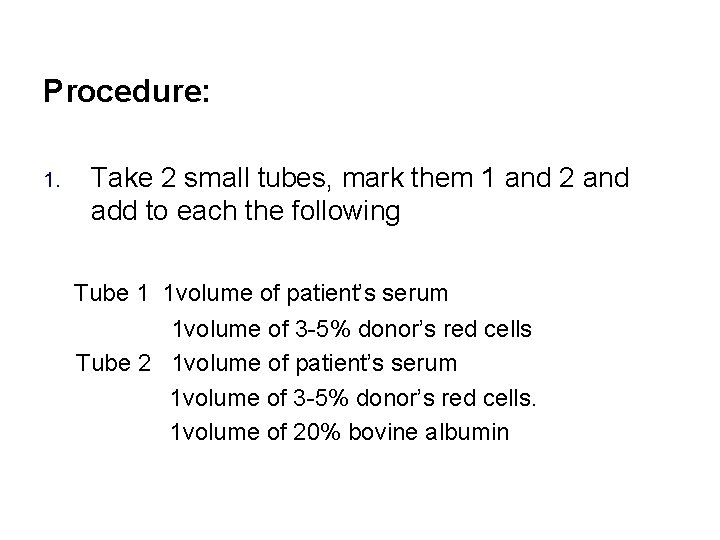
Procedure: 1. Take 2 small tubes, mark them 1 and 2 and add to each the following Tube 1 1 volume of patient’s serum 1 volume of 3 -5% donor’s red cells Tube 2 1 volume of patient’s serum 1 volume of 3 -5% donor’s red cells. 1 volume of 20% bovine albumin
Cross match (Emergency)… 2. Leave tube 1 at room temp for 15 minutes incubate tube 2 for 15 minutes at 370 C. 3. Centrifuge both tubes for one minute at 1000 rpm/min 4. Examine the tubes macroscopically for hemolysis and microscopically for agglutination.
Cross match (Emergency)… Results n If no hemolysis or agglutination is seen in either tube 1 or 2 ¨ the blood is compatible and can be issued with the emergency cross match. n If agglutination or hemolysis is seen in either of the tubes ¨ the blood is incompatible and must not be issued for the patient.
7. 5. 3. Rapid direct slide cross match (Request for un cross matched blood ) n Takes only 3 or 4 minutes n Plasma is used instead or serum. n Not safe and must only used in extreme emergencies n Standard cross match should be carried out while the transfusion is in progress.
Procedure 1. Take 2 volume of patient’s plasma on a slide 2. Add 1 volume of donor’s whole blood of the same group as the patient and mix. 3. Leave for 2 minutes and examine microscopically for agglutination
Cross match (Rapid)… Results n If the cells show agglutination the blood must not be given and will usually indicate that the wrong ABO group blood is being cross marched.
Cross match (Rapid)… Sources of errors in cross-matching n Rouleaux n Auto agglutinins n Infected donor cells n Anti- A 1 n Over centrifugation n Dirty glass wares etc. .
Review Questions 1. What is cross-matching? 2. What is the purpose of cross-matching? 3. List the types of cross-match with their constituents 4. List the stages of cross-match and their respective importance in antibody detection.
References 1. Immunohematology for medical laboratory science students, Yayehyirad T. and Misganaw B. , Upgraded lecture note. 2008 2. Basic and applied concepts of Immunohematology, 2 nd ed. Kathy D. Blaney and Paula R. Howard, 2009 3. Blood banking and transfusion medicine: basic principles and practice. Christopher D. Hilliyer et al. , 2 nd ed. 2007. 4. Safe blood donations, Module 1 WHO. 2002 46
References… 5. Screening for HIV and other infectious agents, Module 2, WHO. 2002 6. Blood group serology. Module 3 WHO. 2002 7. Guidelines and principles for safe blood transfusion practice, Introductory module. WHO 2002. 8. Immunohematology: Principles and Practice Quinley. 2 nd ed. 1998. 9. AABB Technical Manual. 15 th Edition. 2005 47
- Slides: 47