
CHPTER FOUR Other Blood Group System CH Acknowledgements
CHPTER -FOUR Other Blood Group System CH
Acknowledgements n Addis Ababa University n Jimma University n Hawassa University n Haramaya University n University of Gondor n American Society for clinical Pathology n Center for Disease Control and Prevention Ethiopia
Content Ø Ø Ø Ø 3 Kell Blood Group system Duffy Blood Group system Lutheran blood group system Lewis Blood group system I blood group system P blood group system MNSs blood group system Kidd (JK) blood group system
Learning objectives At the end of this chapter, the student will be able to: Ø Briefly explain the characteristics and biochemistry of other blood group antigen. Ø Name the type of immunoglobulin class produced in other blood group system and their reactivity. Ø Compare and contrast the characteristics of antibodies in other blood group system. 4
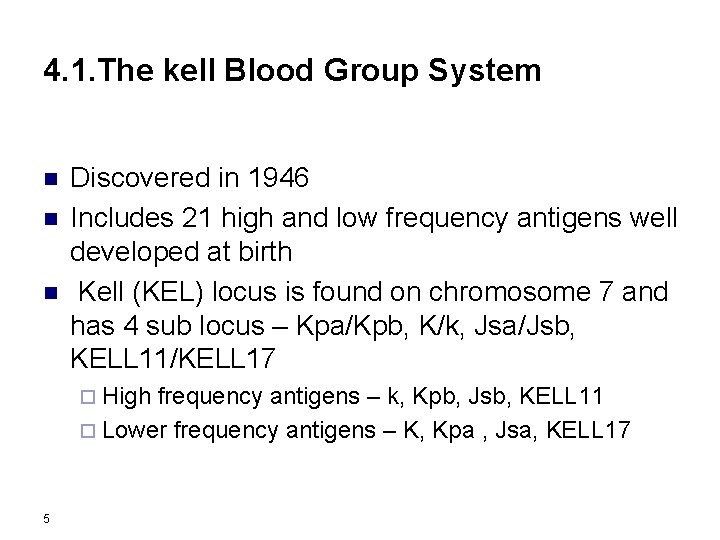
4. 1. The kell Blood Group System n n n Discovered in 1946 Includes 21 high and low frequency antigens well developed at birth Kell (KEL) locus is found on chromosome 7 and has 4 sub locus – Kpa/Kpb, K/k, Jsa/Jsb, KELL 11/KELL 17 ¨ High frequency antigens – k, Kpb, Jsb, KELL 11 ¨ Lower frequency antigens – K, Kpa , Jsa, KELL 17 5
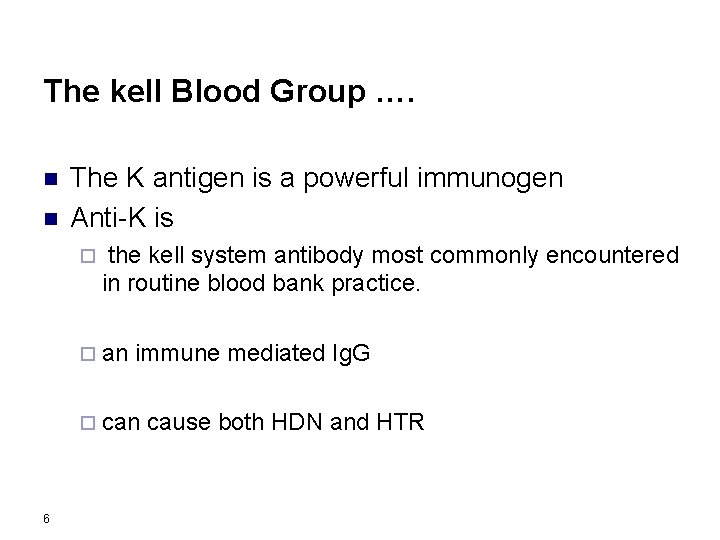
The kell Blood Group …. n n The K antigen is a powerful immunogen Anti-K is ¨ the kell system antibody most commonly encountered in routine blood bank practice. ¨ an immune mediated Ig. G ¨ can 6 cause both HDN and HTR
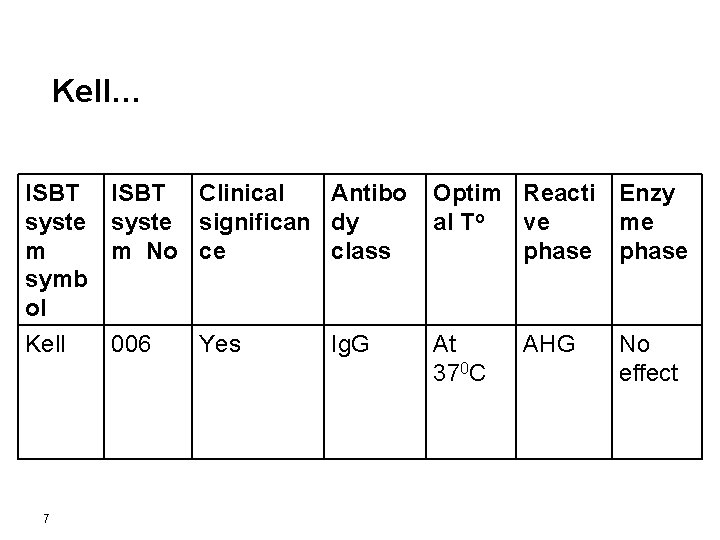
Kell… ISBT syste m symb ol Kell 7 ISBT Clinical Antibo syste significan dy m No ce class Optim Reacti al To ve phase Enzy me phase 006 At 370 C No effect Yes Ig. G AHG
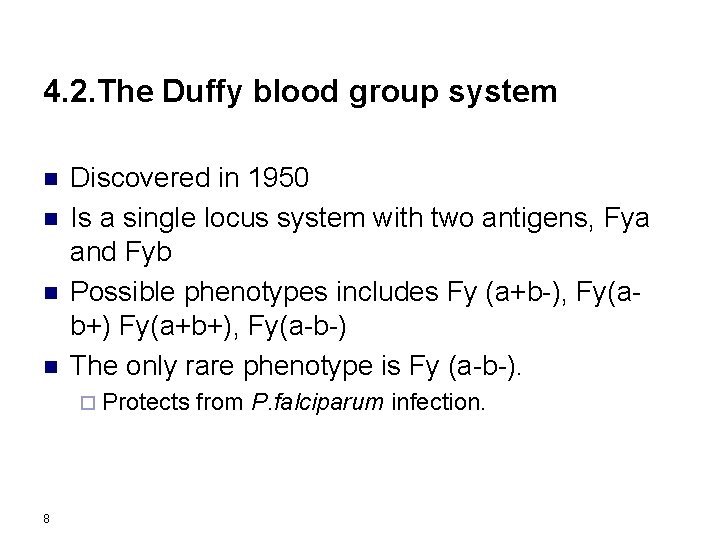
4. 2. The Duffy blood group system n n Discovered in 1950 Is a single locus system with two antigens, Fya and Fyb Possible phenotypes includes Fy (a+b-), Fy(ab+) Fy(a+b+), Fy(a-b-) The only rare phenotype is Fy (a-b-). ¨ Protects 8 from P. falciparum infection.

Duffy… n Anti-Fya and anti-Fyb are the antibodies encountered in this Fy sytem with anti-Fya being seen much more commonly. n These antibodies usually are Ig. G n Even though rare antibodies of this system are associated with mild HDN and HTR 9
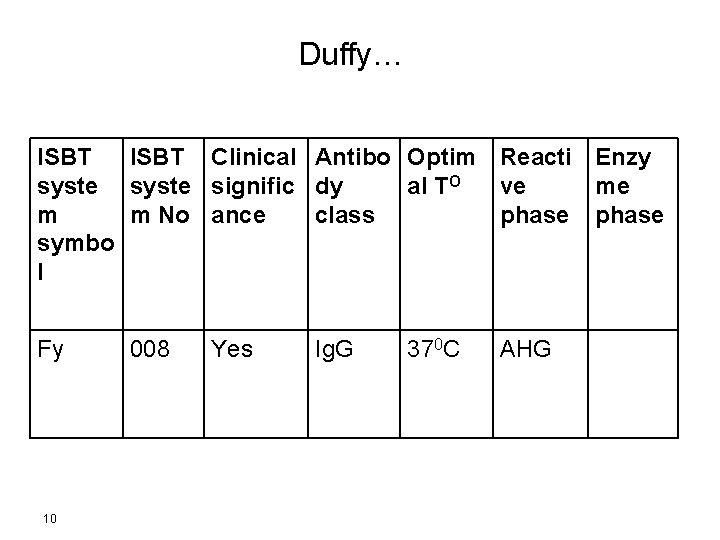
Duffy… ISBT Clinical Antibo Optim Reacti Enzy syste signific dy al TO ve me m m No ance class phase symbo l Fy 10 008 Yes Ig. G 370 C AHG
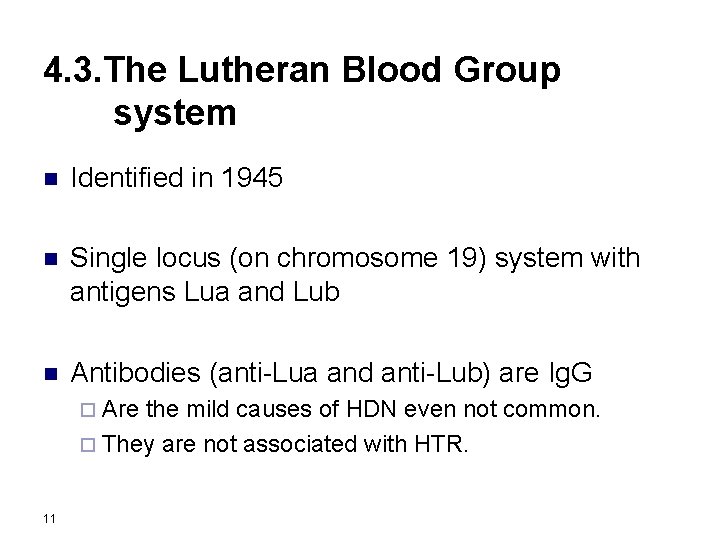
4. 3. The Lutheran Blood Group system n Identified in 1945 n Single locus (on chromosome 19) system with antigens Lua and Lub n Antibodies (anti-Lua and anti-Lub) are Ig. G ¨ Are the mild causes of HDN even not common. ¨ They are not associated with HTR. 11
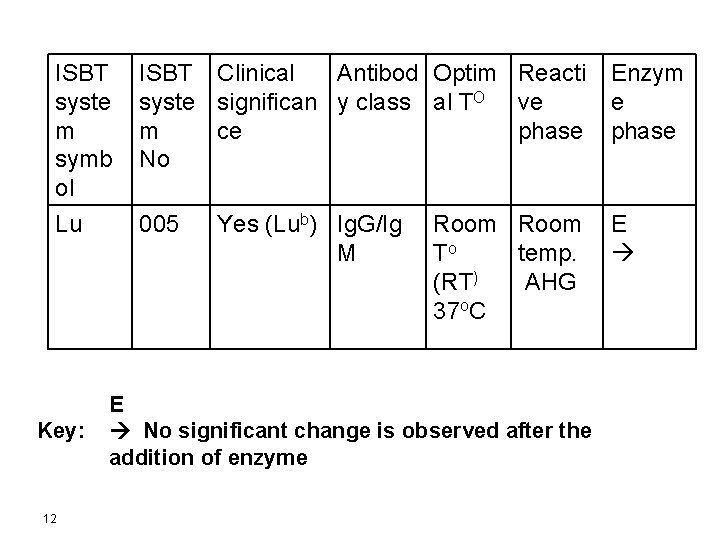
ISBT syste m symb ol ISBT Clinical Antibod Optim Reacti syste significan y class al TO ve m ce phase No Enzym e phase Lu 005 E Key: 12 Yes (Lub) Ig. G/Ig M Room To temp. (RT) AHG 37 o. C E No significant change is observed after the addition of enzyme

4. 4. The Lewis blood group q Identified in 1946 n Lele locus is on chromosome 19. n Lea and Leb are the major antigens. n Others include Lec, Led, and Lex (LE 3) 13

The Lewis… Difference of Lewis blood group from the others n Lewis antigens are not intrinsic to the RBC membrane produced during cell development n An individual’s Lewis phenotype is not determined solely by genes at the Lele locus but also by the action of genes at the Hh and Sese loci. n The amount of Lewis antigen expressed on the RBC varies according to the cell’s ABO phenotype. 14
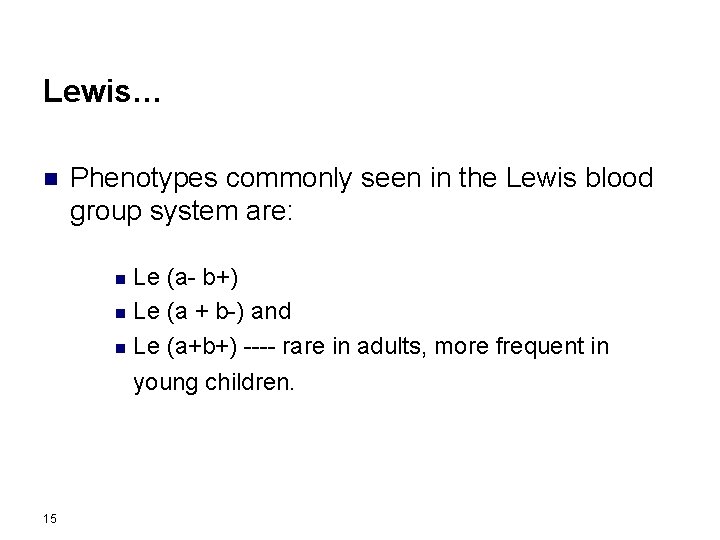
Lewis… n Phenotypes commonly seen in the Lewis blood group system are: Le (a- b+) n Le (a + b-) and n Le (a+b+) ---- rare in adults, more frequent in n young children. 15

Acquisition of Lewis Ags by RBCs n The Lewis phenotype of RBC’s ¨ depends on the phenotype of the plasma in which they are suspended ¨ can be changed by incubating the cells in plasma containing different Lewis active glycolipids. Example If Le (a – b-) cells incubated with plasma containing Lea or Leb glycolipid, ¨ they adsorb the available antigen from the plasma and ¨ subsequently type as Le (a+ b-) or Le (a-b+) 16

Lewis system Abs Two main types: anti-Lea and anti-Leb n Anti-Lea ¨ Very common and naturally accruing ¨ Produced almost exclusively by the Le (a-b-) phenotype ¨ Usually Ig. M, react best at room temp and rarely at 370 C ¨ Can bind complement ¨ Not associated with HDN because the antigen is not present on fetal RBCs 17
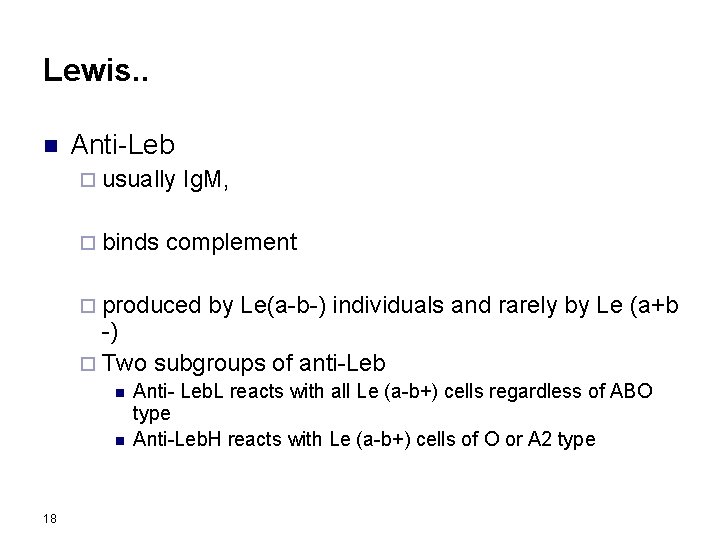
Lewis. . n Anti-Leb ¨ usually ¨ binds Ig. M, complement ¨ produced by Le(a-b-) individuals and rarely by Le (a+b -) ¨ Two subgroups of anti-Leb n n 18 Anti- Leb. L reacts with all Le (a-b+) cells regardless of ABO type Anti-Leb. H reacts with Le (a-b+) cells of O or A 2 type
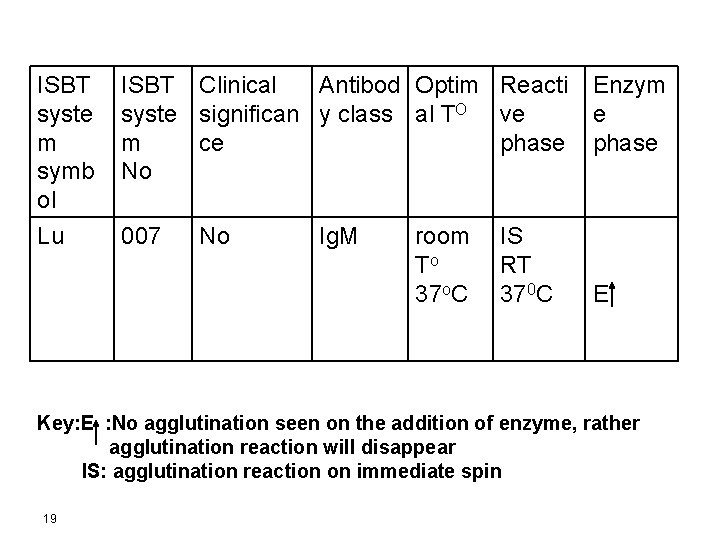
ISBT syste m symb ol ISBT Clinical Antibod Optim Reacti syste significan y class al TO ve m ce phase No Lu 007 No Ig. M room To 37 o. C IS RT 370 C Enzym e phase E Key: E : No agglutination seen on the addition of enzyme, rather agglutination reaction will disappear IS: agglutination reaction on immediate spin 19
4. 5. The I Blood group system n Discovered around 1956 by Winner and his associates n The I Ag is found on almost all adults n Is part of the precursor component of the oligosaccharide that forms the A, B and H Ags. 20
I… n Red cells that posses this Ag are labeled as I and those that lack as i. n The anti-I antibodies are naturally occruing, of Ig. M type with their optimal temp at 40 C n The antibodies of the I blood group system are not associated with HDN and HTR 21
4. 6. The P Blood group system n Discovered in 1927 n The most common phenotype are P 1 and P 2 which are analogous to the A 1 and A 2 phenotypes seen in the ABO system. n P 1 individuals have two antigens on their RBCs: P 1 and P. 22
P… n P 2 individuals have only the P Ag and can produce anti-P 1. n Anti-P 1 is frequently encountered antibody ¨ It is naturally occurring ¨ Ig. M, cold – reactive agglutinin, and does not react above RT ¨ Not associated with HDN or HTR 23
4. 7. The MNSs Blood group system q n n n Discovered in 1927 by Land Steiner and Levine There are two loci on chromo. 4 M/N and S/S. The Antigens are M, N, S and s Anti-M, Anti-N and Anti-S Anti-s are the major Abs of the system Anti-M ¨ Naturally occurring reacting at RT or below ¨ May be either Ig. M or Ig. G ¨ Rarely causes HDN or HTR 24
MNSs… Anti-N ¨ Usually weak cold-reactive, ¨ naturally occurring Ig. M Ab produced by individuals who are M+N- and who are positive for S or s ¨ Clinically not significant Anti-S and Anti-s ¨ Usually present as immune Abs. ¨ Usually Ig. G but rare Ig. M types present ¨ Anti-M and anti-N are not associated with HDN or HTR but Anti-s and anti-s 25
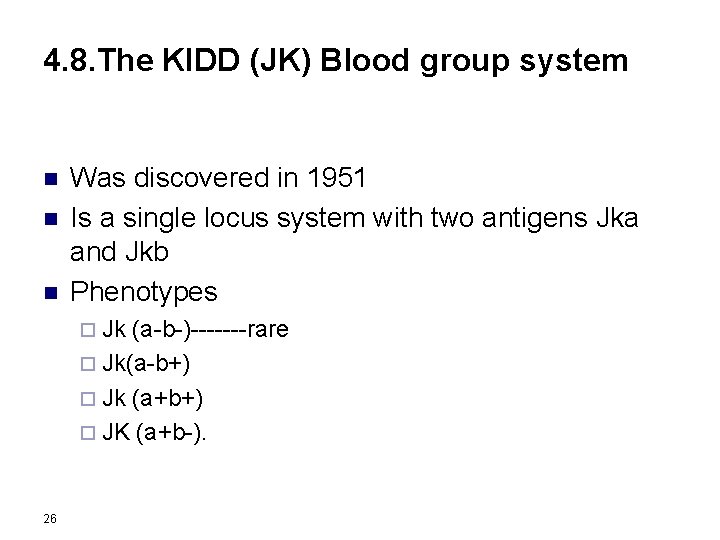
4. 8. The KIDD (JK) Blood group system n n n Was discovered in 1951 Is a single locus system with two antigens Jka and Jkb Phenotypes ¨ Jk (a-b-)-------rare ¨ Jk(a-b+) ¨ Jk (a+b+) ¨ JK (a+b-). 26
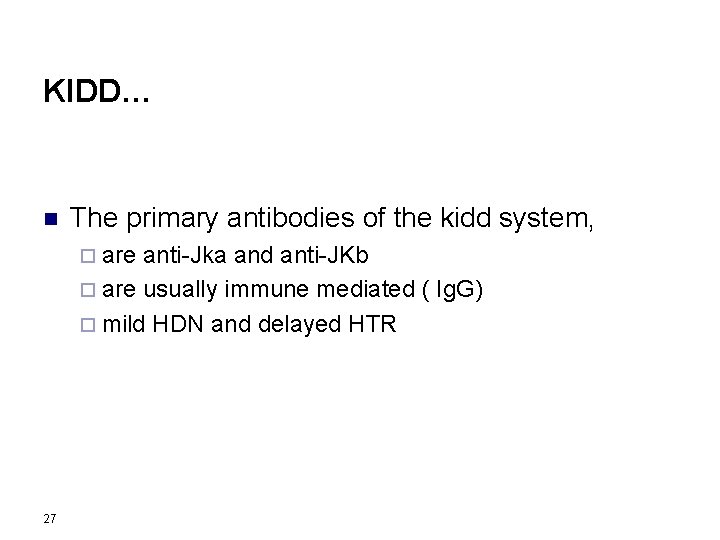
KIDD… n The primary antibodies of the kidd system, ¨ are anti-Jka and anti-JKb ¨ are usually immune mediated ( Ig. G) ¨ mild HDN and delayed HTR 27

Review questions 1. Explain why blood groups like Lewis, Kidd… are called minor blood groups? 2. Explain the relationship and difference of ABO and Lewis system antigens development. 3. Compare and contrast the different other blood group antibodies. 4. List the different other blood group antibodies responsible for hemolytic reactions. 28
References 1. 2. 3. 4. 29 Immunohematology for medical laboratory science students, Yayehyirad T. and Misganaw B. , Upgraded lecture note. 2008 Basic and applied concepts of Immunohematology, 2 nd ed. Kathy D. Blaney and Paula R. Howard, 2009 Blood banking and transfusion medicine: basic principles and practice. Christopher D. Hilliyer et al. 2 nd ed. 2007. Safe blood donations, Module 1 WHO. 2002
References… 5. Screening for HIV and other infectious agents, Module 2, WHO. 2002 6. Blood group serology. Module 3 WHO. 2002 7. Guidelines and principles for safe blood transfusion practice, Introductory module. WHO 2002. 8. Immunohematology: Principles and Practice Quinley. 2 nd ed. 1998. 9. AABB Technical Manual. 15 th Edition. 2005 30
- Slides: 30