
ChosenCiphertext Security from Identity Based Encryption Ran Canetti
Chosen-Ciphertext Security from Identity. Based Encryption Ran Canetti, Shai Halevi IBM Jonathan Katz U. Maryland 1/28
Motivation • Security against chosen-ciphertext attacks (“CCA security”) is a powerful and useful notion – Often the security notion of choice when using encryption within a larger protocol • Provably-secure constructions both theoretically and practically important 2/28
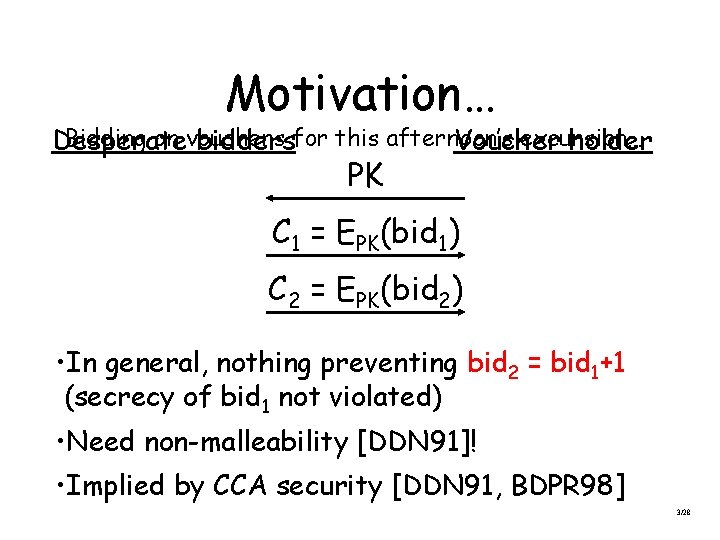
Motivation… Bidding on vouchers excursion… Desperate biddersfor this afternoon’s Voucher holder PK C 1 = EPK(bid 1) C 2 = EPK(bid 2) • In general, nothing preventing bid 2 = bid 1+1 (secrecy of bid 1 not violated) • Need non-malleability [DDN 91]! • Implied by CCA security [DDN 91, BDPR 98] 3/28
Known Constructions? • Essentially only two techniques known for achieving CCA security (without random oracles): – Using NIZK, general assumptions [DDN 91, S 99, L 03] (based on [NY 90]) – Specific assumptions, “smooth hash proofs” [CS 98, CS 02, GL 03, CS 03] 4/28
Known Paradigms? • In fact, almost all constructions are essentially “the same” [ES 04] – Different instantiations of the same underlying paradigm – Very roughly: certain type of CPA-secure scheme plus “proof of well-formedness” • NM-NIZK in [Sahai 99, L 03] • Smooth hash proof systems in [CS 98, CS 02, GL 03, CS 03] 5/28
Overview of our Results • We show a new technique for achieving chosen-ciphertext security – The technique does not (seem to) follow previously-known paradigms • Our approach (along with other work) yields new CCA-secure schemes – Competitive with best previously known – Stay tuned for the next talk… 6/28
More Details… • We show a simple and efficient way to achieve CCA security using any IBE scheme • The IBE scheme needs to satisfy only a relatively “weak” notion of security – Achieved by IBE schemes of [CHK 03, BB 04] – Result: new CCA-secure schemes! • Applications to CCA security for IBE, HIBE, BTE, and FSE… 7/28
Review of definitions 8/28
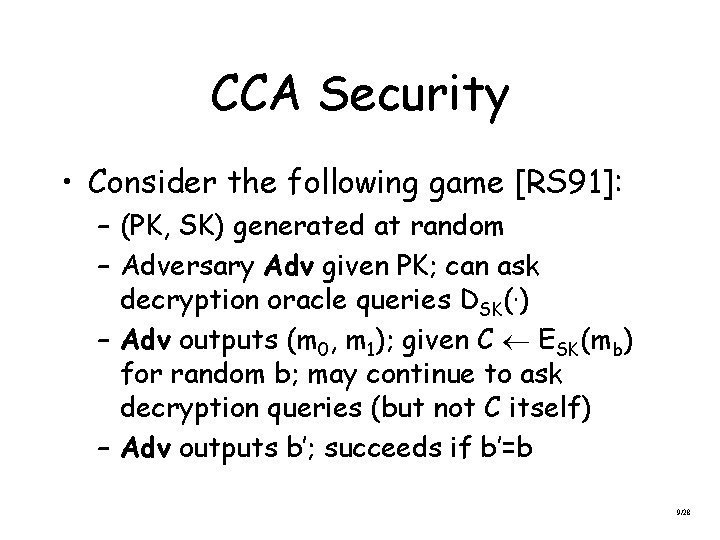
CCA Security • Consider the following game [RS 91]: – (PK, SK) generated at random – Adversary Adv given PK; can ask decryption oracle queries DSK(. ) – Adv outputs (m 0, m 1); given C ESK(mb) for random b; may continue to ask decryption queries (but not C itself) – Adv outputs b’; succeeds if b’=b 9/28
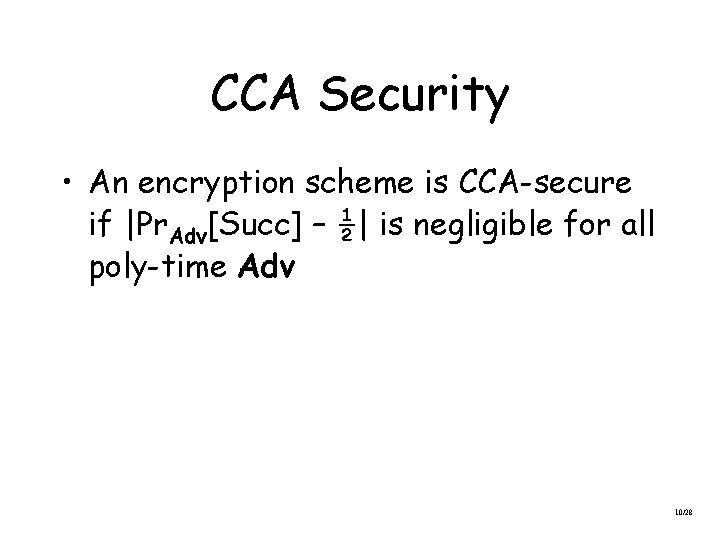
CCA Security • An encryption scheme is CCA-secure if |Pr. Adv[Succ] – ½| is negligible for all poly-time Adv 10/28
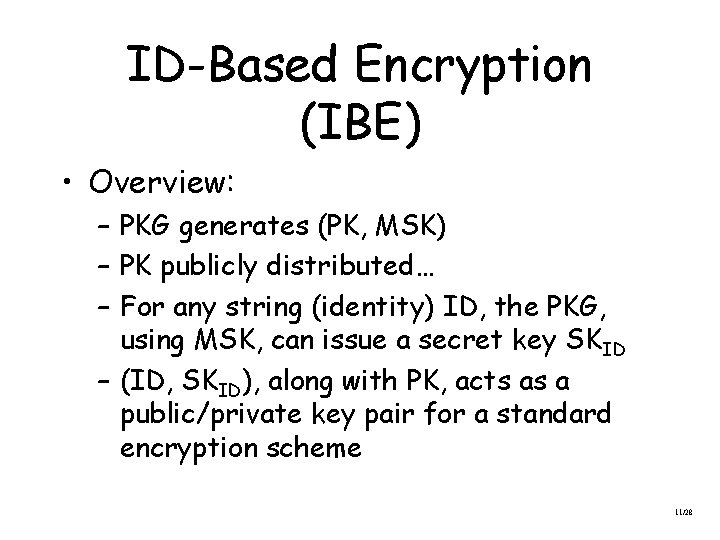
ID-Based Encryption (IBE) • Overview: – PKG generates (PK, MSK) – PK publicly distributed… – For any string (identity) ID, the PKG, using MSK, can issue a secret key SKID – (ID, SKID), along with PK, acts as a public/private key pair for a standard encryption scheme 11/28
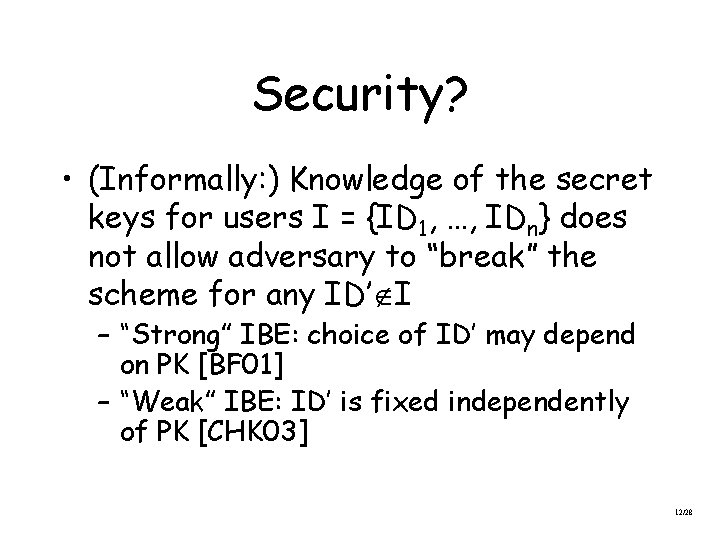
Security? • (Informally: ) Knowledge of the secret keys for users I = {ID 1, …, IDn} does not allow adversary to “break” the scheme for any ID’ I – “Strong” IBE: choice of ID’ may depend on PK [BF 01] – “Weak” IBE: ID’ is fixed independently of PK [CHK 03] 12/28
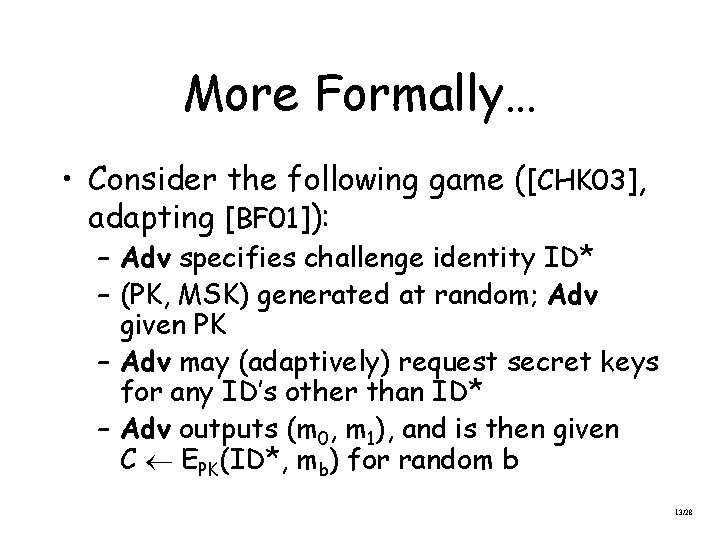
More Formally… • Consider the following game ([CHK 03], adapting [BF 01]): – Adv specifies challenge identity ID* – (PK, MSK) generated at random; Adv given PK – Adv may (adaptively) request secret keys for any ID’s other than ID* – Adv outputs (m 0, m 1), and is then given C EPK(ID*, mb) for random b 13/28
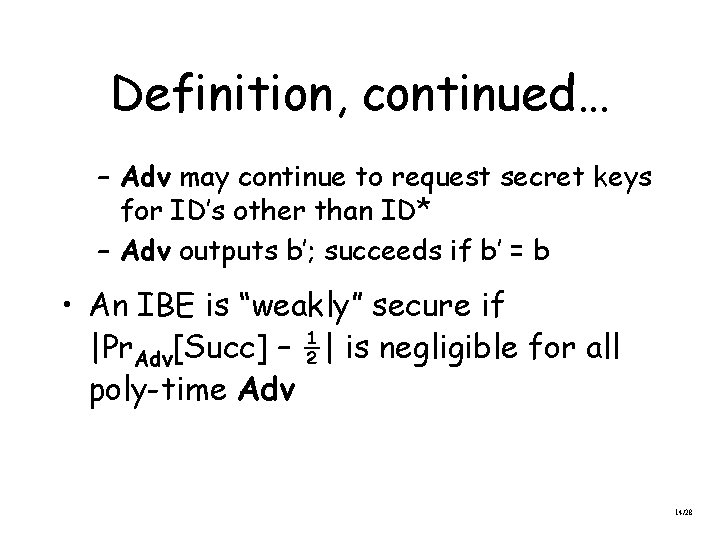
Definition, continued… – Adv may continue to request secret keys for ID’s other than ID* – Adv outputs b’; succeeds if b’ = b • An IBE is “weakly” secure if |Pr. Adv[Succ] – ½| is negligible for all poly-time Adv 14/28
Known Constructions? • “Strong” IBE: [C 01, BF 01], both in random oracle model • “Weak” IBE: [CHK 03, BB 04] • “Strong” IBE: [BB 04, to appear] 15/28
From IBE to chosenciphertext security 16/28
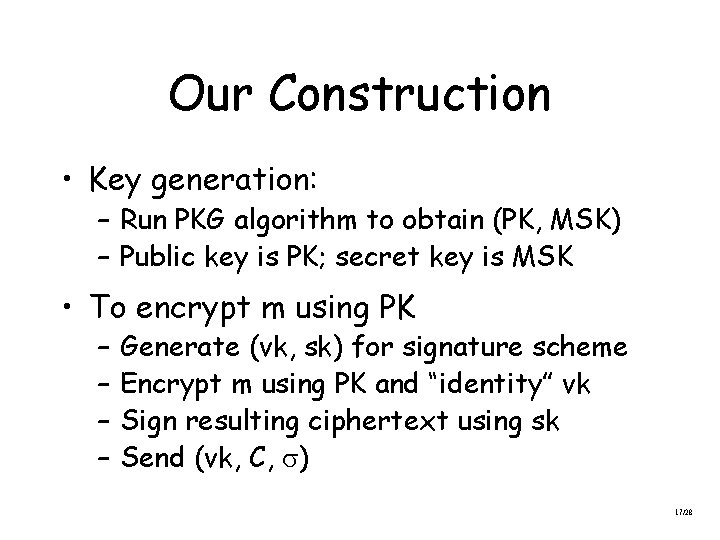
Our Construction • Key generation: – Run PKG algorithm to obtain (PK, MSK) – Public key is PK; secret key is MSK • To encrypt m using PK – – Generate (vk, sk) for signature scheme Encrypt m using PK and “identity” vk Sign resulting ciphertext using sk Send (vk, C, ) 17/28
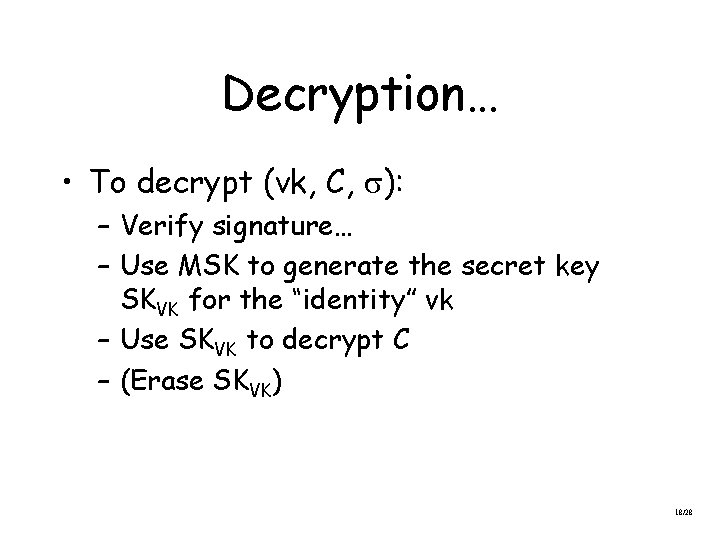
Decryption… • To decrypt (vk, C, ): – Verify signature… – Use MSK to generate the secret key SKVK for the “identity” vk – Use SKVK to decrypt C – (Erase SKVK) 18/28
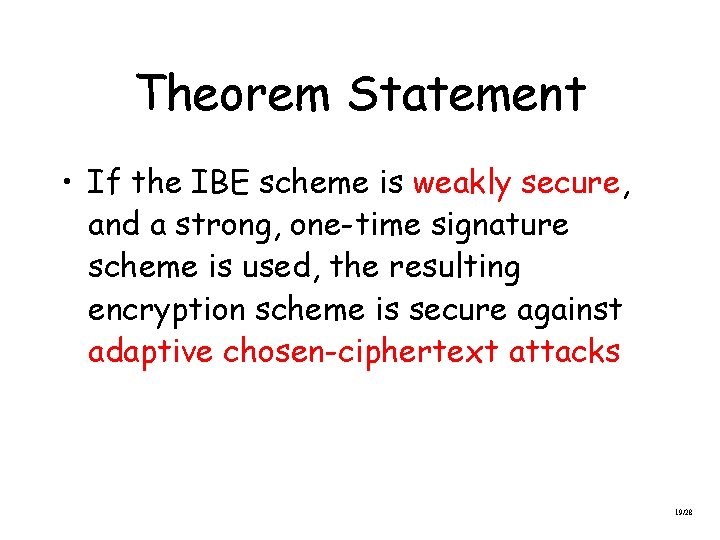
Theorem Statement • If the IBE scheme is weakly secure, and a strong, one-time signature scheme is used, the resulting encryption scheme is secure against adaptive chosen-ciphertext attacks 19/28
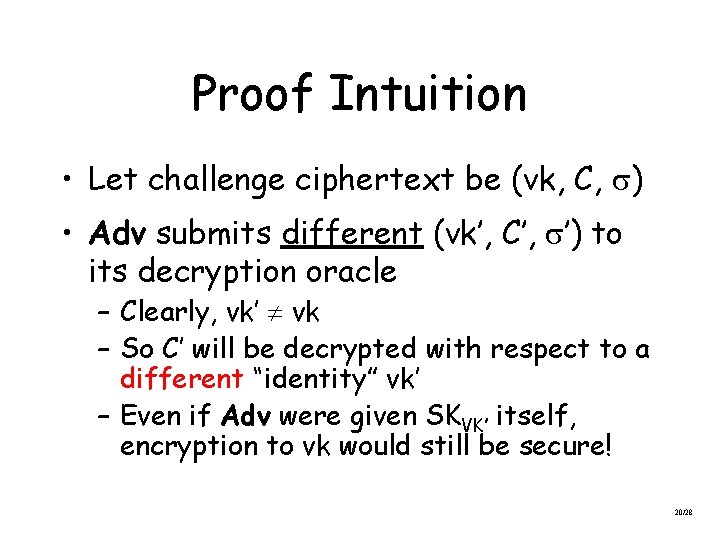
Proof Intuition • Let challenge ciphertext be (vk, C, ) • Adv submits different (vk’, C’, ’) to its decryption oracle – Clearly, vk’ vk – So C’ will be decrypted with respect to a different “identity” vk’ – Even if Adv were given SKVK’ itself, encryption to vk would still be secure! 20/28
Remarks • Weak IBE security is enough to achieve adaptive CCA security – vk chosen by encryption oracle, not by the adversary • The conversion is efficient • Non-adaptive CCA security can be achieved with virtually no overhead 21/28

Extensions and further applications 22/28
Binary Tree Enc. (BTE) • Introduced by [CHK 03] • As before, PKG generates (PK, MSK) • PKG viewed as “identity” with secret key SK = MSK • Any secret key SKw can be used to derive secret keys SKw 0 and SKw 1 • (ID, SKID) acts as a public/private key pair for a standard encryption scheme 23/28
“Weak” Security • Ancestors of (ID 1…IDn) are identities of the form (ID 1…IDi) for 1 i n • (Informally: ) Secret keys for any set of users I does not allow an adversary to “break” the scheme for any ID having no ancestors in I • Constructions in standard model known ([CHK 03, BB 04], building on [GS 02]) 24/28
Our Construction • CCA-secure (weak) BTE from CPAsecure (weak) BTE: – (Consider fixed-length BTE) – Key generation as before – To encrypt m for identity ID: generate (vk, sk), encrypt m for “identity” ID|vk, and sign ciphertext using sk – As before, decrypt using SKID by first generating “transient” SKID|vk 25/28
Results • This approach yields a CCA-secure (weak) BTE scheme from any CPAsecure (weak) BTE scheme • CPA-secure BTE CCA-secure BTE – Analogous result not known for the case of standard public-key encryption 26/28
Applications • (Weak) BTE implies (weak) IBE, (weak) HIBE, and forward-secure encryption [CHK 03] • Our results yield CCA-secure constructions of these primitives more efficient than those previously known 27/28
Summary • New method for constructing CCAsecure public-key encryption • Gives new, practical CCA-secure schemes in standard model • Further applications to CCA-security in other contexts 28/28
- Slides: 28