
Choosing your research project Stepbystep approach to research
Choosing your research project Step-by-step approach to research

Step 1: Defining your research topic • Identify your topic of research • Identify your product (which medium(s) is it for - TV, print, radio, web etc? ) • Identify your audience (age, gender, socioeconomic status, ethnicity or a combination) • Define your problematic - what do you want to find out about your topic? Which questions will you ask? • Write up a research plan and schedule and work backwards from it.
Step 2: Embarking on your research • Write up a research proposal outlining your topic, the problematic, the plan and schedule • Start secondary research by making a list of potential sources from different media • Collate your secondary research including text, images, videos, audio etc. • Decide on how to approach primary research? Through face-to-face interviews, questionnaires or focus groups? • Conduct your primary research
Step 3: Verify your sources • Using sources: Relevance, authenticity, accuracy • Relevance - is the material relevant to what you are trying to find out? • Authenticity - is it academic, official, reporting, marketing or expression of opinion? Question WHY it is there and WHO wrote it. • Accuracy - sources need to be backed up. Always use bibliographies and references • Try to cross-reference information if you can - it is always better to have two or more sources than one single source.
Step 4: Analysing results • Once you have collected all your secondary and primary research, you need to evaluate and summarise your findings. • Create a research folder (or online equivalent such as a blog). • Organise your findings into relevant and logical categories that will be useful and easy to understand. • Write up a report and prepare a presentation.
Step 5: Presenting your research • Introduce your research and outline its purpose and aims • Explain the methods and techniques that you have used (i. e. secondary / primary research) • Present the research data itself in a suitable form (you can use visuals such as photographs, videos, or graphs and diagrams) • A summary of your main findings • The conclusions that you have made from these findings
Presentation skills • The presentation should include a written report as well as an oral presentation. • Practice the oral presentation in front of friends or colleagues and make a recording of it beforehand. • Think carefully about the structure and content as well as the language you use. • 70% of good presenting skills are about body language, including how you dress, your posture, facial expression and hand / arm movements. • Speak clearly and slowly, maintaining eye-contact. • Use visuals in your presentation - these can help structure what you say.

Analysing bodylanguage • How would you feel if you were part of a small audience and the presenter never looked at you once? How would you feel if the presenter looked at YOU and only YOU? • The face is the most communicative area of the body with 44 muscles that can contort and twist into almost 5000 expressions. Always be aware of what your face communicates.

Analysing bodylanguage • • In the 1960 s presidential elections in the US, Richard Nixon was expected to be a clear winner over JF Kennedy. However many of the 70 million TV viewers were not impressed by his unshaven appearance and sweating. This is said to have cost him the presidency. Always think of your appearance! Skilled speakers such as politicians are famed for their hand arm movements while they present. How do these make them look decisive and in control of the situation?
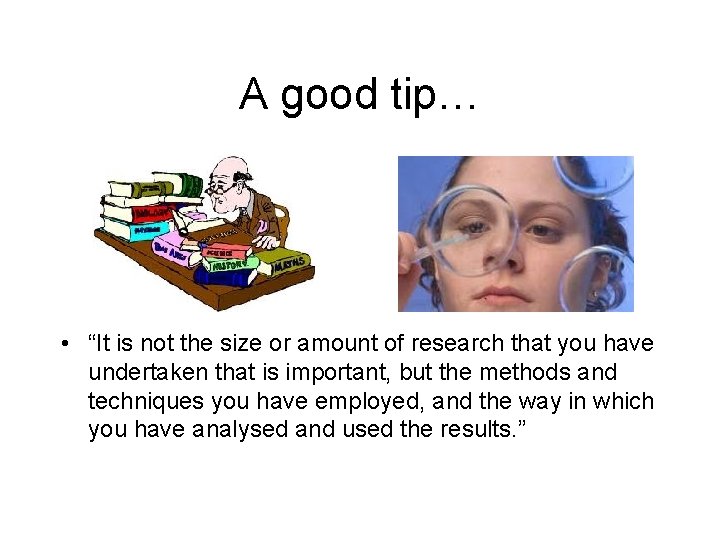
A good tip… • “It is not the size or amount of research that you have undertaken that is important, but the methods and techniques you have employed, and the way in which you have analysed and used the results. ”
- Slides: 10