
Choosing The Right Cable Can Improve Rig Performance
Choosing The Right Cable Can Improve Rig Performance October 2016
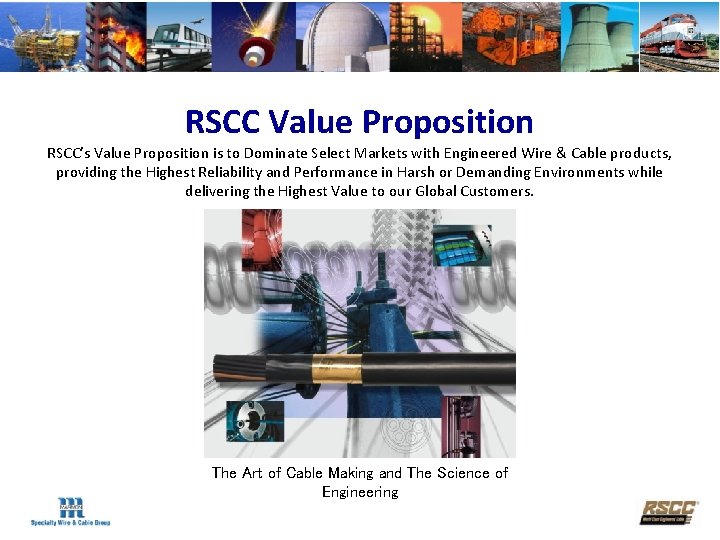
RSCC Value Proposition RSCC’s Value Proposition is to Dominate Select Markets with Engineered Wire & Cable products, providing the Highest Reliability and Performance in Harsh or Demanding Environments while delivering the Highest Value to our Global Customers. The Art of Cable Making and The Science of Engineering
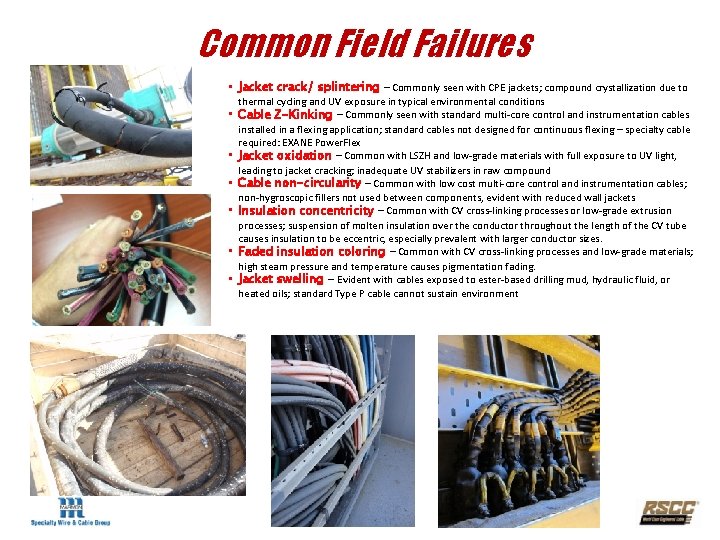
Common Field Failures • Jacket crack/ splintering – Commonly seen with CPE jackets; compound crystallization due to thermal cycling and UV exposure in typical environmental conditions • Cable Z-Kinking – Commonly seen with standard multi-core control and instrumentation cables • • • installed in a flexing application; standard cables not designed for continuous flexing – specialty cable required: EXANE Power. Flex Jacket oxidation – Common with LSZH and low-grade materials with full exposure to UV light, leading to jacket cracking; inadequate UV stabilizers in raw compound Cable non-circularity – Common with low cost multi-core control and instrumentation cables; non-hygroscopic fillers not used between components, evident with reduced wall jackets Insulation concentricity – Common with CV cross-linking processes or low-grade extrusion processes; suspension of molten insulation over the conductor throughout the length of the CV tube causes insulation to be eccentric, especially prevalent with larger conductor sizes. Faded insulation coloring – Common with CV cross-linking processes and low-grade materials; high steam pressure and temperature causes pigmentation fading. Jacket swelling – Evident with cables exposed to ester-based drilling mud, hydraulic fluid, or heated oils; standard Type P cable cannot sustain environment

Poor Type P Cable Qualities • Low Grade Polyolefin Insulation – results in: poor high current overload capacitance low flame retardance not resistant to harsh chemicals or ester-based mud’s faded insulation coloring separator tape used with CV cross-linked compounds poor abrasion / cut-thru resistance CPE (Chlorinated Polyethylene) Jacket – results in: • poor heated oil resistance • limited to cold bend of -35°C and cold impact of -40°C • high frictional properties when bundled together in service loops or drag chains • bonding to underlying materials such as braid armor and shield tapes • jacket constriction and brittleness may occur with exposure to high heat and outdoor exposure • poor flame retardance • extremely difficult to strip when terminating Poor O. D. Tolerances – results in: • gland sizes may vary upon factory runs, creating installation problems for projects • consistent with Continuous Vulcanization (CV) cross-linking processes Minimal Non-Hygroscopic Fillers – results in: • poor cable circularity creates gland egression seal and cold flow issues • conductor corkscrewing in continuous flexing applications Crush & Impact Resistance – results in: • not all manufacturers pass this difficult UL 2225 test for TC-ER-HL listing • • •

EXANE Your Long-Term Cable Solution! ü ü ü ü ü EXANE 125 Listed UL 1309 Marine Shipboard, IEC 60092 -3, 353, 376 EXANE MR Listed UL 1309 Marine Shipboard, IEC 61892 -4 ABS, DNV-GL, Lloyds Registry Type Approved Mud & Oil Resistant Ester-based Mud, Hydraulic Fluid Resistant (MR) Meets NEK 606 SH Mud Resistant Requirements (MR) UV Resistant Hot Surface Resistant Abrasion & Cut Thru Resistant IEEE Std. P 45. 8 Electrical Installations (recently published) API RP-14 F/FZ Design, Installation, Maintenance IEC 60092 -350 Shipboard Cable Anti-Wrinkling Construction -40°C Cold Impact -55°C Cold Bend 110°C Continuous Operating Temperature (ABS) Available in Power. Flex Construction (service loops, drag chains) 5 Year Manufacturers Product Warranty 40+ Years Superior Performance History
- Slides: 5