
Choosing Mesh Spacings and Mesh Dimensions for Wave
- Slides: 40
Choosing Mesh Spacings and Mesh Dimensions for Wave Optics Simulation Steve Coy Justin Mansell MZA Associates Corporation coy@mza. com (505) 245 -9970 ext. 115 1
Overview • We will present a simple step-by-step method for choosing mesh spacings and dimensions for any wave optics simulation problem. To the best of our knowledge this has never been done before. • This method addresses both modeling correctness and computational efficiency, while leaving the user enough flexibility to deal with additional constraints. • The method is amenable to automated implementation and well-suited for use with automated optimization techniques. • This work has been funded in part by the Air Force Research Laboratory and the Airborne Laser Program. 2
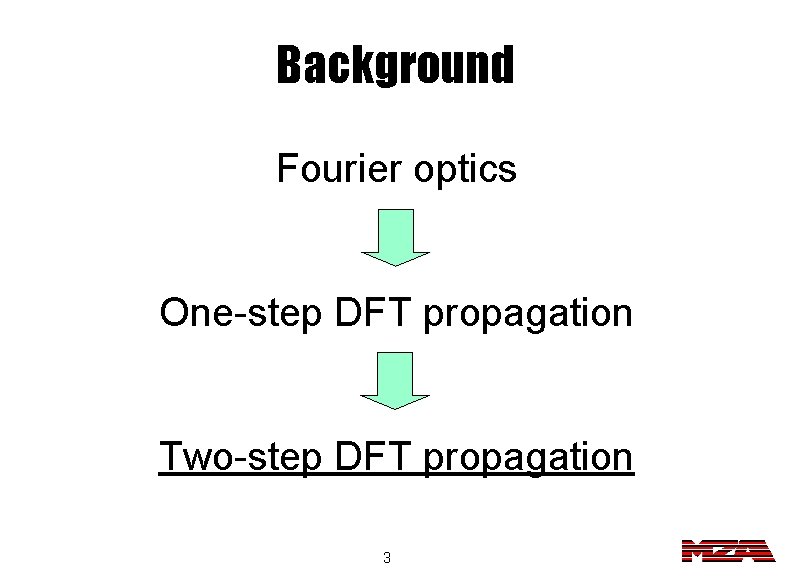
Background Fourier optics One-step DFT propagation Two-step DFT propagation 3
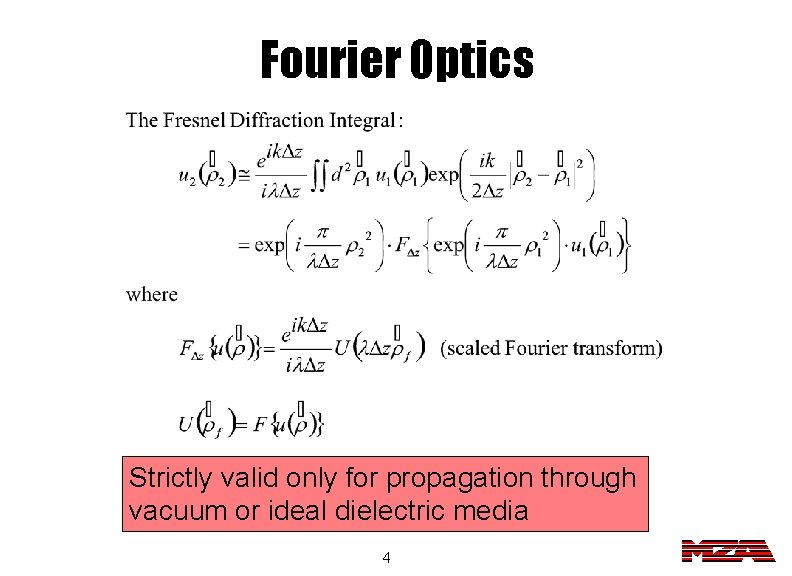
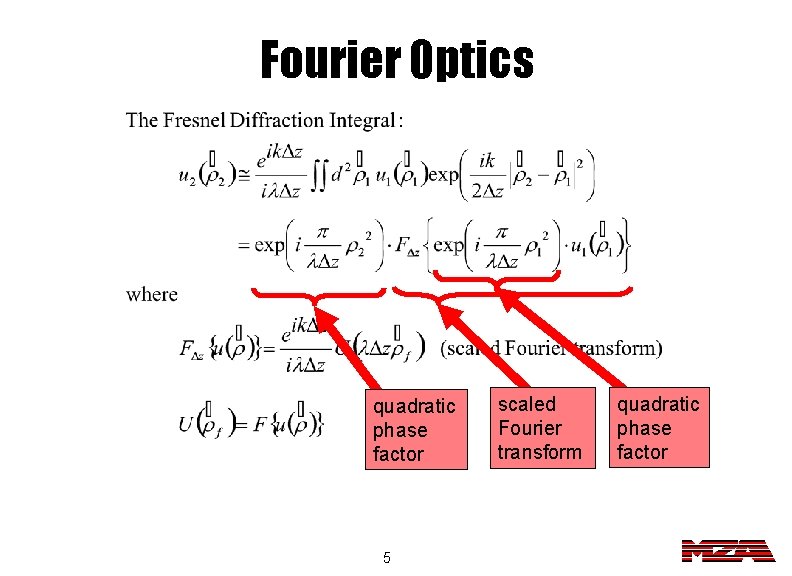
Fourier Optics Strictly valid only for propagation through vacuum or ideal dielectric media 4
Fourier Optics quadratic phase factor 5 scaled Fourier transform quadratic phase factor
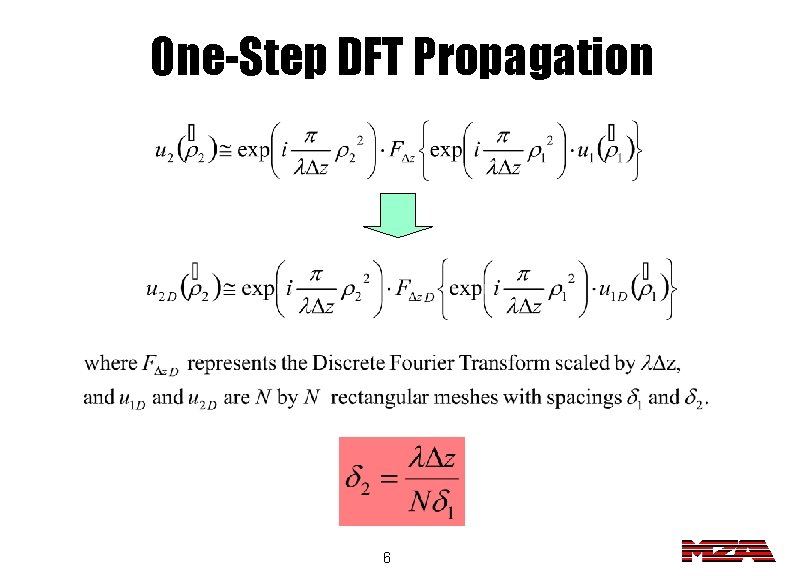
One-Step DFT Propagation 6
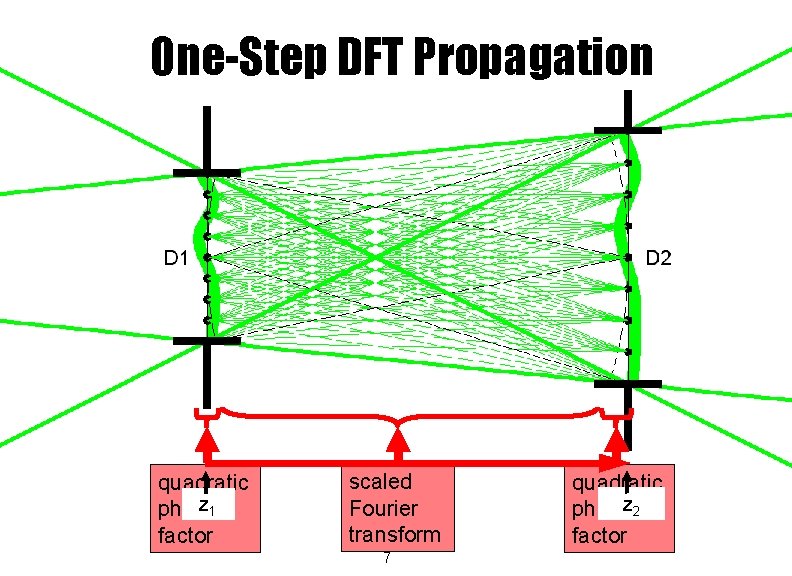
One-Step DFT Propagation quadratic z 1 phase factor scaled Fourier transform 7 quadratic phasez 2 factor
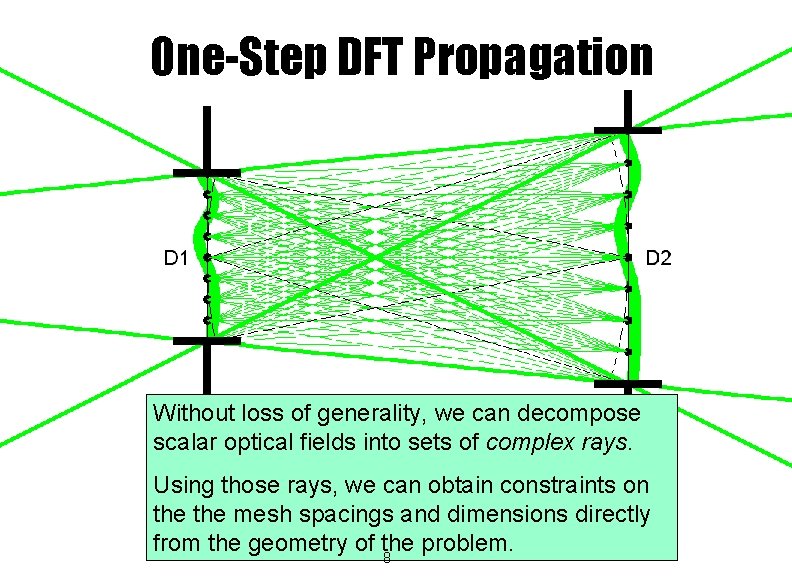
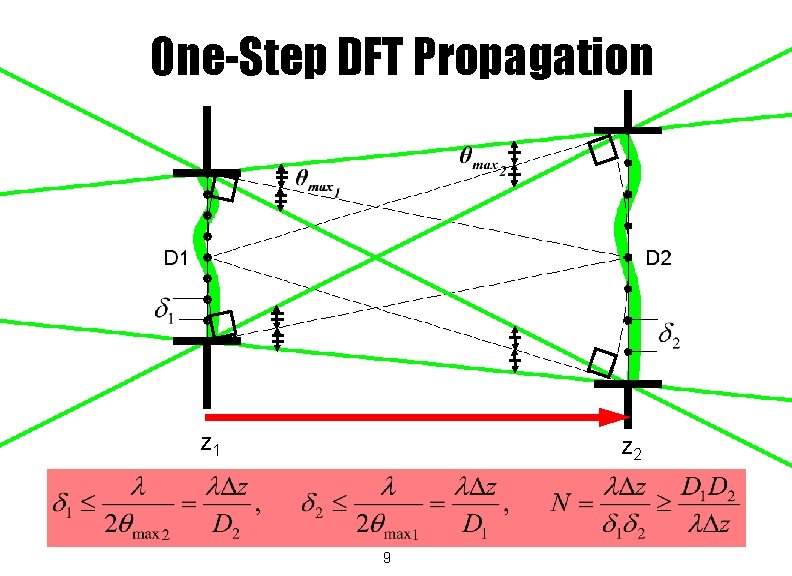
One-Step DFT Propagation Without loss of generality, we can decompose scalar optical fields into sets of complex rays. Using those rays, we can obtain constraints on z 2 z 1 the mesh spacings and dimensions directly from the geometry of the problem. 8
One-Step DFT Propagation z 1 z 2 9
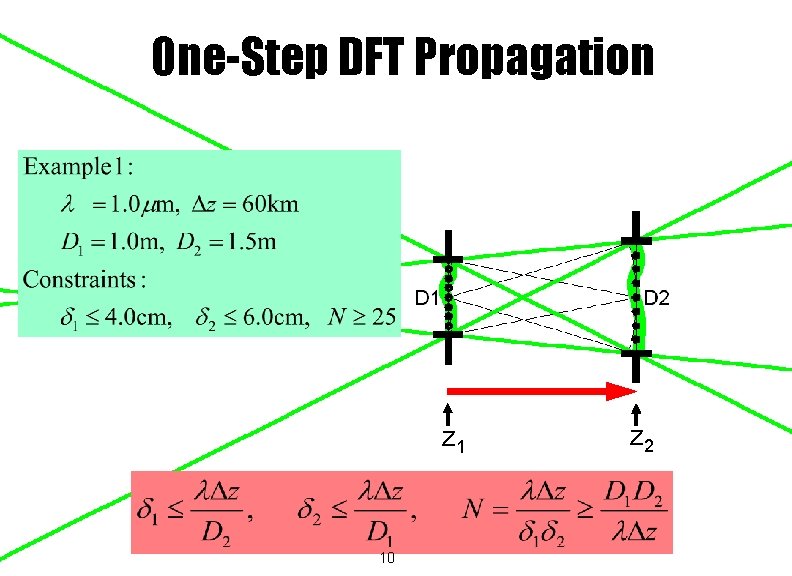
One-Step DFT Propagation z 1 10 z 2
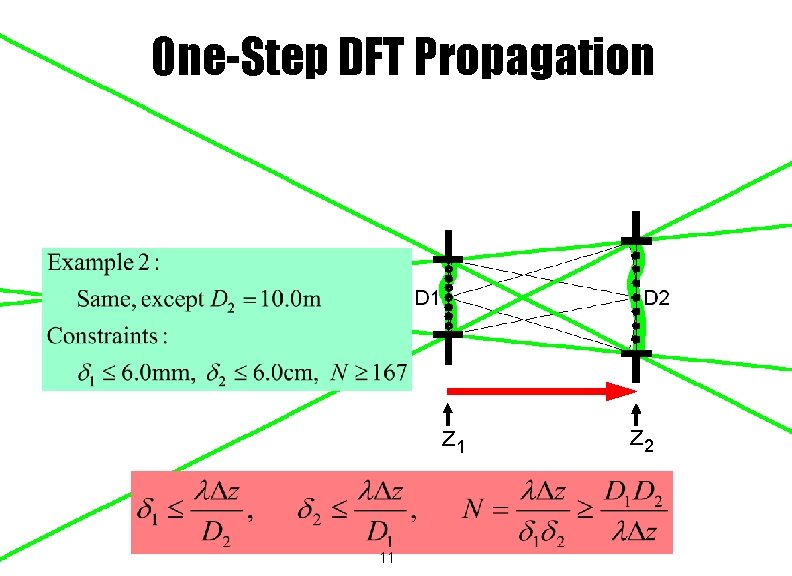
One-Step DFT Propagation z 1 11 z 2
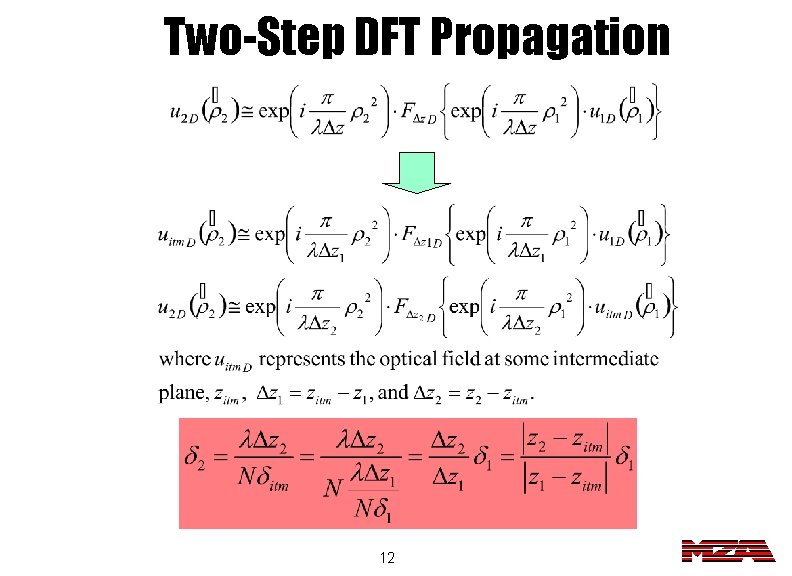
Two-Step DFT Propagation 12
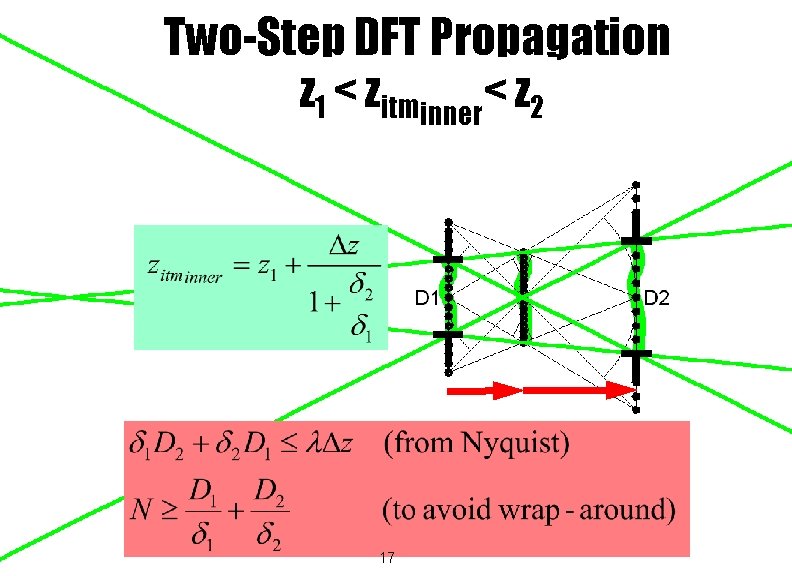
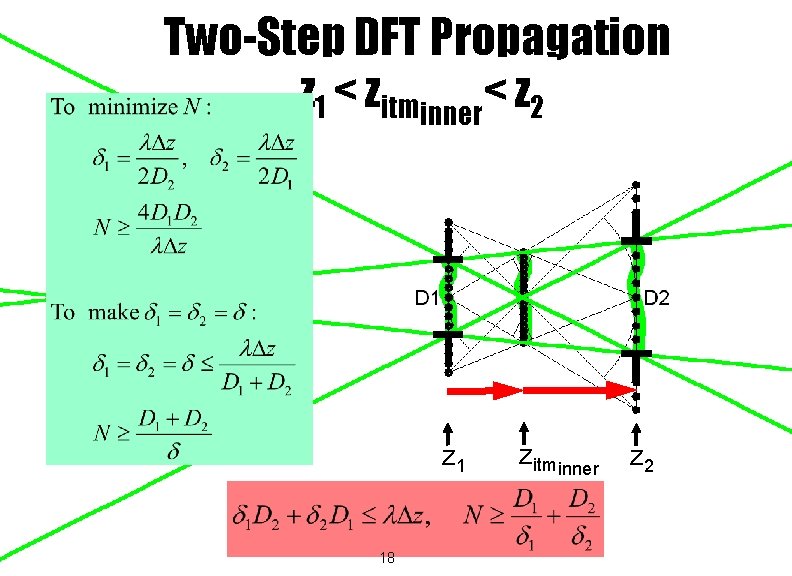
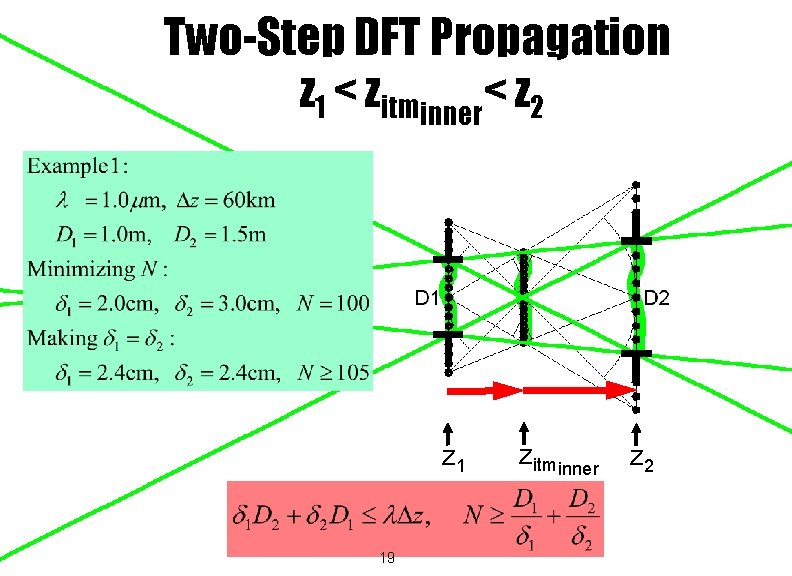
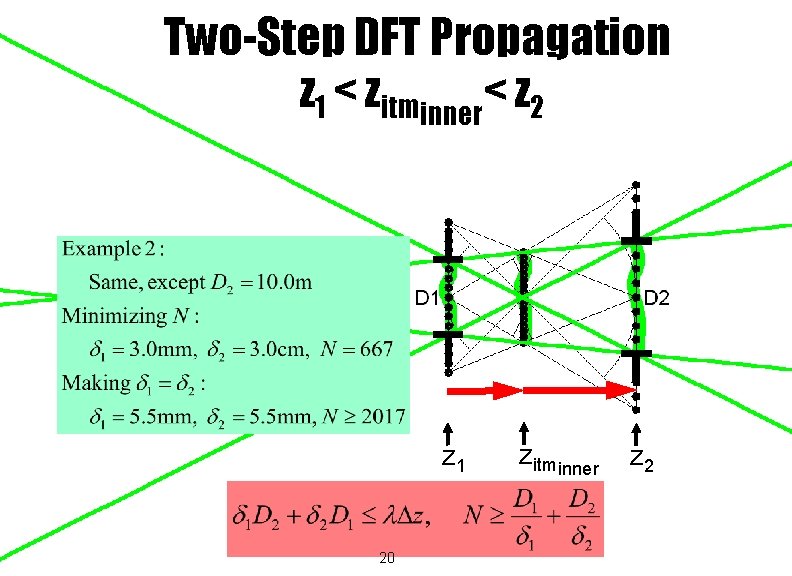
Two-Step DFT Propagation Some authors make a distinction between two different algorithms for two-step DFT propagation: (1) Two concatenated one-step DFT propagations, as we have just described. (2) Frequency domain propagation, i. e. Perform a DFT Multiply by a kernel Perform an inverse DFT However it turns out that (2) can be regarded as a special case of (1) where the two propagation steps are in opposite directions. 13
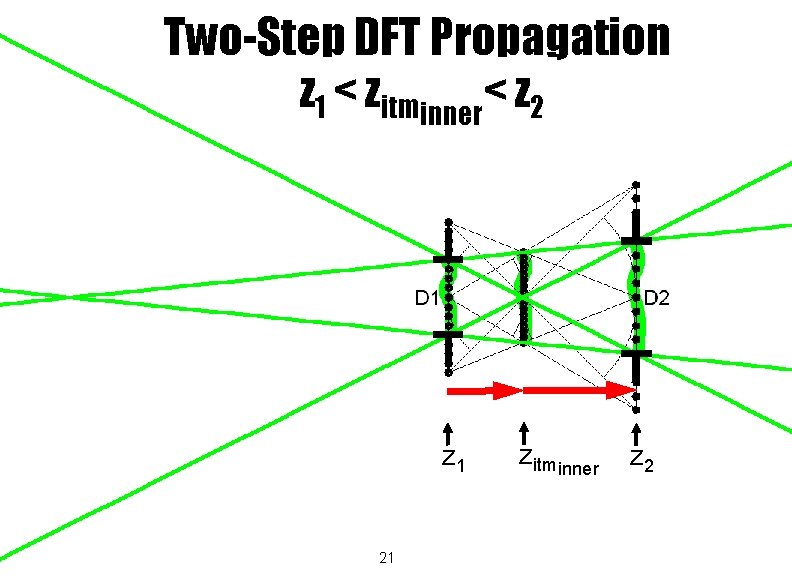
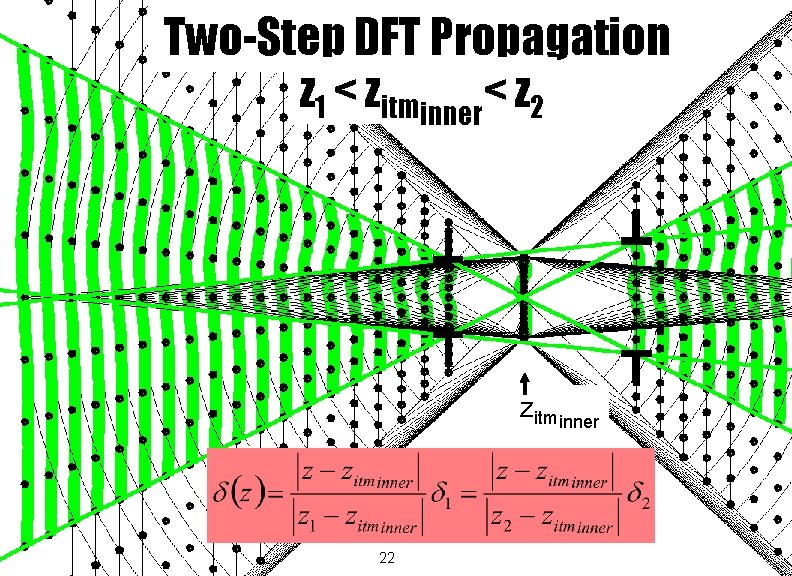
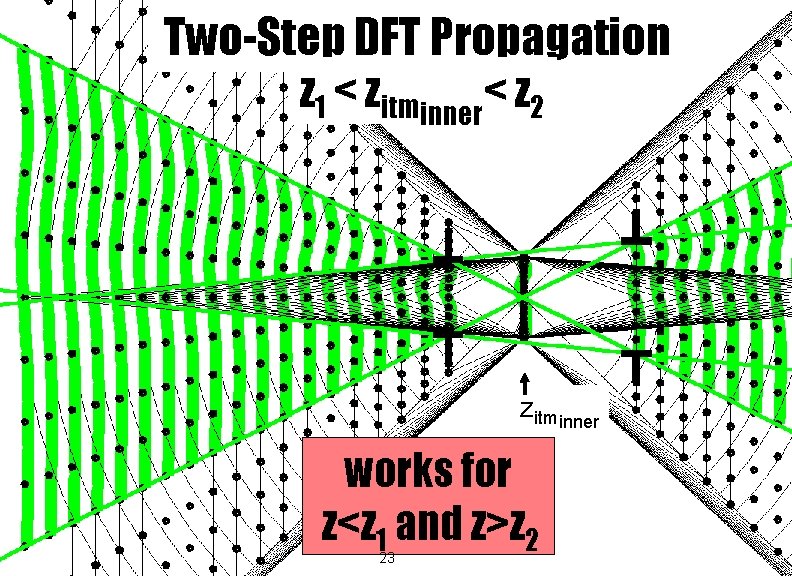
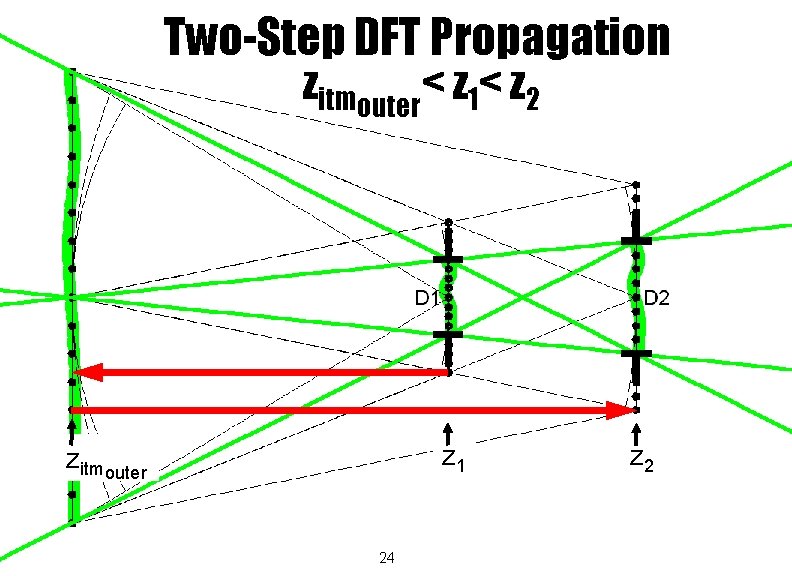
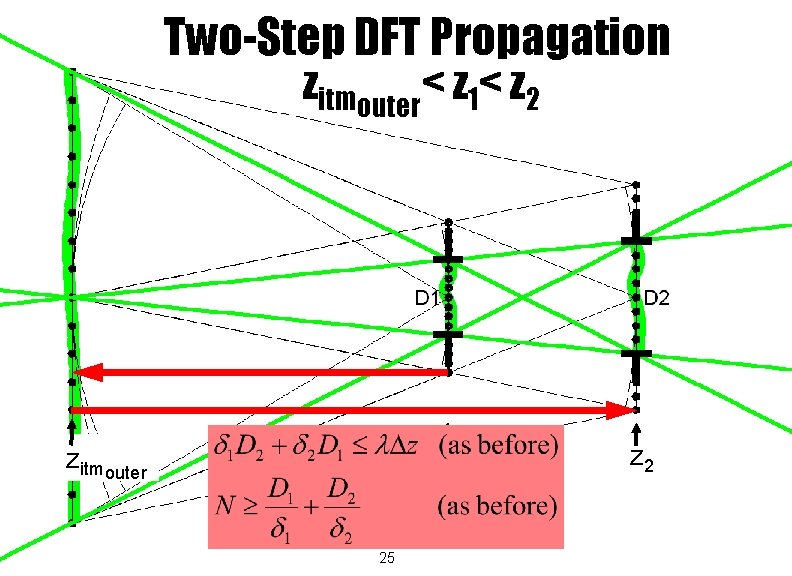
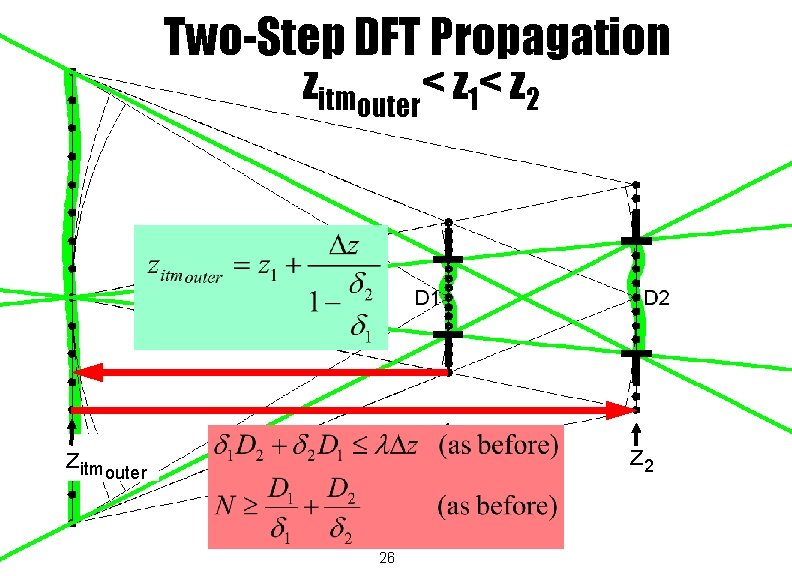
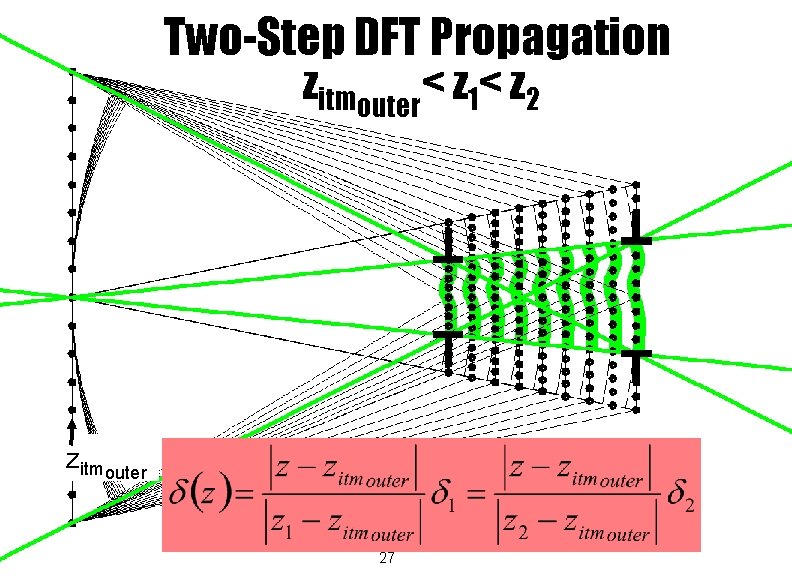
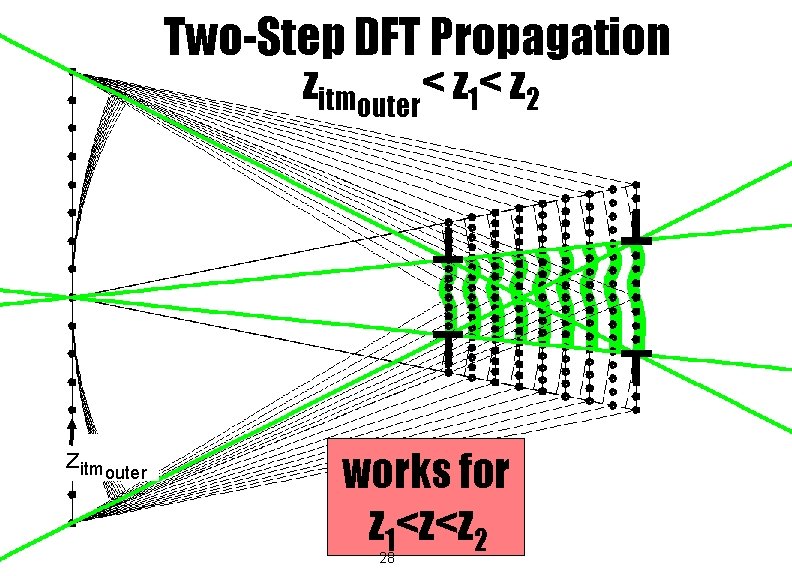
Two-Step DFT Propagation For propagations between the same pair of limiting apertures twostep propagation is much less efficient than one-step propagation. So why use two-step propagation? Answer: (a) The mesh spacings at the initial and final planes can be chosen independently. (b) It works well for propagations between any two planes along the optical path. (For one-step propagation N blows up for small Dz. ) 14
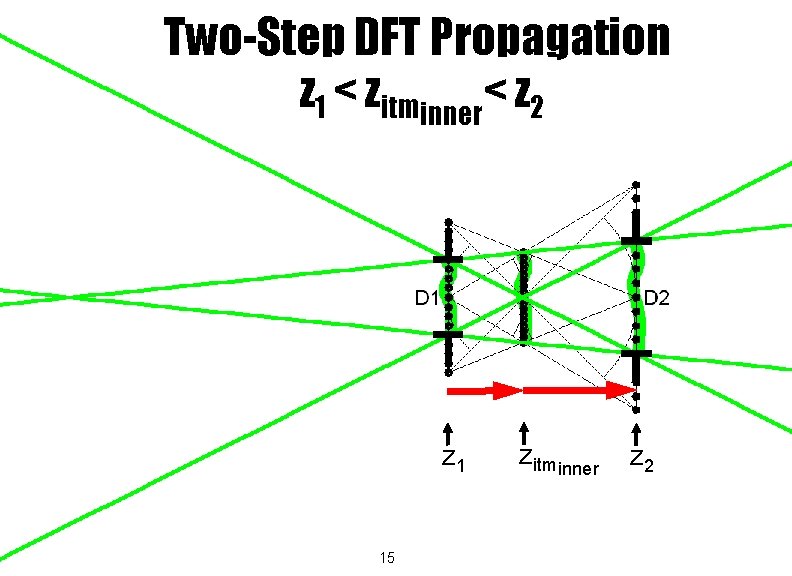
Two-Step DFT Propagation z 1 < zitminner< z 2 z 1 15 zitminner z 2
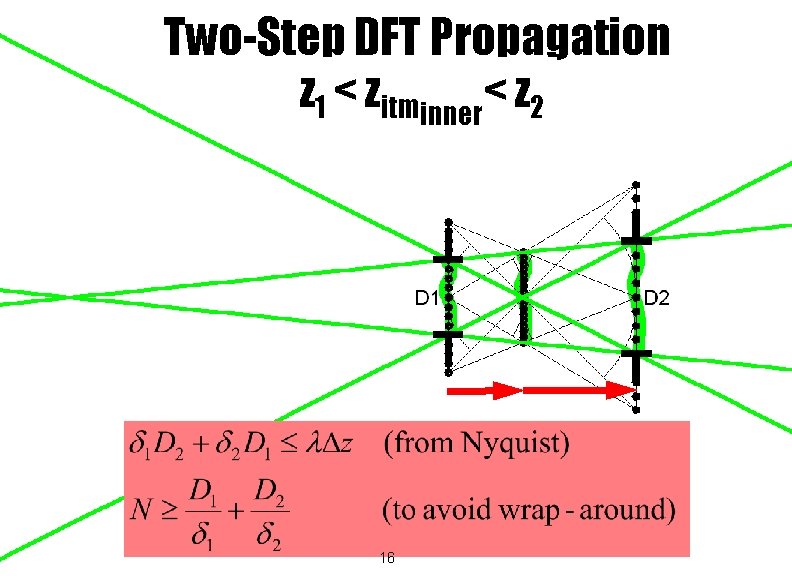
Two-Step DFT Propagation z 1 < zitminner< z 2 z 1 16 zitminner z 2
Two-Step DFT Propagation z 1 < zitminner< z 2 z 1 17 zitminner z 2
Two-Step DFT Propagation z 1 < zitminner< z 2 z 1 18 zitminner z 2
Two-Step DFT Propagation z 1 < zitminner< z 2 z 1 19 zitminner z 2
Two-Step DFT Propagation z 1 < zitminner< z 2 z 1 20 zitminner z 2
Two-Step DFT Propagation z 1 < zitminner< z 2 z 1 21 zitminner z 2
Two-Step DFT Propagation z 1 < zitminner< z 2 zitminner 22
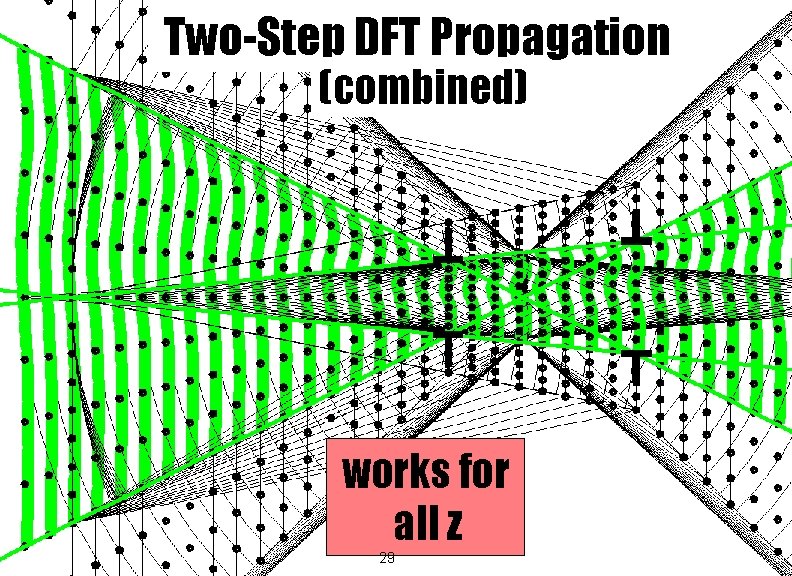
Two-Step DFT Propagation z 1 < zitminner< z 2 zitminner works for z<z 1 and z>z 2 23
Two-Step DFT Propagation zitmouter< z 1< z 2 z 1 zitmouter 24 z 2
Two-Step DFT Propagation zitmouter< z 1< z 2 z 1 zitmouter 25 z 2
Two-Step DFT Propagation zitmouter< z 1< z 2 z 1 zitmouter 26 z 2
Two-Step DFT Propagation zitmouter< z 1< z 2 zitmouter 27
Two-Step DFT Propagation zitmouter< z 1< z 2 zitmouter works for z 1<z<z 2 28
Two-Step DFT Propagation (combined) works for all z 29
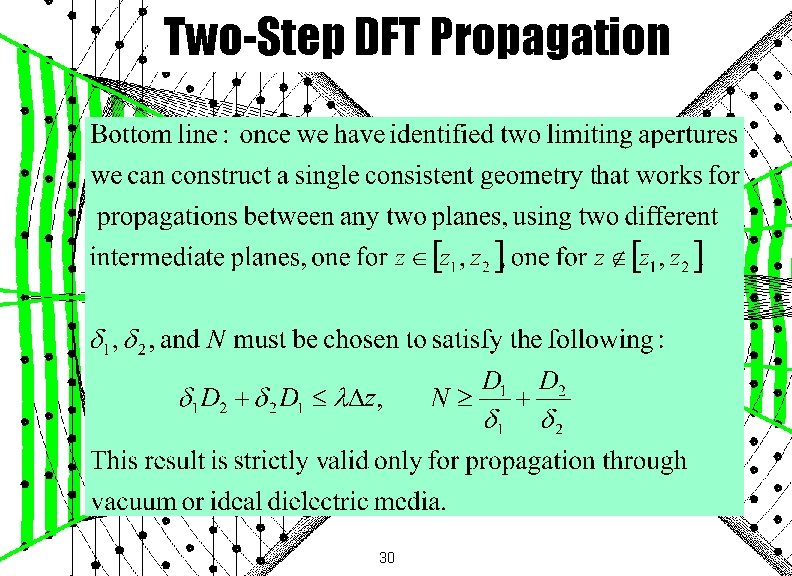
Two-Step DFT Propagation 30
A General Method for Choosing Mesh Spacings and Mesh Dimensions We now have a method for choosing mesh spacings and dimensions for the special case of propagation through vacuum or ideal dielectric media, given two limiting apertures. Next, we will present a simple step-by-step procedure to reduce any wave optics simulation problem, including propagation through optical systems and aberrating media, to one or more instances of the special case. 31
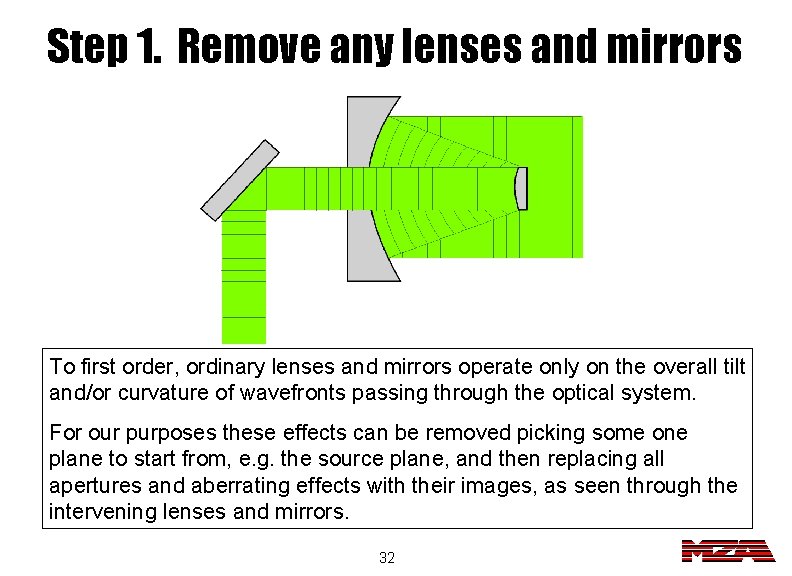
Step 1. Remove any lenses and mirrors To first order, ordinary lenses and mirrors operate only on the overall tilt and/or curvature of wavefronts passing through the optical system. For our purposes these effects can be removed picking some one plane to start from, e. g. the source plane, and then replacing all apertures and aberrating effects with their images, as seen through the intervening lenses and mirrors. 32
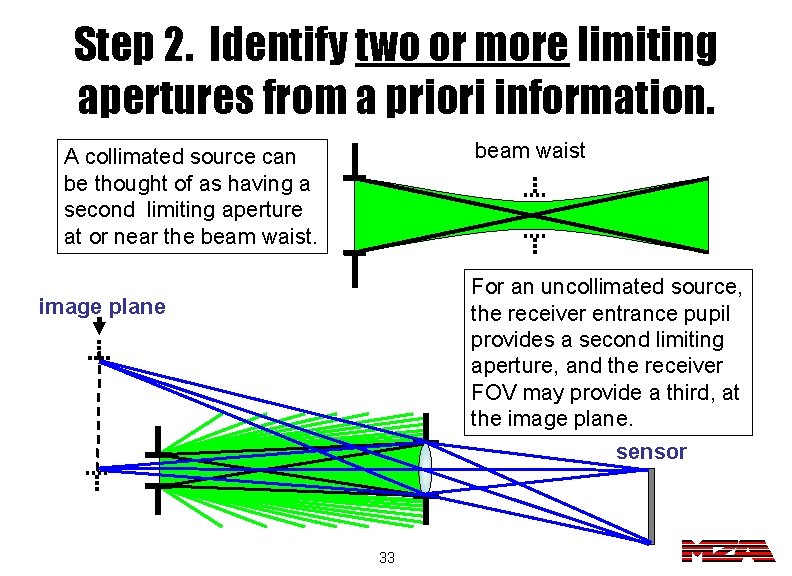
Step 2. Identify two or more limiting apertures from a priori information. beam waist A collimated source can be thought of as having a second limiting aperture at or near the beam waist. For an uncollimated source, the receiver entrance pupil provides a second limiting aperture, and the receiver FOV may provide a third, at the image plane sensor 33
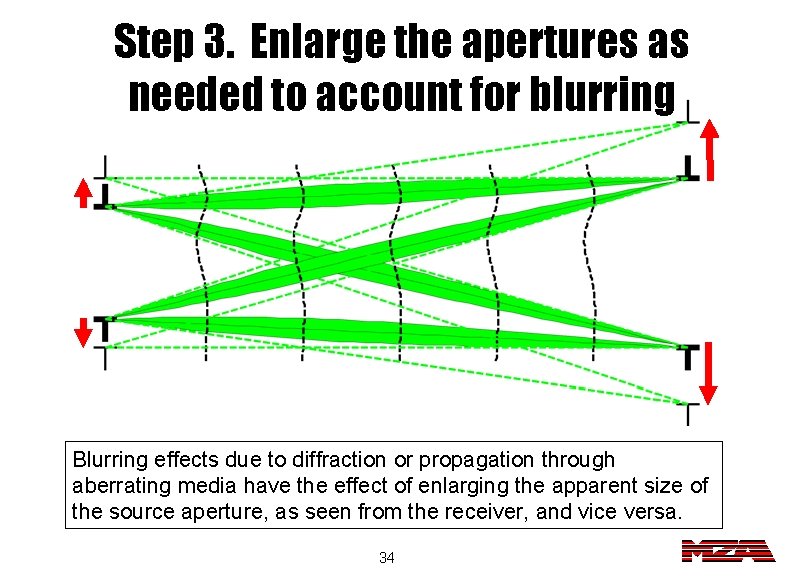
Step 3. Enlarge the apertures as needed to account for blurring Blurring effects due to diffraction or propagation through aberrating media have the effect of enlarging the apparent size of the source aperture, as seen from the receiver, and vice versa. 34
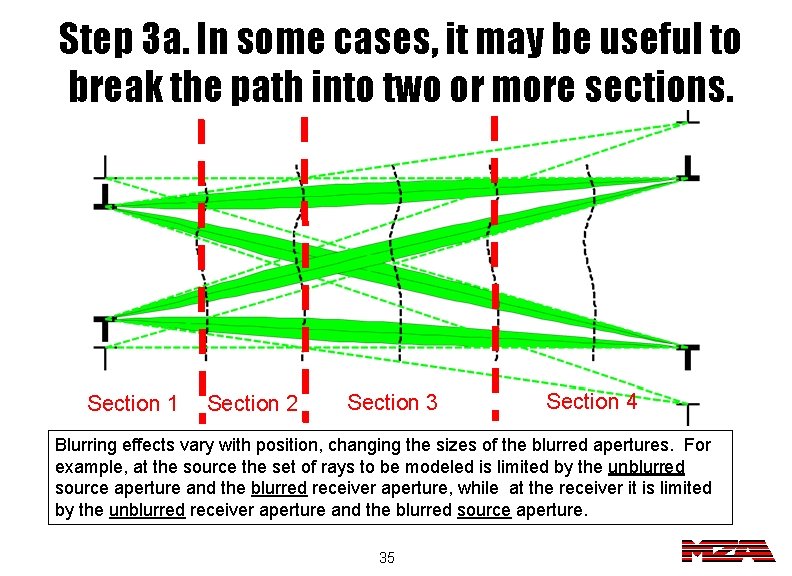
Step 3 a. In some cases, it may be useful to break the path into two or more sections. Section 1 Section 2 Section 3 Section 4 Blurring effects vary with position, changing the sizes of the blurred apertures. For example, at the source the set of rays to be modeled is limited by the unblurred source aperture and the blurred receiver aperture, while at the receiver it is limited by the unblurred receiver aperture and the blurred source aperture. 35
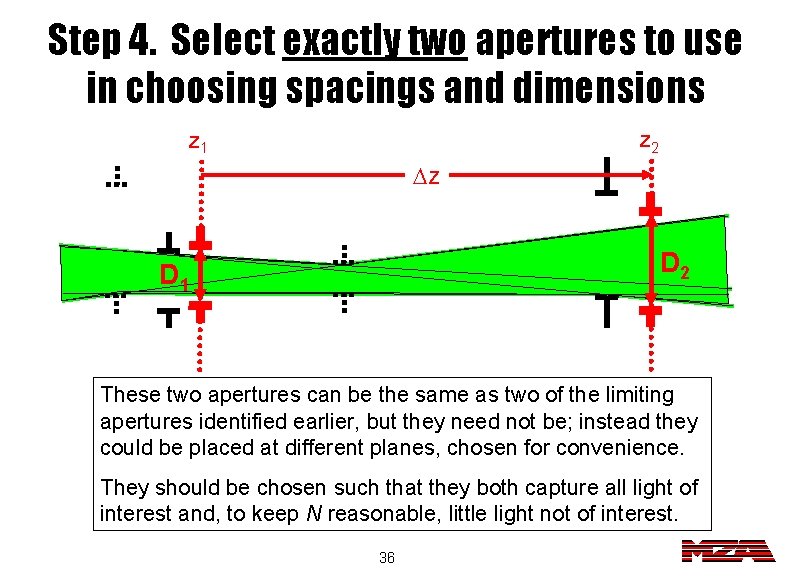
Step 4. Select exactly two apertures to use in choosing spacings and dimensions z 2 z 1 Dz D 2 D 1 These two apertures can be the same as two of the limiting apertures identified earlier, but they need not be; instead they could be placed at different planes, chosen for convenience. They should be chosen such that they both capture all light of interest and, to keep N reasonable, little light not of interest. 36
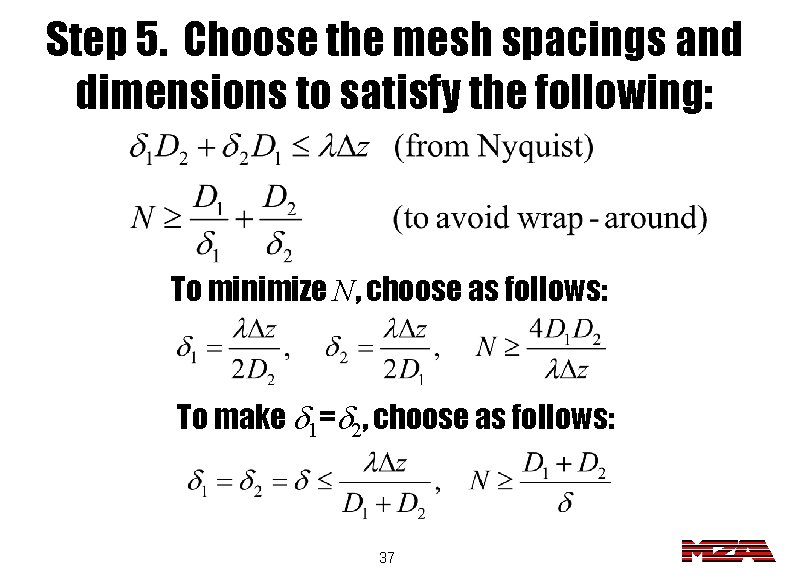
Step 5. Choose the mesh spacings and dimensions to satisfy the following: To minimize N, choose as follows: To make d 1=d 2, choose as follows: 37
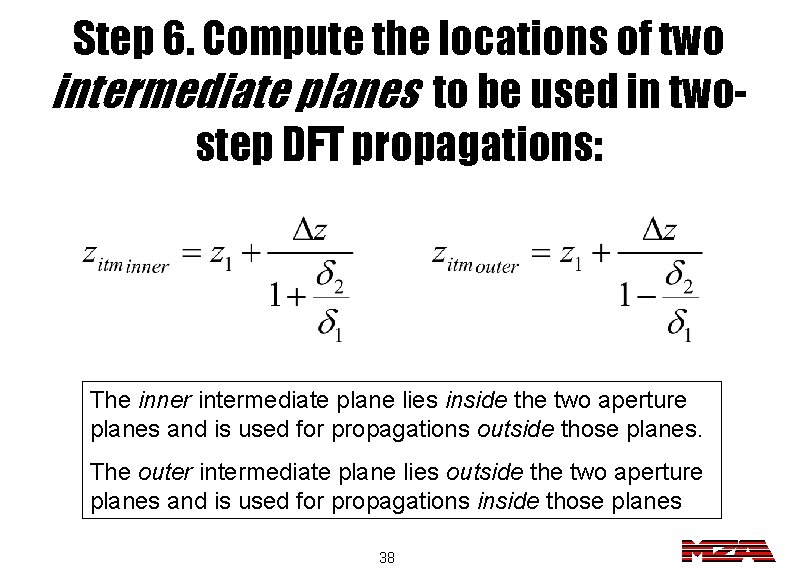
Step 6. Compute the locations of two intermediate planes to be used in twostep DFT propagations: The inner intermediate plane lies inside the two aperture planes and is used for propagations outside those planes. The outer intermediate plane lies outside the two aperture planes and is used for propagations inside those planes 38
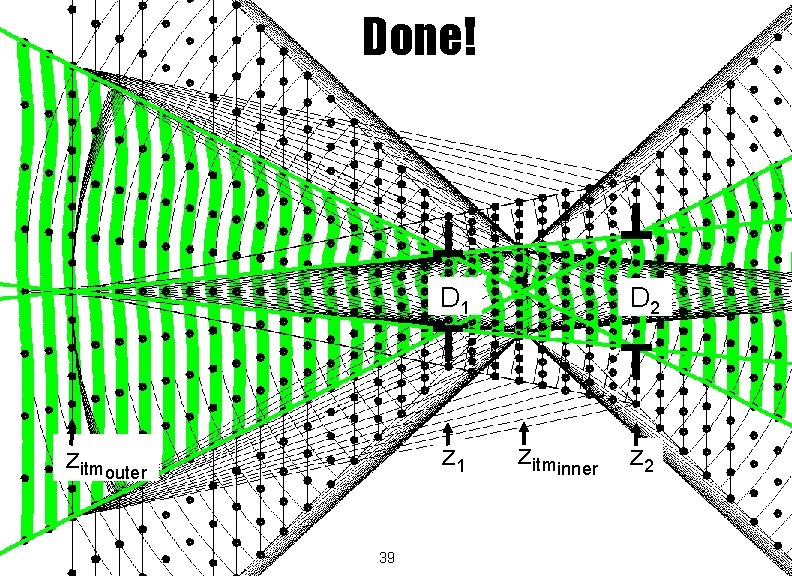
Done! D 1 zitmouter 39 D 2 zitminner z 2
Summary and Conclusions • We have presented a simple step-by-step method for choosing mesh spacings and dimensions for wave optics simulation. • This method addresses both modeling correctness and computational efficiency, while leaving the user enough flexibility to deal with additional constraints. • The method is amenable to automated implementation and well-suited for use with automated optimization techniques. • Caveat: there are other important issues that must be taken into account in order to obtain correct results using wave optics simulation. • For more information: – read the paper in the Proceedings – download our short course on Modeling and Simulation of Beam Control Systems, http: //www. mza. com/doc/MZADEPSBCSMSC 2004 – or contact me, Steve Coy, coy@mza. com. 40