
Choosing Effective Drivers for Whole System Reform Michael


- Slides: 34
Choosing Effective Drivers for Whole System Reform Michael Fullan Ontario, Canada Strong Performers and Successful Reformers Lessons from PISA OECD-Tokyo, Japan Seminar June 28 -29, 2011 www. michaelfullan. ca
Outline ★ ★ On the Dangers of misinterpreting Lessons from PISA. Ontario illustration Advice to Japan Questions/Comments from the Floor
Wrong vs Right Drivers ★ ★ Accountability vs Capacity Building Individual vs Teamwork Technology vs Pedagogy Piecemeal vs Systemic —Fullan, 2011
Drivers ★ ★ Wrong Driver: a deliberate lead policy/strategy force that has little chance of achieving the result Right Driver: lead policy/strategy with a high chance of achieving the result
Four Essential Conditions ★ ★ Intrinsic motivation Engage students and teachers in continuous improvement Inspire teamwork Affect 100% of students and teachers —Fullan, 2011
Key distinctions ★ ★ ★ Right (dominant) vs Wrong (second tier) drivers Sequence is critical Cohesion, not just alignment
On Misinterpreting PISA ★ You need to understand the basic philosophy and ‘feel’ that effective system leaders grasp—not a patchwork of good ad hoc ideas, but an integrated ‘cohesive system’ of a small number of core things that they do well and persistently
Misinterpreting Accountability ★ ★ ★ It is not Centralization vs Decentralization but rather what parts you centralize and decentralize and how they work together When you decentralize how do you get ‘systemness’. It is not local autonomy that is important but locals working as peers in a transparent way to get results, supported and monitored by the center (see Mc. Kinsey finding)
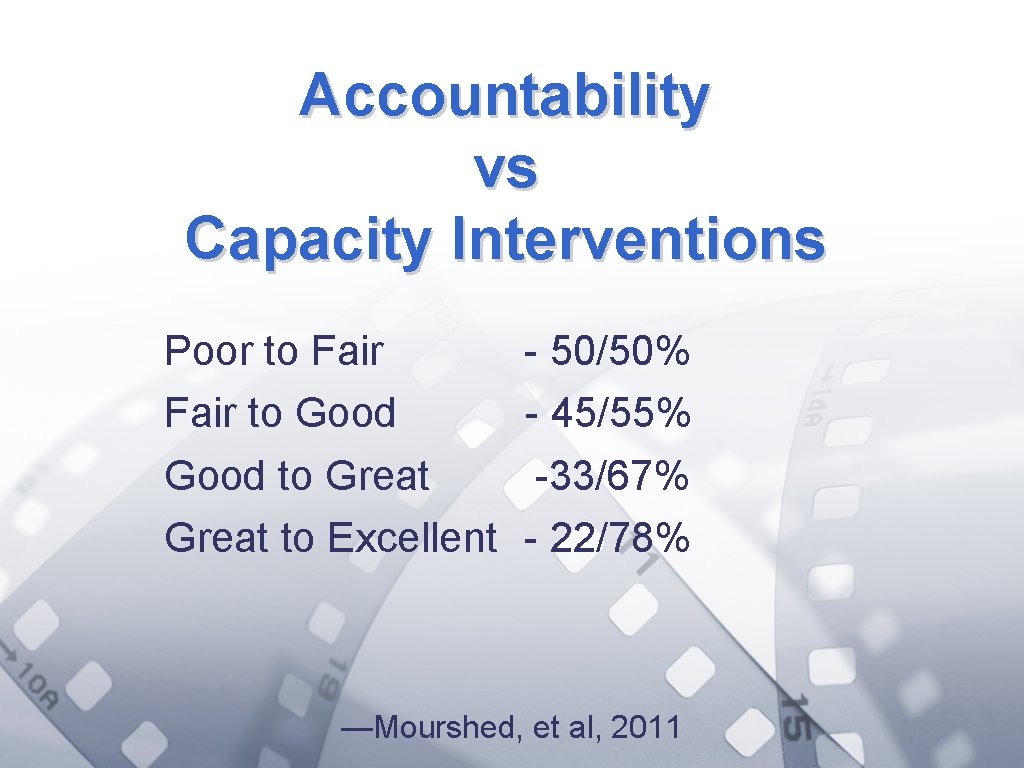
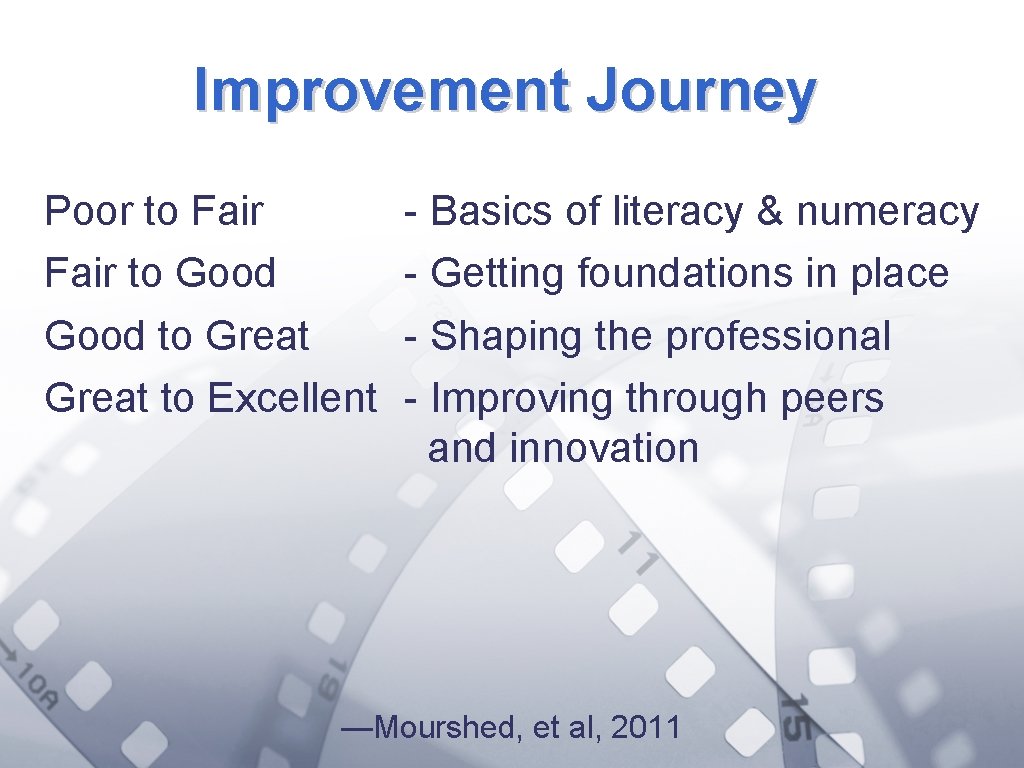
Accountability vs Capacity Interventions Poor to Fair to Good to Great to Excellent - 50/50% - 45/55% -33/67% - 22/78% —Mourshed, et al, 2011
Vertical Accountability ★ ★ Direction from the center re core goals. Partnership with the sector in pursuit of the goals. Transparency of results and practice Monitoring and non-judgmental intervention
Lateral Accountability Capacity building, engagement and trust building across schools and regions. Openness of sharing Builds mutual allegiance and collaborative competition —Fullan, 2011
Misinterpreting Quality of Teachers ★ ★ The finding that student learning cannot rise above the quality of teachers is being dangerously misunderstood. The 30% myth. The big driver is not human capital but social capital. What you do AFTER teachers begin their jobs is more important than what you do before/working conditions are key.
Social Capital ★ ★ Social capital drives human capital more than the other way around Social capital across the system not just within schools (clusters, pairing, learning from other successes) In all of this, focus, precision, preoccupation with implementation Mc. Kinsey finding
Improvement Journey Poor to Fair to Good to Great to Excellent - Basics of literacy & numeracy - Getting foundations in place - Shaping the professional - Improving through peers and innovation —Mourshed, et al, 2011
Technology vs Pedagogy ★ ★ ★ Technology has been winning the race over pedagogy for the past 40 years Technology is more seductive than pedagogy Deepen instruction and harness technology—this is the correct sequence
Piecemeal vs Systemic ★ ★ Back to the feel, underpinnings that shapes the strategy: continuous integration and cohesion Constantly, deliberately and transparently connecting the dots. Overdetermine systemness.
Ontario Case: Main Elements 1/Levin ★ ★ ★ Public goals and targets Clear strategy, strong leadership at all levels Beyond projects to system change Sector support: partnership, positive twoway communication. Policy is supportive
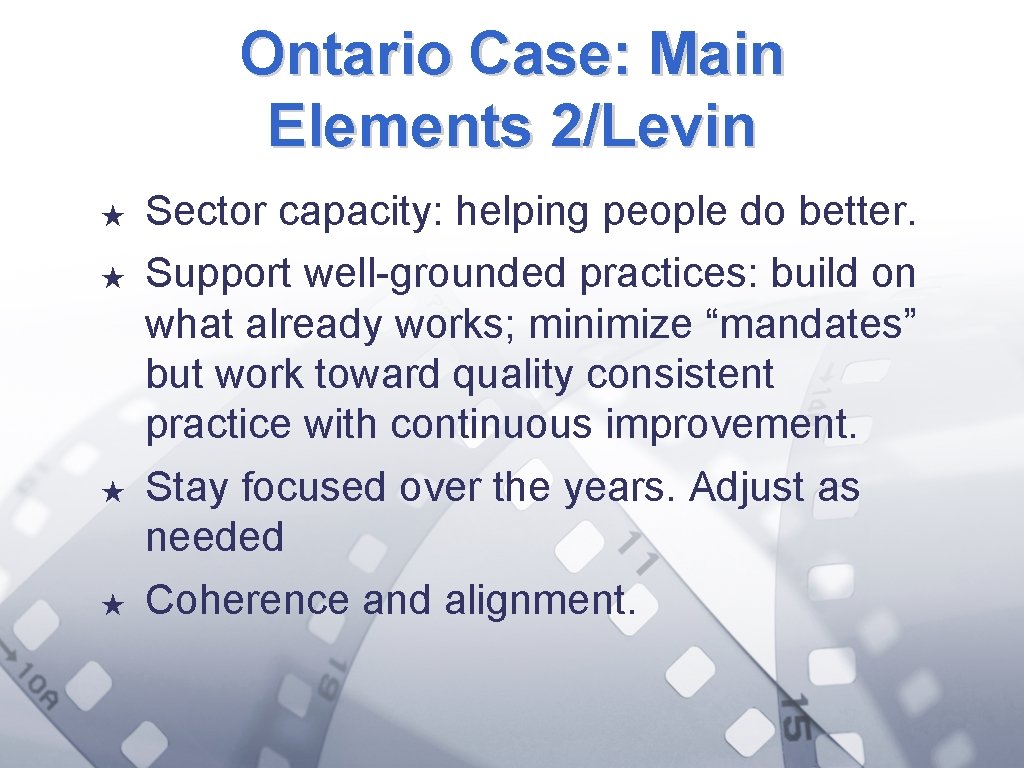
Ontario Case: Main Elements 2/Levin ★ ★ Sector capacity: helping people do better. Support well-grounded practices: build on what already works; minimize “mandates” but work toward quality consistent practice with continuous improvement. Stay focused over the years. Adjust as needed Coherence and alignment.
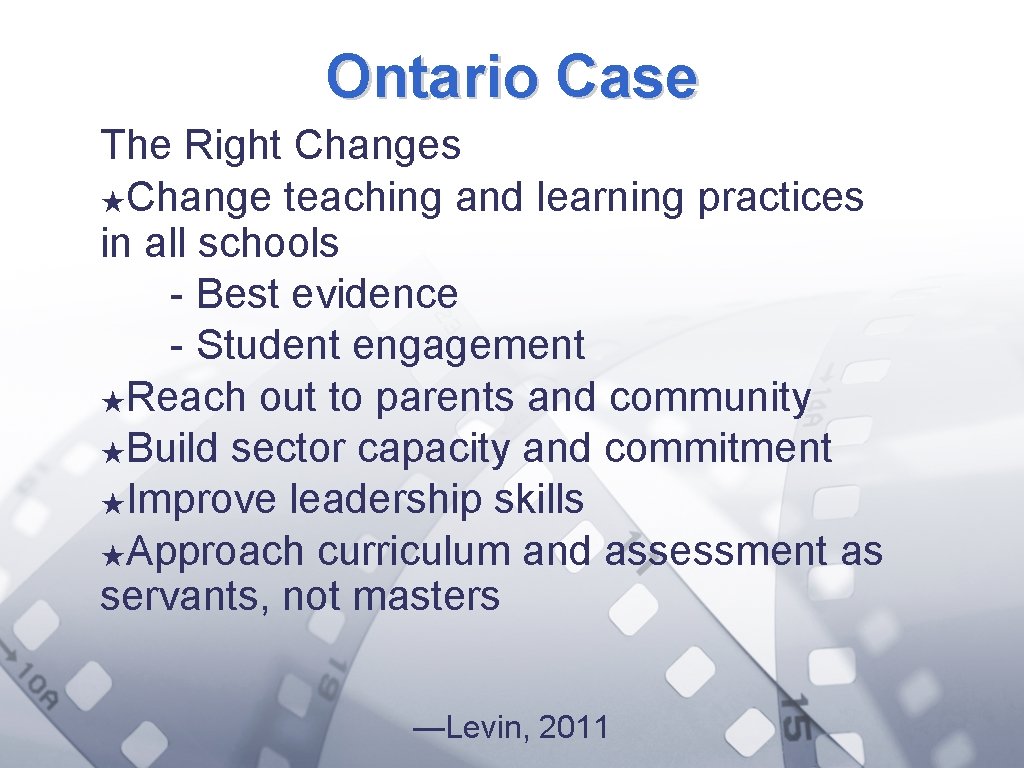
Ontario Case The Right Changes ★Change teaching and learning practices in all schools - Best evidence - Student engagement ★Reach out to parents and community ★Build sector capacity and commitment ★Improve leadership skills ★Approach curriculum and assessment as servants, not masters —Levin, 2011
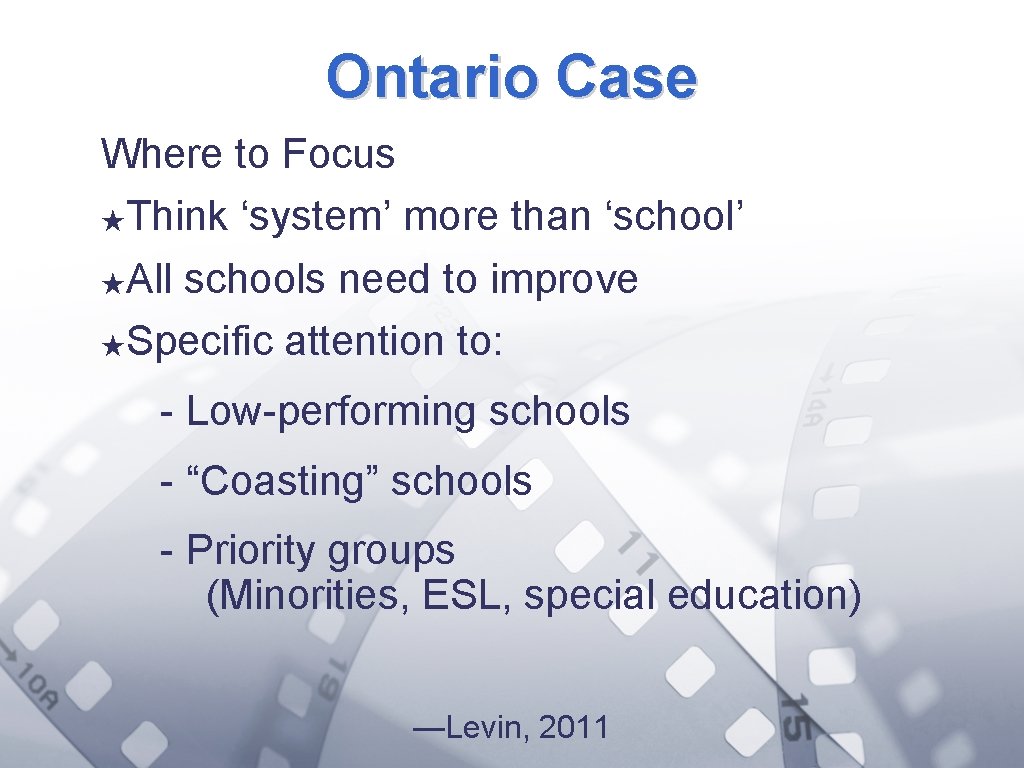
Ontario Case Where to Focus ★Think ‘system’ more than ‘school’ ★All schools need to improve ★Specific attention to: - Low-performing schools - “Coasting” schools - Priority groups (Minorities, ESL, special education) —Levin, 2011
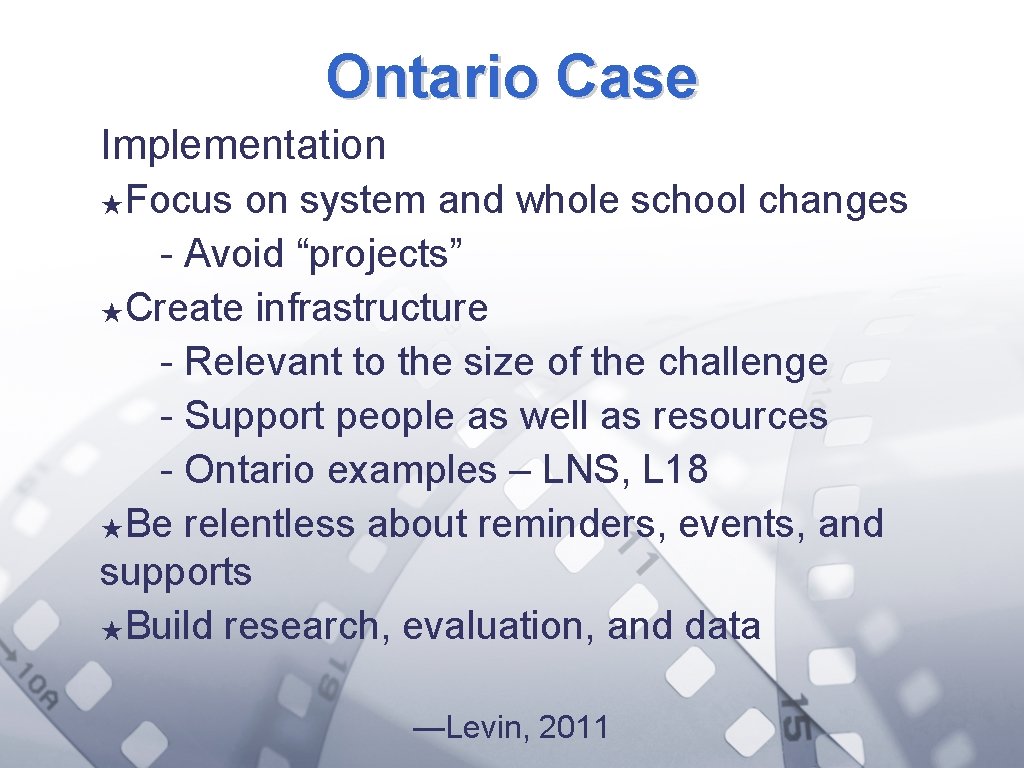
Ontario Case Implementation ★Focus on system and whole school changes - Avoid “projects” ★Create infrastructure - Relevant to the size of the challenge - Support people as well as resources - Ontario examples – LNS, L 18 ★Be relentless about reminders, events, and supports ★Build research, evaluation, and data —Levin, 2011
Ontario Detour Capacity to Deliver ★Fullan’s ‘tri-level solution’ ★State departments/ministries need lots of change Never initially designed to support improvement ★Alignment of policy and approach across units - This is very hard to do ★Same at district level —Levin, 2011
Lessons for Japan ★ ★ ★ Danger of getting the lessons wrong Great capacity IF the right lessons are incorporated Don’ts and Do’s for Japan given their situation and current plan
Don’ts for Japan ★ ★ ★ ★ Don’t rely too heavily on governance and related structural reform (roles of govt, prefectures, municipalities, schools) Don’t rely on increasing accountability Don’t rely on top-down workshops Don’t rely on revision of courses Don’t rely on smaller class sizes Don’t rely on individual school management Don’t rely on check and improve cycle (unless it is embedded in the day to day work)
Do’s for Japan ★ ★ Focus on a small number of core goals (literacy, math, science). Take advantage of lesson planning capacity to focus and leverage social capital. Schools learning from each other. Do find and spread best practice-who is getting best results re ‘improving lower ranks’; re ‘ improving top proficiency’. Work on enjoyment and engagement of students (teacher role, student peers)
Do’s for Japan ★ ★ ★ Do reduce administrative load of school leaders and support learning on the job, backed up by professional development (PD is not the driver, it is the reinforcer) Create a climate and strategy for leanring from prefectures that are getting best results. Build partnerships with parents and the communities
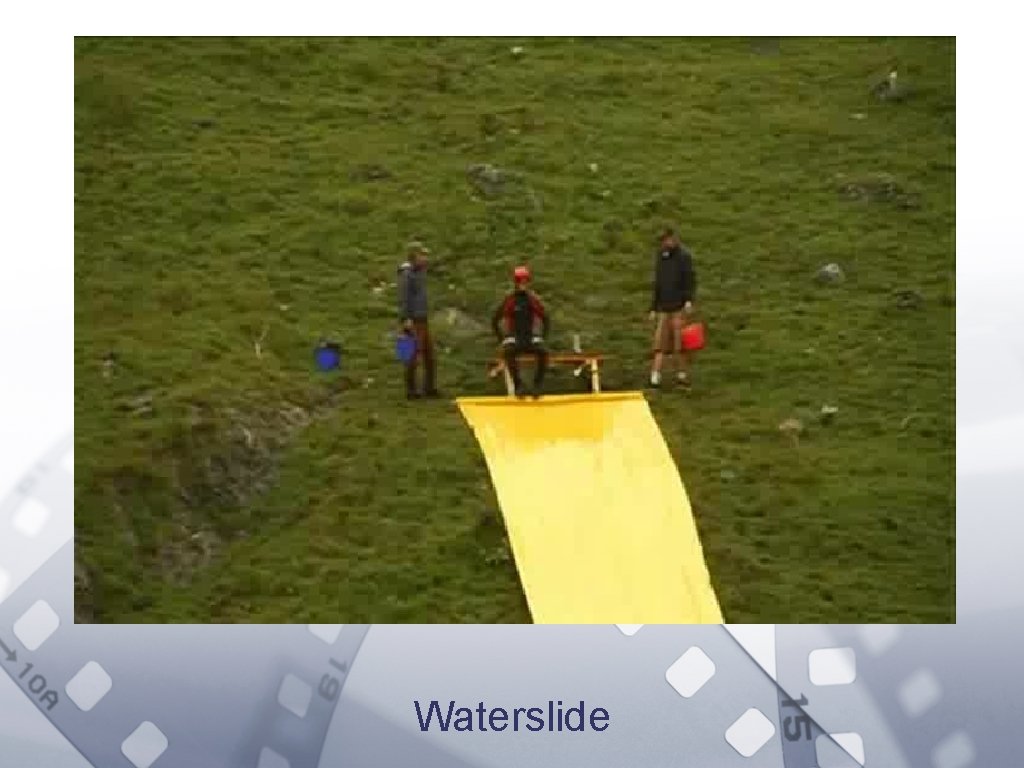
Waterslide
Questions/Comments ★ ★ THANK YOU <mfullan@me. com>
Evidence ★ ★ Wrong drivers don’t work Right drivers do —Fullan, 2011
Right Drivers ★ ★ Attitude/Philosophy: Focus on improvement Transparency of results and practice —Fullan, 2011
Riding the Right Elephant: Focus on Changing the Culture ★ ★ Capacity Building Teamwork Instruction Systemic —Fullan, 2011
The Heart of the Matter ★ ★ Learning-instruction nexus Social capital Pedagogy matches technology Systemic synergy —Fullan, 2011
Whole System Reform: Criteria ★ ★ ★ All means all Raise the bar, close the gap Individual and collective capacity of educators Precision/specificity Deep student engagement Measureable improvement/results —Fullan, 2011
References ★ ★ ★ Fullan, M. (2011). Choosing the wrong drivers for whole system reform. Melbourne, AU. , Centre for Strategic Education, Seminar Series. 2011. Levin, B. (2011). System improvement. Presentation at PARCC, Washington, DC. June, 2011. Mourshed, M. , Chinezi, C. , & Barber, M. (2010). How the world’s most improved systems keep getting better. London: Mc. Kinsey & Company.