
Choosing and developing a topic ch 10 It

- Slides: 32
Choosing and developing a topic ch. 10
It is important that you select a topic of interest to you: Researching will be more fun Audience will be interested if you are
Choosing an interesting topic When looking for a topic consider: Ø Your favorite hobbies Ø Personal experiences Ø Values- what is important to you Ø Interests- what would you like to learn more about?
Criteria for selecting a topic: ü Is this topic appropriate to the occasion? ü Will this topic appeal to my listeners’ interests? ü Is this topic something I can speak about with enthusiasm and insight? ü Will I be able to offer a fresh perspective on this topic?
When narrowing your topic ask the following questions: 1. What does the audience most likely know about this subject? 2. What elements are most important to this topic? 3. How much can I competently research and report on in the time I am given to speak?
Defining the general purpose of your speech • What do you hope to accomplish in presenting this speech? • What topic do you want to speak about and why? • How will your audience be affected by your speech?
Three general purposes for speaking • To entertain- providing your audience with something pleasurable to listen to • To inform- teaching your audience about a topic • To persuade- to move your audience to a new attitude or behavior
• After defining your general purpose you will need to define your specific purpose
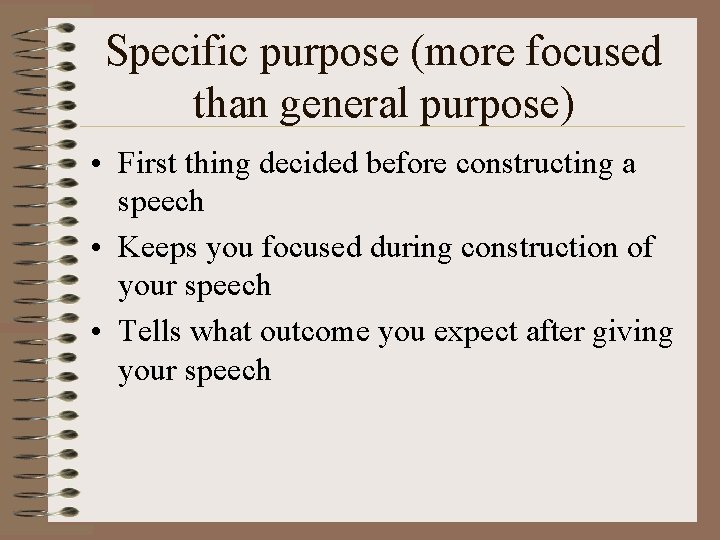
Specific purpose (more focused than general purpose) • First thing decided before constructing a speech • Keeps you focused during construction of your speech • Tells what outcome you expect after giving your speech
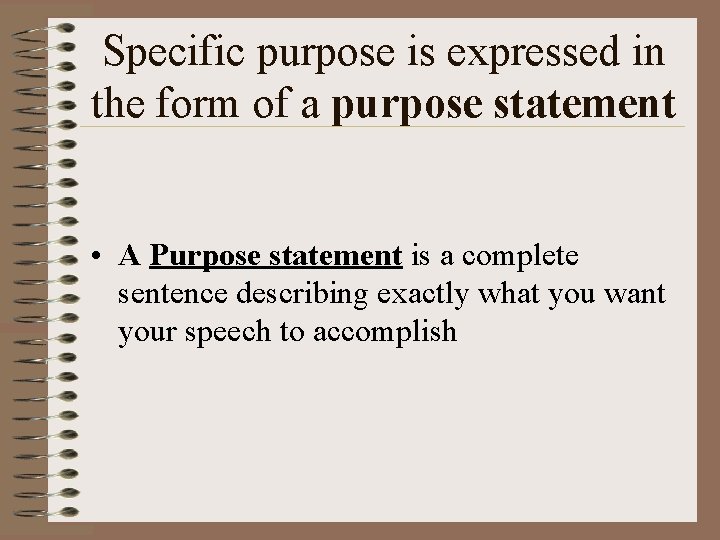
Specific purpose is expressed in the form of a purpose statement • A Purpose statement is a complete sentence describing exactly what you want your speech to accomplish
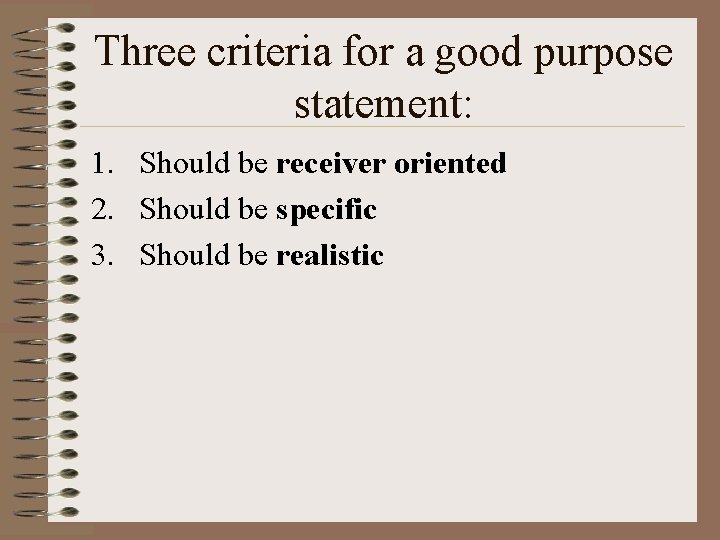
Three criteria for a good purpose statement: 1. Should be receiver oriented 2. Should be specific 3. Should be realistic
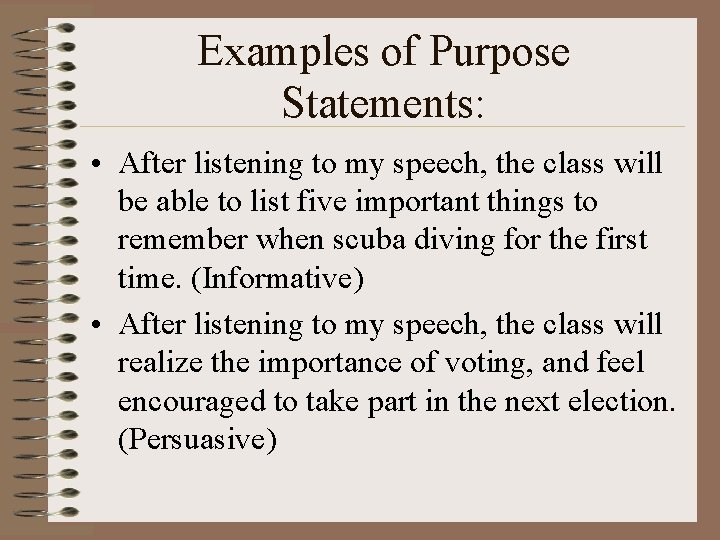
Examples of Purpose Statements: • After listening to my speech, the class will be able to list five important things to remember when scuba diving for the first time. (Informative) • After listening to my speech, the class will realize the importance of voting, and feel encouraged to take part in the next election. (Persuasive)
The thesis statement • Central idea of your speech is • Main idea you want your audience to remember • Stated in beginning and end of your speech • Constructed at the end of creating your speech • The thesis is much more focused than your purpose statement
Let’s review Why is it important to choose a topic of interest to you? • Researching will be more fun • Audience interest
True or False? • When narrowing my topic I should not consider my audience. FALSE!!!!
What are three general purposes for speaking? • To entertain • To inform • To persuade
• After defining your general purpose you need to define your________ • specific purpose
In conclusion • Topic selection is a very important element in creating a successful speech • When choosing a topic look for one that will interest you as well as your audience
Beginning and ending your speech
Introduction • There are four functions of the introduction: 1. Capture audience attention 2. Preview main points of your speech 3. Set the mood and tone of the speech 4. Demonstrate why this topic is of importance
The conclusion • 1. 2. 3. Conclusion has three essential functions: To review thesis To review your main points To provide a memorable final remark
When Concluding Remember… • Do not end abruptly • Do not ramble, make it clear when speech is over • Do not introduce new points • Do not apologize • Do end your speech in a strong manner, with a powerful concluding statement
Supporting material • Four functions of supporting material 1. To clarify 2. To make interesting 3. To make memorable 4. To prove
Types of supporting material • Definitions • Examples -hypothetical examples • Statistics • Analogies/ Comparison-contrast • Anecdotes • Quotation/ Testimony
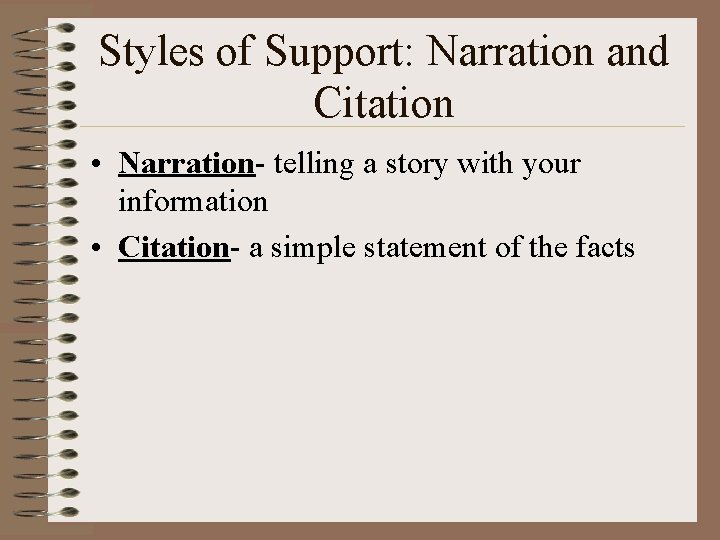
Styles of Support: Narration and Citation • Narration- telling a story with your information • Citation- a simple statement of the facts
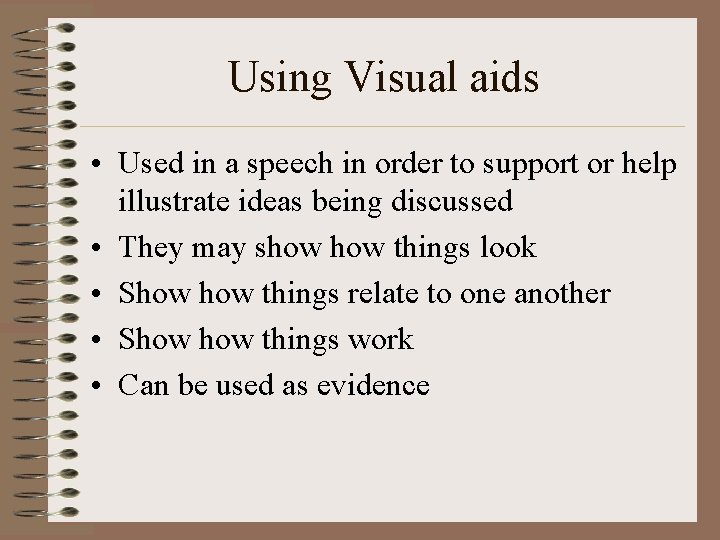
Using Visual aids • Used in a speech in order to support or help illustrate ideas being discussed • They may show things look • Show things relate to one another • Show things work • Can be used as evidence
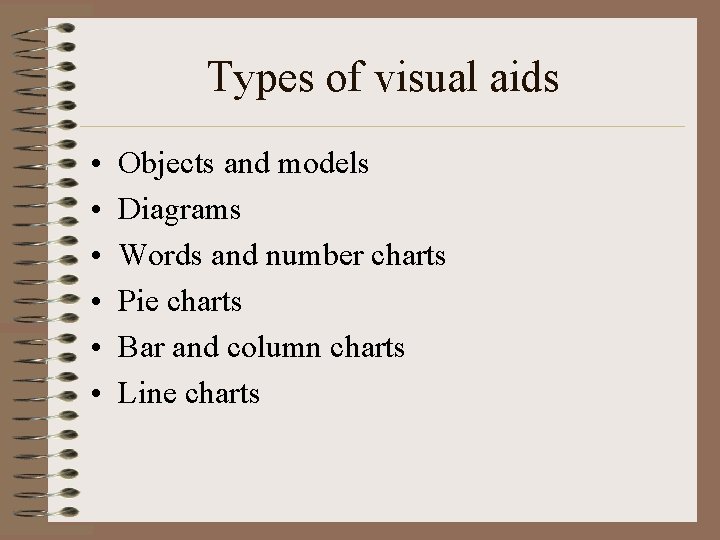
Types of visual aids • • • Objects and models Diagrams Words and number charts Pie charts Bar and column charts Line charts
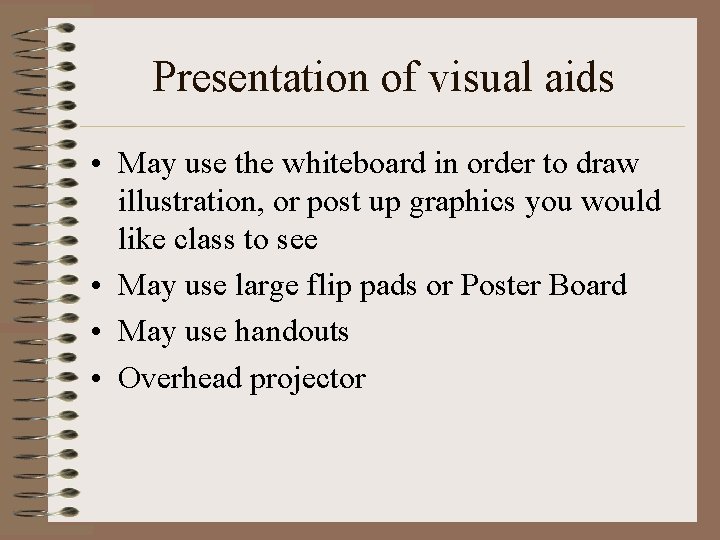
Presentation of visual aids • May use the whiteboard in order to draw illustration, or post up graphics you would like class to see • May use large flip pads or Poster Board • May use handouts • Overhead projector
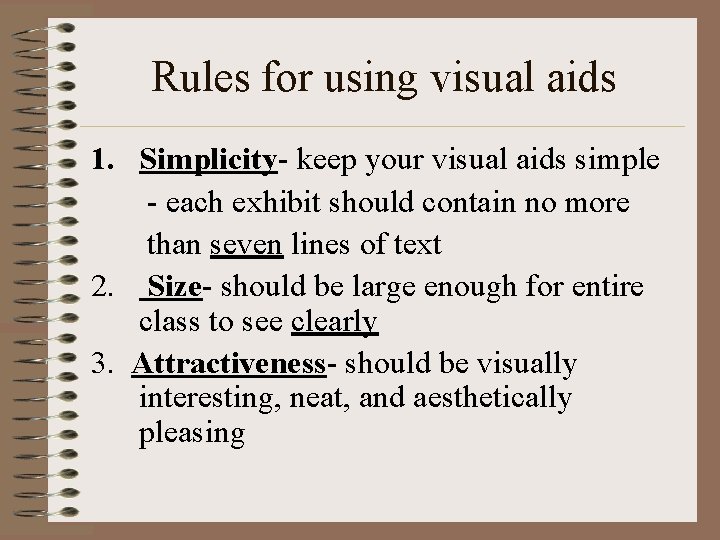
Rules for using visual aids 1. Simplicity- keep your visual aids simple - each exhibit should contain no more than seven lines of text 2. Size- should be large enough for entire class to see clearly 3. Attractiveness- should be visually interesting, neat, and aesthetically pleasing
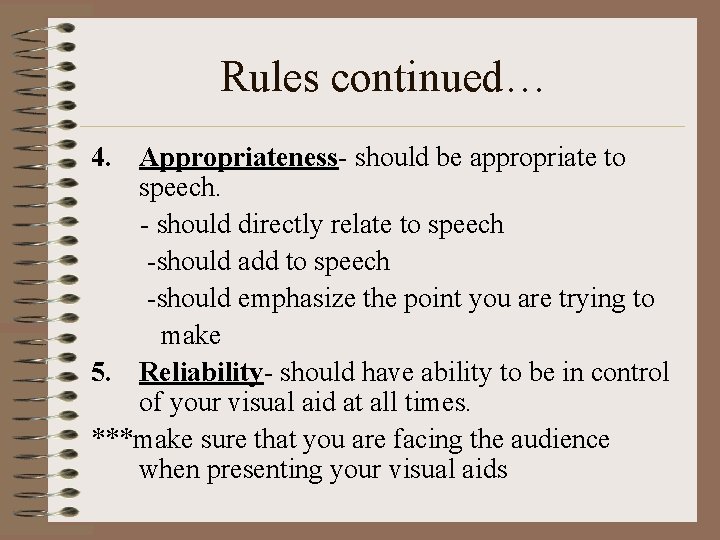
Rules continued… 4. Appropriateness- should be appropriate to speech. - should directly relate to speech -should add to speech -should emphasize the point you are trying to make 5. Reliability- should have ability to be in control of your visual aid at all times. ***make sure that you are facing the audience when presenting your visual aids
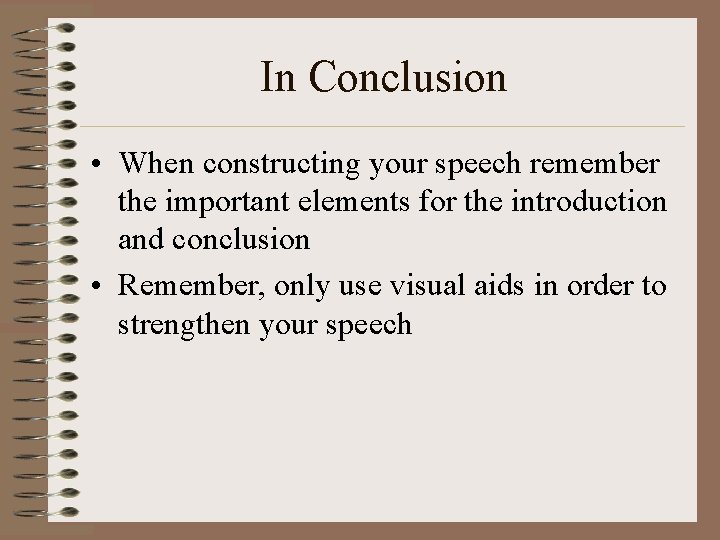
In Conclusion • When constructing your speech remember the important elements for the introduction and conclusion • Remember, only use visual aids in order to strengthen your speech