
Choosing A Place To Live The DecisionMaking Process

- Slides: 15
Choosing A Place To Live
The Decision-Making Process • • Step 1: State the Situation Step 2: Identify Your Resources Step 3: List the Options Step 4: Weigh the Options Step 5: Choose the Best Option Step 6: Carry Out Your Decision Step 7: Evaluate the Decision
Influences on Housing Decisions • • • Needs Wants & Priorities Resources – Human Resources: personal qualities that people possess including creativity, imagination, knowledge, skills, talent, time, energy and experience. – Material Resources: tangible assets, such as money, property, supplies, and tools.
Choosing A Location • Housing Trends in the United States – Housing tends to be more expensive on the East and West Coasts than in the interior of the country. – Housing costs tend to be higher in areas with the most desirable climates and lower in areas with severe winters. – Housing within and near major cities tends to be more expensive.
Housing Trends cont. • Within major cities, housing costs are generally higher in downtown areas. • Single-family homes in suburbs often cost more than those in cities. • Housing costs in rural areas tend to be the lowest of all.
Types of Locations • Urban– living in the city, convenience of living close to work, shopping and cultural opportunities • Suburban– residential area adjacent to a city, offers the best of both city and country living. Offers more space than city living but within driving distance of the amenities of the city. • Rural– living in the country, offers a slower –paced life, wide open spaces, less industry in area.
Factors to Consider in Choosing A Location • Convenience – Close to public transportation – Close to place of employment – Close to basic services such as retail stores etc. – Close to schools or recreational facilities • Condition of the Neighborhood – The value of the home increases or decreases with the value of other homes in the area.
Factors to Consider in Choosing A Location (cont. ) • Neighbors – If have children are there other children in the neighborhood? – Friendly neighbors? • Drawbacks – Check amount of noise and air pollution – Noise on streets – Safety concerns such as child abusers, drug activity etc. in the neighborhood
Assessing Community Services vary from community to community. Check out availability and quality of the services before choosing a place to live. • Utilities & Public Services – Electricity, gas, water, telephone, internet access • Public Safety – Number of staff and distance from the home can affect response time – Location of nearest hospital and ambulance
Assessing Community Services (cont. ) • Tax Policies – What is the tax rate?
Housing Alternatives • Multifamily Units-offer lower housing costs than single-family housing • Apartments: – High-rise apartment: one of many separate living units in a multistory building. – Low-rise apartments: an apartment in a building with few floors. – Garden apartment: unit in a low-rise building that includes landscaped grounds – Efficiency apartment: unit with one main room, a small kitchen area, and a bathroom. It is also known as a studio apartment.
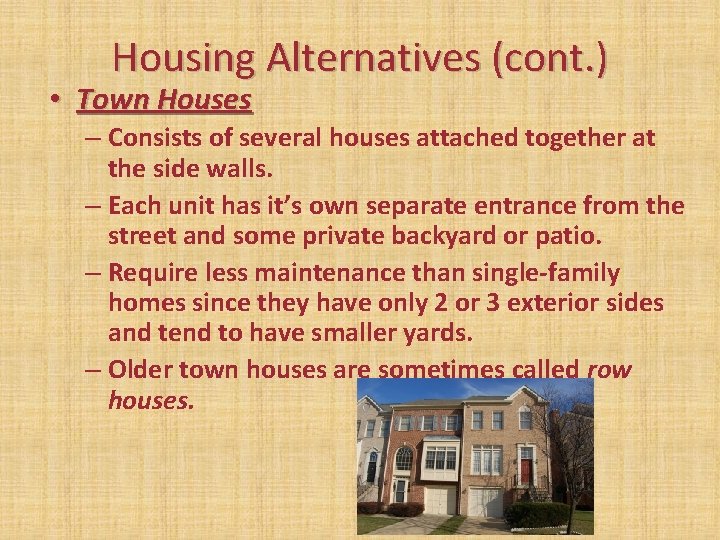
Housing Alternatives (cont. ) • Town Houses – Consists of several houses attached together at the side walls. – Each unit has it’s own separate entrance from the street and some private backyard or patio. – Require less maintenance than single-family homes since they have only 2 or 3 exterior sides and tend to have smaller yards. – Older town houses are sometimes called row houses.
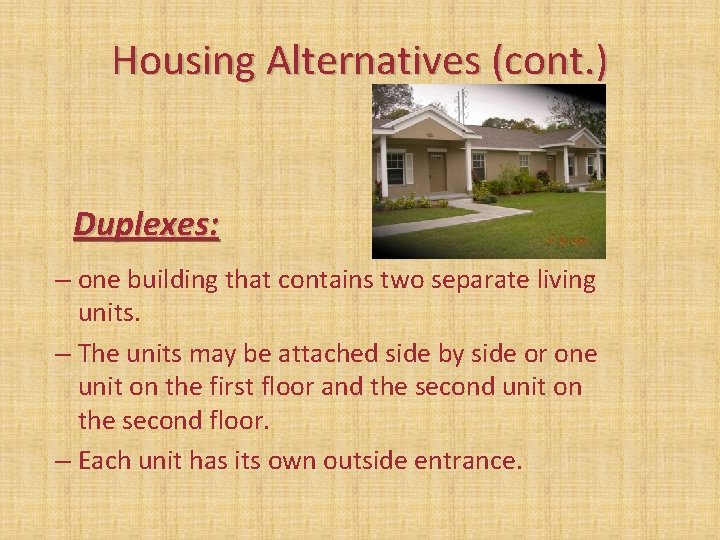
Housing Alternatives (cont. ) Duplexes: – one building that contains two separate living units. – The units may be attached side by side or one unit on the first floor and the second unit on the second floor. – Each unit has its own outside entrance.
Housing Alternatives (cont. ) • Other Multifamily Units: – Triplex: 3 housing units that are attached at the side walls – Fourplex: 4 housing units that are attached at the side walls • Single Family Housing: – A detached, or separated dwelling designed to be used by one household. – Most attractive advantage is privacy – Owners are responsible for their own outdoor maintenance and upkeep of the home.
The End