
Choose and Implement a Mobile Strategy BYOD is
Choose and Implement a Mobile Strategy BYOD is not the only option, nor is it dead, but it is only part of a custom-fit mobile strategy. Choose the right mix of models, then tie all of your mobile initiatives together. Info-Tech Research Group, Inc. is a global leader in providing IT research and advice. Info-Tech’s products and services combine actionable insight and relevant advice with Info-Tech's products and services combine actionable insight advice ready-to-use tools and templates that cover theand fullrelevant spectrum of IT with concerns. and templates that cover the full spectrum©of 1997 -2015 IT concerns. © 1997 -Research 2015 Info-Tech Group Research Inc. Info-Tech Research Group 1
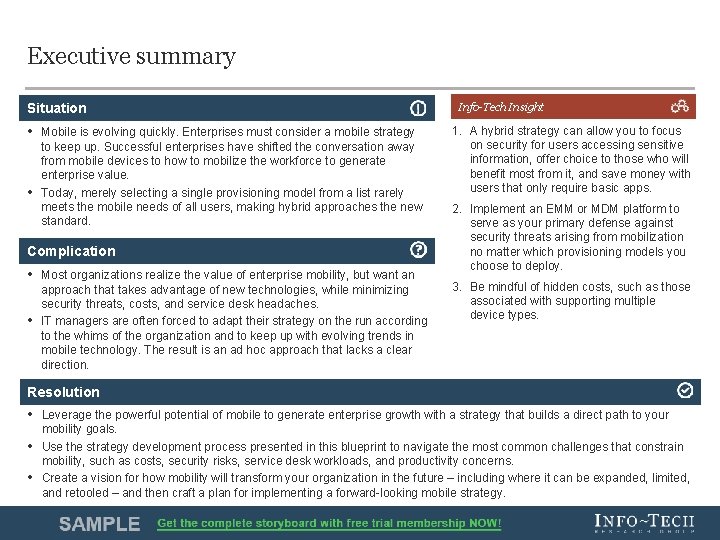
Executive summary Situation • Mobile is evolving quickly. Enterprises must consider a mobile strategy • to keep up. Successful enterprises have shifted the conversation away from mobile devices to how to mobilize the workforce to generate enterprise value. Today, merely selecting a single provisioning model from a list rarely meets the mobile needs of all users, making hybrid approaches the new standard. Complication • Most organizations realize the value of enterprise mobility, but want an • approach that takes advantage of new technologies, while minimizing security threats, costs, and service desk headaches. IT managers are often forced to adapt their strategy on the run according to the whims of the organization and to keep up with evolving trends in mobile technology. The result is an ad hoc approach that lacks a clear direction. Info-Tech Insight 1. A hybrid strategy can allow you to focus on security for users accessing sensitive information, offer choice to those who will benefit most from it, and save money with users that only require basic apps. 2. Implement an EMM or MDM platform to serve as your primary defense against security threats arising from mobilization no matter which provisioning models you choose to deploy. 3. Be mindful of hidden costs, such as those associated with supporting multiple device types. Resolution • Leverage the powerful potential of mobile to generate enterprise growth with a strategy that builds a direct path to your • • mobility goals. Use the strategy development process presented in this blueprint to navigate the most common challenges that constrain mobility, such as costs, security risks, service desk workloads, and productivity concerns. Create a vision for how mobility will transform your organization in the future – including where it can be expanded, limited, and retooled – and then craft a plan for implementing a forward-looking mobile strategy. Info-Tech Research Group 2
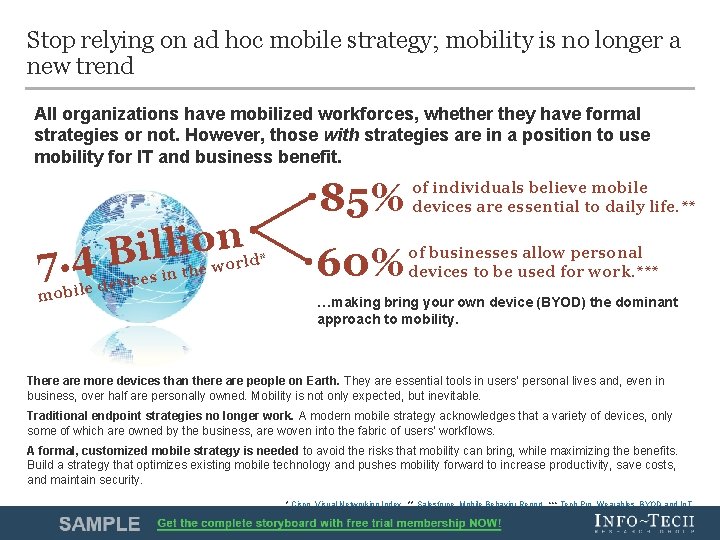
Stop relying on ad hoc mobile strategy; mobility is no longer a new trend All organizations have mobilized workforces, whether they have formal strategies or not. However, those with strategies are in a position to use mobility for IT and business benefit. n o i l l i 7. 4 B in the world* vices e d e l i ob m 85% of individuals believe mobile devices are essential to daily life. ** 60% of businesses allow personal devices to be used for work. *** …making bring your own device (BYOD) the dominant approach to mobility. There are more devices than there are people on Earth. They are essential tools in users’ personal lives and, even in business, over half are personally owned. Mobility is not only expected, but inevitable. Traditional endpoint strategies no longer work. A modern mobile strategy acknowledges that a variety of devices, only some of which are owned by the business, are woven into the fabric of users’ workflows. A formal, customized mobile strategy is needed to avoid the risks that mobility can bring, while maximizing the benefits. Build a strategy that optimizes existing mobile technology and pushes mobility forward to increase productivity, save costs, and maintain security. * Cisco, Visual Networking Index ** Salesforce, Mobile Behavior Report *** Tech Pro, Wearables, BYOD and Io. T Info-Tech Research Group 3
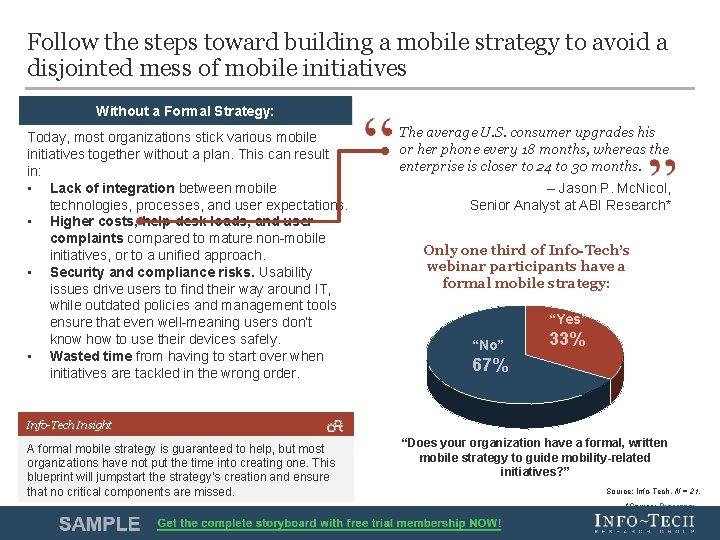
Follow the steps toward building a mobile strategy to avoid a disjointed mess of mobile initiatives Without a Formal Strategy: Today, most organizations stick various mobile initiatives together without a plan. This can result in: • Lack of integration between mobile technologies, processes, and user expectations. • Higher costs, help desk loads, and user complaints compared to mature non-mobile initiatives, or to a unified approach. • Security and compliance risks. Usability issues drive users to find their way around IT, while outdated policies and management tools ensure that even well-meaning users don’t know how to use their devices safely. • Wasted time from having to start over when initiatives are tackled in the wrong order. The average U. S. consumer upgrades his or her phone every 18 months, whereas the enterprise is closer to 24 to 30 months. – Jason P. Mc. Nicol, Senior Analyst at ABI Research* Only one third of Info-Tech’s webinar participants have a formal mobile strategy: “Yes” “No” 33% 67% Info-Tech Insight A formal mobile strategy is guaranteed to help, but most organizations have not put the time into creating one. This blueprint will jumpstart the strategy’s creation and ensure that no critical components are missed. “Does your organization have a formal, written mobile strategy to guide mobility-related initiatives? ” Source: Info-Tech. N = 21. *Source: Processor. Info-Tech Research Group 4
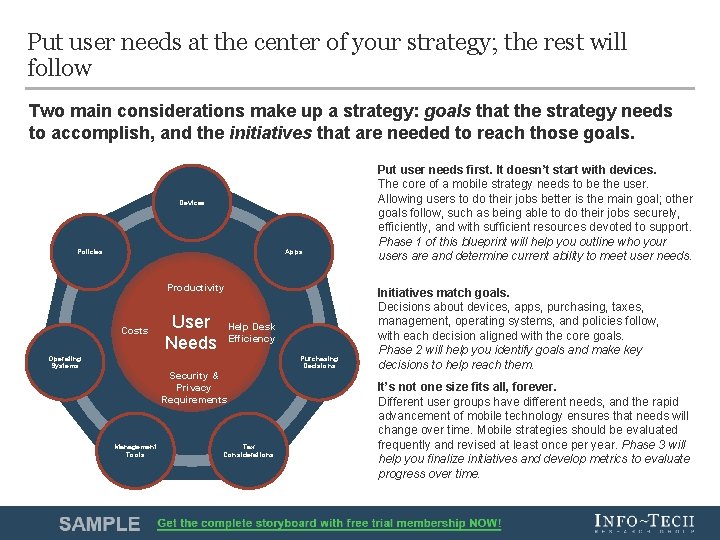
Put user needs at the center of your strategy; the rest will follow Two main considerations make up a strategy: goals that the strategy needs to accomplish, and the initiatives that are needed to reach those goals. Devices Policies Apps Productivity Costs Operating Systems User Needs Help Desk Efficiency Security & Privacy Requirements Management Tools Tax Considerations Purchasing Decisions Put user needs first. It doesn’t start with devices. The core of a mobile strategy needs to be the user. Allowing users to do their jobs better is the main goal; other goals follow, such as being able to do their jobs securely, efficiently, and with sufficient resources devoted to support. Phase 1 of this blueprint will help you outline who your users are and determine current ability to meet user needs. Initiatives match goals. Decisions about devices, apps, purchasing, taxes, management, operating systems, and policies follow, with each decision aligned with the core goals. Phase 2 will help you identify goals and make key decisions to help reach them. It’s not one size fits all, forever. Different user groups have different needs, and the rapid advancement of mobile technology ensures that needs will change over time. Mobile strategies should be evaluated frequently and revised at least once per year. Phase 3 will help you finalize initiatives and develop metrics to evaluate progress over time. Info-Tech Research Group 5
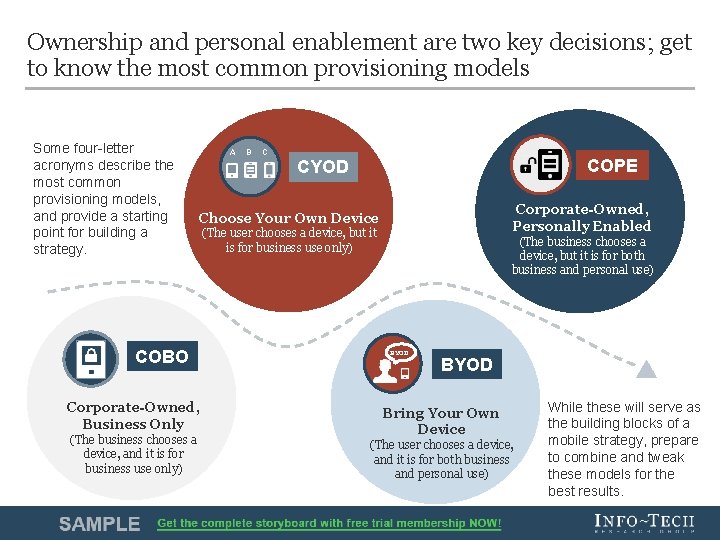
Ownership and personal enablement are two key decisions; get to know the most common provisioning models Some four-letter acronyms describe the most common provisioning models, and provide a starting point for building a strategy. A C COPE CYOD Corporate-Owned, Personally Enabled Choose Your Own Device COBO Corporate-Owned, Business Only (The business chooses a device, and it is for business use only) B (The user chooses a device, but it is for business use only) (The business chooses a device, but it is for both business and personal use) BYOD Bring Your Own Device (The user chooses a device, and it is for both business and personal use) While these will serve as the building blocks of a mobile strategy, prepare to combine and tweak these models for the best results. Info-Tech Research Group 6
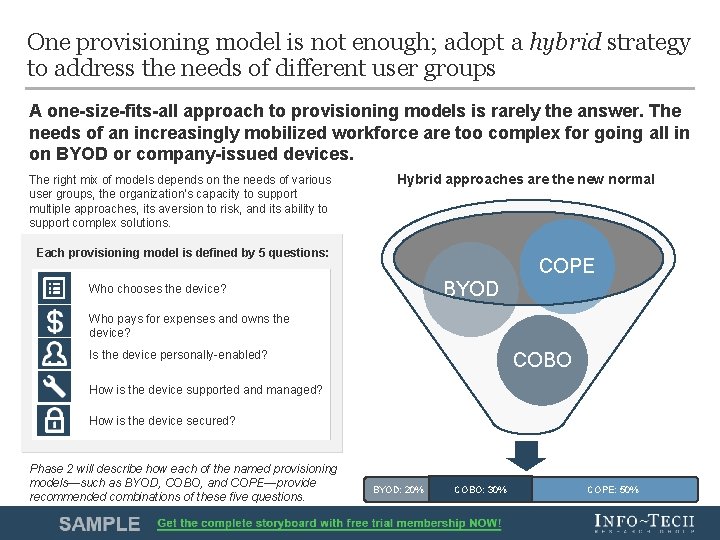
One provisioning model is not enough; adopt a hybrid strategy to address the needs of different user groups A one-size-fits-all approach to provisioning models is rarely the answer. The needs of an increasingly mobilized workforce are too complex for going all in on BYOD or company-issued devices. The right mix of models depends on the needs of various user groups, the organization’s capacity to support multiple approaches, its aversion to risk, and its ability to support complex solutions. Hybrid approaches are the new normal Each provisioning model is defined by 5 questions: COPE BYOD Who chooses the device? Who pays for expenses and owns the device? Is the device personally-enabled? COBO How is the device supported and managed? How is the device secured? Phase 2 will describe how each of the named provisioning models—such as BYOD, COBO, and COPE—provide recommended combinations of these five questions. BYOD: 20% COBO: 30% COPE: 50% Info-Tech Research Group 7
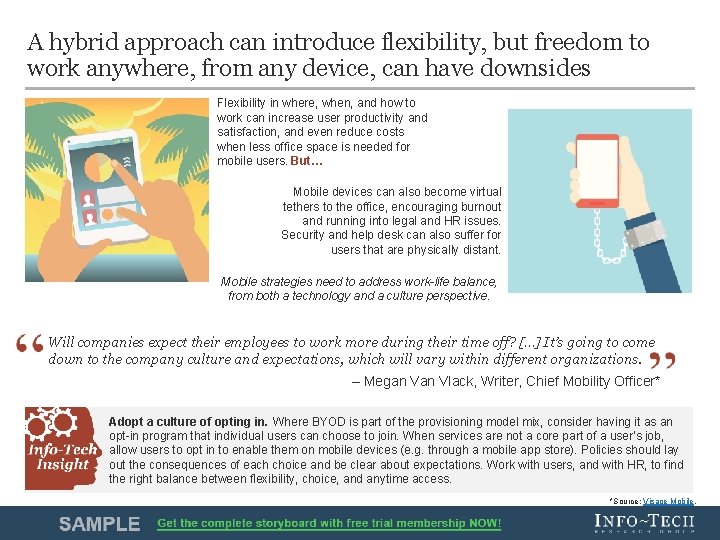
A hybrid approach can introduce flexibility, but freedom to work anywhere, from any device, can have downsides Flexibility in where, when, and how to work can increase user productivity and satisfaction, and even reduce costs when less office space is needed for mobile users. But… Mobile devices can also become virtual tethers to the office, encouraging burnout and running into legal and HR issues. Security and help desk can also suffer for users that are physically distant. Mobile strategies need to address work-life balance, from both a technology and a culture perspective. Will companies expect their employees to work more during their time off? […] It’s going to come down to the company culture and expectations, which will vary within different organizations. – Megan Vlack, Writer, Chief Mobility Officer* Adopt a culture of opting in. Where BYOD is part of the provisioning model mix, consider having it as an opt-in program that individual users can choose to join. When services are not a core part of a user’s job, allow users to opt in to enable them on mobile devices (e. g. through a mobile app store). Policies should lay out the consequences of each choice and be clear about expectations. Work with users, and with HR, to find the right balance between flexibility, choice, and anytime access. *Source: Visage Mobile. Info-Tech Research Group 8
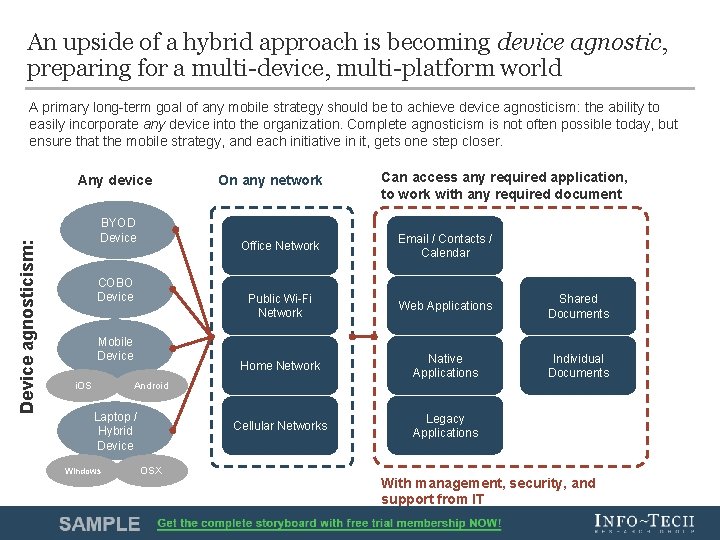
An upside of a hybrid approach is becoming device agnostic, preparing for a multi-device, multi-platform world A primary long-term goal of any mobile strategy should be to achieve device agnosticism: the ability to easily incorporate any device into the organization. Complete agnosticism is not often possible today, but ensure that the mobile strategy, and each initiative in it, gets one step closer. Device agnosticism: Any device BYOD Device COBO Device Mobile Device i. OS On any network Can access any required application, to work with any required document Office Network Email / Contacts / Calendar Public Wi-Fi Network Web Applications Shared Documents Home Network Native Applications Individual Documents Cellular Networks Legacy Applications Android Laptop / Hybrid Device Windows OSX With management, security, and support from IT Info-Tech Research Group 9

Integrate your mobile strategy with a broader end-user computing roadmap A strong mobile strategy is one stop in a comprehensive end-user computing roadmap. Start here Mobility Desktops Master the Ever. Expanding Puzzle of End. User Computing Disruptive Technology Create a Practical BYOE Action Plan Vendor Landscape: Enterprise Mobility Management Switch Mobile Platforms Implement Enterprise Mobility Management Develop & Enforce Policies That Securely Enable a Mobile Workforce A Exploit Disruptive Technology Develop a Windows Migration & Deployment Plan You are here: Choose and Implement a Mobile Strategy Implement Desktop Virtualization Seize the Potential of the Internet of Things Today Vendor Landscape: Desktop Virtualization Vendor Landscape: Thin Clients Info-Tech Research Group 10
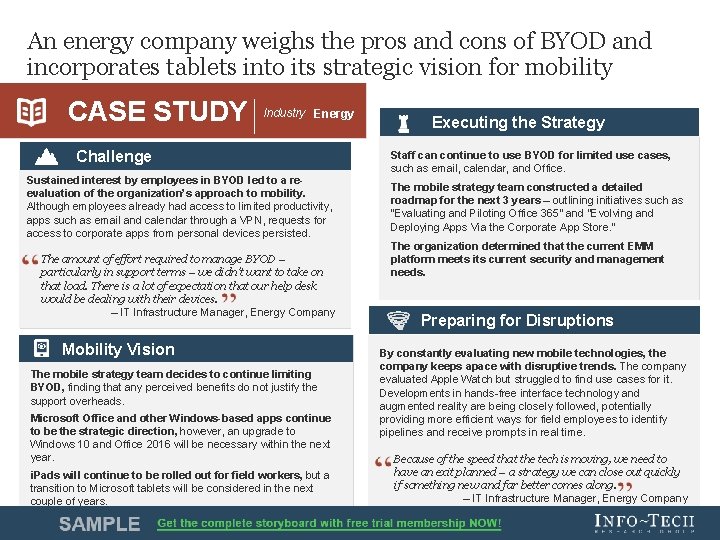
An energy company weighs the pros and cons of BYOD and incorporates tablets into its strategic vision for mobility CASE STUDY Industry Energy Challenge Sustained interest by employees in BYOD led to a reevaluation of the organization’s approach to mobility. Although employees already had access to limited productivity, apps such as email and calendar through a VPN, requests for access to corporate apps from personal devices persisted. The amount of effort required to manage BYOD – particularly in support terms – we didn’t want to take on that load. There is a lot of expectation that our help desk would be dealing with their devices. – IT Infrastructure Manager, Energy Company Mobility Vision The mobile strategy team decides to continue limiting BYOD, finding that any perceived benefits do not justify the support overheads. Microsoft Office and other Windows-based apps continue to be the strategic direction, however, an upgrade to Windows 10 and Office 2016 will be necessary within the next year. i. Pads will continue to be rolled out for field workers, but a transition to Microsoft tablets will be considered in the next couple of years. Executing the Strategy Staff can continue to use BYOD for limited use cases, such as email, calendar, and Office. The mobile strategy team constructed a detailed roadmap for the next 3 years – outlining initiatives such as “Evaluating and Piloting Office 365” and “Evolving and Deploying Apps Via the Corporate App Store. ” The organization determined that the current EMM platform meets its current security and management needs. Preparing for Disruptions By constantly evaluating new mobile technologies, the company keeps apace with disruptive trends. The company evaluated Apple Watch but struggled to find use cases for it. Developments in hands-free interface technology and augmented reality are being closely followed, potentially providing more efficient ways for field employees to identify pipelines and receive prompts in real time. Because of the speed that the tech is moving, we need to have an exit planned – a strategy we can close out quickly if something new and far better comes along. – IT Infrastructure Manager, Energy Company Info-Tech Research Group 11
Info-Tech Research Group Helps IT Professionals To: ü ü ü Quickly get up to speed with new technologies ü Manage business expectations ü Justify IT spending and prove the value of IT ü Train IT staff and effectively manage an IT department Make the right technology purchasing decisions – fast Deliver critical IT projects, on time and within budget Sign up for free trial membership to get practical solutions for your IT challenges • “Info-Tech helps me to be proactive instead of reactive – a cardinal rule in a stable and leading edge IT environment. - ARCS Commercial Mortgage Co. , LP Toll Free: 1 -888 -670 -8889 www. infotech. com Info-Tech Research Group 12
- Slides: 12