
Chomskys Innatism Behaviourist position Skinner 1950 s Main
Chomsky’s Innatism
Behaviourist position (Skinner, 1950 s) Main behaviourist claim: all learning, including language learning, is the product of habit formation. We learn through imitation and repetition. Emphasis on the importance of the observable in any theory claiming to be scientific (empirical view). Since only behaviour is observable, we must study learning by observing behaviour patterns.
Behaviourist position We learn through: Imitation + reinforcement (praise or success in communication) = habit formation. According to this view Stimulus-Response-Reinforcement IS the learning mechanism. Language is considered ‘verbal behaviour’. Children practise and repeat what they hear, and in this way learn their L 1.
Who is Chomsky? You’ve probably heard of him already Noam Chomsky, 1928 -present, American Professor in Linguistics at MIT (more famous outside our field as a political commentator) Chomsky is a syntactician His work on syntax led him to believe language is innate Chomsky is a theorist, not an experimenter But others have applied his theories
What is Chomsky’s theory? An innatist theory “Nature” over “Nurture” According to Chomsky, crucial parts of the human language ability are built into the brain – part of our biology, programmed into our genes
Chomsky V Skinner Remember Skinner? Late 1950 s: environment-only theories of language acquisition in the ascendant Chomsky (1959) reviewed Skinner’s book Verbal Behaviour Chomsky found flaws in Skinner’s mechanism Chomsky argued that environment-only mechanisms couldn’t possibly account for language acquisition
How so? Evidence for Chomskyan innatism (and against environment-only mechanisms)
The brain: missing evidence? Neuroscience could be convincing… …but our knowledge of the brain is not that advanced. We cannot see the proposed language structures Even if we could, we could not establish that these structures were innate
Creativity Language is CREATIVE We can produce and understand an infinite range of novel grammatical sentences Children do not imitate a fixed repertoire of sentences Chomsky: creativity is not explicable if language is learnt just from the environment
Degeneracy of the data The child’s language data is degenerate Ungrammatical utterances are frequent and are not marked out as “wrong” Therefore it is impossible to deduce the grammar of a language, if your only input data is utterances from the environment
Poverty of the stimulus Chomskyan syntax: more complex than people had previously thought syntax to be! The grammar of a sentence can’t be deduced from its surface form The schoolchildren were difficult to teach The schoolchildren were eager to learn So environmental language data is insufficient: grammar can’t be learned from it
Misleading feedback Adults correct children for truth, not grammaticality … so the feedback data children receive does not actually tell them how well they are doing Misleading feedback makes it even harder for children to learn grammar
Evidence from Creoles Pidgin: simple language that arise in contact situations Creole: a fully complex language descended from a pidgin The grammar of a Creole is created by children as they learn it This is evidence that this grammar comes from some innate source
Universal features of language Languages vary greatly, but have some common features Example: nouns and verbs Example: structure dependency Grammatical rules rely on the structure of the sentence, not the surface order of the words
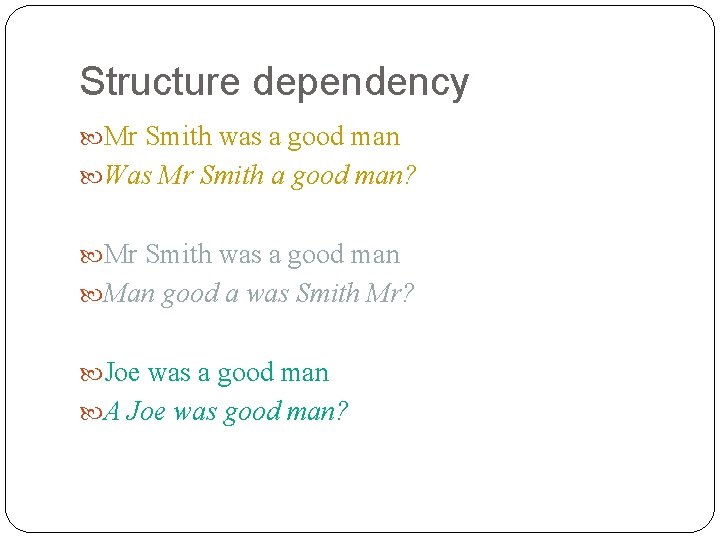
Structure dependency Mr Smith was a good man Was Mr Smith a good man? Mr Smith was a good man Man good a was Smith Mr? Joe was a good man A Joe was good man?
Universals explained Universals unexpected if language is learnt from the environment alone Universals due to innate language Or due to something else? Universal functions of language Universal forms of cognition
The theory: innate language knowledge If children don’t/can’t learn the rules of grammar from the language around them in their environment… … then these rules must have been in-born This explains all the difficulties we found with environment-only acquisition theories
The Essentials Key points of Chomskyan Theory
Innatism What is innate? Chomsky: the essential core of grammar is innate A generative grammar that can produce an infinite range of novel sentences The innate system for language learning Language Acquisition Device (LAD) Universal Grammar (UG) “bioprogram” “language organ” “language instinct”
Autonomy Inside the Chomskyan brain
Is language autonomous? Chomsky thinks that language is autonomous in the mind This means that language (i. e. UG) is a separate system in the brain’s architecture It is connected to, but does not interact extensively with, other sorts of thought
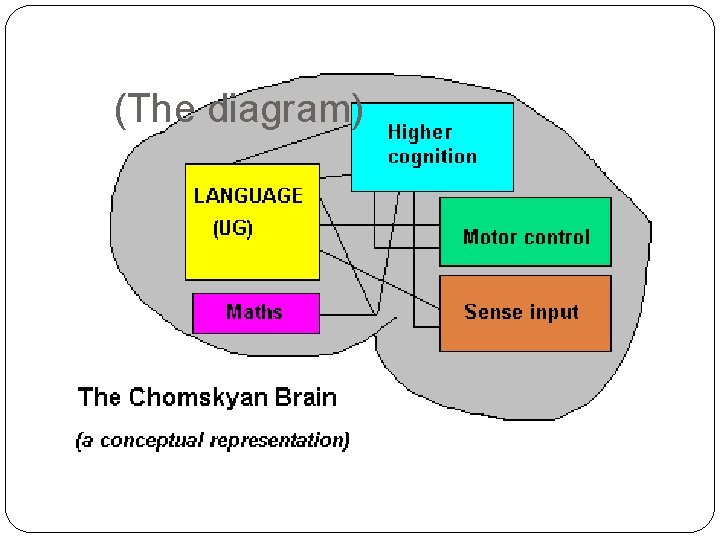
(The diagram)
Maturation Chomsky’s theory is a maturationist theory Language acquisition runs to an innate biological timetable UG matures in the brain and is slowly released in predetermined stages as the child grows This linguistic maturation is analogous to the sexual maturation we go through at puberty… … and is just as involuntary! Only the younger ones were at the right stage of maturation
Language is species-specific UG and the language system only occur in the human brain Therefore, no other animals can acquire a human language But is this solely due to their lesser intelligence? Can chimps learn language? We’ll look at this next term!
Evolution? ? How did UG get there in the first place? There is much disagreement on this Chomsky: not by natural selection! Chomsky, Bickerton: a single lucky language mutation (a “Hopeful Monster”) Pinker: by normal natural selection
Universal Grammar But what exactly is Universal Grammar? What knowledge does it contain? How does it function in the process of language acquisition? www. english-tc. tk
- Slides: 26