
Cholinesterase Inhibitors Indirect acting cholinergic agonists 1072020 Saja
Cholinesterase Inhibitors (Indirect acting cholinergic agonists) 10/7/2020 Saja Hamed, Ph. D 1

o o prevent the degradation of ACh by acetylcholinesterase limited therapeutic applications they lack selectivity. two basics category: 10/7/2020 Saja Hamed, Ph. D 2
10/7/2020 Saja Hamed, Ph. D 3
Reversible inhibitors: a. o o o Neostigmine: absorbed poorly from the GI tract, and has minimal effect on the brain and fetus one molecule of Ch. E can break down a huge amount of ACh in a very short time Ch. E splits neostigmine more slowly than it splits Ach 10/7/2020 Saja Hamed, Ph. D 4
Pharmcologic effects: o o In sufficient doses it intensify transmission at junctions where ACh is the transmitter skeletal muscle stimulation, activation of muscarinic receptors, ganglionic stimulation, activation of cholinergic receptors in the CNS At therapeutic doses it affects only the muscarinic receptors and nicotinic receptors of the NMJ 10/7/2020 Saja Hamed, Ph. D 5
Pharmacokinetics: o o o administered orally poorly absorbed Duration of action: 2 -4 hours 10/7/2020 Saja Hamed, Ph. D 6
Therapeutic Uses: o Oral therapy of myasthenia gravis: n n o neuromuscular disorders: antibodies against nicotinic. M receptors on skeletal muscles muscle weakness: Drooping eyelids, difficulty swallowing, weakness of skeletal muscle, difficulty breathing Myasthenia crisis vs. cholinergic crisis all share the muscle weakness and paralysis 10/7/2020 Saja Hamed, Ph. D 7
Adverse effects: o o excessive muscarinic stimulation: excessive salivation, increased gastric secretions, increased tone and motility of the GI, urinary urgency, bradycardia, sweating, miosis Neuromuscular blockade : at therapeutic doses they inc force of contraction, in toxic doses they reduce the force of contraction because excessive amount of ACh at he NMJ keep the motor end plate in a state of constant depolarization. Paralysis of respiratory muscle can be fatal 10/7/2020 Saja Hamed, Ph. D 8
Precautions and contraindications: o same as direct-acting muscarinic agonists: Obstruction of the GI, obstruction of the UT, peptic ulcer, asthma, coronary insufficiency, hyperthyroidism Acute toxicity: o excessive muscarinic stimulation and respiratory depression o IV atropine and mechanical ventilation with oxygen (Respiratory depression cannot be managed by drug) 10/7/2020 Saja Hamed, Ph. D 9
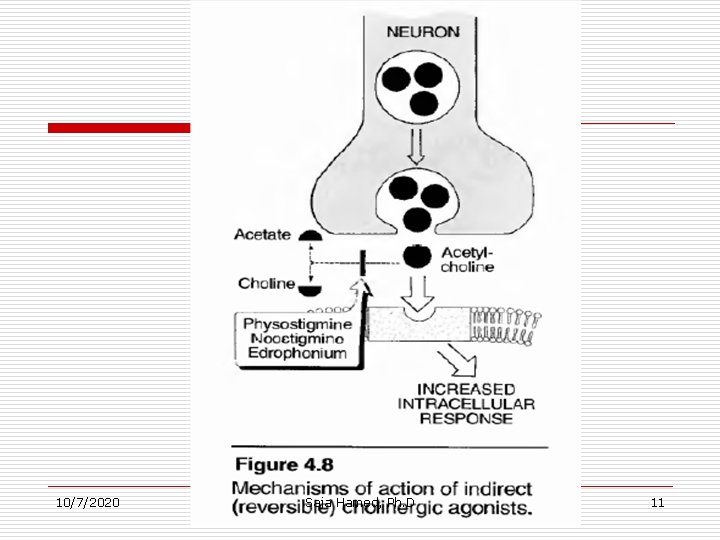
: b. Physotigmine o o readily crosses membranes[A 1] drug of choice for treating poisoning by atropine and other drugs that cause muscarinic blockade[A 3] IM or slow IV injection It counteract antimuscarinic poisoning by causing ACh to build up at muscarinic receptors. The accumulated ACh compete with muscarinic blockade for receptor binding and thereby reverse receptor blockade 10/7/2020 Saja Hamed, Ph. D 10
10/7/2020 Saja Hamed, Ph. D 11
10/7/2020 Saja Hamed, Ph. D 12
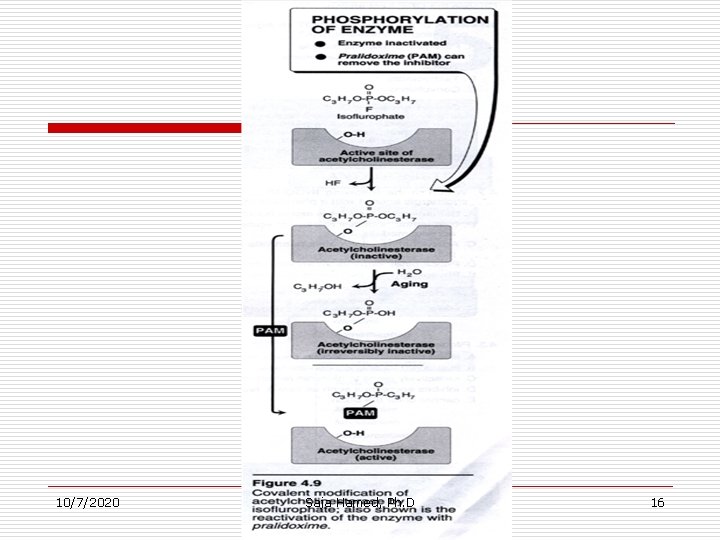
: Irreversible inhibitors o o o highly toxic insecticides nerve agents (World war II) known as organophosphate cholinesterase inhibitors lipid soluble (Easily absorbed from the skin that is why they are useful insecticides and chemical warfare) effects persist until new molecules of cholinesterase is synthesized 10/7/2020 Saja Hamed, Ph. D 13
Toxicology: o o o agricultural workers excessive muscarinic stimulation and depolarizing neuromuscular blockade paralysis and death from apnea treatment: mechanical ventilation, giving atropine to reverse muscarinic stimulation, giving pralidoxime to reverse inhibition of cholinesterase 10/7/2020 Saja Hamed, Ph. D 14
o Pralidoxime: n n o Antidote Effective at NMJ Cannot cross BBB Must be administered soon after poisoning otherwise aging take place The bond bet organophosphate and cholinesterase increases in strength. Once aging take place pralidoxime unable to dissociate inhibitor from the enzyme. Aging varies according to nerve agents from 2 minutes up to 13 hours 10/7/2020 Saja Hamed, Ph. D 15
10/7/2020 Saja Hamed, Ph. D 16
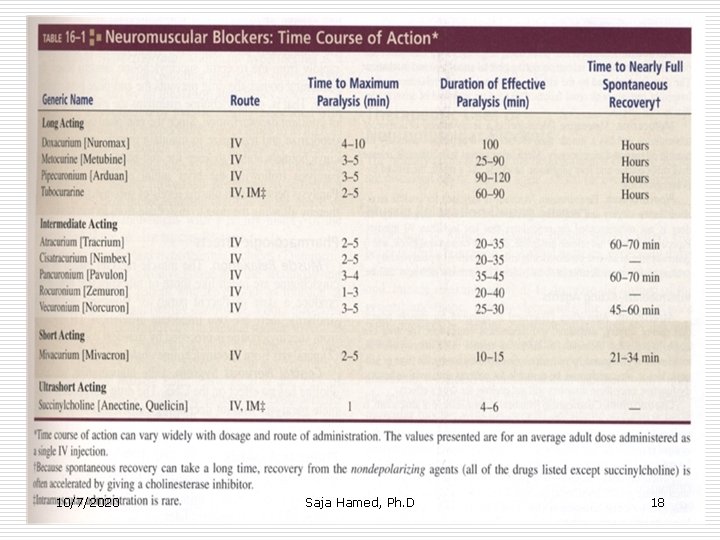
Neuromuscular blocking agents 10/7/2020 Saja Hamed, Ph. D 17
10/7/2020 Saja Hamed, Ph. D 18
10/7/2020 Saja Hamed, Ph. D 19
block nicotinic. M receptors at the NMJ (Prevent Ach from binding causing muscle relaxation) o Muscle relaxation during surgery: a. relaxation of skeletal muscles to make the surgeon’s work easier. b. allow us to decrease the dosage of general anesthetic thereby decreasing the risk associated with anesthesia (Dec. the risk of respiratory depression and recovery occurs fast) o See attached information o 10/7/2020 Saja Hamed, Ph. D 20
a. Nondepolarizing Neuromuscular blockers: 1. Tubocurarine: o o curare: an arrow poison used for hunting by South American Indian (Cause relaxation (paralysis) of skeletal muscle. Death from paralysis of respiration muscles) carry a positive charge 10/7/2020 Saja Hamed, Ph. D 21
Pharmacologic effects: o o o Muscle relaxation: produces a state of flaccid paralysis Hypotension: by release of histamine and partial ganglionic blockade[A 3] Have no effect on CNS (Do not diminish consciousness or perception of pain even with complete paralysis) 10/7/2020 Saja Hamed, Ph. D 22
Pharmacokinetics: o IV: paralysis develops in minutes o Several hours for complete recovery Therapeutic uses: o muscle relaxation during surgery, mechanical ventilation, endotracheal intubation Adverse effects: o respiratory arrest: facilities for artificial ventilation must be immediately available o hypotension, bradycardia, and cardiac arrest 10/7/2020 Saja Hamed, Ph. D 23
Precautions and contraindications: o Myasthenia Gravis o The dosage of neuromuscular blocker should be reduced when combined with general anesthetics Toxicology: o Overdose lead to apnea o Apnea managed by respiratory support and a cholinesterase inhibitor (e. g. neostigmine) 10/7/2020 Saja Hamed, Ph. D 24
b. Depolarizing neuromuscular blockers: 1. Succinylcholine: o binds to nicotinic. M receptors and causes depolarization muscle contractions remains bound prevent repolarizing paralysis o The end plate must repeatedly depolarize and repolarize to maintain contraction 10/7/2020 Saja Hamed, Ph. D 25
Pharmacologic effects: o muscle relaxation o no effect on CNS: Causes complete paralysis without decreasing consciousness or pain Pharmacokinetics: o short duration of action o IV injection: solutions unstable use within 24 hours. Multidose vials are stable up to 2 weeks o Rapidly degraded by plasma cholinesterase 10/7/2020 Saja Hamed, Ph. D 26
Therapeutic Uses: o Muscle relaxation during short procedures (Endotracheal intubation, endoscopy, electroconvulsive therapy) Adverse effects: o apnea in patients with low pseudocholinesterase activity o postoperative muscle pain (neck, shoulders, back): 12 -24 hours after surgery and may persists several hours or even days 10/7/2020 Saja Hamed, Ph. D 27

Drug interactions: o Cholinesterase inhibitors potentiate the effects of succinylcholine o No antidote to succinylcholine poisoning (Supportive management) 10/7/2020 Saja Hamed, Ph. D 28
- Slides: 28